
What a Deferral Actually Signals About Your Application, and What It Does Not
On this page
- What a Deferral Actually Signals About Your Application
- Why Colleges Issue Deferrals: Yield, Class Size, and Comparative Review
- What a Deferral Does Not Mean: Clearing Up the Three Biggest Misconceptions
- Not Sure Which Gap Triggered Your Deferral?
- The Three Application Levers That Matter Most After a College Deferral
- Three Levers, One Window, One Conversation
- FAQ: College Deferrals and What to Do Next
- What does a deferral mean?
- What are good reasons to ask for a deferral?
- Does being deferred mean you are rejected?
- What are the disadvantages of a deferral?
- Your Next Step on a Deferral
A college deferral signals that your early application was strong enough to avoid rejection but not distinct enough for an immediate offer. A deferral is a decision status that moves an early applicant into the regular decision pool for a second review. It is not a rejection, not a waitlist.
Your file stays active. The harder question is what the committee wants to see before the regular decision deadline, and which of the two or three moves left to you actually carries weight.

What a Deferral Actually Signals About Your Application
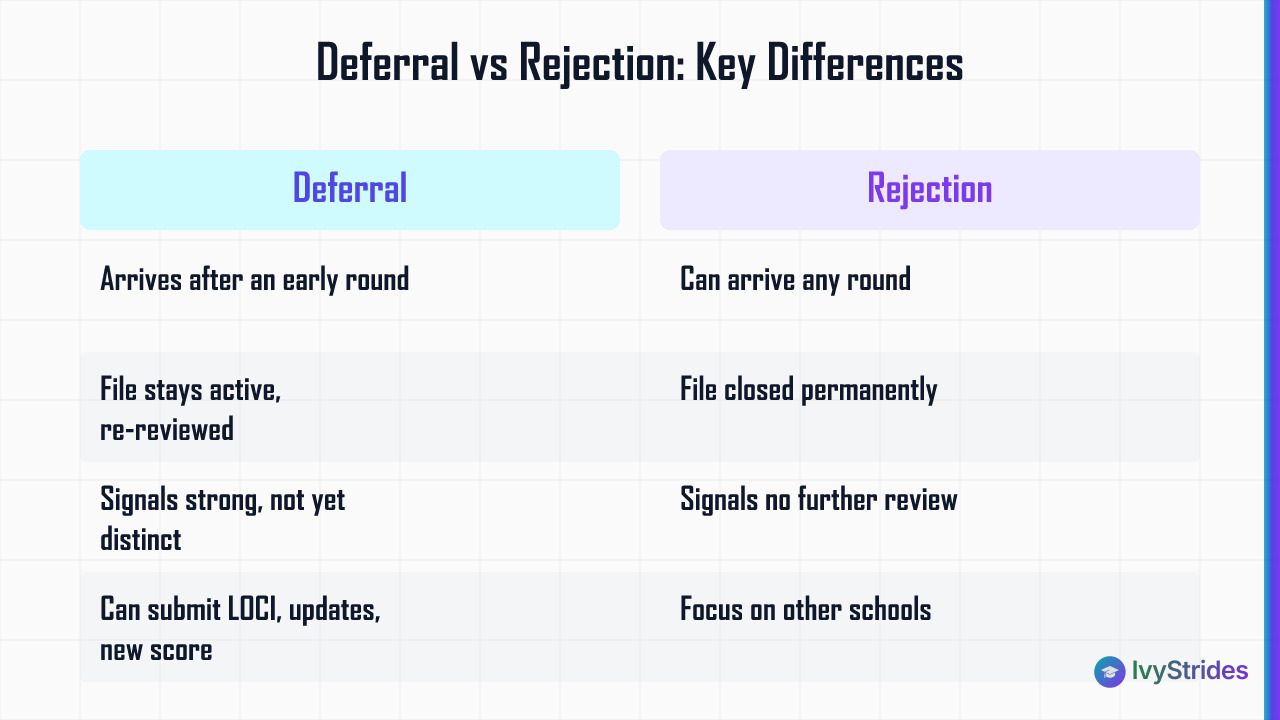
A college admissions deferral moves your early application into the regular decision pool, where the committee re-reviews it alongside the full set of regular decision applicants before deciding. Your admissions file stays open and competitive. Most deferred students applied through the Common App, which is also the platform that carries any updates.
A deferral differs from a rejection in one concrete way: a rejection closes the file permanently, while a deferral keeps it open for a second read. It differs from a waitlist in timing. A waitlist arrives after regular decision offers go out, when a school has a class and holds a few spots in reserve; a deferral arrives from an early round, weeks earlier, before any regular decision offers exist.
What it signals. In our coaching with deferred students, three application gaps show up most often. A borderline score sits at or below the low end of a school's middle 50 percent. A generic "Why This College" essay names rankings and programs but never connects them to a specific, personal reason for fit. And yield uncertainty appears, where the school suspects a strong applicant will enroll elsewhere.
Understanding where a deferral fits in the admissions calendar means knowing how early decision vs early action vs regular decision pools differ from the round your application now enters. That context tells you what the comparative evaluation actually weighs.
| Decision | When It Arrives | File Status | What It Signals | What You Can Do |
| Deferral | After an early round | Active, re-reviewed | Strong, not yet distinct | LOCI, updates, new score |
| Waitlist | After RD offers | Held in reserve | Admissible if space opens | Confirm interest, wait |
| Rejection | Any round | Closed | No further review | Focus on other schools |
Why Colleges Issue Deferrals: Yield, Class Size, and Comparative Review
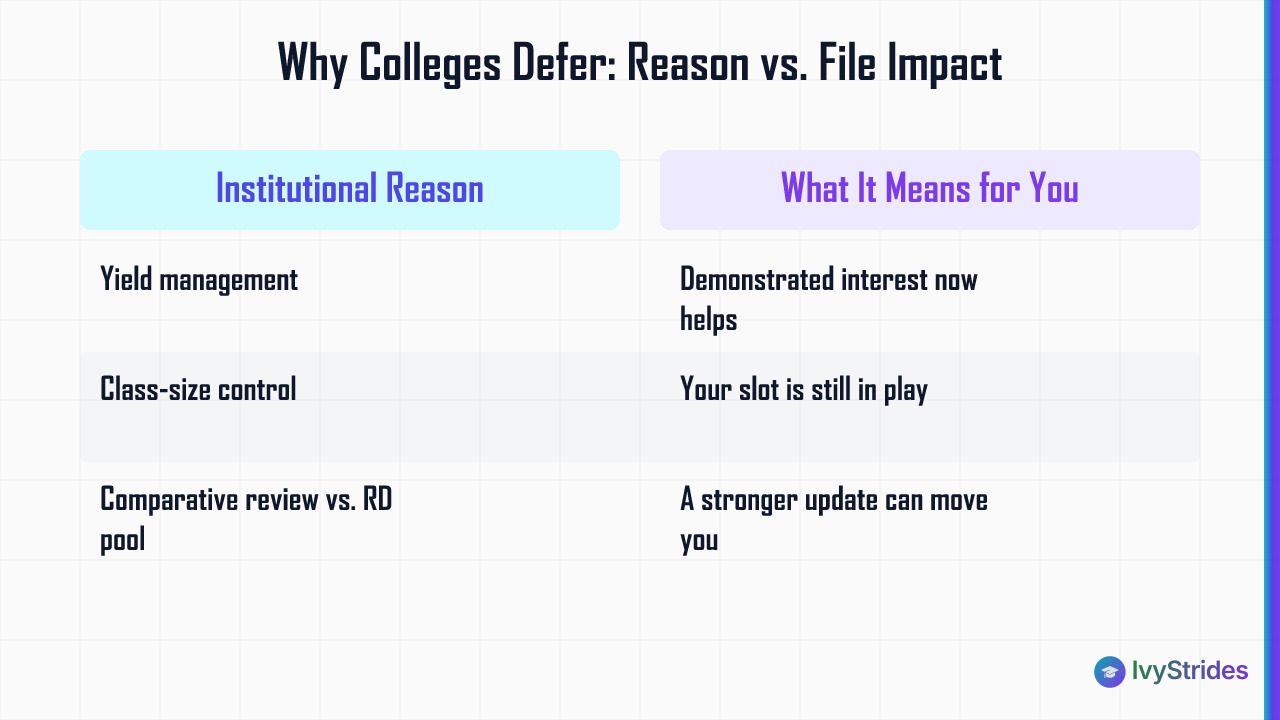
Colleges issue deferrals for three institutional reasons: to manage yield, to control class size, and to compare early applicants against a much larger regular decision pool. A deferral is often a class-management tool, not a personal verdict. That reframes the question from "what is wrong with me" to "what can I do about it."
Yield rate. A yield rate is the percentage of admitted students who enroll. Colleges protect it by not over-committing in the early round, since a lower yield weakens both planning and rankings. A school that suspects a strong applicant will pick a rival sometimes defers to see genuine commitment first.
Comparative review. The regular decision pool re-reads deferred files with the full context of the class taking shape, and that pool runs roughly three to five times the size of the early pool at selective schools. A borderline early file that looked ordinary in December can read differently against the actual regular decision applicants.
That larger comparative review, driven by the same yield logic above, is why some deferrals go to applicants the college genuinely wants but cannot commit to yet. The delay buys the committee data, not distance from you.
Timing matters here. Most regular decision deadlines fall between January 1 and January 15, so the window between a December deferral notification and the regular decision deadline is often three to five weeks. IvyStrides derives that window by comparing typical mid-December notification timing against the standard January deadline range. For the full picture, see our guide to college application deadlines for fall 2026.
| Reason | What the College Is Doing | What It Means for Your File |
| Yield management | Protecting enrollment predictability | Demonstrated interest now helps |
| Class-size control | Holding spots to gauge total demand | Your slot is still in play |
| Comparative review | Weighing you against the RD pool | A stronger update can move you |
What a Deferral Does Not Mean: Clearing Up the Three Biggest Misconceptions
A deferral does not mean rejection, does not mean a fatal flaw, and does not mean your chances are gone. Weighed against the yield and comparative-review logic above, three misreadings cause deferred students to either give up or take counterproductive action, and each is worth correcting before you touch the response steps.
-
Deferred means rejected. False. Your file is active and gets a second review; a rejection closes it for good.
-
Deferred means a fatal flaw. False. The usual trigger is a borderline or comparative issue, not a disqualifying one. A borderline score is fixable in a way a weak transcript is not.
-
Deferred applicants never get in. False. Admission from deferral happens, though the rate varies widely by school and year.
Be honest about the trade-offs, though. The real disadvantages of a deferral are extended uncertainty, a compressed response window of roughly three to five weeks, and a regular decision pool that is larger and more competitive than the early round. Admission rates from deferral typically run lower than from the early round at most selective schools.
Schools do not publish deferral-to-admission rates uniformly, so treat any single number with caution. Check each school's Common Data Set for its regular decision admission rate as a rough proxy, and remember that admissions outcomes depend on the full application, not on the deferral response alone.
If a borderline test score is the gap you suspect, our framework for applying early decision with a borderline test score walks through the same decision logic from the other side of the cycle.
| Misconception | Reality |
| Deferred equals rejected | File is active and re-reviewed in RD |
| Deferred means a fatal flaw | Usually a fixable borderline or comparative gap |
| Deferred applicants never get in | Happens, though rarer than early admits |
Not Sure Which Gap Triggered Your Deferral?
You have a deferral, a school, and roughly three to five weeks before the regular decision deadline. A free 15-minute call reviews your score against the school's middle 50 percent, checks whether a December retake is still feasible, and tells you which response carries the most weight.
The Three Application Levers That Matter Most After a College Deferral
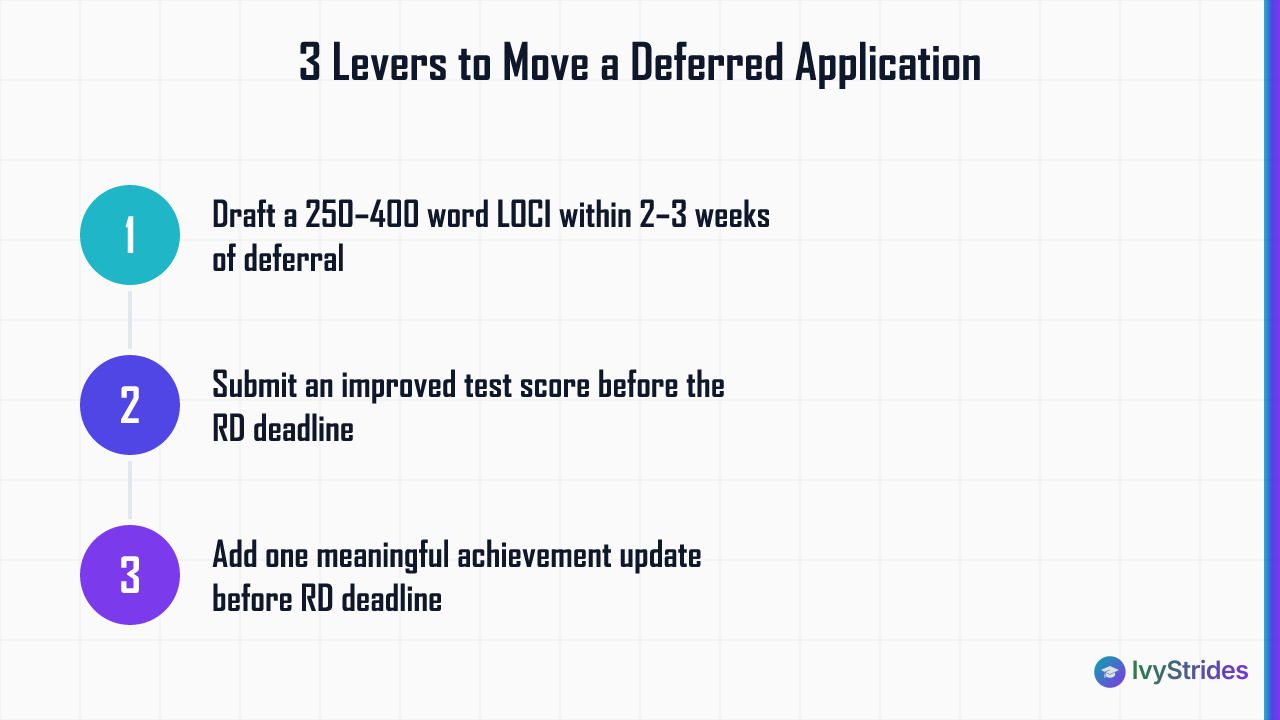
Three levers move a deferred file before the regular decision deadline: a letter of continued interest, an improved test score if you can get one, and a meaningful achievement update. Everything else is noise in a three-to-five-week window. Those same fixable gaps named above, the borderline score and the weak fit essay, are exactly what these levers address.
The letter of continued interest. A letter of continued interest (LOCI) is your primary written response to a deferral, typically 250 to 400 words, sent within two to three weeks of the notification. Include one concrete new development, one specific detail about the school that was not in your original application, and a clear reaffirmation that it remains your first choice.
Skip the emotional appeals and skip repeating what the committee already read. Across students we have worked with who were deferred and later admitted, the LOCI that worked best did exactly this: one new development, one specific fit detail.
A weak "Why This College" essay is one of the most common deferral signals, and the LOCI is your one remaining chance to demonstrate genuine, specific fit. You cannot revise a submitted essay, but you can get the tone and specificity right in the letter. Our college essay coaching helps students draft that letter. Studying strong supplemental essay examples first sharpens what "specific fit" actually reads like.
The updated score. If a borderline test score contributed to your deferral, a December or January retake may still reach the admissions office before most regular decision deadlines. December SAT scores typically release within two to three weeks, which can fall before a January 1 deadline; check the exact December ACT release date against your school's deadline before you count on it.
At test-optional schools, a deferred applicant who now has a score above the 75th percentile should weigh whether submitting it strengthens the file, keeping in mind that test-optional policies vary by school and year. Verify each school's current policy through FairTest or the school's own admissions page before you send anything. If a retake is on the table, our guide on how a December retake fits an early decision timeline covers the scheduling math.
| Step | Action | Timeline | What to Avoid |
| 1 | Draft the LOCI | Within 2 to 3 weeks | Emotional appeals, repetition |
| 2 | Submit improved score | Before RD deadline | Sending a score below the median |
| 3 | Add one achievement | Before RD deadline | Padding with minor items |
None of these guarantees an outcome. A stronger score may strengthen the file, and a sharp LOCI is the standard recommended response, but admission still depends on the full application.
Three Levers, One Window, One Conversation
You know the steps: a letter of continued interest, a possible score update, and a meaningful achievement addition. Figuring out which one carries the most weight for your specific school, your current score, and the weeks you have left takes a trained eye. A free 15-minute call maps all three to your actual situation.
FAQ: College Deferrals and What to Do Next
What does a deferral mean?
A deferral means your early application was not rejected but moved into the regular decision pool for a second review. The college wants to compare your file against the full regular decision applicant pool before making a final call. Your application stays active and competitive.
What are good reasons to ask for a deferral?
In a college admissions context, you do not ask for a deferral; the college issues one. If you mean requesting a gap-year deferral after being admitted, valid reasons include a significant personal circumstance, a structured gap-year program, or a medical situation. These policies vary by school, so check the admissions office directly.
Does being deferred mean you are rejected?
No. A deferral keeps your admissions file open and active, while a rejection closes it permanently. Deferred applicants get re-reviewed in the regular decision round alongside new applicants. Admission from deferral is less common than from the early round, but it does happen.
What are the disadvantages of a deferral?
The main disadvantages are extended uncertainty, a compressed response window of roughly three to five weeks before most regular decision deadlines, and competing against a larger, more competitive regular decision pool. The limbo period is also hard to manage emotionally alongside your other application deadlines.
Your Next Step on a Deferral
A deferral is a conditional "not yet," and the weeks before the regular decision deadline are the highest-use moment left in your cycle. Read the signal accurately, then act on the levers that actually move a file.
- Draft a 250-to-400-word letter of continued interest within two to three weeks.
- Submit an improved SAT or ACT score if one is achievable before the deadline.
- Add one meaningful achievement update, and verify each school's current test-optional policy before sending scores.

Award-winning author (South Asian Book Award) and graduate of BITS Pilani and UCLA Luskin School of Public Affairs. Brings a published writer's eye to Common App essays and grammatical precision to SAT and ACT R&W instruction.