
Applying to Stanford Early Action? Public and Non-US Schools Stay Open
On this page
- What Stanford's Restrictive Early Action Plan Actually Is
- What the Stanford REA Restriction Actually Means
- What Stanford REA Requires Before November 1
- Stanford REA vs Regular Decision: Which Round Fits Your File
- FAQ: Stanford Early Action Deadlines and Scores
- Is 1470 SAT good for Stanford?
- Can I get into Stanford with a 1400 SAT score?
- At what time do Stanford decisions come out?
- Does Stanford Early Action help your chances compared to Regular Decision?
- Your Next Step on Stanford REA
Stanford's Restrictive Early Action (REA) is a non-binding early application plan with a November 1 deadline. Decisions arrive by mid-December, and if admitted, you have until May 1 to decide. REA bars you from applying early to other private US colleges, but non-binding early plans at public universities and non-US schools stay open.
The harder question is not what REA is, but whether committing your November 1 to Stanford is the right trade for your file.

What Stanford's Restrictive Early Action Plan Actually Is
REA carries no obligation to enroll, which separates it from binding Early Decision, where admission locks you in. An REA application ends in admission, a denial that is final for the cycle (you may not reapply in Regular Decision), or a deferral to Regular Decision with a final decision by early April.
No Early Decision at Stanford. Your two choices are Restrictive Early Action by November 1 or Regular Decision by January 5. With an arts portfolio, the REA application deadline moves up to October 15, and portfolio materials are due October 20.
The "restrictive" part is what trips people up. Stanford's REA policy bars applicants from applying under any early plan, EA, REA, ED, or Early Notification, at other private US colleges. Students weighing Stanford REA against Harvard or Yale early plans face a direct conflict: all three private plans share the same November 1 deadline, and each one bars early applications to the other two.
What stays open is broad. You may still apply early, on a non-binding basis, to public universities, rolling-admission schools, and universities outside the US, and you may apply to any military academy. A non-binding early plan is also allowed where applying early is required for a scholarship or special academic program, as with USC's merit-scholarship Early Action, Stanford's own example.
| Round | Application Deadline | Deadline With Arts Portfolio | Decision Release | Reply Deadline |
| Restrictive Early Action | November 1 | October 15 | Mid-December | May 1 |
| Regular Decision | January 5 | December 5 | Early April | May 1 |
What the Stanford REA Restriction Actually Means
The Stanford REA restriction blocks two things. First, you cannot file an EA, REA, ED, or Early Notification application at Harvard, Yale, Princeton, or any other private US college. Second, you cannot apply to a public university under a binding early plan such as Early Decision. The private-college limit is the trade-off the whole decision turns on.
Public university early action is different. Non-binding early action at a public flagship like UT Austin stays fully open under Stanford REA, because those plans carry no commitment, and the same holds for a non-binding plan at a university in the UK, Canada, or elsewhere.
One point students confuse constantly: REA is not binding ED, and a first-round Early Decision application anywhere is blocked under Stanford REA. Early Decision II is different: if Stanford denies or defers you, you may then apply ED II elsewhere, and the usual rule against applying to two Early Decision schools at once still holds in that round.
| Application Type | Allowed Under Stanford REA? |
| Harvard REA / Yale SCEA (private, early) | No |
| Early Action at another private US college | No |
| First-round binding Early Decision at any school | No |
| Early Decision II after a Stanford denial or deferral | Yes |
| Non-binding early plan at a public university | Yes |
| Non-binding rolling admission | Yes |
| Non-binding early plan at a non-US university | Yes |
| Any military academy | Yes |
| Non-binding early plan required for a scholarship or special program | Yes |
| Regular Decision anywhere | Yes |
What Stanford REA Requires Before November 1

Photo by https://kaboompics.com/ on Pexels
Stanford REA requires the same application components as Regular Decision, all due by November 1 instead of January 5. The core set is the Common App, an SAT or ACT score, the School Report with a counselor letter, transcripts, two teacher recommendations from academic subjects, and Stanford's own writing supplement.
Stanford is test-required for fall 2027. You must submit an SAT or ACT score, and Stanford superscores both tests, combining your best section results across sittings. You self-report scores on the application; official scores are required only if you are admitted and choose to enroll.
The writing load is heavier than the word counts suggest. On top of the Common App personal essay, Stanford asks for five short questions of 3 to 50 words each plus three short essays of 100 to 250 words each. Give the short questions real revision time; at 50 words, every phrase has to earn its place.
Planning those five short questions and three short essays as one connected set keeps the writing from stacking up against the November 1 deadline, since each prompt rewards a different angle on your file. Treat the supplement as a project to start in summer, not a form to fill the week before.
Daily SAT and ACT prep on YouTube: short strategy videos from IvyStrides. Subscribe to IvyStrides on YouTube.
Two components are optional. An alumni interview is offered by invitation, depending on alumni availability near your high school, across the US and in international interview areas including India, the UK, and Canada; REA interviews take place in the first few weeks of November, and declining carries no penalty. An arts portfolio is optional too, though choosing it moves your REA application deadline to October 15.
| Component | Required or Optional | Notes |
| Common App | Required | Core application |
| SAT or ACT | Required | Test-required for fall 2027; superscored |
| School Report + counselor letter | Required | Submitted by your counselor |
| Transcripts | Required | Midyear transcript due Feb 15 (RD, plus REA admits and deferrals) |
| Two teacher recommendations | Required | From academic subjects |
| Five short questions + three essays | Required | Questions 3-50 words; essays 100-250 words |
| Alumni interview | Optional | By invitation; no penalty for declining |
| Arts portfolio | Optional | REA application due October 15; materials October 20 |
Once you see both the test requirement and the writing load, the real question is whether your file is ready for the earlier date. IvyStrides' admissions counselors build the grade-by-grade plan that sequences your test window, essay drafts, and recommendation requests against that November 1 anchor, which is what a counselor who maps your file against Stanford's deadline does on day one.
Stanford REA vs Regular Decision: Which Round Fits Your File
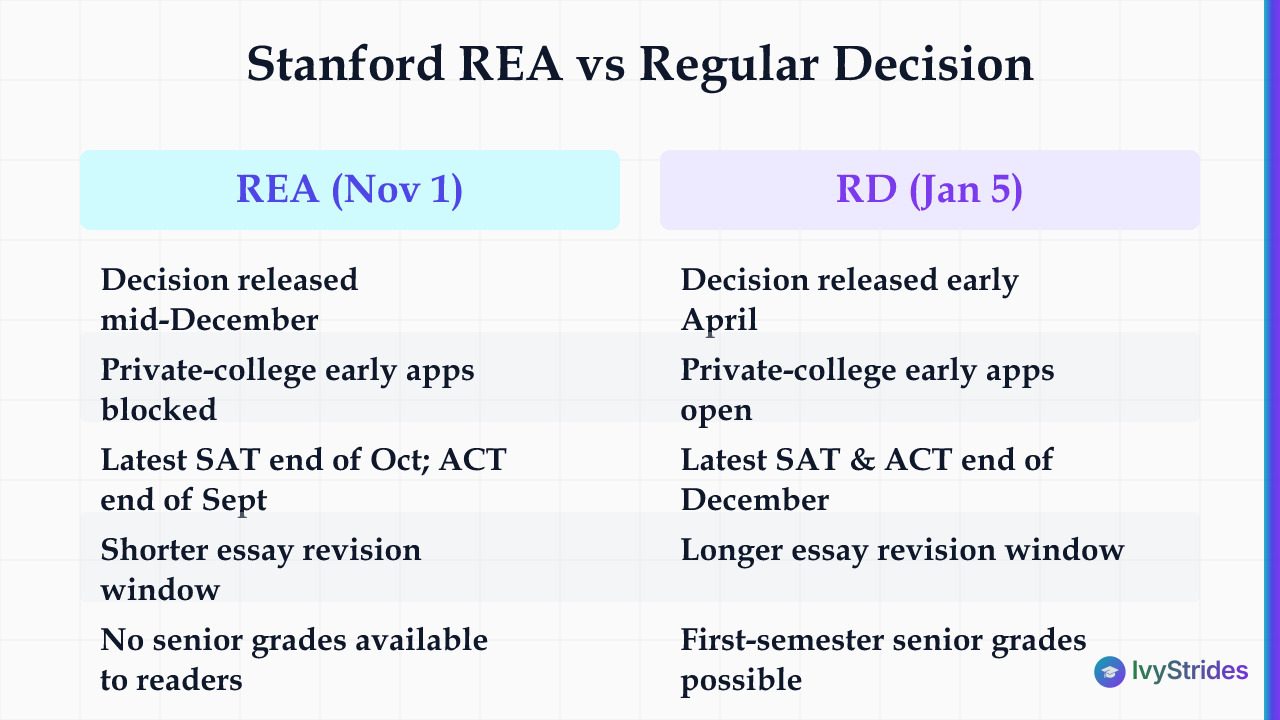
Stanford says it evaluates applications the same way in REA and Regular Decision. What differs is the timeline, the restriction, and your transcript: REA readers will not yet have your first-semester senior grades, so your record through grade 11 carries the file. Stanford's Common Data Set rates nine factors "Very Important": rigor of secondary school record, class rank, academic GPA, standardized test scores, application essay, recommendations, extracurriculars, talent/ability, and character. Intellectual Vitality is a named section of Stanford's holistic review, looking for curiosity, openness, and imagination.
That same holistic frame rewards depth over breadth. Stanford says strong commitment to one or two activities shows passion better than a long list, and it weighs achievements against each applicant's circumstances, schooling path, and family duties.
What REA costs you. Beyond the private-college restriction, REA compresses your calendar: essay revisions move into October, and Stanford's testing FAQ lists the latest REA sittings as the end of September for the ACT and the end of October for the SAT, against the end of December for both in Regular Decision.
What RD offers. A January 5 deadline lets you test through December and gives you weeks more essay revision. Students in 10th or 11th grade should plan senior-year testing and essays backward from November 1, which keeps both rounds open.
Score readiness often decides it. A 1500 SAT sits at the 97th percentile of College Board's user group, yet the middle 50 percent of Stanford's fall 2025 entrants who submitted the SAT scored 1520 to 1570. Students whose score is not yet competitive face a sharper version of the early-versus-regular trade-off, and waiting for RD to retake is often the stronger call. Stanford sets no minimum score, though, and admission rests on the full application.
| Factor | Restrictive Early Action (Nov 1) | Regular Decision (Jan 5) |
| Deadline | November 1 | January 5 |
| Decision release | Mid-December | Early April |
| Private-college early apps | Blocked | Open |
| Latest test sitting | ACT end of Sept; SAT end of Oct | End of December |
| Essay revision time | Shorter | Longer |
| Public/non-US early plans | Open | Open |
| Review criteria | Same nine factors | Same nine factors |
FAQ: Stanford Early Action Deadlines and Scores
Is 1470 SAT good for Stanford?
A 1470 sits at the 96th percentile of College Board's user group, recent SAT takers, so it is a strong score by most measures. At Stanford, though, it falls below the 1520 to 1570 middle range of fall 2025 entrants who submitted the SAT. A retake before your round's last sitting is worth considering if time allows.
Can I get into Stanford with a 1400 SAT score?
A 1400 is the 93rd percentile of College Board's user group, but it sits well below the middle range Stanford reports for entering students who submitted the SAT. Stanford rates test scores as Very Important and requires them for fall 2027. A 1400 does not disqualify you, yet the rest of your file, rigor, essays, and Intellectual Vitality, would need to be exceptional. Evaluate a retake before either deadline.
At what time do Stanford decisions come out?
Stanford releases REA decisions by mid-December and Regular Decision results by early April, and it posts the exact day and time on its News & Announcements page a few days in advance. Admitted students have until May 1 to reply, whichever round admitted them.
Does Stanford Early Action help your chances compared to Regular Decision?
Stanford does not publish separate REA and RD acceptance rates, and the REA pool tends to be highly self-selected. Stanford says it evaluates applications the same way in both rounds, and its Common Data Set rates level of applicant's interest Not Considered, so applying early is not scored as a sign of interest. The main benefit of REA is an earlier decision, not an admissions advantage.
Your Next Step on Stanford REA
Stanford REA is non-binding, due November 1, and restricts early applications to other private US colleges plus binding early plans elsewhere. The choice between REA and Regular Decision comes down to whether your score and essays are ready for the earlier date and whether you want to keep a private early slot elsewhere.
- Check whether your current SAT or ACT score is competitive, and whether you can still test by the REA sitting deadlines (end of September for the ACT, end of October for the SAT).
- Audit your college list against the private-college restriction, keeping non-binding public and non-US early plans in play.
- Start the five short questions and three short essays early; they need more revision cycles than their length suggests.
College admissions insights on LinkedIn: follow IvyStrides for application guidance and counseling updates.

Rajesh is a technology leader, entrepreneur, and angel investor with 28+ years in Business & Technology Leadership and Product & Solution Engineering. He is passionate about education, mentoring, and driving digital transformation.