
Harvard, Princeton or Yale Early Action? How to Choose Your One Pick
On this page
- Yale SCEA, Harvard REA, and Princeton SCEA: Key Differences at a Glance
- What Yale, Harvard, and Princeton Each Require by November 1
- How to Choose Your One Early Pick: A Decision Framework
- What Happens After You Apply: Decisions, Deferrals, and the May 1 Deadline
- FAQ: Yale, Harvard, and Princeton Early Action
- Is there Early Action for Yale?
- Is Yale Early Action or Early Decision?
- Is it easier to get into Yale early action?
- What time do Yale early action decisions come out?
- Your Next Step on Your Early Pick
Yale offers Single-Choice Early Action (SCEA): non-binding, with a November 1 deadline and mid-December decisions. Harvard calls its version Restrictive Early Action (REA); Princeton also uses SCEA. All three share one restriction: no early applications to other private US colleges. Harvard REA also bars binding early programs at public universities, which Yale and Princeton SCEA do not.
Those deadlines and policies come from each school's official admissions pages, cited below. For fall 2027 entry, Yale and Harvard are test-required and Princeton is test-optional. The harder question is the one this article exists to answer: with only one early slot to spend, which program fits your profile, and what does each require before November 1?

Yale SCEA, Harvard REA, and Princeton SCEA: Key Differences at a Glance
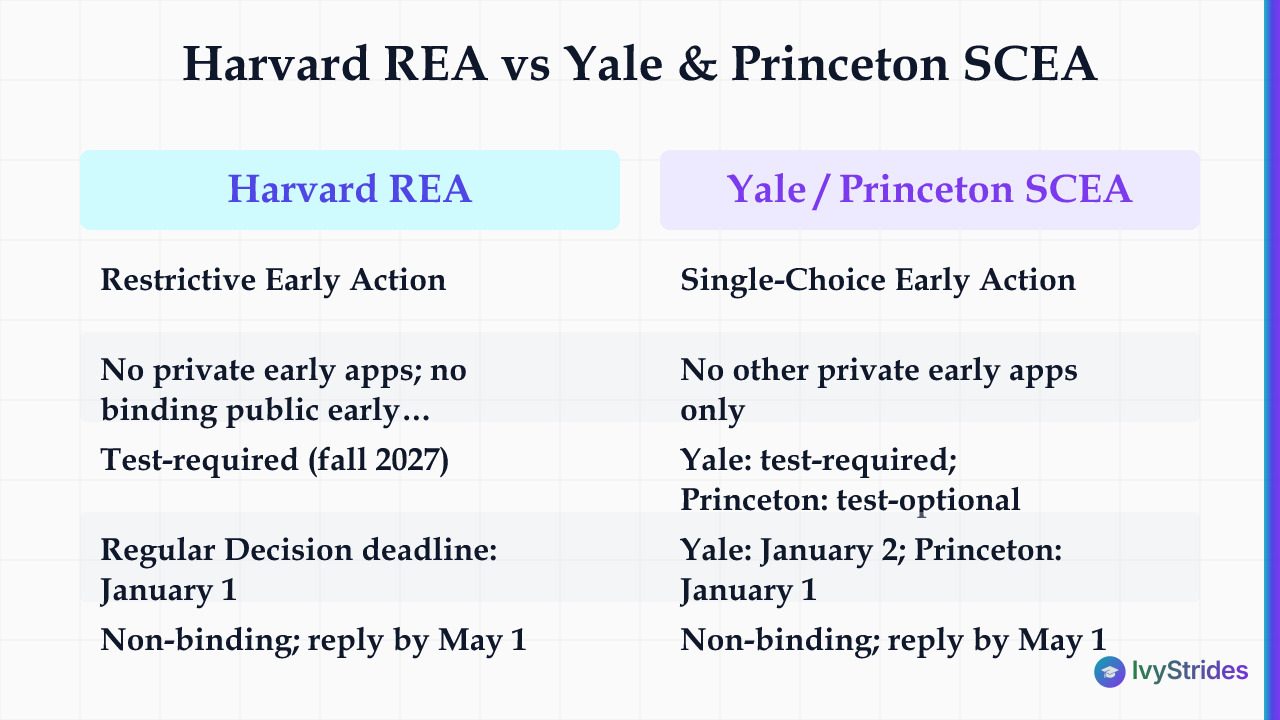
Single-Choice Early Action (SCEA) and Restrictive Early Action (REA) are the same deal under two names: non-binding early review with a restriction rule. Yale and Princeton call it SCEA; Harvard calls it REA. Non-binding means admission does not commit you to enroll, so you keep your choice until the May 1 reply deadline. The restriction rule forbids applying early to any other private US college while your application is pending.
One detail students miss: for Yale and Princeton SCEA, the restriction rule allows public-university early action. You can apply SCEA to Yale and early action to a flagship state school on the same November timeline. Only private early programs are off-limits. Harvard REA is stricter: it also bars binding early programs at public universities, so it does not work the same way as Yale and Princeton SCEA on this point.
The sharpest split is test policy. On May 27, 2026, Yale announced that first-year applicants must submit SAT or ACT scores starting with students entering fall 2027, ending its test-flexible policy (Yale News). Harvard is also test-required for this cycle. Princeton stays test-optional for fall 2027 and shifts to test-required from fall 2028 (Princeton Admission).
Early acceptance rate, in context. For the Class of 2030 (the prior cycle, students who entered fall 2026), a third-party report states Yale admitted 779 of 7,140 SCEA applicants, a 10.9% early acceptance rate. That is higher than the overall rate, but the early pool is stronger, filled with students who put Yale first. Where a 1540 SAT sits against Harvard, Yale, and Princeton's published ranges tells you whether your score clears the bar at these test-required schools.
| Feature | Yale SCEA | Harvard REA | Princeton SCEA |
| Program name | Single-Choice Early Action | Restrictive Early Action | Single-Choice Early Action |
| Binding? | Non-binding | Non-binding | Non-binding |
| Restriction rule | No other private early apps | No other private early apps; no binding public early programs | No other private early apps |
| Deadline | November 1, 2026 | November 1, 2026 | November 1, 2026 |
| Decisions | Mid-December | Mid-December | Mid-December |
| Test policy (fall 2027) | Test-required | Test-required | Test-optional |
| Regular Decision deadline | January 2 | January 1 | January 1 |
| Reply deadline | May 1 | May 1 | May 1 |
What Yale, Harvard, and Princeton Each Require by November 1

Photo by https://kaboompics.com/ on Pexels
Each school's application carries one distinctive component that decides how you spend your prep time. Because that deadline and restriction rule are identical across all three, these differences in required components, not the timeline, separate the programs. Yale, Harvard, and Princeton all require two teacher recommendations from different academic subjects plus a counselor recommendation. All three accept the Common App; Yale and Princeton also accept the Coalition Application (on Scoir) and QuestBridge.
Yale asks for a 200-word answer about a topic or idea that excites you within your chosen academic areas (Yale Admissions). Yale interviews are by invitation only, evaluative, and run 30 to 60 minutes; you cannot request one, and the committee offers them when it wants more information (Yale Admissions).
Harvard requires five short answers, each 150 words maximum, and says each can be answered in about 100 words. Harvard also does not consider demonstrated interest, which the Common Data Set rates Not Considered. For early applicants that is freeing: visiting campus or emailing an officer adds nothing to your file.
Princeton's graded paper is the component students underprepare. All first-year applicants must submit a graded written paper, preferably from English, social studies, or history, written in the last three years of high school (Princeton Admission).
A common pattern in essay coaching: students applying to Princeton treat the graded paper as an afterthought and grab whatever is handy. It deserves the same preparation as a supplemental essay. Princeton also splits applicants into an A.B. or B.S.E. track, each with its own academic prompt; the A.B./undecided prompt is 250 words or fewer, and offers an optional alumni interview of 30 to 45 minutes with no disadvantage for skipping it.
Answering Yale's academic-interest prompt and the other Yale-specific questions well takes a strategy the 200-word limit forces you to earn.
| Component | Yale | Harvard | Princeton |
| Platform | Common App, Coalition (Scoir) or QuestBridge | Common App | Common App, Coalition or QuestBridge |
| School essay | 200-word academic | Five 150-word answers | 250-word academic (A.B.); confirm B.S.E. |
| Graded paper | Not required | Not required | Required |
| Teacher recs | Two | Two | Two |
| Counselor rec | Required | Required | Required |
| Interview | Invitation only | Committee discretion | Optional |
| Demonstrated interest | Considered in review | Not considered | Not considered (CDS) |
How to Choose Your One Early Pick: A Decision Framework
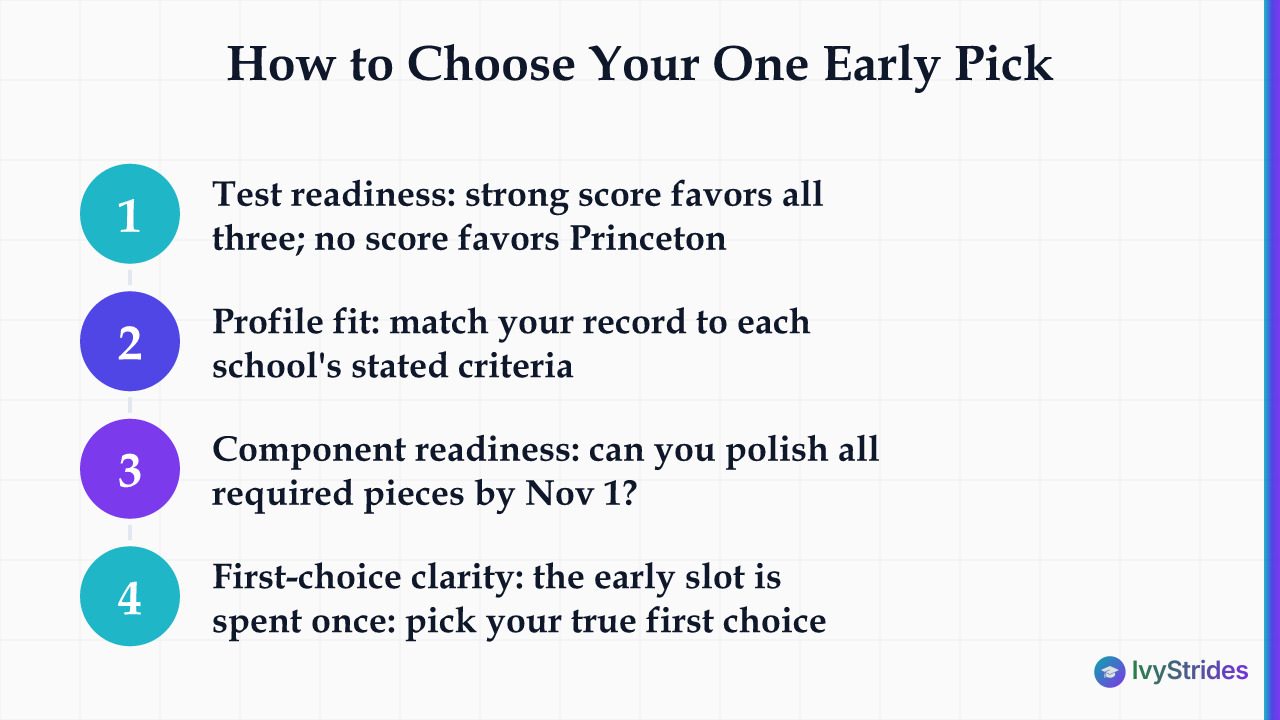
Four variables decide your one early pick: test readiness, profile fit, component readiness, and genuine first-choice clarity. That graded paper and those short answers matter here too, because component readiness is one of the four, and a half-ready Princeton paper is a reason to look elsewhere.
Start with test readiness. Yale and Harvard require the SAT or ACT for fall 2027, so a student without a competitive score cannot lean on policy there. Princeton is test-optional for this cycle, which keeps the door open for a strong applicant whose score is not yet ready.
Don't misread that: Princeton's Common Data Set rates standardized test scores Very Important when submitted, so test-optional is not score-blind. If your score is still below the 25th percentile for your target school, whether to push now or wait for a retake is the call to make before you commit your slot.
Match your profile to stated criteria. Yale reviews every applicant against who will "make the most of Yale's resources" and "contribute most significantly to the Yale community," and calls the transcript the single most important document (Yale Admissions).
Harvard says "there is no formula" and weighs community involvement, leadership, and personal character (Harvard College). Princeton looks for students who "make a difference in their schools and communities" and builds a service essay into the application. Princeton also rates legacy as a plus factor among similarly qualified applicants.
Here is the part most students miss. In our admissions coaching, we steer students to apply early where their application is genuinely strongest, rather than most prestigious, because the early file forces them to sharpen their strongest story first.
-
Test readiness. Strong score for all three; no score yet favors Princeton's test-optional path for this cycle.
-
Profile fit. Match your record to each school's stated criteria, not its ranking.
-
Component readiness. Can you deliver a polished graded paper, five tight short answers, or a sharp 200-word essay by November 1?
-
First-choice clarity. Non-binding lets you decline later, but the early slot is spent once. Pick the true first choice.
Mapping your full profile against each school's criteria is the work a counselor who audits your record against each school's stated criteria does with you in grades 11 and 12.
What Happens After You Apply: Decisions, Deferrals, and the May 1 Deadline
Three outcomes follow a November 1 early application: admitted, deferred, or rejected, with decisions arriving in mid-December at all three schools. Once the early file is in, those stated criteria stop mattering and the committee's timeline takes over. Because all three programs are non-binding, an admitted student keeps full choice until the May 1 national reply deadline.
A deferral moves your file into the Regular Decision pool for a second read. For the Class of 2030, a third-party report puts Yale's SCEA admission rate at 10.9%. This figure is an IvyStrides calculation. If you are deferred in December, what a deferral signals and whether to send a new test score is the first decision you face in the regular round.
The Regular Decision deadlines differ by a day and a school. Keeping the full 2026-27 application calendar straight matters once you are juggling three different dates.
| Milestone | Yale | Harvard | Princeton |
| Early deadline | November 1 | November 1 | November 1 |
| Early decisions | Mid-December | Mid-December | Mid-December |
| RD deadline | January 2 | January 1 | January 1 |
| RD decisions | Late March | End of March | Late March |
| Reply deadline | May 1 | May 1 | May 1 |
Admissions outcomes depend on the full application, not early timing or a single test score. And verify each school's test policy on its own admissions site before you submit; these policies change year to year.
FAQ: Yale, Harvard, and Princeton Early Action
Is there Early Action for Yale?
Yes. Yale offers Single-Choice Early Action (SCEA), with a November 1 deadline and mid-December decisions. It is non-binding, so admitted students have until May 1 to decide. The restriction: you cannot apply early to any other private US college while your Yale SCEA application is pending.
Is Yale Early Action or Early Decision?
Yale uses Early Action, not Early Decision. Specifically it is Single-Choice Early Action (SCEA), which is non-binding, so admission does not commit you to enroll. The restriction rule resembles Early Decision in one way only: no early applications to other private US colleges. You remain free to apply to public-university early action programs.
Is it easier to get into Yale early action?
The early acceptance rate is higher: 10.9% for the Class of 2030 against a lower overall rate. But the SCEA pool is more competitive, filled with students who have named Yale their top choice and submitted strong files. A higher rate does not mean a lower bar.
What time do Yale early action decisions come out?
Yale releases SCEA decisions in mid-December. Yale has not published a specific release hour; decisions typically appear in the applicant portal during business hours Eastern Time. Check the Yale admissions portal directly on the announced date rather than relying on third-party trackers.
Your Next Step on Your Early Pick
You now have the framework the article set out to give you: the restriction rule, the test policies for fall 2027, the distinctive component at each school, and the mid-December-to-May-1 arc. The choice comes down to where your profile is strongest and your file is readiest by November 1.
- Confirm your test score meets your target school's policy and competitive range.
- Pick the one school whose stated criteria match your record, not its ranking.
- Verify the distinctive component is ready: graded paper, five short answers, or the 200-word essay.
- Submit by November 1 and keep your January deadlines set in case of a deferral.

Award-winning author (South Asian Book Award) and graduate of BITS Pilani and UCLA Luskin School of Public Affairs. Brings a published writer's eye to Common App essays and grammatical precision to SAT and ACT R&W instruction.