
Should You Apply Early Decision If You Need Financial Aid? The Real Trade-off
On this page
- What Early Decision Actually Commits You To on Financial Aid
- The Real Financial Risk: Why ED Removes Your Aid use
- Not sure whether ED is safe for your family's financial situation?
- When Early Decision Can Still Work If You Need Aid
- Early Action: The Lower-Risk Alternative for Aid-Dependent Students
- Ready to map your full application strategy, scores, essays, and round choice together?
- Frequently Asked Questions: Should You Apply Early Decision If You Need Financial Aid
- Can you back out of Early Decision if the financial aid package isn't enough?
- Do colleges give the same financial aid to ED applicants as to Regular Decision applicants?
- Should I empty my savings account before filing FAFSA?
- What do I need to file for aid alongside an ED application?
- Your Next Step on the ED Decision
Most students who depend on financial aid should be cautious about applying Early Decision. Because ED is a binding commitment, an accepted student must enroll and withdraw every other application, which erases the ability to compare aid offers from multiple colleges. That lost use is the core risk. If your target school meets 100% of demonstrated need and publishes that policy, the financial risk drops sharply.
The harder question is which of those two situations describes your target school. The sections below sort that out: what the Early Decision agreement commits you to, why the aid-comparison loss matters in dollars, when ED can still be defensible, and how Early Action preserves your options.

What Early Decision Actually Commits You To on Financial Aid
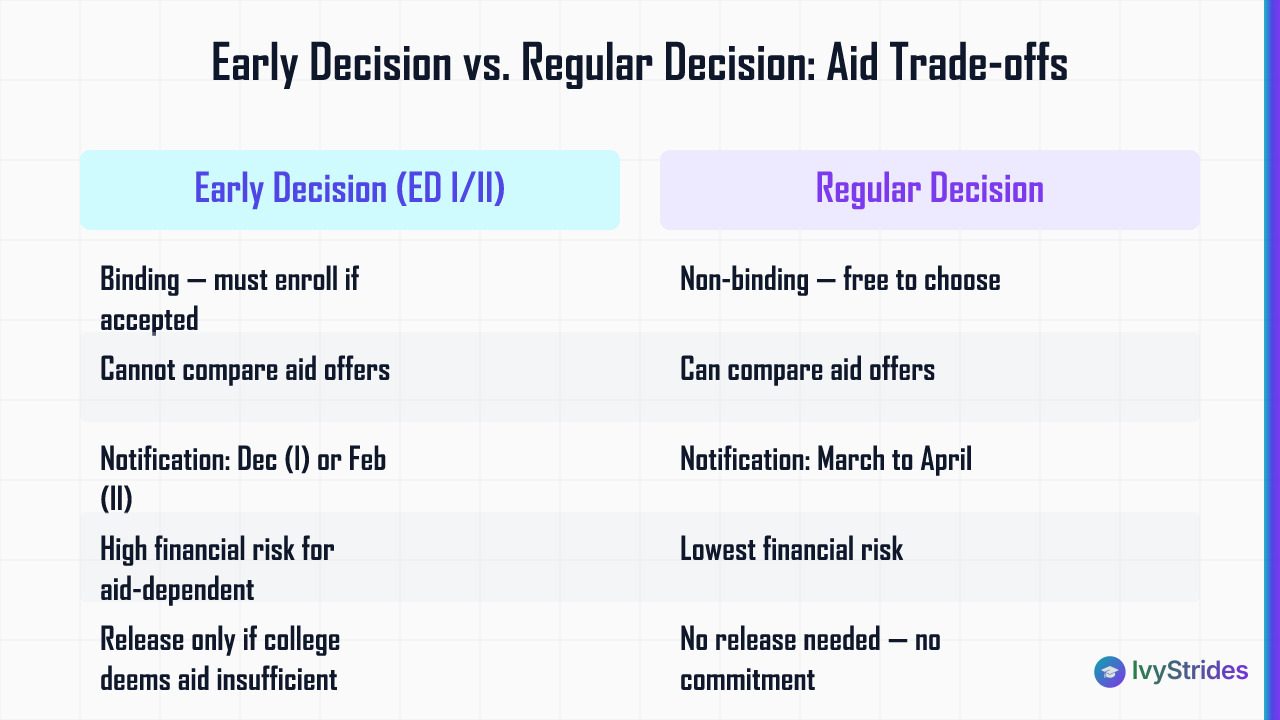
Early Decision is a binding application round in which acceptance obligates you to enroll and withdraw all your other applications. The Early Decision agreement formalizes it, a document signed by three parties: you, a parent or guardian, and your school counselor. Signing it is a legal and ethical promise, not a preference.
ED I deadlines usually fall on November 1 or November 15, with a decision around mid-December. Many schools also offer ED II, with a January 1 or January 15 deadline and a February decision. That later timeline matters for aid, because by then your FAFSA results and family finances are clearer.
The FAFSA (Free Application for Federal Student Aid) for 2026-27 opens to everyone by October 1, 2026, per studentaid.gov. Most private colleges also require the CSS Profile to calculate institutional aid. Under ED I, families often submit both forms in October and receive an aid estimate alongside the December decision.
Here's the part most families miss: ED is not absolutely irreversible. If the aid package is genuinely insufficient to make attendance possible, you can request release from the agreement. But the college, not your family, sets the standard for "insufficient." For how these deadlines line up with score reporting and essay drafts, see our college application timeline for 2026-27.
| Application Round | Binding? | Can Compare Aid Offers? | Typical Notification | Financial Risk for Aid-Dependent Students |
| Early Decision (ED I/II) | Yes | No | Mid-December (I) / February (II) | High unless school meets 100% of need |
| Early Action | No | Yes | December to February | Low |
| Restrictive Early Action | No | Yes | December to February | Low |
| Regular Decision | No | Yes | March to April | Lowest |
For an overview of the early rounds, College Board's counselor guidance is the authoritative reference.
The Real Financial Risk: Why ED Removes Your Aid use
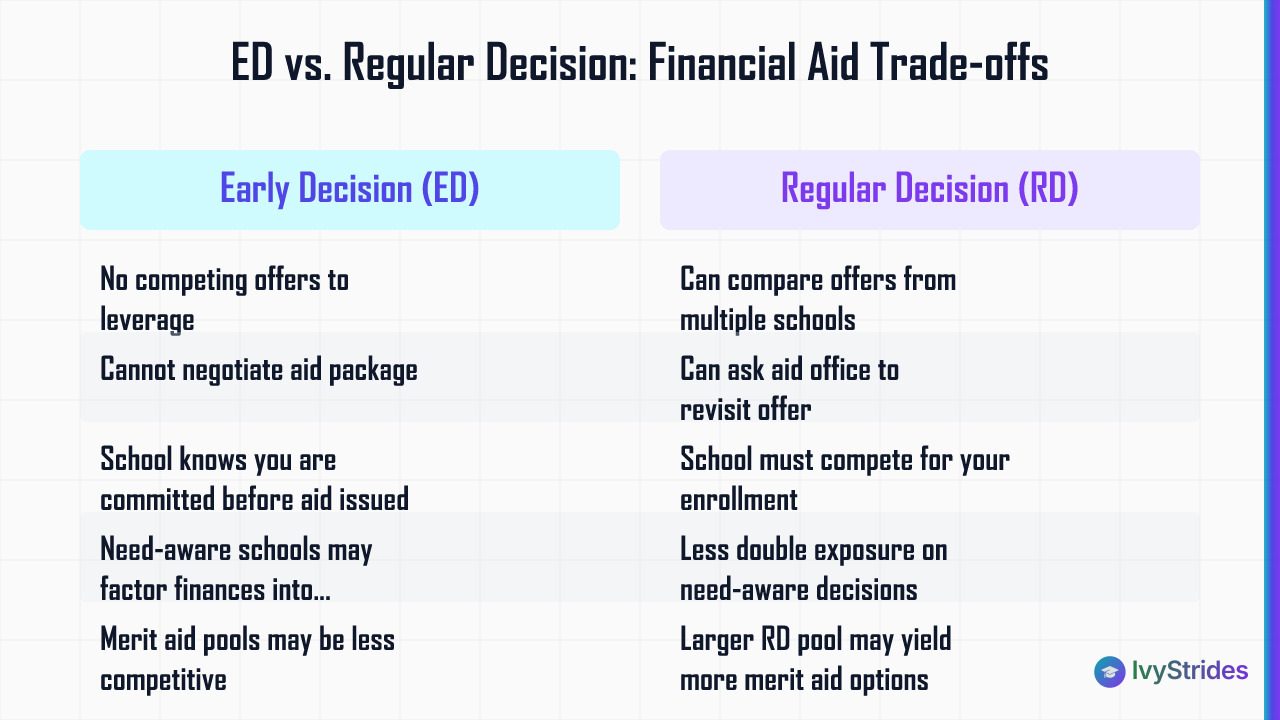
The central financial risk of Early Decision is information asymmetry. Under ED, the college knows you are committed before it issues your aid package. You have no competing offer to point to, which removes the use a family would otherwise use to negotiate.
Picture a family that demonstrates a need for around $30,000 in grants. The financial aid package comes back as $8,000 in institutional grant money and $22,000 in loans. Under Regular Decision, that family could set the offer against three other schools and ask the aid office to revisit it. Under ED, there is nothing to compare it against, and the school knows it.
The risk compounds at need-aware admissions schools, which may factor your ability to pay into the ED decision itself. That is a double exposure: your finances can affect whether you get in, and your locked-in status can affect how generous the offer is.
| Admissions Policy | What It Means | ED Risk for Aid-Dependent Students | Example School Type |
| Need-blind | Ability to pay is not considered in admissions | Lower, especially if paired with 100% need met | Several highly selective private universities |
| Need-aware | Financial need may factor into the decision | Higher; finances affect both admission and package | Some smaller private colleges |
| Meets 100% of demonstrated need | Full demonstrated need is covered by policy | Lowest financial risk under ED | A small group of well-resourced institutions |
Merit aid adds a wrinkle. At some schools, merit scholarships are more competitive in the Regular Decision pool because more applicants sit in it. Most highly selective schools award no merit aid at all, only need-based aid.
In our coaching, the families most exposed sit in the middle-income range. Their Expected Family Contribution is too high to unlock maximum need-based aid, yet too low to absorb a gap of roughly $15,000 to $20,000 a year without strain. That is the group that most needs to run the numbers first. For how score submission interacts with aid, read what is test-optional and should you submit SAT scores.
Not sure whether ED is safe for your family's financial situation?
In a free 15-minute call, an IvyStrides advisor will look at your target school list, your aid expectations, and your application timeline, then tell you exactly which round makes sense for your situation.
When Early Decision Can Still Work If You Need Aid
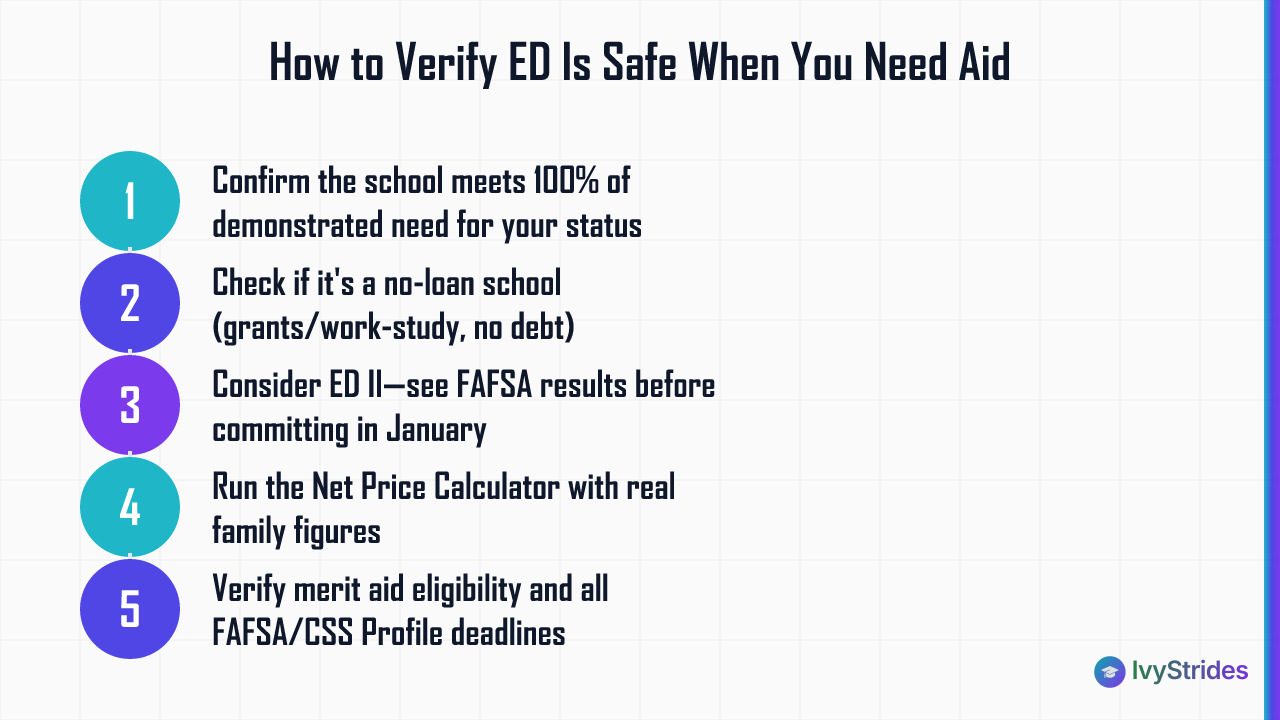
Early Decision can be defensible for an aid-dependent student under specific, verifiable conditions. The clearest one: a school that meets 100% of demonstrated need and publishes that policy. When a college is bound to cover full need in every round, the loss of comparison use matters far less.
The safest ED targets go further and remove loans from aid packages entirely. At a no-loan school, demonstrated need is met with grants and work-study rather than debt, so an ED acceptance does not lock you into years of borrowing. Verify this at the school's own financial aid office or its Common Data Set, not a third-party summary, because these policies change.
ED II is often the smarter version of this bet. With a January deadline, you can see your FAFSA results and, at some schools, a preliminary net-price picture before you commit. That reduces the timing gamble baked into ED I.
There are honest limits worth naming:
- Confirm the school's exact need policy on its financial aid office website.
- Check whether the policy applies to your student status; many schools that meet 100% of need for domestic students do not extend that to international applicants.
- Run the school's Net Price Calculator with real family figures before signing anything.
- Verify whether the school awards merit aid at all, and whether ED applicants are eligible.
- Confirm both FAFSA and CSS Profile deadlines for the ED round.
International students face the tightest constraints. A policy that guarantees full need for domestic applicants frequently does not apply abroad, so an international student should treat the aid question as unresolved until the office confirms otherwise in writing.
Because test-optional policies vary by school and year, verify each school's current policy before deciding whether to include scores. One more point: your application has to carry itself in the ED round, without the safety net of comparing offers later, so a sharp supplemental essay does real work. See Early Decision vs. Early Action vs. Regular Decision for the round-by-round comparison, and our admissions essay coaching if the writing is where you feel least sure.
Early Action: The Lower-Risk Alternative for Aid-Dependent Students
Early Action is a non-binding early application round. You apply early and hear back early, but acceptance does not obligate you to enroll. That single difference makes EA the practical choice for most families who need to compare aid.
Under EA, you can hold offers from several schools at once and choose the best combination of fit and affordability by the May 1 National Candidates Reply Date. You keep your use and your options, and you still get the earlier notification.
Restrictive Early Action, used by schools such as Harvard, Yale, Princeton, and Stanford, prohibits applying ED or EA to other private colleges at the same time. The application itself stays non-binding. Regular Decision remains the full-comparison fallback, with the widest set of offers to weigh.
| Factor | Early Action | Early Decision |
| Binding commitment | No | Yes |
| Compare aid offers | Yes, across all acceptances | No |
| Withdraw other applications | Not required | Required on acceptance |
| Typical deadline | November | November 1 or 15 (ED I) |
| Financial risk if aid falls short | Low; you can decline | High; release requires proof |
| Best for | Aid-dependent students | Full-need schools you can afford |
For students who need to compare packages, the lower-risk plan is EA at your dream school plus Regular Decision at match and safety schools. You get an early answer where it matters most and preserve every dollar of comparison use everywhere else. For the deeper breakdown, see our Early Decision vs. Early Action vs. Regular Decision guide.
EA gives your essays a longer runway than a rushed ED deadline. Start with how to write supplemental essays that get you in. If you want a coach's eye on a draft, our college essay coaching is built for that. Admissions outcomes depend on the full application, not the round or a single score.
Ready to map your full application strategy, scores, essays, and round choice together?
Book a free 15-minute strategy call. We'll review your target schools, your current scores, and your financial aid picture, then recommend the application round and prep plan that fits your goals.
Frequently Asked Questions: Should You Apply Early Decision If You Need Financial Aid
Can you back out of Early Decision if the financial aid package isn't enough?
Yes, in most cases. If the package is genuinely insufficient to make attendance possible, you can request release from the Early Decision agreement. The college sets the standard for what counts as insufficient, so document the gap and contact the financial aid office promptly after the award letter arrives. Most schools will release a student rather than force an unaffordable enrollment.
Do colleges give the same financial aid to ED applicants as to Regular Decision applicants?
Schools that meet 100% of demonstrated need are bound by their own policy to do so in every round. At schools without that commitment, ED applicants can see less generous packages because the college knows there's no competing offer. Merit scholarships vary: some award the same amounts across all rounds, others hold larger awards for the Regular Decision pool.
Should I empty my savings account before filing FAFSA?
No. Deliberately depleting assets to manipulate FAFSA calculations is misrepresentation and can cause aid to be rescinded. FAFSA does assess parent and student assets, but the formula weights them at a low rate. Talk to a school counselor or the financial aid office about legitimate asset-reporting before making any financial moves.
What do I need to file for aid alongside an ED application?
Most schools require the FAFSA, which opens by October 1 each year per studentaid.gov, and many private colleges also require the CSS Profile. Under ED I, families typically submit both in October and receive an aid estimate with the mid-December decision. Confirm each school's exact requirements on its financial aid office website.
Your Next Step on the ED Decision
The financial choice comes down to one verifiable fact about each school: does it meet 100% of demonstrated need, and does that policy apply to you? Sort that first, and the ED-versus-EA question mostly answers itself.
- Look up your target school's need policy on its financial aid office page or Common Data Set.
- Run its Net Price Calculator with your family's real figures.
- If the school meets full need and you can absorb the estimate, ED is defensible. If not, apply Early Action and keep your comparison use.
- If you want help fitting scores, essays, and round choice into one plan, meet the tutors who work with aid-dependent families. You can also read about our approach.
Test-optional and aid policies change year to year, so verify current terms directly with each school before you sign anything binding.

Award-winning author (South Asian Book Award) and graduate of BITS Pilani and UCLA Luskin School of Public Affairs. Brings a published writer's eye to Common App essays and grammatical precision to SAT and ACT R&W instruction.