
Early Decision or Early Action at UMich? ED Is Faster, Not Easier
On this page
- UMich ED and EA Deadlines, Decisions, and Key Dates for Fall 2027
- What the UMich ED Binding Agreement Actually Requires
- Is UMich ED Actually Easier to Get Into Than EA or RD?
- How to Decide Between UMich ED and EA Before November 1
- FAQ: UMich Early Decision and Early Action
- Does UMich have an Early Decision?
- What day do UMich EA decisions come out?
- Does UMich do rejections for EA?
- Will UMich put ED and EA applicants into one single pool?
- Your Next Step on the UMich Early Plan Decision
University of Michigan Early Decision is a binding plan for fall 2027: apply by November 1, get a decision by December 24, commit by January 6. Early Action shares the November 1 deadline but stays nonbinding, with a decision by January 29. ED is faster, not easier.
These dates come from UMich's first-year application plans page, cited throughout this article. The harder question is what you actually sign up for when you choose ED, and whether that binding commitment buys you anything. That is what the rest of this page settles.

UMich ED and EA Deadlines, Decisions, and Key Dates for Fall 2027
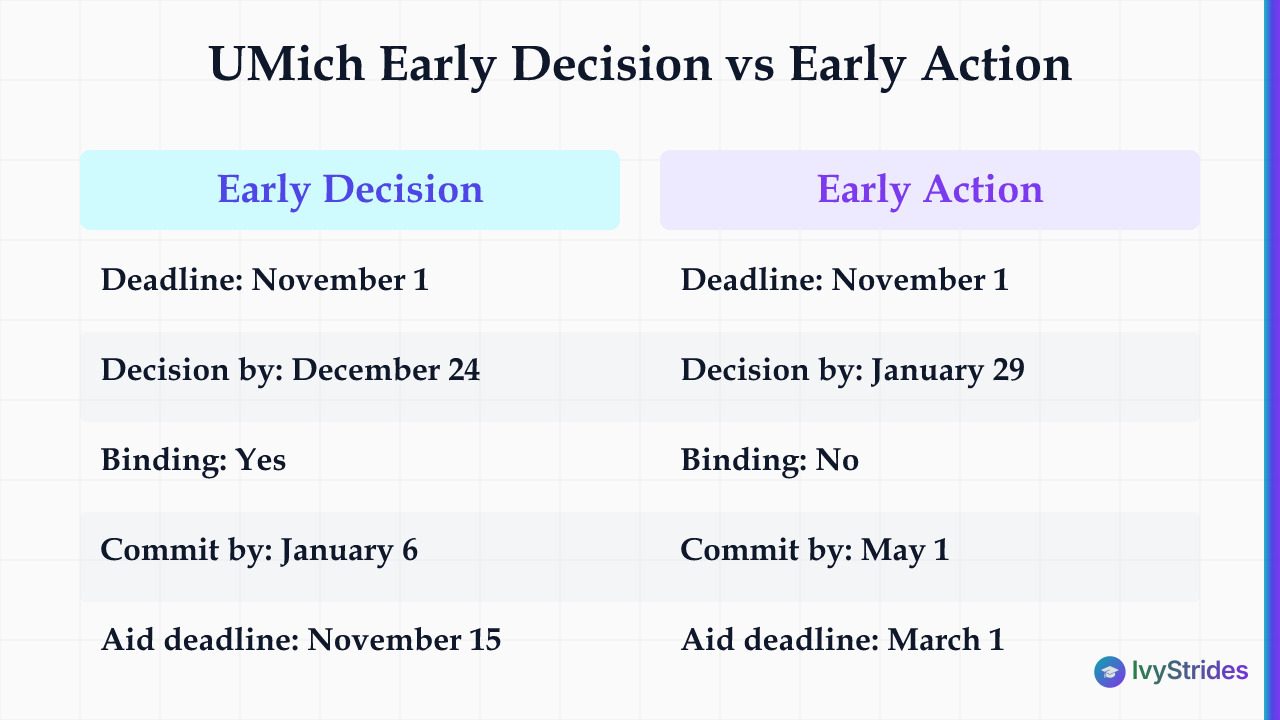
University of Michigan runs three first-year application plans through the Common App: Early Decision, Early Action, and Regular Decision. ED and EA both close on November 1; Regular Decision closes February 1. The binding rules and decision dates differ, and those differences drive the whole choice.
Here is every plan side by side, per UMich's first-year application plans page.
| Plan | Deadline | Decision By | Binding? | Commit By |
| Early Decision | November 1 | December 24 | Yes | January 6 |
| Early Action | November 1 | January 29 | No | May 1 |
| Regular Decision | February 1 | April 2 | No | May 1 |
The money deadline sits earlier than you think. ED applicants must file the FAFSA and CSS Profile by November 15 to receive a financial aid package if admitted, per UMich's Office of Financial Aid and its plans page. EA applicants face a March 1 aid deadline, though filing by the December 15 suggested date brings a preliminary package sooner if admitted.
Test scores are your call. UMich is test-optional for the 2026-27 cycle, so you choose whether to submit an SAT or ACT score, and non-submitters are not disadvantaged, per UMich's application changes page. If you do want scores read, you self-report them by November 1 alongside the application. The mechanics of binding versus nonbinding plans apply across many selective schools, not just UMich, and whether Early Decision is workable when you need financial aid is the question most families get wrong first.
What the UMich ED Binding Agreement Actually Requires
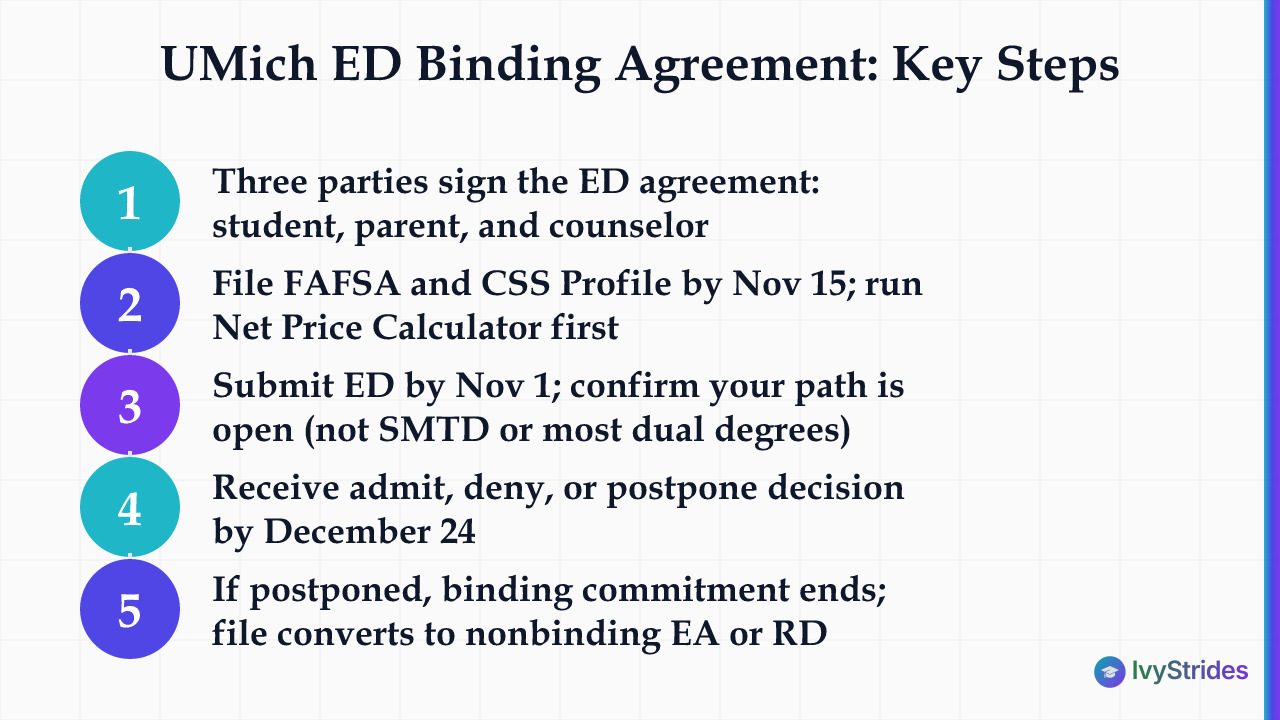
University of Michigan Early Decision requires a signed agreement from three people: the student, a parent or guardian, and the high school counselor, per UMich's first-year application plans page. That signature carries a binding commitment: if UMich admits you under ED, you withdraw every other college application and enroll. This is the lever that sits behind the December 24 decision date from the section above.
Check the aid math before you sign. UMich stays need-blind in ED, and families who file the FAFSA and CSS Profile by November 15 get an aid package soon after the December decision, per the same page. UMich's admissions pages describe no automatic release when aid falls short; its ED admission decisions FAQ says admitted students may request removal from the agreement, decided case by case, and an approved request ends their admission consideration for the cycle. Run UMich's Net Price Calculator before applying ED.
ED produces one of three outcomes: admit, deny, or postpone. UMich releases a postponed applicant from the binding commitment and considers the application in Early Action (except Taubman applicants), with a decision by the end of January if admitted; those not admitted there move to Regular Decision and hear by early April, per UMich's ED admission decisions FAQ. So a deferral does not trap you. It converts your file to a nonbinding one.
Confirm these before you click submit under ED.
- UMich is your clear first choice, ahead of every other school
- Your parent and counselor will both sign the ED agreement
- You have filed, or will file, the FAFSA and CSS Profile by November 15
- You have decided whether to self-report an SAT or ACT score by November 1
- Both UMich essays are drafted
- Your path is open in ED: not SMTD, not preferred admission, and not a dual degree other than Integrated Business and Engineering (IBE)
- Any portfolio or interview your school requires (Ross, Stamps, Taubman architecture, Marsal's video interview) is ready
- Your family can pay the enrollment deposit by January 6
Not every UMich path is open in ED. Per UMich's dual-degree applicants page, dual-degree applicants cannot apply ED: Stamps and Taubman combinations must choose EA or RD, and anything involving SMTD is Regular Decision only, because SMTD programs take applications only in Regular Decision, with a December 1 deadline. The plans page applies the EA-or-RD rule to preferred admission, with the IBE dual degree the one dual degree available in ED.
First-year applicants apply to a specific first-year admitting school or college, and direct-admit BBA applicants submit a portfolio through SlideRoom, per Michigan Ross. The Ross page does not directly confirm ED handling for 2026-27, so verify with Ross before committing to an ED-to-Ross application.
Whichever plan you choose, the second UMich essay (100-550 words) asks why your specific school or college. Your application-plan decision and your essay strategy link from day one. That essay runs alongside a first prompt on leadership and citizenship (100-300 words), per UMich's essay questions page, and the school-fit essay UMich requires, capped at 550 words, is the harder of the two to get right. If your score sits below UMich's typical admitted range and you are weighing applying ED with a score you are not sure about submitting, that call feeds directly into the ED-versus-EA decision.
Is UMich ED Actually Easier to Get Into Than EA or RD?
University of Michigan has not published a separate acceptance rate for Early Decision, Early Action, or Regular Decision. Its report on the fall 2026 entering class, the first class with an ED option, gives only whole-pool figures, with no split by decision plan. UMich says the same holistic review applies regardless of decision plan.
So the honest answer: ED is not demonstrably easier at UMich. What UMich says it does instead is review the whole file. The admissions office does not admit on any single criterion such as GPA or test scores, per UMich's selection process page. Multiple evaluators rate five criteria: secondary school academic performance, educational environment, counselor and teacher recommendation, essays, and awards, honors, involvement, leadership, and service.
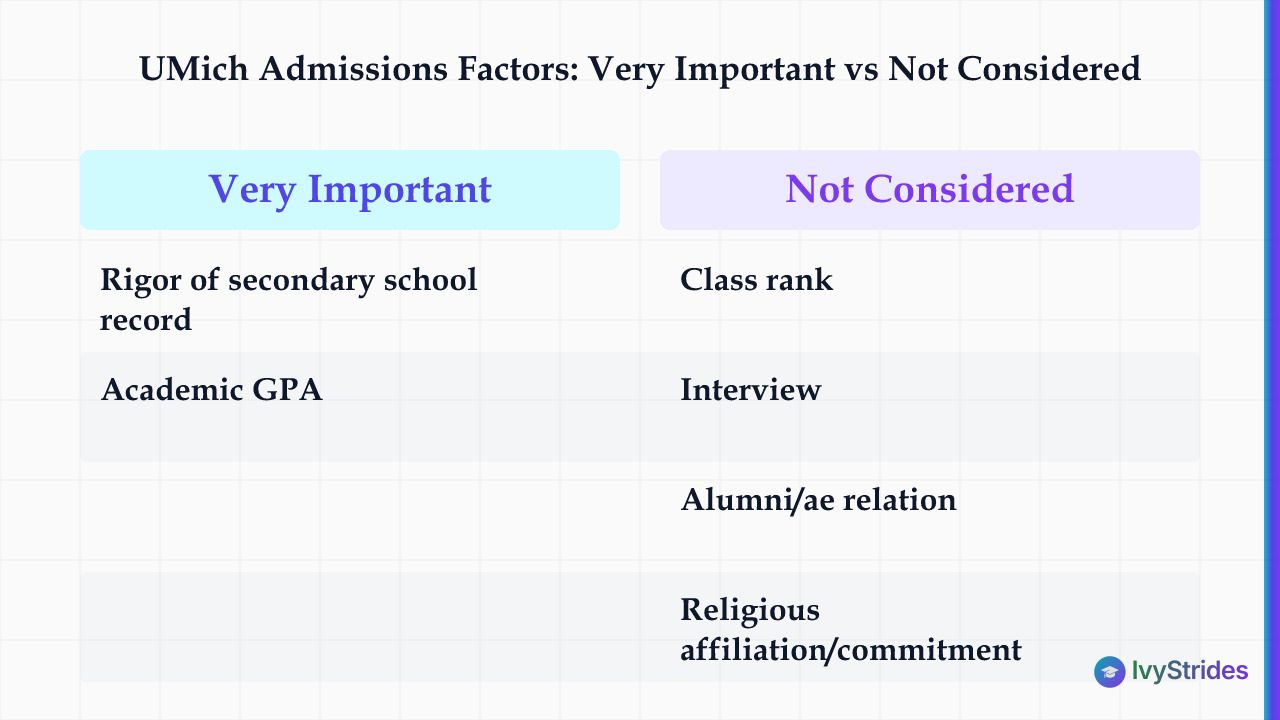
Two factors sit at the top. Here are UMich's Very Important and Not Considered factors, per its Common Data Set 2025-26, section C7; the other 12 factors it rates sit in between.
| Factor | UMich Rating |
| Rigor of secondary school record | Very Important |
| Academic GPA | Very Important |
| Class rank | Not Considered |
| Interview | Not Considered |
| Alumni/ae relation | Not Considered |
| Religious affiliation/commitment | Not Considered |
Rigor, read against your own school. UMich says the intellectual challenge you took on relative to what your school offers will be highly important, and it calls what you did beyond simply taking AP courses, your extracurricular preparation, a very important consideration. The plan you pick does not change which transcript lands on the reader's desk. For the full admissions-data picture, where your GPA stands against UMich's overall admit rate is the natural next read.
If your SAT or ACT score sits below UMich's typical admitted range and you are weighing whether to submit it under the test-optional policy, the ED-versus-EA decision intersects directly with your score strategy. A borderline score you choose not to send does not count against you, but it also cannot help you. A strong UMich strategy starts with reading your transcript rigor and GPA against UMich's C7 weighting before the plan question is even on the table.
How to Decide Between UMich ED and EA Before November 1
University of Michigan ED and EA both close November 1, so the deadline does not pick for you. First-choice confidence does. The ED-versus-EA decision almost always turns on one question: whether you can honestly say UMich is your first choice before seeing any financial aid offers.
Match your situation to the plan that fits it.
| Your situation | Better plan | Why |
| UMich is your clear first choice | ED | Binding, decision by December 24 |
| You need to compare aid offers | EA | Nonbinding, keeps options open |
| UMich is strong, not the top | EA | Lower risk, decision by January 29 |
| Finances uncertain, aid offer could decide it | EA or RD | No binding commitment |
| Fall-semester transcript strengthens your file | RD | February 1 buys time |
ED buys 36 days, not an edge. IvyStrides' analysis of UMich's published decision calendar puts the latest Early Decision answer (December 24) 36 days ahead of the latest Early Action answer (January 29), and UMich itself calls a guaranteed decision date the chief advantage of ED. That is the full trade: an earlier answer and a binding signature, in exchange for giving up the ability to compare offers.
Applying ED to UMich without confirming it is your clear first choice sets up the hardest part of the process: withdrawing applications to schools you were genuinely excited about. If UMich postpones an ED application instead, the binding commitment ends, and the file is considered in Early Action and then, if not admitted there, in Regular Decision.
Knowing the mechanics is not the same as having a plan for them, and what to do if your ED application is deferred is a strategy in itself. Mapping all of this against your full profile is the work of college admissions counseling for grades 11 and 12.
FAQ: UMich Early Decision and Early Action
Does UMich have an Early Decision?
Yes. UMich offers binding Early Decision for the 2026-27 cycle (fall 2027 entry). The ED deadline is November 1, the decision comes by December 24, and admitted students must commit by January 6 with an enrollment deposit. The student, a parent, and the high school counselor all sign the binding agreement.
What day do UMich EA decisions come out?
UMich Early Action decisions for the 2026-27 cycle arrive by January 29. ED decisions come earlier, by December 24. Applicants postponed in ED are considered in Early Action (except Taubman applicants) and hear by the end of January if admitted; the rest are considered in Regular Decision, with a decision by early April.
Does UMich do rejections for EA?
Yes. UMich EA outcomes include admit, deny, and postponement to Regular Decision. A postponement is not a rejection; UMich reviews the file again in the Regular Decision round, with a decision by early April. A denial in EA is final for that cycle.
Will UMich put ED and EA applicants into one single pool?
Not at first. UMich decides ED applications in their own round, by December 24, using the same holistic review as its other plans. Postponed ED applicants are then released from the binding commitment and considered in Early Action, then Regular Decision if not admitted in EA.
Your Next Step on the UMich Early Plan Decision
The plan is a strategy call, not a coin flip. Before November 1, settle whether UMich is truly your first choice, because that one answer decides ED versus EA more than any acceptance-rate rumor will.
- Confirm your first-choice standing honestly, then pick ED only if the answer is yes
- File the FAFSA and CSS Profile on time if you want aid considered
- Decide whether to self-report an SAT or ACT score by November 1
- Draft both UMich essays, including the 100-550 word school-fit prompt
- Confirm ED is open to your path: SMTD is Regular Decision only, and preferred admission and dual degrees other than IBE are EA or RD only
Policies shift each cycle, so confirm every date on UMich's admissions site before you submit. These figures hold for the 2026-27 cycle, fall 2027 entry.

Hemant is a seasoned entrepreneur, investor, and growth strategist with deep ground in education and technology-driven learning. His core training is in Mathematics and Physics — he authored Physics for IB Diploma: Ultimate Revision Guide, recognized as a top student resource.