
UT Austin Early Action by Oct 15: A Faster Answer, the Same Review
On this page
- What UT Austin Early Action Actually Changes About Your Timeline
- Does Applying Early Action to UT Austin Actually Help Your Chances?
- Is Your UT Austin File Ready for the October 15 Deadline?
- What Happens After a UT Austin Early Action Deferral
- FAQ: UT Austin Early Action
- What time is UT Austin Early Action coming out?
- Is it better to apply Early Action to UT Austin?
- Does UT Austin have Early Decision or Early Action?
- What is the UT Austin acceptance rate for Early Action?
- Your Next Step on UT Austin Early Action
UT Austin Early Action is the non-binding early application round at the University of Texas at Austin, with an October 15 application deadline and materials due October 22. Early Action applicants receive an admission decision or a deferral notice by January 15, 2027. UT states it carries no admissions advantage over Regular Decision.
The distinction worth holding onto: "early" here means when you hear back, not how your file reads. The holistic review is identical in both rounds, so you get a faster answer, not a better one.

What UT Austin Early Action Actually Changes About Your Timeline
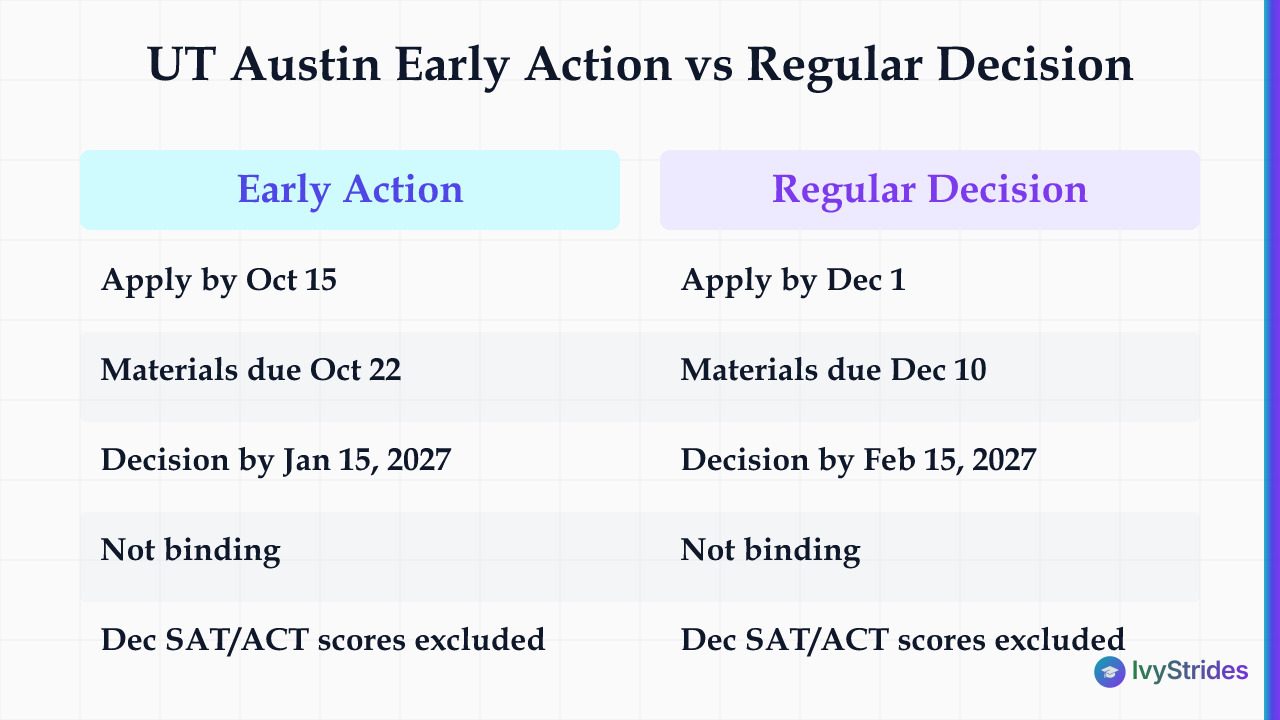
UT Austin Early Action changes one thing: the date you get a decision. Apply by October 15, send materials by October 22, and UT releases a decision or a deferral by January 15, 2027. Regular Decision applicants submit by December 1, finish materials by December 10, and hear back by February 15, 2027.
Two deadlines, not one. The application form is due October 15. Your supplemental materials, including official test scores, are due October 22. UT's published Early Action calendar gives a seven-day window after the application itself, so a student who submits on October 15 still has a week for official scores, though not for the short answers, which must be complete before the application can be submitted.
| Round | Apply by | Materials due | Decision by | Binding? |
| Early Action | Oct 15 | Oct 22 | Jan 15, 2027 | No |
| Regular Decision | Dec 1 | Dec 10 | Feb 15, 2027 | No |
UT Austin is test-required for fall 2027 entry, so your official SAT or ACT score must reach UT by October 22 if you apply Early Action, a week after the application itself is due. Send scores straight from the testing agency: SAT code 6882, ACT code 4240. An official Classic Learning Test score also counts.
Platform makes no difference. You can apply through Common App or ApplyTexas. UT states the choice does not affect the decision. You must select Early Action on the application itself; it is not automatic from an early submission.
Because UT Austin does not superscore, the score in your file is your highest composite from a single test date among the official scores that reach UT by October 22. If a retake would realistically lift that composite, Regular Decision buys you one more sitting, provided the official score reaches UT by December 10, which rules out the December SAT and ACT dates.
One footnote on auto-admit. For summer/fall 2027, UT automatically admits eligible students in the top 5% of their Texas high school class, though that covers admission to the university, not to a requested major.
Does Applying Early Action to UT Austin Actually Help Your Chances?
No. UT Austin Early Action gives no admissions advantage. UT states the Early Action deadline gives no advantage in review and is not binding. The same individualized holistic review reads your file in both rounds. The difference UT describes is timing: an admission decision or a deferral notice by January 15, instead of a decision by February 15.
Because UT Austin's holistic review weighs the same factors in both rounds, the real question is whether your file, including your test score, short answers, and major choice, is stronger on October 15 or December 1. That is a readiness question, not a timing-advantage question.
| Review Factor | Source | Notes |
| Class rank | Review and Decision page | Named freshman factor |
| Strength of academic background | Review and Decision page | Named freshman factor |
| Test scores | Review and Decision page | Required for fall 2027 |
| Achievements, honors, awards | Review and Decision page | Named factor |
| Work and service | Review and Decision page | In and out of school |
| Essays and required short answers | Catalog | Required components |
| Recommendations | Review and Decision page | Not required |
| Competitiveness of the major | Catalog | Named review factor |
UT's catalog adds special circumstances that put achievements in context: socioeconomic status, growing up in a single-parent home, family responsibilities, and overcoming adversity. UT also states no single rank or score ensures admission, other than Texas automatic admission.
No Early Decision here. UT Austin offers non-binding Early Action only for undergraduate freshmen. There is no binding Early Decision option, so an Early Action application does not commit you to attend. The same factors that decide admission in Regular Decision decide it in Early Action, so the question is whether what UT Austin's holistic review weighs in depth is stronger in your file now or in December.
UT does not publish a separate Early Action acceptance rate. Because UT states EA carries no review advantage, the early pool reflects who applies early, not a different standard. Understanding where your profile sits against UT Austin's overall acceptance rate and admitted range helps you judge whether your file is ready for October 15.
Is Your UT Austin File Ready for the October 15 Deadline?
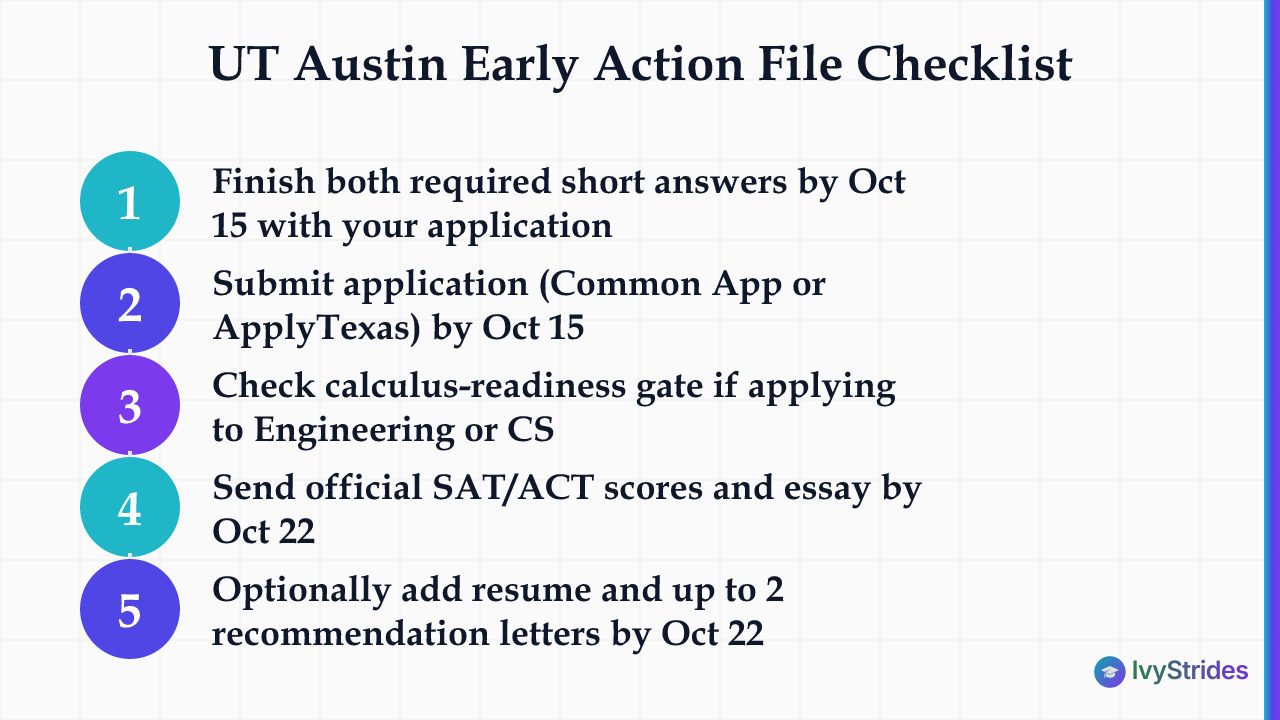
Run your UT Austin file against this list before you commit to October 15. The application, including the two required short answers, is due that day; the remaining materials, including your official test score, are due October 22. Missing the materials window undoes an on-time application.
| Component | Deadline | Required or Optional |
| Application (Common App or ApplyTexas) | Oct 15 | Required |
| Open-topic essay, 500-650 words | Oct 22 | Required |
| Short answer: first-choice major | Oct 15 (with application) | Required |
| Short answer: most proud activity | Oct 15 (with application) | Required |
| Official SAT (6882) or ACT (4240) | Oct 22 | Required |
| Resume | Oct 22 | Optional |
| Letters of recommendation (up to 2) | Oct 22 | Optional |
The essay and short answers. UT requires one open-topic essay of 500 to 650 words; the Common App personal statement satisfies it. Then two required short answers, each capped at about 250-300 words or 40 lines: one on why you are interested in your first-choice major, one on the activity you are most proud of. That second answer can be a job or a family responsibility, not only a club.
Your two required short answers are part of the application itself, so they must be finished by October 15, a week before your official test scores are due. If you rush to meet the Early Action deadline without a finalized short answer on your first-choice major, consider whether the extra weeks to December 1 would let you revise it more fully. Give the required short answer about why you are interested in your first-choice major the same drafting time as your essay.
The calculus gate catches people. A common mistake: applying to Cockrell Engineering or Computer Science without checking the calculus-readiness gate first. UT counts markers such as SAT Math 620 or above, ACT Math 26 or above, or a Calculus I grade of B or higher, sent by the applicable admissions deadline. UT requires calculus readiness for all Cockrell Engineering majors, all Jackson Geosciences majors, both Environmental Science majors, and Computer Science plus its combined CS majors.
Optional, but useful. UT lets you send up to two letters of recommendation, not from family, and encourages writers from outside your high school. The resume is optional for freshmen; UT states format and length have no effect on review, so list hours per week and weeks per year rather than polishing a layout.
Deciding whether UT Austin Early Action is the right round is where IvyStrides' counselors help most. Two components that commonly need more time than students expect are the test score and the first-choice major short answer. An admissions counselor who maps each component against UT's named factors can help you plan the drafting of your short answers and essay against the deadline.
What Happens After a UT Austin Early Action Deferral

Photo by Andrea Piacquadio on Pexels
A UT Austin Early Action deferral is not a rejection. After a deferral, UT continues to consider your application based on the competitiveness of the applicant pool, and you receive a decision by February 15, 2027, alongside regular deadline applicants. IvyStrides' analysis of UT's published decision calendar, January 15 for Early Action decisions and February 15 for all decisions, puts the wait between the two release dates at 31 days.
-
By January 15, 2027: You receive an admission decision or a notification of deferral.
-
Deferred: Your application stays under consideration for a decision by February 15. Keep checking MyStatus for any items still needed.
-
By February 15, 2027: Deferred Early Action applicants and regular deadline applicants receive a decision.
-
Not admitted: You can join UT's waitlist, and some Texas students who are not offered admission may be offered an alternative pathway to enroll.
If UT defers your file in January and then does not admit it in February, the next step UT names is UT Austin's self-join waitlist, which opens February 15, the date UT lists for all decisions. A deferral from Early Action is not unique to UT Austin; the same response framework applies across schools that defer rather than reject in the early round.
FAQ: UT Austin Early Action
What time is UT Austin Early Action coming out?
Early Action applicants receive an admission decision or a deferral notice by January 15, 2027, and UT notes that some decisions arrive earlier than the published dates. UT does not publish a release time. It alerts applicants by email, and MyStatus, its applicant portal, always has the most up-to-date information.
Is it better to apply Early Action to UT Austin?
Applying Early Action gets you an admission decision or a deferral notice by January 15 instead of a decision by February 15. UT explicitly states Early Action carries no admissions advantage. Apply early if your application, including both short answers, is finished by October 15 and your official test score can reach UT by October 22. If a stronger score that arrives by December 10, or a better short answer by December 1, is realistically within reach, Regular Decision may serve you better.
Does UT Austin have Early Decision or Early Action?
UT Austin offers non-binding Early Action for undergraduate freshmen and does not offer Early Decision. Because UT states Early Action is not binding, admission does not commit you to attend, and UT's admissions pages set no restriction on applying to other schools.
What is the UT Austin acceptance rate for Early Action?
UT Austin does not publish a separate Early Action acceptance rate. Because UT states Early Action carries no review advantage, the early pool reflects who applies early rather than a different admissions standard. For admitted-student benchmarks, look to UT's institutional data rather than a separate EA rate.
Your Next Step on UT Austin Early Action
The decision comes down to readiness, not strategy. UT applies the same holistic review in both rounds, so submit early only when your application and both short answers are finished by October 15 and every remaining required item can reach UT by October 22.
- Confirm your official SAT or ACT score can reach UT by October 22 (SAT code 6882, ACT code 4240).
- Finish both required short answers before you submit, because UT will not let you submit the application without them.
- If your first-choice major sits behind the calculus-readiness gate, verify you meet it before you submit.
- If a retake whose official score can reach UT by December 10, or a stronger short answer, is realistically within reach, target December 1 instead.

Hemant is a seasoned entrepreneur, investor, and growth strategist with deep ground in education and technology-driven learning. His core training is in Mathematics and Physics — he authored Physics for IB Diploma: Ultimate Revision Guide, recognized as a top student resource.