
Duke's ED Acceptance Rate Is Triple the RD Rate. Should You Commit?
On this page
- Duke's ED Acceptance Rate: The Numbers
- Who Actually Gets Into Duke Early Decision
- Is Duke Early Decision Worth the Binding Commitment?
- Duke ED Acceptance Rate: What the Numbers Cannot Tell You
- FAQ: Duke ED Acceptance Rate and Decision
- Is Duke's Early Decision worth it?
- Is 1400 a good SAT score for Duke?
- Is Duke very hard to get into?
- What percent of Duke admits are ED?
- Your Next Step on the Duke ED Decision
Duke's Early Decision admit rate was 12.6% in the 2025-2026 admissions cycle, against 4.2% for Regular Decision, per Duke's own admissions FAQ. Early Decision is binding: if Duke admits you, you must enroll. Duke offers no Early Action.
Those figures come from Duke's admissions FAQ. The harder question is whether that gap helps your profile, and whether a binding commitment rules out comparing financial aid offers.

Duke's ED Acceptance Rate: The Numbers
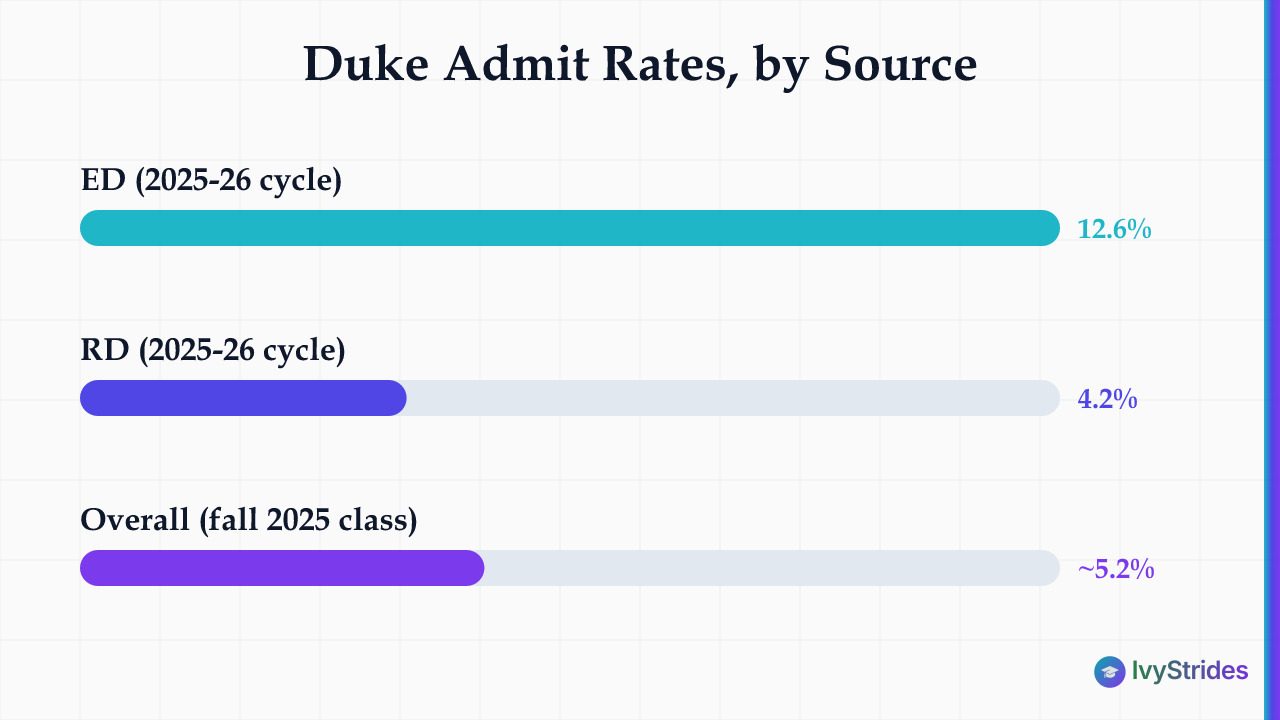
Duke's ED acceptance rate in the 2025-2026 cycle was 12.6%, against 4.2% for Regular Decision. Duke publishes both rates; by IvyStrides' calculation, the ED rate is three times the RD rate. Duke's FAQ also says outright that applying Early Decision "has an advantage in the admissions process."
For scale, Duke's Common Data Set 2025-26, section C1 reports 55,541 first-year applicants and 2,910 admits for the fall 2025 entering class: an overall rate of about 5.2% by IvyStrides' calculation. Duke leaves its Early Decision counts blank in the CDS.
Why the two rates diverge. In our view, ED pools self-select for strong, committed applicants, and ED lets Duke lock in its class early. Both push the ED rate up, while the RD pool spreads tens of thousands of applications over the seats that remain.
| Source | Cycle | ED Rate | RD Rate | Overall |
| Duke admissions FAQ | 2025-2026 | 12.6% | 4.2% | not stated |
| Duke CDS 2025-26, C1 | Fall 2025 entering class | not reported | not reported | about 5.2% (2,910 of 55,541) |
Duke publishes the rates in the first row and the counts in the second; IvyStrides calculated the 5.2%.
For a peer-school comparison, see our breakdown of the UPenn early decision acceptance rate.
Who Actually Gets Into Duke Early Decision
Duke Early Decision admits students who clear a holistic bar, not a single cutoff. The same forces that lift the ED rate, self-selection and yield management, also mean the ED pool arrives stronger on average than the RD pool. So the 12.6% rate rewards profiles that were already competitive.
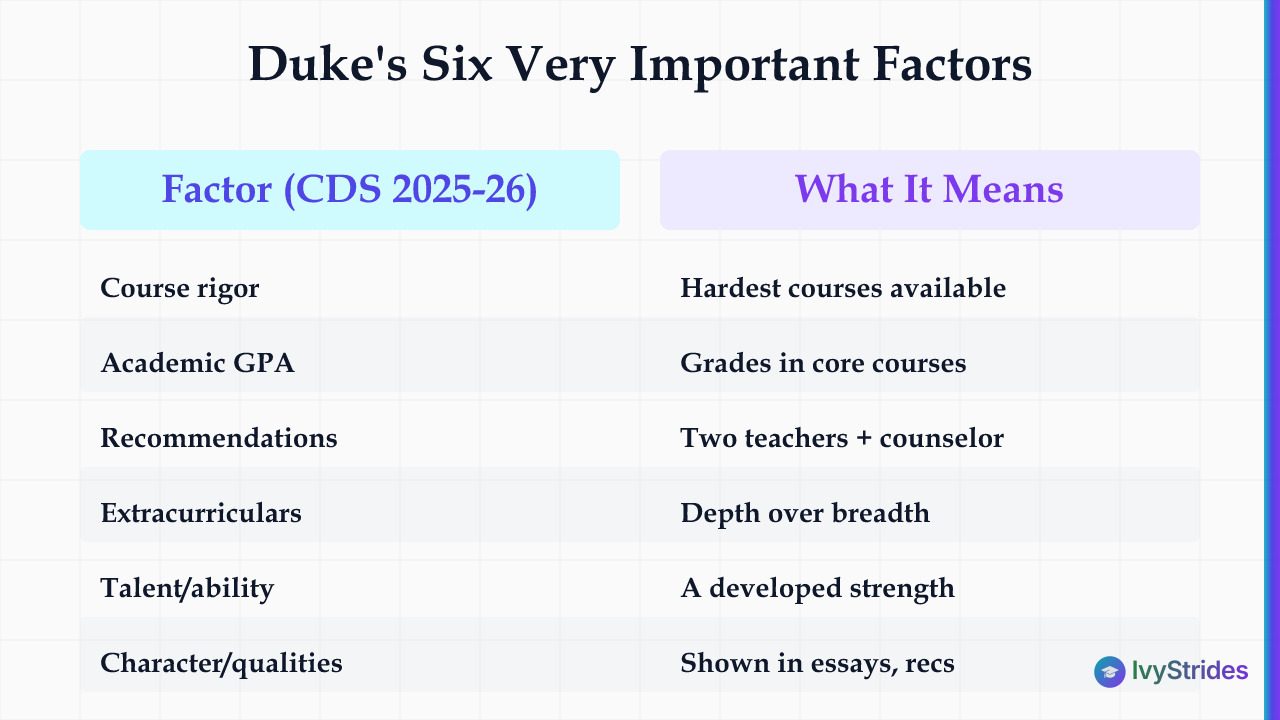
Duke rates six factors "Very Important" in its Common Data Set 2025-26, section C7: rigor of secondary school record, academic GPA, recommendations, extracurricular activities, talent/ability, and character/personal qualities. Religious affiliation it rates "Not Considered."
| Factor | Duke's Rating | What It Means for Your Application |
| Rigor of secondary school record | Very Important | Take the hardest courses your school offers |
| Academic GPA | Very Important | Grades in academic courses carry the most weight |
| Recommendations | Very Important | Two teachers plus a counselor |
| Extracurricular activities | Very Important | Depth over breadth |
| Talent/ability | Very Important | A genuine, developed strength |
| Character/personal qualities | Very Important | Surfaced through essays and recommendations |
Rigor comes first. Duke's What We Look For page expects the most challenging courses available, generally five academic courses per year. That page names five primary factors: rigor of your academic program, grades, recommendations, extracurriculars, and the quality of thought and expression in your essay. Duke values both "well-rounded and well-lopsided" students, so a passion-driven profile can matter more than breadth for its own sake.
Out-of-state and international applicants. Duke does not publish separate ED acceptance rates by residency or citizenship, so treat any "Duke ED acceptance rate out of state" or "for international students" figure you see elsewhere as an estimate. International applicants, particularly those at schools in China, can submit an optional InitialView interview that Duke considers.
Applicants choose Trinity College of Arts and Sciences or the Pratt School of Engineering at the point of application. Duke states plainly that it is no easier or harder to enter either school, so pick the one that fits your academic interest. The early decision versus early action versus regular decision framework explains how self-selection shapes these pools across selective colleges.
Is Duke Early Decision Worth the Binding Commitment?
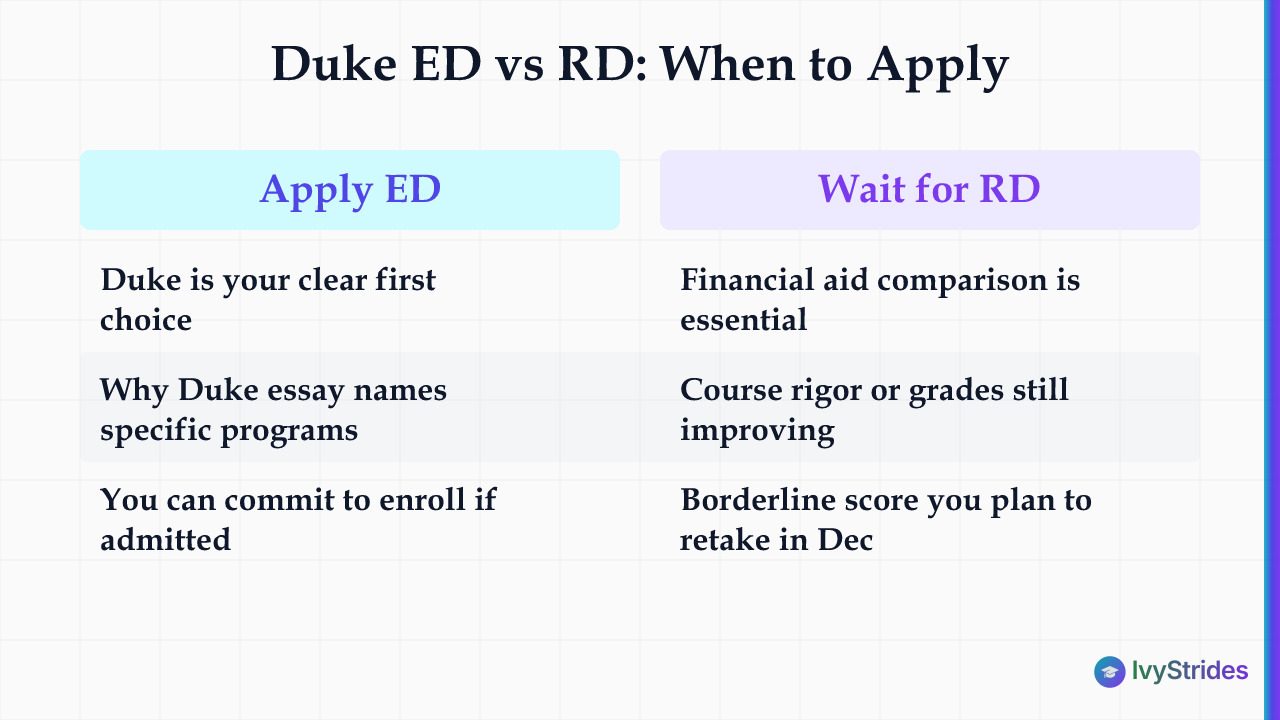
Duke Early Decision is worth it when Duke is a clear first choice and your financial picture is settled, not simply because the rate is triple. That binding commitment, the same yield lever that lifts the ED rate, is also the single biggest reason to hold back. If Duke admits you under ED, you withdraw your other applications and enroll.
The financial aid trade-off. ED applicants cannot compare aid offers from other schools before committing.
Duke says there is no financial aid advantage or disadvantage in applying ED, that it meets full demonstrated need, and that students who want to compare packages should apply Regular Decision (FAQ). In rare cases Duke releases a family that cannot afford to attend from the ED commitment, after discussions with its financial support and admissions offices. For a full walk-through of that calculus, read whether to apply Early Decision when you need financial aid.
The deadlines are fixed. Duke's ED deadline is November 2, with decisions in mid-December; the RD deadline is January 4.
| Condition | ED or Wait? |
| Duke is your clear first choice | ED |
| Financial aid comparison is essential | Wait for RD |
| Why Duke essay already names specific programs | ED |
| Course rigor or grades still improving this fall | Wait |
| Borderline score you plan to retake in December | Wait |
| You can commit to enroll if admitted | ED |
The borderline-score question. Duke is test-optional for the 2026-27 cycle, and states applicants without SAT or ACT scores are not at a disadvantage. So a score on the edge of Duke's range does not automatically disqualify you under ED. If you're deciding between a December retake and the November 2 deadline, weigh whether to push ED or wait on a borderline test score. Students who want to lift a score before deciding can work through focused one-on-one SAT prep first.
Demonstrated knowledge, not demonstrated interest. Duke's resources page says demonstrated interest "as most people use the term" is not a plus factor. Emailing or meeting your regional officer brings no benefit.
What Duke wants instead is demonstrated knowledge, shown through a well-researched Why Duke essay. Note the tension: Duke's Common Data Set rates "Level of applicant's interest" as Considered, while the FAQ says interest is not a plus factor. Present both to yourself rather than assuming Duke is quietly tracking visits.
Applicants who apply Duke ED without a specific Why Duke angle rooted in named programs or faculty risk writing essays that read as generic enthusiasm rather than demonstrated knowledge, which is exactly the distinction Duke's own resources page draws. Mapping your full profile against Duke's Very Important factors before November 2 is precisely what college admissions counseling for grades 11 and 12 covers.
Duke ED Acceptance Rate: What the Numbers Cannot Tell You
Duke's ED acceptance rate tells you the pool's odds, not yours. A 12.6% rate says nothing about how your specific file reads against Duke's six Very Important factors. The rate gap reflects self-selection and yield management, not a thumb on the scale for any individual profile.
On scores. Because Duke is test-optional for 2026-27, a 1400 is read in context alongside your rigor, GPA, and essays rather than against a published minimum. Duke does not list test scores among its Very Important factors.
The two Duke short essays, each capped at 250 words, are the levers you actually control. "Why Duke" asks for your impression of Duke and why it matches your goals, inviting you to name specific Trinity or Pratt offerings. "Communities" asks about a community that shaped you.
| Factor | Source and Rating | What You Can Do Before Nov 2 |
| Course rigor | CDS C7: Very Important | Confirm your fall schedule is the hardest available |
| Academic GPA | CDS C7: Very Important | Protect first-quarter grades |
| Essay quality | What We Look For page: primary factor (not a standalone CDS C7 rating) | Draft a Why Duke rooted in named programs |
| Extracurriculars | CDS C7: Very Important | Sharpen your well-lopsided spike |
| Test score | Not listed in CDS C7 Very Important factors | Decide submit or withhold, test-optional |
A common pattern in essay coaching: students conflate demonstrated interest, campus visits and emails to admissions, with demonstrated knowledge, naming specific Pratt labs or Trinity programs. Duke explicitly says the former brings no benefit. US applicants may also submit an optional 60-90 second Glimpse video, due November 9 for ED. To sequence Duke's dates against your other schools, build out your full application timeline for 2026-27.
Admissions outcomes depend on the whole application, not the ED decision alone, and Duke's test-optional policy is confirmed for 2026-27 only. Before you commit, read what test-optional status means for applicants deciding whether to submit a score.
FAQ: Duke ED Acceptance Rate and Decision
Is Duke's Early Decision worth it?
Early Decision is worth it when Duke is a genuine first choice and your financial aid picture is settled. Last cycle's rates were 12.6% for ED and 4.2% for RD (2025-2026), a real gap, but the binding commitment means you cannot compare aid packages from other schools before you enroll.
Is 1400 a good SAT score for Duke?
Duke is test-optional for the 2026-27 cycle, so applicants without a score are not at a disadvantage per Duke's own statement. A submitted 1400 is read in context alongside your course rigor, GPA, and essays. Duke publishes no minimum, and test scores do not appear among its Very Important factors.
Is Duke very hard to get into?
Yes. The Regular Decision admit rate was 4.2% in 2025-2026, and about 5.2% of all first-year applicants for fall 2025 by IvyStrides' calculation from its Common Data Set. ED applicants saw 12.6%, but that pool self-selects for strong profiles. Duke evaluates rigor, GPA, recommendations, extracurriculars, and essay quality holistically.
What percent of Duke admits are ED?
Duke does not publish that share: its Common Data Set leaves the Early Decision counts blank. Its FAQ gives rates instead: 12.6% of ED applicants and 4.2% of RD applicants were admitted in 2025-2026.
Your Next Step on the Duke ED Decision
The rate gap is real, but it only works in your favor when Duke is a first choice, your file matches its Very Important factors, and your family can commit without comparing aid offers. Before November 2, do these four things:
- Confirm your fall course load is the most rigorous your school offers.
- Draft a Why Duke essay that names specific Trinity or Pratt programs, not generic enthusiasm.
- Settle the financial aid question honestly: can you commit without comparing packages?
- Decide submit or withhold on your SAT or ACT, given Duke's test-optional policy for 2026-27.

Hemant is a seasoned entrepreneur, investor, and growth strategist with deep ground in education and technology-driven learning. His core training is in Mathematics and Physics — he authored Physics for IB Diploma: Ultimate Revision Guide, recognized as a top student resource.