
UChicago Early Action or ED? Which of Four 2026-27 Plans Fits You
On this page
- UChicago's Four 2026-27 Application Plans: Deadlines and Decision Dates
- Is UChicago Early Action Binding, and When Does ED Make More Sense?
- What UChicago Reads in Every Round, Regardless of Plan
- Which UChicago Plan Fits Your Readiness Right Now?
- FAQ: UChicago Early Action and Application Rounds
- What is the UChicago EA acceptance rate?
- Is UChicago Early Action binding?
- When do UChicago Early Action decisions come out?
- Does applying Early Action to UChicago hurt your chances compared to ED?
UChicago Early Action is a non-binding early plan with a November 2, 2026 deadline and a mid-December decision. It shares that deadline with binding Early Decision I. Early Decision II and Regular Decision share a January 4, 2027 deadline.
Those dates and binding terms come from UChicago's official application plans page. The harder question is which plan fits a student whose essays, test score, and financial-aid priorities sit at different stages of readiness.
UChicago's Four 2026-27 Application Plans: Deadlines and Decision Dates
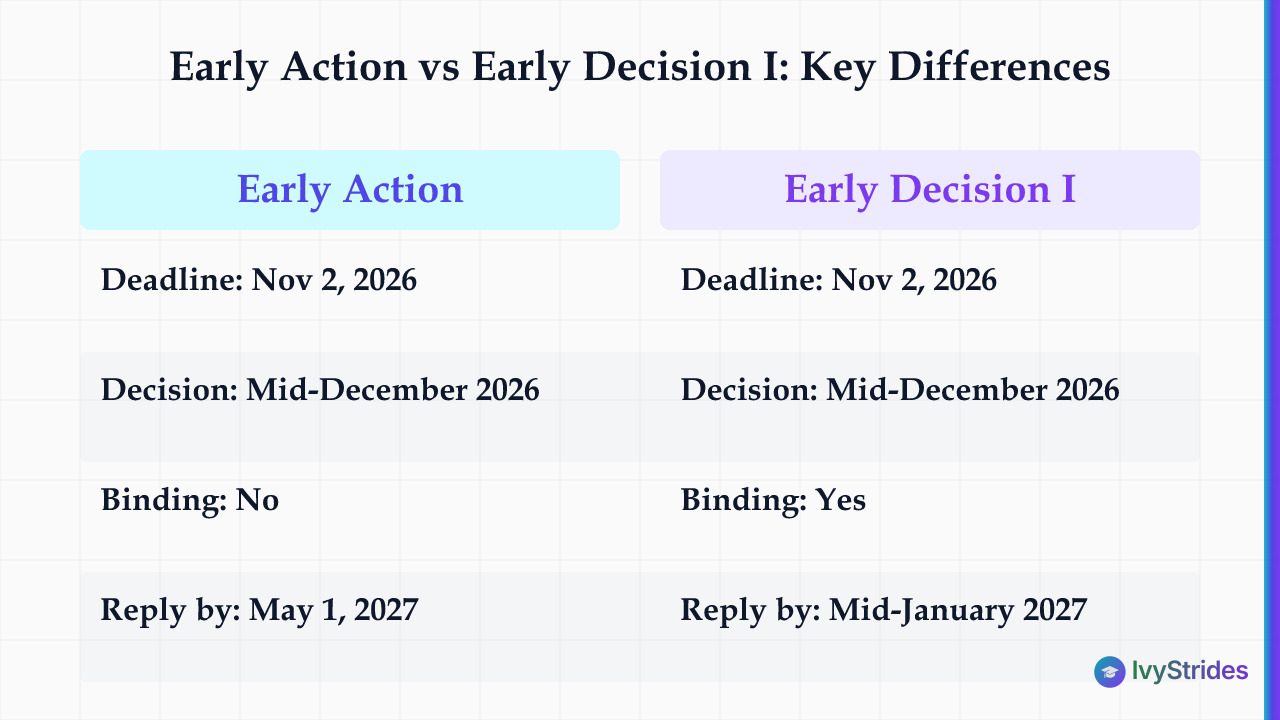
UChicago offers four application plans for the 2026-27 cycle, entry in fall 2027. Each carries its own deadline, decision date, binding status, and reply date.
| Plan | Deadline | Decision | Binding? | Reply By |
| Early Action | Nov 2, 2026 | Mid-December 2026 | No | May 1, 2027 |
| Early Decision I | Nov 2, 2026 | Mid-December 2026 | Yes | Mid-January 2027 |
| Early Decision II | Jan 4, 2027 | Mid-February 2027 | Yes | Mid-March 2027 |
| Regular Decision | Jan 4, 2027 | Late March 2027 | No | May 1, 2027 |
All four deadlines, decision windows, and reply dates come from UChicago's application plans page.
When Early Action decisions come out. UChicago posts EA and ED I decisions in mid-December 2026 to the student's UChicago Account. ED II applicants hear in mid-February 2027, and Regular Decision applicants in late March 2027.
Choosing November over January also puts UChicago's two supplement essays into the same weeks as the other early application deadlines on your 2026-27 calendar.
IvyStrides' analysis of UChicago's published deadlines, November 2, 2026 and January 4, 2027, puts the gap between the early and later rounds at 63 days, nine extra weeks for students who need more time on essays or a test retake. UChicago accepts October ACT and November SAT scores for EA and ED I, and December SAT and ACT scores for ED II.
Is UChicago Early Action Binding, and When Does ED Make More Sense?
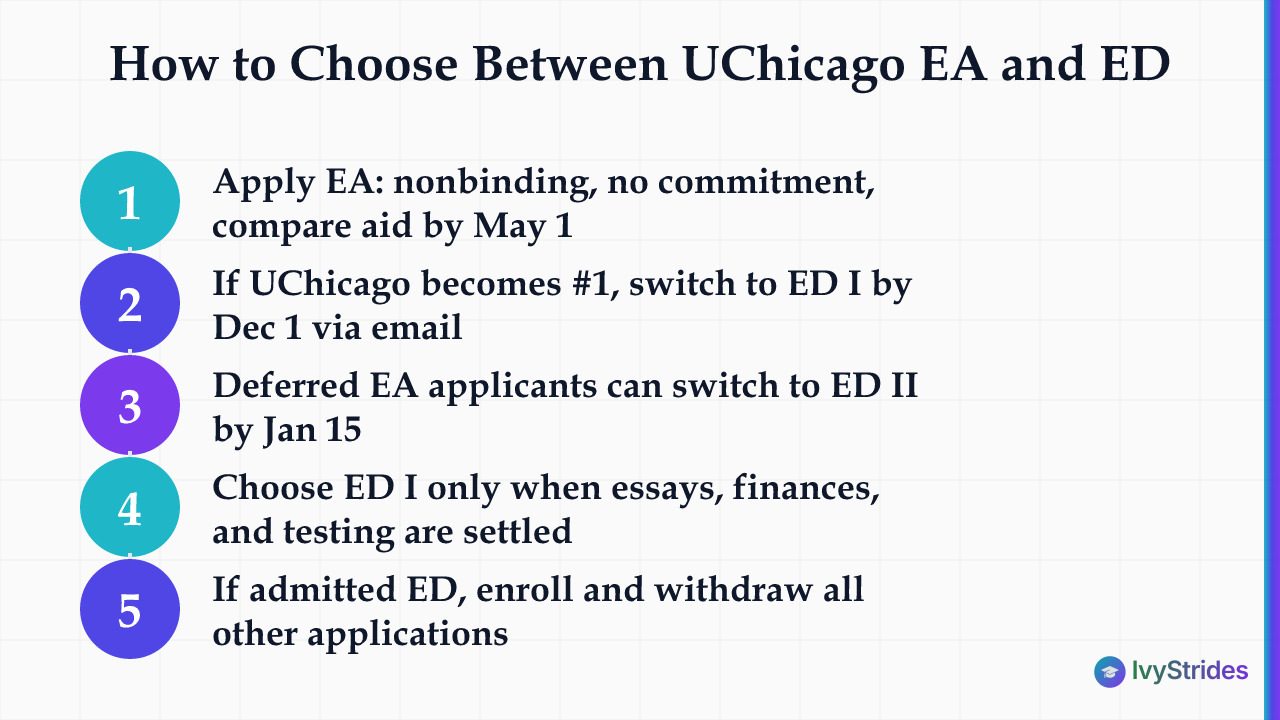
UChicago Early Action is not binding and not restrictive. The school's Common Data Set 2025-2026, section C22 lists it as a nonbinding plan that does not limit applicants from applying to other early plans, so an EA applicant owes no enrollment commitment and can wait until May 1, 2027 to reply. If UChicago becomes your clear first choice after you apply EA, you can switch to ED I by December 1 by emailing admissions and submitting the Early Decision agreement; deferred EA applicants can switch to ED II by January 15.
Binding Early Decision means you sign UChicago's Early Decision agreement: if admitted, you enroll and withdraw all other applications. The one exception is financial: if the aid package offered is insufficient to make attendance affordable, you may decline and are released from the commitment. ED I (November 2) and ED II (January 4) use the same agreement; ED II simply gives students who need more time a second, later window to apply binding.
The financial-aid trade-off. A binding ED admit commits before regular-round aid offers from other schools arrive, so there is no side-by-side comparison; an aid applicant may keep other applications open only until UChicago's own aid notification arrives. EA preserves the full comparison. UChicago's institutional aid application is due November 15 for EA and ED I, January 15 for ED II, and February 15 for Regular Decision. In our admissions coaching, students who choose EA over ED I most often do so because they want to compare financial-aid packages or because their college list is not yet finalized by October.
If your SAT is under 1500, the 25th percentile for enrolled students who sent one in UChicago's Common Data Set 2025-2026, and you are considering binding ED, decide whether to push now or wait for a retake before you commit. For applicants for fall 2027 entry, UChicago is test-optional under its No Harm policy: a submitted score is used only if it would positively affect your chance, and a score that could hurt is not considered. That changes the math on whether binding ED is workable when your score is still improving.
UChicago's agreement lets you apply to other schools while your ED application is pending but allows only one active ED application, so holding two binding applications at the same time is not an option.
Choose ED I only when all of these are true:
Daily SAT and ACT prep on YouTube: short strategy videos from IvyStrides. Subscribe to IvyStrides on YouTube.
- UChicago is your clear, confirmed first choice.
- Your UChicago Supplement essays are already strong, not still in outline.
- Financial-aid comparison across schools is not a constraint for your family.
- Your testing is settled: a score you are ready to send, or a decision to apply without one.
- You can meet the November 2 deadline without rushing the application.
What UChicago Reads in Every Round, Regardless of Plan

Photo by https://kaboompics.com/ on Pexels
UChicago says your application goes through the same careful review process whichever plan you choose. The round changes your timeline and your commitment, not what the committee weighs.
The school's holistic review rates six factors "Very Important" in its Common Data Set 2025-2026, section C7. It also marks two factors "Not Considered," and one of those bears directly on the EA-versus-ED question.
| Factor | CDS C7 Rating |
| Rigor of secondary school record | Very Important |
| Application essay | Very Important |
| Recommendation(s) | Very Important |
| Extracurricular activities | Very Important |
| Talent/ability | Very Important |
| Character/personal qualities | Very Important |
| Interview | Not Considered |
| Level of applicant's interest | Not Considered |
Ratings from UChicago's Common Data Set 2025-2026, section C7.
Level of applicant's interest is Not Considered. That's the line to internalize: UChicago's formal review does not rate demonstrated interest, so choosing EA to keep your options open is not scored as weaker interest.
Recommendations and transcript. UChicago requires two academic-subject teacher recommendations, ideally from teachers who best know your academic personality, not necessarily the ones who gave you the best grades. A counselor letter is not officially required, and one optional supplemental letter is allowed. The committee reads your transcript across all four years to see that you challenged yourself in course selection, always judged against what your own high school offered.
Whichever round you choose, the UChicago Supplement requires a Why UChicago response and one extended essay from the 2026-27 list, and those essays carry the same weight in EA as they do in ED. The Why UChicago response asks for specificity about the learning, community, and future you want; UChicago's FAQ calls 300 to 600 words a good benchmark, not a strict limit.
For the extended essay, chosen from six 2026-27 options that include the classic choose-your-own-adventure prompt, the FAQ's benchmark is 500 to 700 words, and UChicago says its prompts can be approached "with utter seriousness, complete fancy, or something in between." Once your round is set, the next decision is which of the six extended essay prompts fits your strongest material.
A common pattern in essay coaching: students underestimate how long the Why UChicago response takes to write well, and the November 2 deadline arrives before the essay reflects genuine specificity about UChicago's academic culture.
Optional, but worth doing. UChicago does not offer on-campus or alumni interviews. Instead it highly recommends an optional two-minute video profile, which does not need to be polished or edited, uploaded to your UChicago Account by November 6 for EA/ED I or January 10 for RD/ED II, per the admissions FAQ. Students who skip it are not penalized. UChicago treats the Common App and Apply Coalition, Powered by Scoir, equally, and also takes QuestBridge applicants. There is no minimum GPA, and applicants for fall 2027 entry need no test score.
Which UChicago Plan Fits Your Readiness Right Now?
The right UChicago plan depends on three things: whether your essays are ready, whether UChicago is your clear first choice, and whether your family needs to compare financial aid.
| Your Situation | Best Plan | Deadline |
| UChicago clear first choice, essays strong, aid not a constraint | Early Decision I | Nov 2, 2026 |
| UChicago a top choice, but you need to compare aid or finalize your list | Early Action | Nov 2, 2026 |
| Essays or score not ready by November, UChicago first choice | Early Decision II | Jan 4, 2027 |
| Essays or score not ready by November, you want to stay non-binding | Regular Decision | Jan 4, 2027 |
Deadlines from UChicago's application plans page.
The May 1 lever. EA's reply deadline of May 1, 2027 is what makes it the right call when financial aid matters. You collect offers from every school, compare them, and decide. Binding ED narrows that to one question: whether UChicago's own offer makes attendance affordable. If the essays simply are not there by early November, the January 4 deadline buys you the 63 extra days to make them genuinely yours, and ED II keeps the binding option open if UChicago is where you most want to be.
College admissions insights on LinkedIn: follow IvyStrides for application guidance and counseling updates.
In our college admissions coaching, we point students toward ED I only once they have drafted a strong Why UChicago essay and confirmed that comparing financial-aid offers is not a constraint. The hard part is judging your own file objectively, which is the review IvyStrides' admissions counselors run against the UChicago round decision, reading essay drafts, testing plans, and aid priorities within a grade-by-grade admissions plan for juniors and seniors.
UChicago's EA is not restrictive, so it can sit alongside early applications at schools where you face the same Early Action or Early Decision choice. Round choice sets your timeline, not your outcome: UChicago says no single piece of information, from essays to SAT or ACT scores, alone determines whether you would be a good fit.
FAQ: UChicago Early Action and Application Rounds
What is the UChicago EA acceptance rate?
UChicago does not publish admit rates by round: its Common Data Set 2025-2026 gives no early decision applicant or admit counts. For all rounds combined, UChicago admitted 2,039 of 45,533 first-year applicants for fall 2025, which works out to 4.5%. The six Very Important factors, including the application essay and course rigor, are the same in every round.
Is UChicago Early Action binding?
No. UChicago Early Action is non-binding and not restrictive, per the school's own Common Data Set, section C22. An EA admit can compare financial aid offers, keep applying to other schools, and reply as late as May 1, 2027. Only ED I and ED II carry a binding enrollment commitment.
When do UChicago Early Action decisions come out?
UChicago releases EA and ED I decisions in mid-December 2026. ED II decisions arrive in mid-February 2027, and Regular Decision decisions come in late March 2027. All decisions post to the student's UChicago Account.
Does applying Early Action to UChicago hurt your chances compared to ED?
UChicago says every application goes through the same careful review process whichever plan you choose, and its Common Data Set 2025-2026 rates level of applicant's interest as Not Considered, so applying EA is not scored as weaker interest. ED makes sense when UChicago is a clear first choice and comparing financial aid offers is not needed.

Rajesh is a technology leader, entrepreneur, and angel investor with 28+ years in Business & Technology Leadership and Product & Solution Engineering. He is passionate about education, mentoring, and driving digital transformation.