
How to Become an AP Teacher in 2026: Course Authorization, Training, and Requirements

On this page
- What AP Means for Teachers and Counselors in 2026
- What an AP Teacher Is and What the Role Requires
- AP Course Authorization: The Course Audit Process Step by Step
- AP Summer Institute and AP Workshops: Which Training Do AP Teachers Need?
- The College Board Counselor Summer Institute and Counselor Workshops in 2026
- How School Counselors Support AP Students: Placement, Recommendations, and Equity
- AP Classroom Tools Every AP Teacher and Counselor Should Know
- FAQ: AP for Teachers and Counselors
- What does AP stand for in education?
- What does AP mean for teachers?
- What is an AP teacher?
- Is AP Summer Institute attendance required to teach AP?
- How do counselors guide students into the right AP courses?
- How does a counselor's Common App recommendation differ from a teacher's?
- Why do teachers make AP classes seem so difficult?
- How can a student convince a counselor to approve an AP course?
- Where This Leaves You
AP stands for Advanced Placement, a College Board program of college-level courses and exams taught in high schools. To become an authorized AP teacher, you complete the AP Course Audit on AP Central, submit a syllabus that aligns with the official curriculum framework for your subject, and secure administrator sign-off. Most new AP teachers also attend an AP Summer Institute (APSI) before or during their first year. Counselors take a separate track: the College Board Counselor Summer Institute plus shorter counselor workshops, focused on placement, equity, and college recommendations. There is no separate "AP certification" credential; authorization is granted per course, per syllabus.
The primary sources for the guidance below are the College Board AP Program, College Board International for teachers and counselors outside the US, and the Common App for the counselor recommendation form. Dates for the 2026 AP professional learning calendar shift by provider, so verify each session on AP Central before you register.
What AP Means for Teachers and Counselors in 2026
Advanced Placement is a College Board program of college-level courses and exams offered in high schools across 38 subjects, from AP Biology to AP Art History. AP exams are scored on a 1-to-5 scale. A score of 3 or higher is generally treated as passing, though whether that score earns college credit varies by institution and is updated annually.
Here's the part that trips up most new-to-AP educators. AP is not a certification a teacher earns, and it is not a title. It is a course-level authorization tied to a specific syllabus at a specific school. The moment a teacher moves schools, a new Course Audit submission is required. If the school has never taught AP, the school administrator has to enroll in AP Course Audit first, and only then can teachers submit syllabi under that school code.
The two roles matter here. The AP teacher owns the curriculum framework, the AP Classroom platform, and exam preparation. The school counselor owns placement, equity, and the contextual recommendation on the Common App. Both use tools inside AP Central, but their day-to-day work is different, and College Board's professional development pathways reflect that split.
| Role | Owns | Primary training pathway |
| AP teacher | Curriculum framework, AP Classroom, exam prep | AP Course Audit + AP Summer Institute |
| School counselor | AP placement, equity, Common App recommendation | College Board Counselor Summer Institute + workshops |
| School administrator | Course Audit school-level enrollment | AP administrator workshops |
If you or a family member is new to the program from the student side, our guide to what AP is and how it affects college admissions covers the 38 subjects, the 1-5 scoring scale, and how AP scores affect college admissions from the student perspective. Because families always ask, our article on whether AP credit transfers to your target college explains what varies by school and why a 4 in AP US History does not automatically become three college credits.
What an AP Teacher Is and What the Role Requires

An AP teacher is a high school teacher who has completed AP Course Audit authorization for a specific subject and delivers a course that follows the College Board curriculum framework for that subject. The role is subject-matter specific. An AP Biology authorization does not authorize you to teach AP Chemistry, even if you hold a general science license from your state.
Three responsibilities define the work. First, you cover the full curriculum framework. AP Biology has 8 units, from Unit 1 (Chemistry of Life) through Unit 8 (Ecology), and every unit is fair game on the May exam. AP US History runs 9 periods, from 1491 to the present. Skipping units is not an option; the exam samples across the whole framework. Second, you use AP Classroom to assign progress checks, unit guides, and practice questions aligned to that framework. Third, you prepare students for a May AP exam that College Board scores externally on the 1-5 scale.
You are not required to hold an "AP certification" as a teaching credential. Authorization comes through the Course Audit process, which the next section walks through step by step. What you do need is genuine subject-matter expertise, because the exam is designed at college introductory level. In our coaching with AP students, the pattern is consistent: students whose AP teachers have completed APSI training tend to arrive with tighter unit-level foundations, particularly in AP Calculus and AP Chemistry, where the framework is dense and the pacing punishing.
For the student-side view of the exam you are preparing them for, our guide on how students prepare for AP exams by subject breaks down what strong prep looks like from Biology to US Government.
AP Course Authorization: The Course Audit Process Step by Step
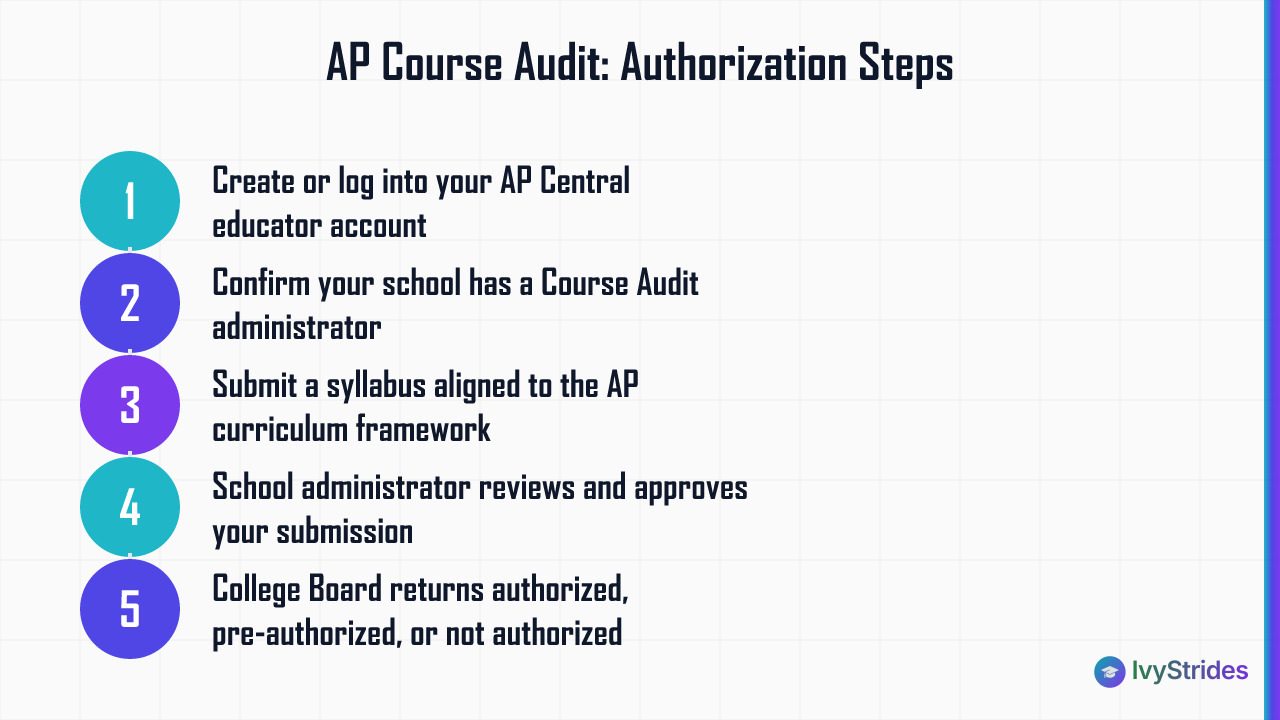
AP Course Audit is the syllabus-review process College Board uses to authorize a specific teacher, at a specific school, to teach a specific AP course. Only authorized courses may carry the "AP" designation on student transcripts. The process is not fast, but it is straightforward once you know the sequence.
Step 1: Create or log into your AP Central account. Go to apcentral.collegeboard.org and set up a professional educator profile. If you are moving schools or adding a subject, log in with your existing account rather than creating a new one.
Step 2: Confirm your school has an AP Course Audit administrator. Every school teaching AP needs an administrator (usually the principal, an assistant principal, or a department chair) enrolled in Course Audit at the school level. Without this, teacher submissions have nowhere to route.
Step 3: Submit a syllabus for the specific AP subject. You can write your own syllabus, use a College Board sample syllabus, or adopt a claim-based syllabus template. Whichever route you pick, the syllabus must show alignment with the current AP curriculum framework for that subject, including all required units, science practices or historical thinking skills, and required labs or texts where applicable.
Step 4: School administrator reviews and approves the submission. The administrator confirms the course is on your school's schedule and that you are the teacher of record.
Step 5: College Board reviews and returns a status. You will receive one of three: authorized (you can use the AP designation), pre-authorized (approved for new teachers whose school is offering the course for the first time), or not authorized (revise and resubmit). Turnaround is not instant. Submit well ahead of the school year.
Step 6: Renew when the framework updates. College Board periodically revises curriculum frameworks. When AP African American Studies was added to the official course lineup, or when AP Precalculus launched, syllabi under those subjects had to be built from scratch. When your subject's framework updates, resubmit.
Course Audit happens before your students register for the exam. Once the course is authorized and students are enrolled, exam registration follows a separate timeline through AP coordinators at your school. Our guide on AP exam dates and registration deadlines for students covers that side of the calendar.
AP Summer Institute and AP Workshops: Which Training Do AP Teachers Need?
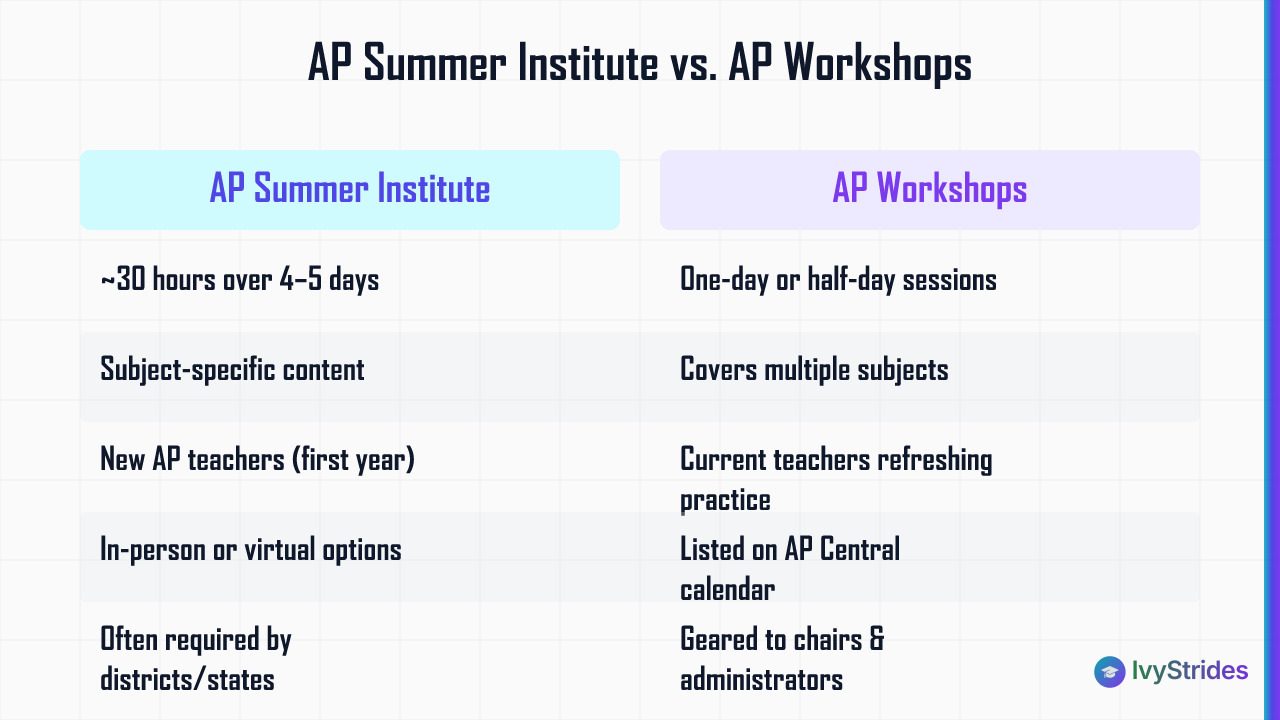
Course Audit authorizes the course. AP Summer Institute (APSI) authorizes you, in a practical sense, to teach it well. Two different things, and educators new to AP often conflate them.
An AP Summer Institute is a multi-day intensive training, typically running about 30 hours across four to five days, hosted by a College Board-endorsed provider at a university or independent school. The content is subject-specific. An APSI for AP Chemistry looks nothing like an APSI for AP English Literature; the former spends real time on required labs and the equation-based sections of the exam, the latter on close-reading practice and the free-response rubric. Both cover AP Classroom navigation and how College Board scores the exam.
AP workshops are the shorter cousin. These are one-day or half-day sessions covering multiple subjects, often geared to current AP teachers refreshing their practice, department chairs, or administrators. College Board International publishes workshop and institute schedules for teachers outside the United States.
Is APSI required? College Board strongly recommends APSI attendance before or during a teacher's first year teaching AP. It is not, as a rule, a universal College Board mandate for teaching the course. Many US school districts, most International Baccalaureate-adjacent independent schools, and a growing number of state education departments make APSI attendance a contractual or hiring condition. Check with your administrator before assuming it is optional.
The AP professional learning calendar on AP Central lists every upcoming APSI, workshop, and online module by subject, date, location, and format. Both in-person and virtual APSI options exist; virtual options expanded significantly after 2020 and remain a permanent part of the calendar. Experienced AP teachers can attend "experienced teacher" APSI tracks focused on advanced pedagogy, scoring calibration, and framework updates rather than introduction.
Cost varies. College Board does not charge a separate APSI fee beyond what the host institution sets, so a university-hosted AP Biology APSI in the US may be priced differently from a College Board International APSI in Singapore. Some districts fully fund it; others expect teacher self-funding with reimbursement. Ask this before you register, not after.
For students whose schools do not offer the AP subject they want, our AP courses online piece covers the options families should consider.
The College Board Counselor Summer Institute and Counselor Workshops in 2026
School counselors have their own professional development pathway, distinct from teacher APSI in both content and calendar. The College Board Counselor Summer Institute is a dedicated multi-day event focused on the counselor's role in the AP program: identifying student readiness, expanding equitable AP access, writing contextual college recommendations, and using AP data to advise families on credit and placement.
What counselors learn at these institutes is different from what teachers learn. Teacher APSI drills into curriculum, pacing, and exam scoring. Counselor institutes cover placement frameworks, data literacy inside AP Classroom aggregate reports, the AP Potential tool (which uses PSAT/NMSQT data to flag students who may succeed in specific AP courses), and how to write the Common App counselor recommendation in a way that reflects a student's course rigor against the school's actual offerings.
Shorter counselor workshops run through the school year and cover narrower topics. College Board International offers dedicated counselor training for international schools. Both US and international counselors register through the AP professional learning calendar on AP Central.
For 2026 registration, verify dates directly against AP Central before committing. In our observation, counselor institute seats fill earliest for the June and July sessions closest to major regional hubs. If you are new to the counselor role, prioritize the institute over a single workshop; the multi-day format gives you time to build the placement frameworks you will use every application cycle.
Across hundreds of college application cycles our essay coaches have supported, counselor recommendations that contextualize a student's AP course load against the school's actual offerings carry more weight with admissions readers than generic praise. That contextualization is exactly what the Counselor Summer Institute teaches.
Counselors also field the question we hear from every family: how many AP classes a student should take. The institute covers this question the way it deserves, which is with reference to the student's school, workload, and goals, not a generic number.
How School Counselors Support AP Students: Placement, Recommendations, and Equity
The counselor's role in AP is best understood as three connected tasks: guiding placement into the right courses, writing the contextual recommendation admissions officers read, and advising on credit and placement decisions once scores arrive.
Placement. Counselors use a combination of prior grades, teacher input, PSAT/NMSQT results (via AP Potential), and student conversation to guide AP course selection. AP Classroom aggregate score data, once students are enrolled, gives counselors a mid-year read on which students may need support or a course-load adjustment. The goal is not to gate-keep AP; it is to match rigor to readiness. Equitable AP access means counselors actively identify students from underrepresented backgrounds who have the readiness for AP but have not self-selected in. This is not aspirational language. It is a specific practice covered in Counselor Summer Institute sessions.
Common App recommendation. The Common App counselor recommendation is distinct from teacher recommendations. Teacher recommendations focus on classroom performance in a subject. The counselor recommendation gives admissions officers context on the whole student and, critically, on the school itself: what AP courses are offered, which the student took, whether the student's course selection reflects reasonable rigor for that school's offerings. A student at a school with 4 AP options who took 3 is a stronger candidate, contextually, than a student at a school with 25 APs who took 3. The counselor recommendation is where that context lives.
Credit and placement advising. Once AP scores arrive in July, counselors help families translate scores into decisions. The caveat matters here: AP credit policies vary by college and are updated annually. A 3 in AP Psychology earns credit at some universities and not others. A 4 in AP Calculus BC may earn credit for two semesters of college calculus at one school and one semester at another. Counselors should direct students to each college's current AP credit chart rather than relying on old information.
Once your students are enrolled in an authorized AP course, the next logistical step is exam registration; our guide on AP exam registration deadlines and fees covers deadlines, fees, and the step-by-step sign-up process. For the student side, our AP exam prep by subject guide gives students a concrete study plan for every major AP, which counselors can share as a resource during advising sessions. Parents asking how many AP classes students should take each year will find a data-backed answer in our parent's guide to AP classes, which complements the placement guidance counselors provide.
Counselors advising students on a full testing timeline will also find our integrated guide on building a full AP, SAT, and ACT testing plan useful for mapping out a grade-by-grade strategy. A student's AP course load, SAT or ACT test dates, and application timeline are one system, not three.
One caveat worth naming clearly: a strong counselor recommendation matters, and equitable AP placement matters, but admissions decisions depend on the full application. The recommendation is one document among many.
AP Classroom Tools Every AP Teacher and Counselor Should Know
AP Classroom is the digital platform at myap.collegeboard.org that authorized AP teachers and enrolled students use throughout the year. Access is free once Course Audit authorization is in place. Here is what each feature actually does.
Progress checks. After each unit of the curriculum framework, teachers assign a progress check consisting of multiple-choice and free-response questions drawn from the same item bank College Board uses for the actual AP exam. Results feed a dashboard showing class-level and student-level performance by skill and by unit. This is the single most useful diagnostic tool inside AP Classroom.
Unit guides. These map the curriculum framework to teachable units, with suggested pacing, essential knowledge statements, and skill focus per unit. New AP teachers should print these and pace against them.
AP Daily videos. Short instructional videos aligned to each unit, taught by experienced AP teachers. Useful for absent students, for review before unit tests, and for flipped-classroom setups.
Practice exam questions and the practice exam. In the spring, College Board releases a full practice exam through AP Classroom for teachers to administer as a mock. Combined with the item-bank practice questions available all year, this is how most AP teachers structure their April review.
Counselor access. School-level counselors and administrators can view aggregate AP Classroom data across the school, including course-wide readiness by unit. This is what powers mid-year placement conversations and equity audits.
For students whose schools do not offer the AP subject they want, or who need subject-specialist instruction beyond what their school provides, our online AP courses for students who need subject-specialist instruction pair students with per-AP-subject specialists rather than generalist tutors, for the full course or targeted exam prep.
In our coaching with international AP students, the most common gap is not the platform but the authorization: the student's school has not completed AP Course Audit, meaning their AP coursework does not carry the official College Board designation on the transcript that US admissions offices read. If your school teaches AP subjects but has never gone through Course Audit, that is the first fix, not the last.
FAQ: AP for Teachers and Counselors
What does AP stand for in education?
AP stands for Advanced Placement. It is a College Board program that offers college-level courses and exams to high school students across 38 subjects. Scores of 3, 4, or 5 may earn college credit or advanced placement at participating universities, though each institution sets its own policy and updates it annually.
What does AP mean for teachers?
For a teacher, AP means delivering a College Board-authorized course that follows the official curriculum framework for one specific subject. That requires Course Audit approval of a syllabus, use of AP Classroom during the year, and (in most districts) attendance at an AP Summer Institute before or during the first year of teaching the subject.
What is an AP teacher?
Someone whose Course Audit submission for a specific AP subject at a specific school has been approved by College Board. That approval, plus subject expertise and the classroom work of covering the curriculum framework, is what defines the role. There is no separate AP teaching credential.
Is AP Summer Institute attendance required to teach AP?
College Board recommends it strongly, but does not universally mandate it. Where APSI becomes a requirement is at the district or state level: many US districts and independent schools include it in hiring or contract terms. Confirm with your administrator, and check the AP professional learning calendar on AP Central for available 2026 sessions.
How do counselors guide students into the right AP courses?
By combining prior grades, teacher input, PSAT/NMSQT data through the AP Potential tool, and direct conversation with the student. Equity is part of the frame: counselors trained through the Counselor Summer Institute actively look for students from underrepresented backgrounds who show readiness but have not self-selected into AP.
How does a counselor's Common App recommendation differ from a teacher's?
A teacher recommendation speaks to performance inside one classroom. The counselor recommendation speaks to the student's overall profile and, critically, the school context: which AP courses were offered, how many the student took, and whether that selection reflects reasonable rigor. Both live in different sections of the Common App recommender system at commonapp.org.
Why do teachers make AP classes seem so difficult?
Because the courses are designed to match introductory college rigor, and setting that expectation up front tends to produce better outcomes. In our coaching, students who arrive with a realistic picture of the workload manage their year more effectively than those who assumed AP was a heavier high school class.
How can a student convince a counselor to approve an AP course?
Bring evidence: strong grades in the prerequisite course, a teacher recommendation, and a clear reason the subject fits your goals. A plausible plan for managing the workload alongside other commitments matters as much as raw metrics. Our post on whether AP tutoring is worth the cost for students and our guide on how to study for AP exams effectively both help students build that plan.
Where This Leaves You
For a teacher new to AP, the sequence is: create an AP Central account, confirm your school administrator is enrolled in Course Audit, submit a syllabus for your subject, and register for a 2026 APSI on the AP professional learning calendar. For a counselor, the sequence is: register for the College Board Counselor Summer Institute or a counselor workshop, learn the AP Potential and AP Classroom data tools, and build a placement and recommendation practice that reflects your school's actual offerings.
The student-side work sits on top of that infrastructure. You can meet the tutors who work with AP students by subject. To see how AP prep, SAT/ACT prep, and college essays connect into one strategy, read about our coaching approach.

Award-winning author (South Asian Book Award) and graduate of BITS Pilani and UCLA Luskin School of Public Affairs. Brings a published writer's eye to Common App essays and grammatical precision to SAT and ACT R&W instruction.