
AP Exam Dates 2026: Complete Schedule, Make-Ups, and Registration Deadlines

On this page
- Quick Answer: When Are the 2026 AP Exams?
- 2026 AP Exam Schedule by Subject: Week-by-Week Breakdown
- What Happens If You Miss Your AP Exam: Late Testing Explained
- Registration Deadlines and Key Dates Before May 2026
- How to Build Your AP Prep Plan Around Your Exam Date
- What Your AP Score Means for College Credit and Admissions
- How Often AP Exams Are Offered and What That Means for Your Timeline
- FAQ
- What date are the 2026 AP exams?
- Do AP exams take place on the same date everywhere, including internationally?
- Is it necessary to take AP exams in a specific order?
- Does a score of 70 percent on an AP exam equal a 5?
- Will colleges see which AP exams I dropped or did not take?
- Can I take an AP exam if I am an IGCSE or A-level student without an AP course?
- How many times can I take an AP exam?
- Your Plan Starts With Your Exam Date
The 2026 AP exams run May 4-8 (Week 1) and May 11-15 (Week 2). Every subject has a fixed date and a fixed morning (8 a.m. local) or afternoon (12 p.m. local) start time set by the College Board. Students can't pick an alternate day inside the standard window. A separate late testing window runs the following week for students with a documented conflict, illness, or school closure, and it requires AP coordinator approval. Registration runs through your school's AP coordinator, with ordering deadlines that hit months before May.
Every date in this article traces back to the College Board's official AP schedule at apstudents.collegeboard.org and coordinator deadlines at apcentral.collegeboard.org. The harder question is how many weeks of focused prep you actually have left, and what to do if two of your exams collide. The rest of this article walks through both.
Quick Answer: When Are the 2026 AP Exams?
AP exams are administered once per year, in May, over a two-week window. For 2026, that window is May 4 through May 8 and May 11 through May 15. There is no fall sitting, no winter sitting, no June retake. Miss your exam and fail to qualify for late testing, and the next opportunity is May 2027.
Start times are set by the College Board, not by the student or the school. Each subject is administered either in the morning administration (8 a.m. local school time) or the afternoon administration (12 p.m. local school time). Your AP coordinator confirms the exact report time, usually 30-45 minutes before the start time.
International students take the same exam on the same day. A student in Singapore, London, or São Paulo sits the AP Calculus AB exam on the same date as a student in Boston. Verify your subject's date directly at apstudents.collegeboard.org.
2026 AP Exam Schedule by Subject: Week-by-Week Breakdown
Below is the subject-by-subject breakdown for the high-volume AP exams students search for most. Times reflect the College Board's morning administration (8 a.m. local) and afternoon administration (12 p.m. local).
Week 1: May 4-8, 2026
| Date | Morning (8 a.m.) | Afternoon (12 p.m.) |
| Mon, May 4 | AP Chemistry | AP Government and Politics |
| Tue, May 5 | AP Statistics | AP Government (Comparative) |
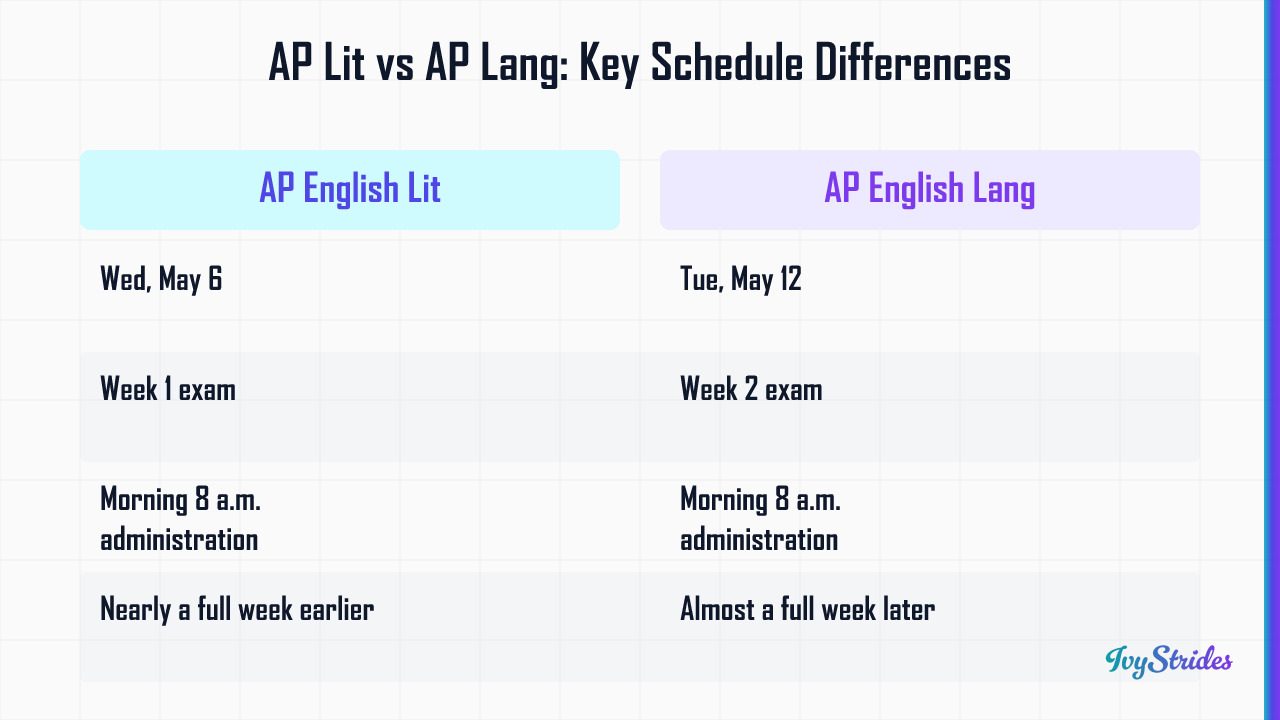
| Wed, May 6 | AP English Literature (AP Lit) | AP Computer Science A |
| Thu, May 7 | AP Chinese Language; AP Environmental Science | AP Psychology |
| Fri, May 8 | AP US History (APUSH) | AP Art History |
Week 2: May 11-15, 2026
| Date | Morning (8 a.m.) | Afternoon (12 p.m.) |
| Mon, May 11 | AP Calculus AB; AP Calculus BC | AP Music Theory; AP Seminar |
| Tue, May 12 | AP English Language (AP Lang) | AP Physics 2; AP Physics C: Mechanics |
| Wed, May 13 | AP Biology | AP Physics C: Electricity and Magnetism |
| Thu, May 14 | AP World History | AP Macroeconomics |
| Fri, May 15 | AP Spanish Language; AP Microeconomics | AP CS Principles; AP Physics 1 |
The College Board publishes the official subject grid at apstudents.collegeboard.org and may adjust order within a week. Confirm with your AP coordinator before locking your prep calendar.
A few things worth flagging from that table. AP Calculus AB and BC fall on the same morning, May 11. AP Lang lands May 12; AP Lit lands May 6, almost a full week earlier. A junior taking AP Lang in the morning and AP Physics 2 in the afternoon on May 12 is sitting two exams in a single day, which is grueling but workable with the right pacing plan.
Students targeting a 5 on Calculus AB or BC can pair the date schedule with a subject-specific coaching plan; see our 12-week guide on how to get a 5 on AP Calculus for a week-by-week breakdown. If you're choosing a class for next year, our ap courses online page lists per-subject specialists. Students sitting AP Chemistry can use our AP Chemistry prep page. For computer science, the AP CS Principles walkthrough covers that exam.
What Happens If You Miss Your AP Exam: Late Testing Explained
Miss your scheduled exam and you don't automatically lose the year. The College Board runs a late testing window the week after the standard administration, with separate exam forms. Late testing typically falls in the third week of May for Week 1 exams and the fourth week of May for Week 2 exams. Your AP coordinator has the exact dates from apcentral.collegeboard.org.
Late testing isn't a free retake. To qualify, you need a documented reason: illness with a doctor's note, a family emergency with documentation, a school closure, a religious observance, or a same-day conflict with another AP exam. Your AP coordinator submits the request to the College Board on your behalf. Oversleeping doesn't qualify.
What about same-day conflicts? They happen. A student taking AP Physics 1 and AP CS Principles on May 15 has both exams scheduled, well, on May 15. The College Board's conflict resolution process moves one of those exams to the late testing window automatically. Your AP coordinator initiates the request, usually as soon as exam orders are submitted in the fall. Don't wait until April to flag this.
Two more cases come up often:
- Different school sitting: if you're traveling or have moved mid-year, you can sit your AP exam at a different school that's willing to host you as an outside candidate. Contact your home school's coordinator and the host school early; arrangements take weeks.
- International students without an AP course: students at IGCSE, A-level, IB, or other non-US curricula can register as exam-only candidates at a school that hosts outside testers. The College Board's international AP coordinator search helps locate a host.
Honestly, in our coaching with students taking three or more AP exams in the same week, the single biggest mistake we see isn't underprepared content knowledge. It's failing to flag a same-day conflict to the coordinator in the fall. By March, the slot is locked. By April, you're stressed.
Still deciding where to take an AP class online? Our checklist for how to choose an online AP course provider walks through the seven criteria that separate strong programs from generic ones.
Registration Deadlines and Key Dates Before May 2026
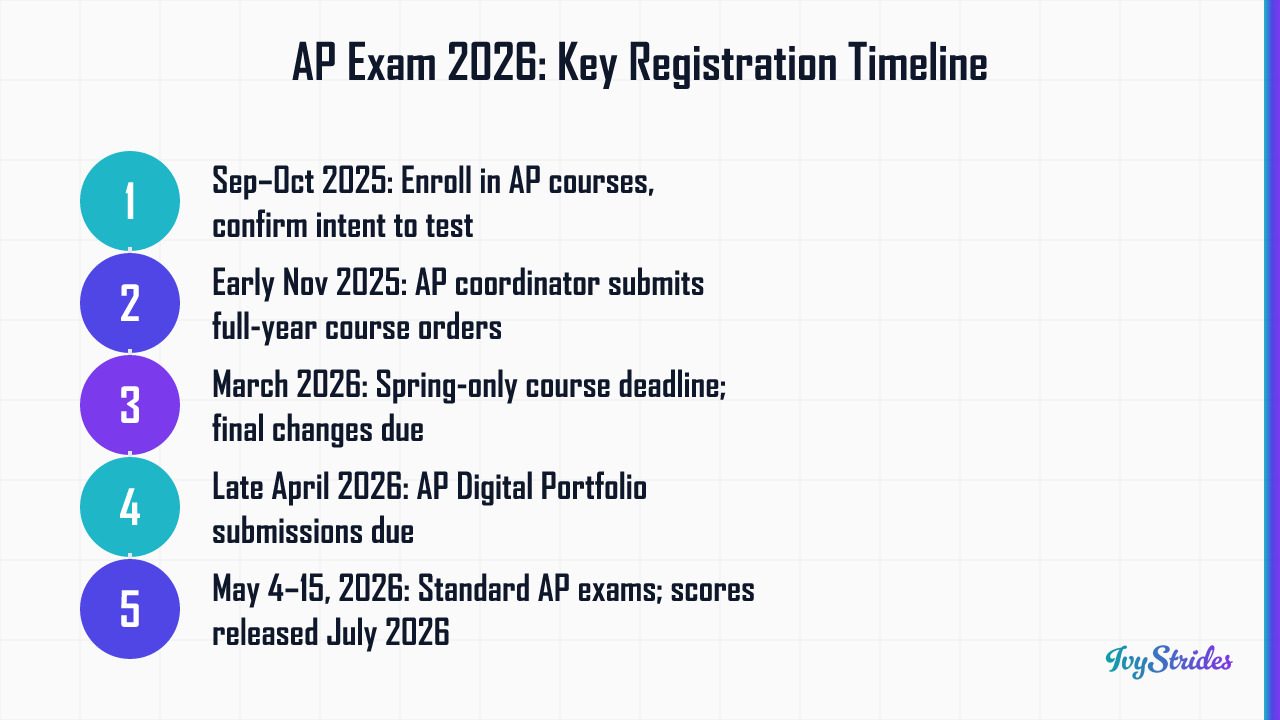
The deadline that actually matters happens in November, not April. AP coordinators submit exam orders to the College Board by the November ordering deadline for full-year courses. Spring-only courses have a March deadline. Miss November and your school pays a late order fee, typically $40 per exam, with no guarantee of availability.
Here's the rough timeline working backward from May 2026:
- September-October 2025: enroll in AP courses; confirm intent to test with your school's AP coordinator.
- Early November 2025: AP coordinator ordering deadline for full-year courses.
- March 2026: ordering deadline for spring-only AP courses; final deadline for any changes (cancellations, additions).
- Late April 2026: AP Digital Portfolio submissions due for AP Art and Design, AP Research, and AP Seminar performance tasks. These deadlines differ from the May written exam dates and are non-negotiable.
- May 4-15, 2026: standard exam administration.
- Mid-to-late May 2026: late testing window.
- July 2026: AP scores released.
The full school-year timeline lives at apcentral.collegeboard.org/about-ap/school-year-timeline. Deadlines vary slightly by school and district, so always confirm with your AP coordinator.
Students balancing AP exams with ACT prep should cross-reference the ACT test dates 2026 schedule to avoid overlap in peak study weeks. The April 2026 ACT and the May AP window create a brutal four-week stretch if you don't sequence them deliberately.
How to Build Your AP Prep Plan Around Your Exam Date

Photo by www.kaboompics.com on Pexels
Open a calendar. Find your exam date. Count the weeks back from that date to today. That number is the single most important variable in your prep plan.
A structured AP prep arc looks like this:
- 12-10 weeks out: take a full-length diagnostic practice exam under timed conditions. Score it honestly. Identify the two or three units where you're furthest from a 5.
- 10-4 weeks out: targeted weakness work, unit by unit. For AP Calculus AB, this often means Unit 5: Analytical Applications of Differentiation and Unit 6: Integration. For AP Lang, it's usually Unit 3: Rhetorical Situation and the synthesis essay. For APUSH, it's the DBQ rubric and Periods 4-6.
- 4-2 weeks out: spaced retesting. Take a second full-length exam. Compare scored sections to the diagnostic. Drill any unit still below target.
- Final 2 weeks: full-length practice under exam conditions, free-response section timing drills, and rest. Cramming new content this late rarely moves the score.
Starting with fewer than 6 weeks to go? The plan compresses. You skip the broad content review and go straight to high-yield units identified by the diagnostic. For AP Stats, that often means inference (Units 6-9). For AP Chemistry, it's equilibrium and thermodynamics (Units 7-9).
Here's the part most students miss. In our coaching with students taking three or more APs in the same week, we prioritize the subject where the diagnostic score is furthest from the target, not the subject with the earliest exam date. A student sitting at a 2 on AP Chem and a 4 on AP Lang doesn't need more Lang time. She needs Chem.
If you're still building content knowledge before your May exam, IvyStrides' AP courses online pair per-subject specialists with a structured weekly schedule timed to the exam date. See our best online ap courses page for how per-subject specialist coaching works. Students sitting physics this May can review our AP Physics 1 prep page for unit-by-unit coverage. The AP Physics 2 track has its own AP Physics 2 prep walkthrough.
What Your AP Score Means for College Credit and Admissions
AP exams are scored on a 1-5 scale. A score of 3 is "qualified," 4 is "well qualified," 5 is "extremely well qualified." Many colleges grant credit for a score of 3; more selective colleges require a 4 or 5, and a handful of the most selective schools don't grant AP credit at all (they may grant placement or advanced standing without course credit).
Here's the question that comes up constantly: does 70% on an AP exam equal a 5? Not necessarily. There's no fixed percentage. The College Board uses an annual score-setting process that adjusts the raw-to-scaled conversion based on that year's exam difficulty. On some subjects, roughly 65-75% of available points lands in the 5 range. On others, the cutoff sits higher or lower. Treat any "70% = 5" rule as folklore, not a target. Aim for mastery.
AP credit policies vary by college and by subject. Stanford may grant credit for a 5 on AP Calculus BC but not for a 5 on AP Psychology. The University of California system publishes a different credit chart than Texas A&M. Check each school's AP credit policy directly before counting on credit.
What about the admissions side? AP scores are one signal in a holistic application. Strong AP scores (4s and 5s) signal college-level rigor; weaker scores in courses you took are usually neutral, not negative. A score sent voluntarily is more useful than one withheld, in most cases. Test-optional policies for the SAT and ACT vary by school and year. If you're navigating that question, our post on do colleges require SAT in 2026 covers the current landscape.
One more nuance students ask about: do colleges see which AP exams I registered for but didn't take? The College Board does not report registered-but-not-sat exams to colleges. However, your high school transcript reflects which AP courses you enrolled in. If your transcript shows "AP Biology" and no AP Bio score appears on your application, an admissions reader may notice. Talk to your school counselor before withdrawing from an exam.
How Often AP Exams Are Offered and What That Means for Your Timeline
Once a year. In May. That's it.
There is no fall AP administration, no January retake, no summer makeup outside the standard late testing window. Score a 2 on AP Chemistry in May 2026 and want a higher score on your application? The next opportunity is May 2027. AP exam dates 2027 will follow the same two-week May structure; exact dates will be published by the College Board in advance and should be verified at apstudents.collegeboard.org.
This matters most for seniors. A senior taking AP exams in May 2026 will receive scores in July 2026, after most college decisions have been made and after deposits are paid. AP scores for seniors function primarily as college credit signals, not admissions signals. For juniors, AP scores released in July 2026 can be self-reported on applications submitted in fall 2026, where they do function as admissions signals.
In our coaching, students who treat their May exam as a one-attempt window invest more consistently in weekly prep. The students who treat it as "I'll see how it goes" almost always wish they'd started earlier. There is no second chance in October. Plan accordingly.
Students prepping for BC can dig into our AP Calculus BC prep page for subject-specific guidance. The AB track gets its own coverage at AP Calculus AB prep.
FAQ
What date are the 2026 AP exams?
The 2026 AP exams run May 4-8 (Week 1) and May 11-15 (Week 2). Each subject has a fixed date and a fixed morning (8 a.m. local) or afternoon (12 p.m. local) start time. Students can't choose an alternate day within the standard window. Confirm your subject's exact date at apstudents.collegeboard.org.
Do AP exams take place on the same date everywhere, including internationally?
Yes. The College Board administers AP exams on the same fixed dates worldwide. A student in Tokyo sits AP Calculus AB on the same day as a student in Chicago. International students should confirm their testing site, local report time, and any time-zone-specific arrangements with their school's AP coordinator well in advance.
Is it necessary to take AP exams in a specific order?
No. There is no required sequence. You take whichever APs you're enrolled in, on the dates the College Board assigns. If two exams fall at the same time, the College Board's conflict resolution process moves one to the late testing window. Contact your AP coordinator as soon as you spot the conflict, ideally in the fall.
Does a score of 70 percent on an AP exam equal a 5?
No fixed percentage guarantees a 5. The AP 1-5 score scale is set each year through a score-setting process that accounts for that year's exam difficulty. On some exams, roughly 65-75% of available points lands in the 5 range, but this varies by subject and year. The College Board publishes annual score distributions at apstudents.collegeboard.org.
Will colleges see which AP exams I dropped or did not take?
The College Board does not report to colleges which AP exams you registered for but chose not to sit. However, your high school transcript shows which AP courses you enrolled in, so an AP course on your transcript with no corresponding score may prompt a question from admissions readers. Talk to your school counselor before withdrawing from an exam.
Can I take an AP exam if I am an IGCSE or A-level student without an AP course?
Yes. Students not enrolled in an AP course at a US high school can sit AP exams as exam-only candidates. You'll need to find a school that hosts outside testers, which is usually arranged through the College Board's international AP coordinator search. Start early; arrangements often take several weeks and not every school accepts outside candidates.
How many times can I take an AP exam?
You can take an AP exam as many times as you wish, once per year in May. There's no College Board limit on retakes. All scores are reported to colleges by default, but you can use the score cancellation or score withholding options if you want to suppress a specific year. Retaking means waiting until the following May.
Your Plan Starts With Your Exam Date
You now know when your AP exams fall, what to do if you miss one, and roughly how many weeks of focused prep you have left. The next step is honest: take a diagnostic practice exam this week and find out where you actually stand. That number, more than any study schedule on paper, tells you what your May looks like.
Article last reviewed November 2025. AP exam dates and policies should be verified annually at apstudents.collegeboard.org as the College Board may adjust the schedule.

Two decades teaching quantitative and verbal aptitude on standardized tests. Rare dual expertise across Math and Verbal — particularly effective for students with gaps on both sides. Senior AP Mentor for our Calculus and English tracks.