
Should I Pay for AP Tutoring? The Straight Answer for 2026 (and What to Do Next)
On this page
- The Straight Answer: When Paying for AP Tutoring Is Worth It (and When It Is Not)
- Which AP Subjects Benefit Most from a Specialist Tutor in 2026
- The Real Reason Your AP Class Grade Does Not Predict Your Exam Score
- How Much Does AP Tutoring Cost in 2026? A Realistic Price Breakdown
- What AP Tutoring Actually Looks Like When It Works
- Is Paying for an AP Tutor Worth It Compared to Self-Study or AI Tools?
- Does a Strong AP Score Actually Help Your College Application?
- How to Decide: A 5-Question Checklist Before You Pay for AP Tutoring
- FAQ: AP Tutoring Costs and Scores in 2026
- What is a reasonable price for AP tutoring per hour?
- Is 1 hour of AP tutoring per week enough?
- Is AI replacing AP tutors?
- Does AP tutoring look good on a college application?
- Where can I find AP tutoring online?
- How much does AP tutoring cost per month?
- What is the average cost of an AP prep course?
- Should I pay for AP tutoring if my school already offers AP classes?
Paying for AP tutoring is worth it when your current class grade doesn't reflect your exam readiness, when you're targeting a 4 or 5 in a high-difficulty subject like AP Calculus BC, AP Chemistry, or AP Physics C, or when the May exam is roughly 8 to 12 weeks away and self-study has stalled. Private AP tutoring typically costs $50 to $175 per hour in 2026. For students on track in class with strong study habits, official College Board AP materials and a structured self-study plan are often enough.
The harder question is which of those situations is actually yours. The rest of this article turns the answer into a decision you can act on: which subjects justify a specialist, what tutoring really costs, how to vet a tutor before spending, and how a strong AP score interacts with the rest of your application. Want the fast route? Jump to the 5-question checklist near the end.
The Straight Answer: When Paying for AP Tutoring Is Worth It (and When It Is Not)
AP tutoring is worth paying for in three specific situations. First, you're targeting a 4 or 5 in a high-difficulty subject: AP Calculus BC, AP Chemistry, AP Physics C, or AP Biology. Second, your practice exam score sits two or more points below your target with 12 or fewer weeks until the May exam window. Third, your AP class grade and your practice exam score disagree, which means the class isn't preparing you for how the exam actually tests.
Paid tutoring is often unnecessary if you're earning an A in a lower-difficulty subject like AP Human Geography or AP Psychology, you have 12 or more weeks of runway, and you're already working through official College Board practice materials without hitting a wall.
Here's a simple self-diagnostic. Answer honestly.
| Signal | Yes = tutor helps |
| High-difficulty subject (Calc BC, Chem, Physics C, Bio) | ✓ |
| Practice exam score is 2+ points below target | ✓ |
| Under 12 weeks to May exam | ✓ |
| Class grade doesn't match practice exam score | ✓ |
| College target requires a 4 or 5 for credit | ✓ |
Three or more checks, and paid tutoring tends to pay for itself. One or fewer, and a structured self-study plan is your starting point. Still unsure whether AP tutoring is it worth it for your case? Keep reading. The subject-by-subject breakdown below usually settles it.
AP exams score on a 1 to 5 scale, and the AP exam fee is $99 per exam in the 2026 cycle per College Board AP Program. Verify that figure against current documentation before the May window, since fees update annually.
Which AP Subjects Benefit Most from a Specialist Tutor in 2026
The subject you're taking predicts tutoring ROI more than any other factor. Not every AP exam warrants a paid specialist.
High-difficulty subjects share three traits: calculus-based or lab-based content, dense free-response sections with strict rubrics, and a persistent gap between class instruction and exam demands. Lower-difficulty subjects lean on content recall and structured reading, which a motivated self-studier can build with official materials.
| AP Subject | Tutoring Need | Why |
| AP Calculus BC | High | Unit 6 integration techniques and Unit 10 series convergence require calculus fluency many students don't build in class alone |
| AP Chemistry | High | Unit 4 reactions and Unit 9 electrochemistry carry rubric-heavy free-response sections |
| AP Physics C (Mech and E&M) | High | Calculus-based problem-solving under time pressure |
| AP Biology | Medium-High | Free-response data analysis is where scores drop |
| AP English Language | Medium | Synthesis and argument essays are rubric-driven and coachable |
| AP US / World / Euro History | Medium | Document-based questions reward pattern practice |
| AP Statistics | Medium-Low | Self-study viable with official practice |
| AP Human Geography | Low | Content-recall driven; self-study to a 4 or 5 is common |
| AP Psychology | Low | Vocabulary and framework recall |
| AP Environmental Science | Low | Structured content, self-study viable |
In our coaching, AP Chemistry and AP Physics C consistently show the largest gap between class grade and practice exam score. A student can earn a B+ in AP Chemistry all year and still score a 2 on a diagnostic practice exam, because the exam tests application of reaction types and electrochemistry rubrics that class quizzes rarely mirror.
For high-difficulty math and science, a subject-specialist tutor is the right investment. Our per-subject pages for AP Calculus BC prep and AP Chemistry show what per-AP-subject specialist instruction looks like.
For lower-difficulty subjects, start with our guide on how to self-study AP Statistics, Human Geography, or Environmental Science for a 5 before spending a dollar on tutoring.
The Real Reason Your AP Class Grade Does Not Predict Your Exam Score
Photo by RDNE Stock project on Pexels
Your AP class grade measures homework completion, unit tests, lab reports, and participation. The AP exam measures something narrower and harder: your ability to apply the AP curriculum framework under timed conditions against a scoring rubric written by College Board AP Program scorers.
That's why a student earning a B in AP Chemistry can score a 2 on the May exam. The class rewards effort across a semester. The exam rewards precision on Unit 4 reaction types and Unit 9 electrochemistry free-response answers, scored against a rubric that awards partial credit for specific verbs and specific quantitative reasoning.
The gap has three sources.
Rubric literacy. Trained readers score the free-response section point by point. A student who writes a correct answer in the wrong structure often loses two or three available points. Class teachers rarely grade to the AP rubric, so students don't learn what full credit looks like until they see their diagnostic score.
Pacing. The multiple-choice section gives roughly one minute per question. Most students who struggle on the exam didn't struggle on content; they ran out of time on roughly the last 10 to 15 questions.
Point distribution. Every AP exam has two or three units carrying outsized point weight, and College Board publishes the weighting for each one in the course and exam description. In AP Calculus BC, integration techniques and series convergence are the two that most often separate a 4 from a 5 in our coaching. A student who's shaky on those units can't score a 5, no matter how strong the rest of the course.
A diagnostic-driven first session surfaces these gaps directly. The tutor gives you a timed AP practice section, categorizes errors by unit and question type, and builds a study plan that attacks the highest-yield weaknesses first. Generic tutoring follows your class syllabus. A diagnostic-driven plan follows the exam's point distribution.
In our coaching, students who start roughly 10 to 12 weeks before the May exam with a diagnostic practice test consistently identify two to three high-yield weakness areas that account for the majority of their lost points. Fixing those first is why targeted weakness work moves a score faster than more class review.
Want structured full-curriculum instruction, not just exam-focused sessions? Our AP classes online pair a per-subject specialist with a diagnostic plan built around your May exam target. If you're weighing a full course, our guide on whether online AP courses count for college credit is a useful next read.
How Much Does AP Tutoring Cost in 2026? A Realistic Price Breakdown
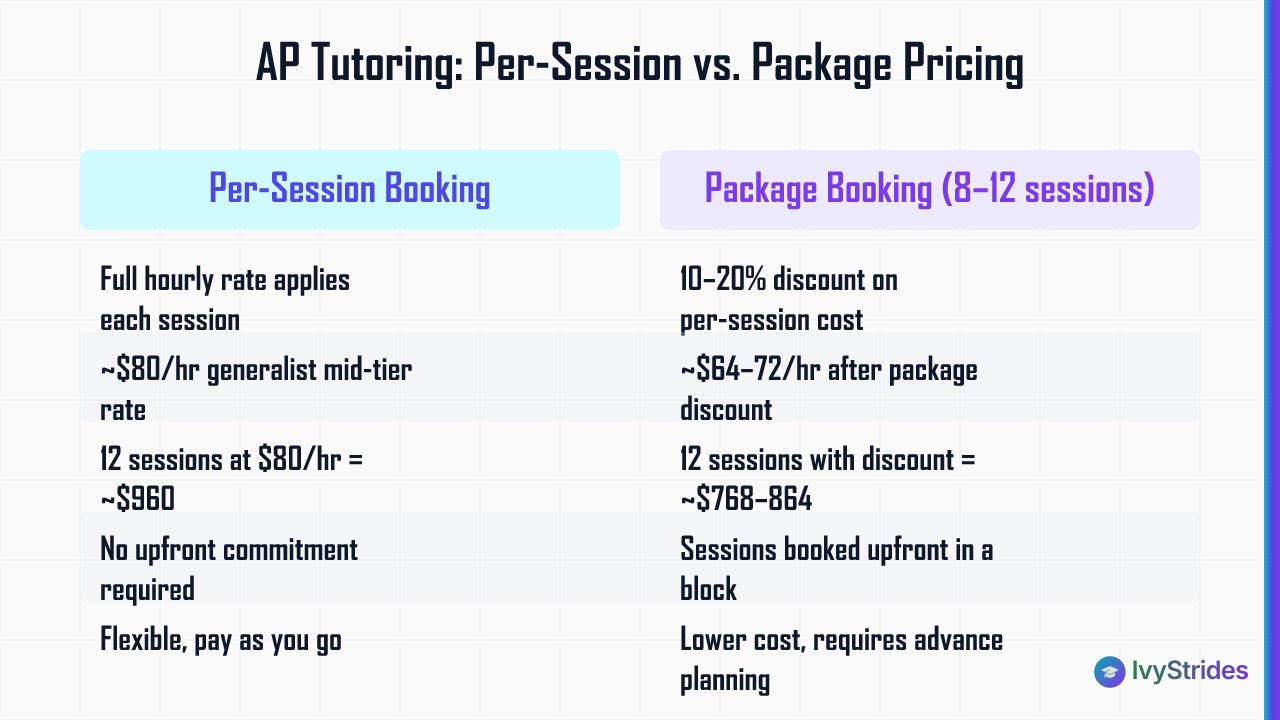
AP tutoring online in 2026 runs roughly $50 to $175 per hour, depending on subject difficulty, tutor credentials, and whether you book per session or in a package. Here's how the range breaks down.
| Tutor Type | Typical Hourly Rate | Best For |
| Generalist online tutor | Around $50 to $80 | Homework help, lower-difficulty AP subjects |
| Subject-specialist (mid-tier) | $80 to $120 | Most AP subjects, students in the 3-to-4 score band |
| AP subject-specialist (senior) | $120 to $175+ | Calculus BC, Physics C, Chemistry, top score band work |
Online AP tutoring runs roughly $10 to $30 per hour less than comparable in-person rates because it drops travel overhead and gives tutors a wider student pool. Online also matters for access: a student in a smaller city, or an international student, often can't find an AP Physics C specialist locally, and online delivery removes geography as a constraint.
Package pricing, meaning blocks of 8 to 12 sessions booked upfront, typically cuts per-session cost by about 10 to 20 percent versus per-session booking.
A realistic total-cost example. A 12-session AP engagement at $80 per hour runs about $960. Compare that to a potential $3,000 to $5,000 in college tuition savings if your target school awards credit for a 4 or 5. The standard AP exam fee is $99 per exam in the 2026 cycle per College Board AP Program, so tutoring that moves you from a 2 to a 4 can pay for itself many times over if your target college awards credit at a score of 4 or higher.
A Texas note. Texas state law requires school districts to provide tutoring for students who didn't meet grade-level standards on state assessments. That mandate covers K-12 class remediation, not AP exam prep. Families in Texas seeking AP exam-focused tutoring engage private providers, and regional pricing tracks the national range above.
For a full breakdown of AP-related family expenses beyond tutoring, see how much does AP cost for families. If you're preparing for a lab-heavy subject, our AP Physics 2 prep page shows how session pricing lays out for that specific exam.
What AP Tutoring Actually Looks Like When It Works
Effective AP tutoring looks nothing like the homework-help sessions many families picture. Here's the structure that produces score gains.
Session zero: the diagnostic. Before your first working session, you take a timed AP practice section, usually one multiple-choice section or one free-response set rather than the whole exam. The tutor scores it against the official rubric, categorizes every missed point by unit and question type, and builds a written plan ranking your weaknesses by point value on the actual exam.
Every working session then runs three blocks:
-
20 minutes reviewing errors from the prior week's timed practice, focused on why the error happened: content gap, rubric misread, or pacing.
-
25 minutes on the highest-yield concept gap from the diagnostic. For an AP Calculus BC student, that might be integration by parts (Unit 6) or the ratio test for series convergence (Unit 10).
-
15 minutes of timed practice on that concept type, so the fix gets tested under exam conditions the same day.
Between sessions, spaced retesting. A good tutor doesn't teach a concept once and move on. They re-test the same concept two or three weeks later to confirm retention, and concepts that fade go back into the rotation.
The specialist question matters. A subject-specialist AP tutor has taught or scored the specific AP exam you're taking. A generalist tutor covers multiple subjects and often doesn't know the current College Board AP rubric for your subject well enough to score your free-response answers accurately. That's the single biggest quality gap in the market.
Before you hire anyone, ask five questions:
-
Have you taught or tutored this specific AP subject, not just the general subject area?
-
Do you start with a diagnostic practice section?
-
How do you track progress between sessions?
-
What is your typical score gain for students at my current level?
-
Do you score my free-response answers against the current AP rubric?
Any tutor who can't answer all five clearly isn't the right fit. To see how our per-AP-subject specialist model is structured, browse our best online AP courses. If you're weighing a full course versus session-based tutoring, read can you take AP classes online.
Is Paying for an AP Tutor Worth It Compared to Self-Study or AI Tools?
Three paths exist for AP prep: self-study with official materials, AI tutoring tools, and a human specialist. Each fits a different student profile.
Self-study is viable when:
- You're earning an A in the AP class.
- You have 12 or more weeks before the May exam.
- Your target is a 3 or 4 in a lower-difficulty subject (AP Human Geography, AP Psychology, AP Environmental Science, AP Statistics).
- You're disciplined enough to work through official College Board practice materials without a set schedule.
AI tools work as a supplement. An AP exam tutor AI can generate extra practice problems on demand, explain a concept a second or third way, and quiz you on vocabulary. What AI can't do, as of 2026, is score your AP free-response answer against the official rubric with the nuance a trained scorer applies. That gap shows up most on AP English Language synthesis essays, AP History document-based questions, and any AP science free-response with a specific quantitative rubric. In our coaching observations, AI also doesn't replicate the error-pattern diagnosis a specialist provides after reviewing your timed practice section.
A human specialist is most valuable when:
- You're in the 2-to-3 or 3-to-5 score band in a high-difficulty subject.
- Your free-response scores run meaningfully lower than your multiple-choice scores.
- You have roughly 6 to 10 weeks to the exam and a two-point gap to close.
- You've tried self-study and hit a wall.
The honest recommendation: use AI for extra practice reps and concept review, use official College Board materials for authoritative content, and hire a specialist when the diagnostic tells you the gap is too large to close alone. Our guide on online AP for homeschoolers covers the full self-study-plus-support stack. And AP CS Principles prep is a good example of a subject where structured coursework often outperforms pure self-study.
Does a Strong AP Score Actually Help Your College Application?
Yes, and in two distinct ways that matter for how you decide about tutoring.
AP scores as an admissions signal. A score of 4 or 5 on a rigorous AP exam, like Calculus BC, Chemistry, Physics C, or English Literature, signals subject-area readiness to admissions readers. Even at test-optional schools, a strong AP score signals academic readiness in a way that a withheld SAT score cannot, which is worth factoring into your decision about where to invest prep time. See FairTest for current test-optional policy context.
AP scores as a connected strategy. AP scores don't exist in isolation. A 5 on AP Calculus BC alongside a strong SAT Math score tells an admissions reader a consistent story about quantitative ability, which is why IvyStrides treats test prep and AP prep as one connected strategy. Students preparing for the SAT or ACT alongside AP exams often find that coordinating both timelines with one coaching team prevents schedule conflicts and reinforces overlapping content, particularly in math and evidence-based reading. Our ACT vs SAT breakdown covers the test-selection side of that strategy.
AP scores as college credit. Credit policies vary widely. Some universities award credit for a 3, others require a 4 or 5, and some highly selective schools award placement but not credit regardless of score. Verify each college's policy against its current Common Data Set or registrar page. As a rough sizing example: if a student earns credit for 4 AP exams at a college charging $3,500 per course, that's about $14,000 in potential tuition savings, which reframes the roughly $960 tutoring investment above.
The YMYL caveat. AP scores are one factor in a holistic admissions review. A 5 on AP Calculus BC does not guarantee admission to any college, and no tutor or program should tell you otherwise. Admissions rest on the full application: transcript, essays, activities, recommendations, and scores in combination. If the essay side of your application also needs work, our common app essay tutor service pairs with AP prep as part of the connected strategy.
How to Decide: A 5-Question Checklist Before You Pay for AP Tutoring
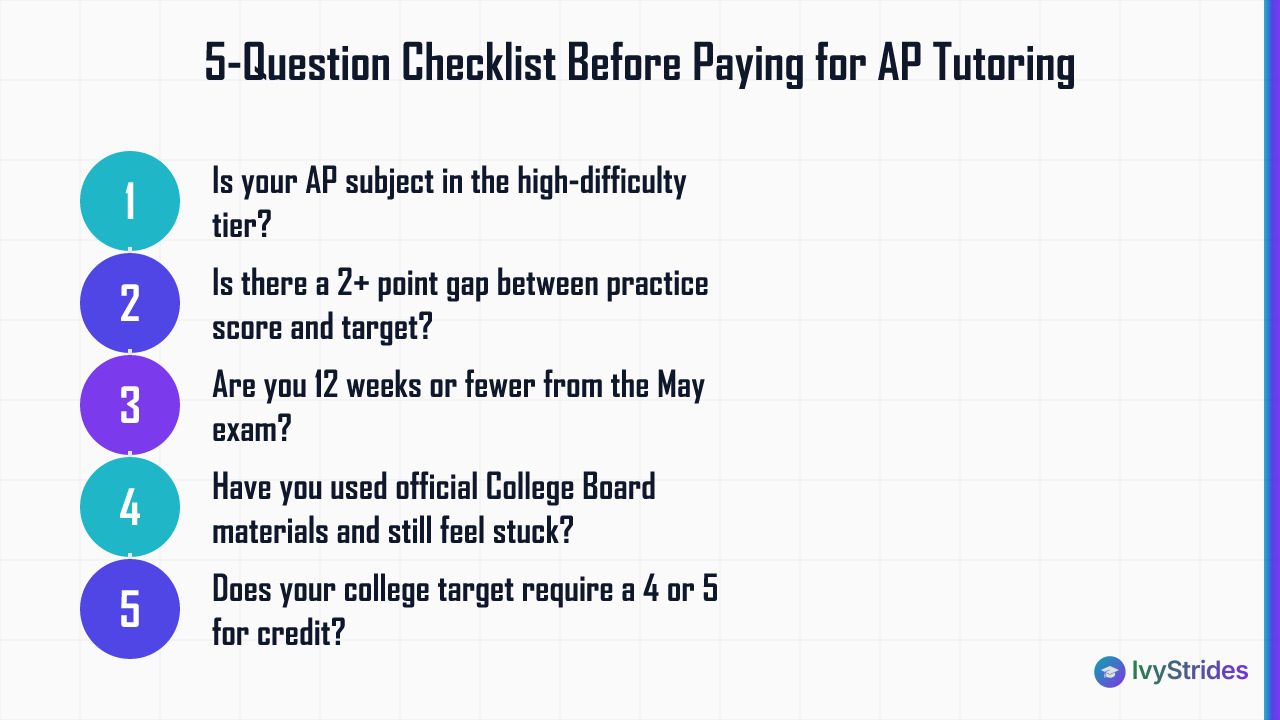
Here's the decision tool. Answer honestly.
-
Is your AP subject in the high-difficulty tier (Calculus BC, Chemistry, Physics C, Biology, English Literature)?
-
Is there a gap of 2 or more points between your current practice exam score and your target?
-
Are you 12 weeks or fewer from the May exam?
-
Have you already worked through the official College Board AP practice materials and still feel stuck?
-
Does your college target require a 4 or 5 for credit?
Three or more yes answers: tutoring is likely worth the investment.
Two yes answers: consider a short 4-to-6 session diagnostic-plus-targeted-work engagement before committing to a full package.
One or zero yes answers: start with a structured self-study plan using official materials, then reassess in about four weeks with a timed practice section.
On session frequency. One hour per week is a reasonable floor for students who are roughly 10 to 12 weeks out with a moderate gap. Students who are 6 to 8 weeks out with a two-point gap typically benefit from 2 to 3 hours per week, plus focused practice between sessions.
On timeline. A 10-to-12-week runway is what makes diagnostic-driven work possible: enough room to test, fix the two or three highest-yield gaps, and still bank timed practice under exam conditions before May. Inside four weeks the work narrows to triage, mostly pacing and rubric literacy. Students in the 2-to-3 band tend to see the clearest movement, because the high-yield fixes pay out first. How far any individual score moves depends on the starting band, the subject, and the hours actually invested. You can read more about our coaching approach on our about page.
If AP prep runs alongside standardized test prep, our 1-on-1 SAT prep service coordinates timelines so the two don't collide. For students on the AP Calculus track, AP Calculus AB prep is often the right starting point before Calc BC.
FAQ: AP Tutoring Costs and Scores in 2026
What is a reasonable price for AP tutoring per hour?
A reasonable rate in 2026 is roughly $50 to $100 per hour for a qualified online generalist and $80 to $175 per hour for a subject-specialist with documented AP exam experience. Price tracks subject difficulty, tutor credentials, and package structure. High-difficulty subjects like AP Calculus BC and AP Chemistry sit at the higher end.
Is 1 hour of AP tutoring per week enough?
One hour per week works as a starting point if you have roughly 10 to 12 weeks before the May exam and a moderate score gap. Closer to the exam, at 6 to 8 weeks out, or when you're chasing a jump of two or more score points, plan on 2 to 3 hours per week with focused practice in between.
Is AI replacing AP tutors?
Not for the tasks that move scores most. AI generates extra practice problems and reviews concepts on demand, which is genuinely useful. What it can't do is score your free-response answers against the official College Board rubric or diagnose the error patterns in your timed practice sections. Treat it as a supplement.
Does AP tutoring look good on a college application?
The tutoring itself doesn't appear on the application, but the AP score it helps you earn does. A 4 or 5 on a rigorous AP exam signals academic readiness and subject-area strength to admissions readers. At test-optional schools, strong AP scores can partly offset a withheld SAT or ACT score in showing course rigor.
Where can I find AP tutoring online?
Look through general tutoring marketplaces or specialist academies that assign per-subject AP coaches rather than generalists. Before you commit, confirm the tutor has experience with the exact AP exam you're taking, not just the subject in general, and that they open with a diagnostic practice section.
How much does AP tutoring cost per month?
At $75 to $100 per hour and 4 sessions per month, budget roughly $300 to $400 monthly. Booking a package of 10 to 12 sessions upfront often shaves about 10 to 20 percent off the per-session rate. A full 10-to-12-week AP exam prep block typically runs $800 to $1,500 total.
What is the average cost of an AP prep course?
A structured 1-on-1 course with a specialist instructor typically runs $800 to $2,000 for a full 10-to-14-week engagement, depending on subject and session frequency. Group AP prep courses cost less, often $200 to $500, but deliver far less diagnostic personalization than 1-on-1 instruction.
Should I pay for AP tutoring if my school already offers AP classes?
Your AP class covers the curriculum; AP tutoring covers the exam. They serve different jobs. If your teacher's instruction lines up with the AP free-response rubrics and you're scoring 4s and 5s on practice sections, extra tutoring may be optional. If your class grade and practice exam score diverge by more than a point, targeted tutoring earns a look.
For more on specific high-difficulty subjects, see our AP Physics 1 prep page. We cover the same ground for AP Precalculus.
Run the 5-question checklist against your own subject, score gap, and timeline. Three or more yes answers, and the math on tutoring cost versus tuition savings and admissions signal usually works in your favor. Fewer than that, and official College Board materials plus a four-week reassessment is the smarter first move.
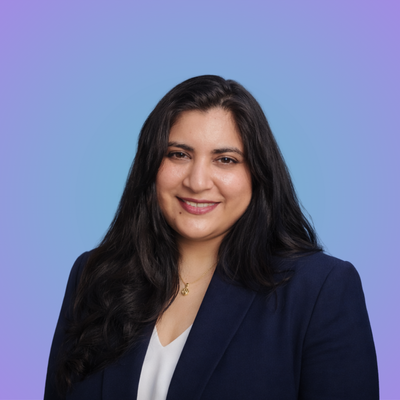
Two decades teaching quantitative and verbal aptitude on standardized tests. Rare dual expertise across Math and Verbal — particularly effective for students with gaps on both sides. Senior AP Mentor for our Calculus and English tracks.