
Hardest AP Classes: Which Ones You Should Not Take Without a Teacher
On this page
- What Makes an AP Class Hard: Pass Rate, Concept Load, or Both
- Which AP Exams Have the Lowest Pass Rates in 2026
- Which AP Exams Can You Realistically Self-Study and Which Ones Cannot
- How Many Hard AP Classes Should You Take in One Year
- FAQ: Hardest AP Classes and Pass Rates
- What are the top 5 easiest AP classes?
- Which AP has the lowest pass rate?
- What's the hardest AP to get a 5 on?
- What are the 5 hardest AP classes?
AP Physics 1, AP Physics C: Electricity and Magnetism, AP Chemistry, AP Biology, and AP United States History are among the hardest AP classes to take without a teacher, judged by concept load, lab or essay demands, and prerequisites. College Board does not rank AP courses by difficulty, and by pass rate alone its 2026 score distributions put AP Music Theory (59%) and AP Statistics (62%) lowest.
Students who attempt them without a teacher or structured course can find a 3 harder to reach, and College Board treats 3 as the lowest qualifying score for college credit and placement. The rest of this guide sorts the hard APs by whether you can self-study them or need live instruction.
What Makes an AP Class Hard: Pass Rate, Concept Load, or Both
This guide measures AP exam difficulty on two axes: pass rate and concept density. Pass rate is the share of all test takers who scored 3 or higher; concept density measures how much reasoning each question demands relative to the content you memorized.
Every AP exam runs on the AP score scale of 1 to 5. College Board calls a 3 "qualified," equivalent to a college grade of B-, C+, or C. A 2 is "possibly qualified," with no grade equivalent listed. College Board delivers most AP Exams through Bluebook, its digital testing app.
Read pass rate carefully. A low pass rate usually signals a hard exam, with one catch: self-selection. A small, specialized subject draws students already strong in it, which inflates the rate.
Concept density is the variable many students underestimate. AP Physics 1 asks you to derive, calculate, estimate, or predict in a scenario you've never seen; AP Human Geography asks you to connect geographic concepts to real-life scenarios and read maps and data. Both cover a lot of ground, but Physics 1 usually stacks more reasoning steps into each question.
| Score | College Board Label | College Grade Equivalent |
| 5 | Extremely well qualified | A+ or A |
| 4 | Very well qualified | A-, B+, or B |
| 3 | Qualified | B-, C+, or C |
| 2 | Possibly qualified | No equivalent |
| 1 | No recommendation | No equivalent |
A score of 3 is the minimum qualifying score, but whether it earns anything depends on how AP scores translate to college credit and placement, which varies by institution.
Which AP Exams Have the Lowest Pass Rates in 2026
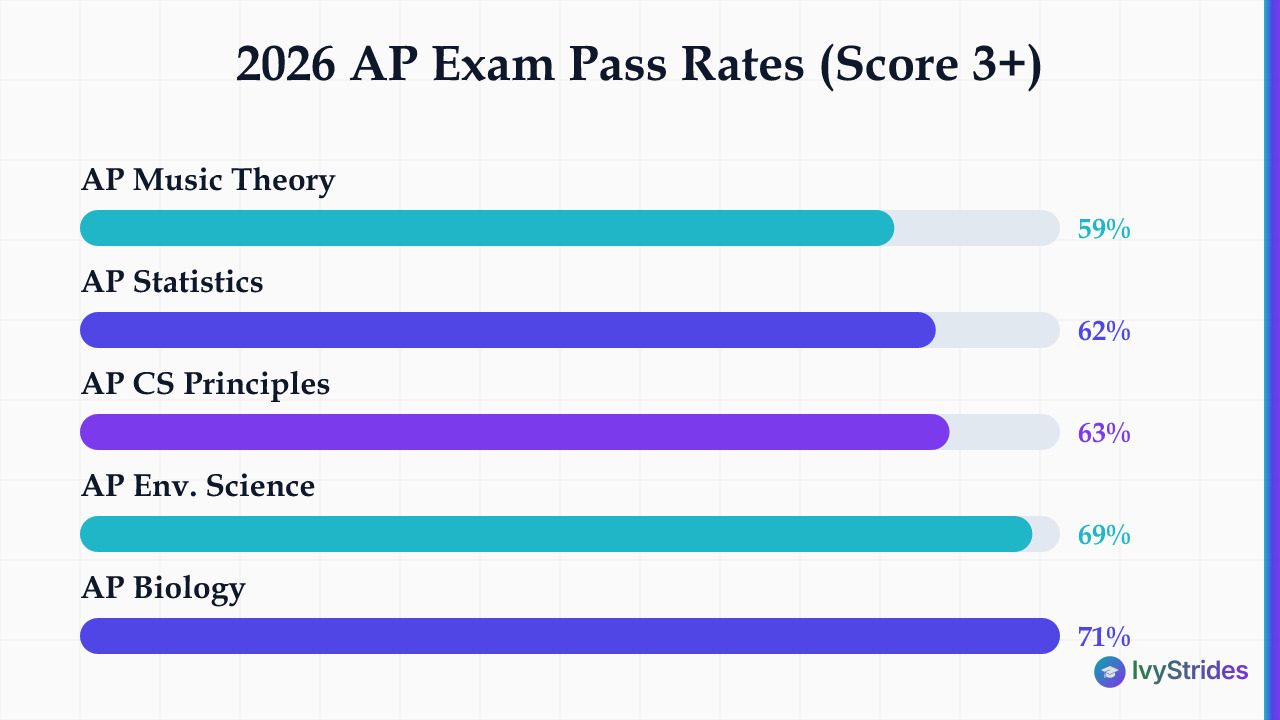
College Board's 2026 score distributions put the lowest pass rates in AP Music Theory (59%), AP Statistics (62%), and AP Computer Science Principles (63%). AP Physics 1: Algebra-Based had the lowest rate of any exam in 2024, at 47.3%, but reached 68% in 2026. Its four free-response questions still cover experimental design and translation between representations, so you must explain your reasoning, not just compute.
AP Physics C: Electricity and Magnetism is the steeper climb in pure content. College Board recommends a calculus-based mechanics course such as AP Physics C: Mechanics first, and calculus taken before or alongside it. Its 75% pass rate in 2026 likely reflects a calculus-ready pool of test takers more than an easier exam.
Named units, real demands. AP Chemistry layers stoichiometry, equilibrium, and thermodynamics on inquiry-based investigations, and College Board recommends prior high school chemistry and Algebra II. AP Biology spreads its content across eight units, and its six free-response questions ask you to interpret experiments and analyze data. AP United States History covers nine periods, and its document-based question asks you to build an argument from seven documents in a recommended 60 minutes.
| AP Exam | 2026 Pass Rate, Scoring 3+ (Scoring 5) | Primary Difficulty Driver | Teacher Required? (Our View) |
| AP Physics 1 | 68% (19%) | Conceptual reasoning, experimental design | Yes |
| AP Physics C: E&M | 75% (24%) | Calculus-based content climb | Yes |
| AP Chemistry | 75% (15%) | Stoichiometry, thermodynamics, experiment design | Yes |
| AP Biology | 71% (15%) | Content volume, data analysis | Recommended |
| AP US History | 74% (14%) | Document-based question writing | Recommended |
| AP Calculus BC | 82% (46%) | Series, parametric and polar topics beyond the AB content | Yes, for most |
| AP English Literature | 73% (16%) | Timed literary analysis | Recommended |
| AP Environmental Science | 69% (13%) | Broad content, lab and field work | Self-study viable |
Pass rates shift year to year, so treat these as 2026 figures, not fixed constants. Students whose schools don't offer these subjects can take them through live online AP courses covering Physics, Chemistry, and Calculus with a specialist for each subject. A student whose school has no AP Physics C section can still take AP online when your school does not offer the course through an authorized online provider, then sit the exam at a school or testing center that administers it.
Which AP Exams Can You Realistically Self-Study and Which Ones Cannot
Photo by cottonbro studio on Pexels
College Board recommends taking the AP course first but says you can self-study for most AP Exams; it does not rank courses for self-study. Our split follows the concept-density line above: where content volume is the main barrier, self-study can work; where concept density and prerequisite depth are the barrier, a teacher helps most.
Self-study viable. In our view, AP Psychology, AP Statistics, AP Human Geography, and AP Environmental Science are the most workable for self-study. College Board lists no recommended prerequisites for AP Psychology or AP Human Geography, though their 2026 pass rates (74% and 66%) show neither is a free pass. College Board recommends two years of lab science and at least one year of algebra before AP Environmental Science.
AP Statistics works for a student already comfortable with algebra and data interpretation, but its 62% pass rate in 2026 was the second lowest of any AP exam. Self-study options expand the slate of APs a student can take beyond what their school offers, but only for subjects where the concept load does not require live instruction.
Teacher strongly recommended. AP Physics 1, AP Physics C: Electricity and Magnetism, AP Chemistry, and AP Calculus BC sit on the other side. College Board says lab experience must be part of every AP Physics course, and Physics C builds on calculus. AP US History sits in between: self-study can cover the content, but the document-based question benefits from feedback on practice essays that a textbook alone cannot give.
Physics 1 and Chemistry are often difficult for students who register assuming the textbook would be enough, without accounting for the reasoning that live instruction and worked-example feedback build. For the exams that are hardest without a teacher, live online AP courses give students a per-subject specialist regardless of what their school offers.
Before you commit to self-study, answer these five:
-
Is the exam on the self-study-viable list above, or on the teacher-recommended one?
-
Have you already completed any prerequisite course the subject assumes?
-
Is the main barrier content volume, which you can out-study, or conceptual reasoning, which you often cannot alone?
-
Can you commit to timed free-response practice with honest self-grading?
-
Is your target a 3, or a 4 or 5 that demands near-complete command of the course?
Students choosing a self-study-viable subject can aim for a 4 or 5 with a structured plan, and how to self-study AP Statistics, Human Geography, and Environmental Science walks through three of them. The exams needing a teacher still vary by instruction format, and live online AP courses add the deadlines and feedback that self-paced video courses often lack. College Board's exam ordering deadline is November 13, 2026 for full-year and first-semester courses and exam-only sections, and late orders run through March 12, 2027, so decide the format before November 13.
How Many Hard AP Classes Should You Take in One Year
For most students, we suggest no more than two to three hard APs in a single year, with grade 11 carrying the heaviest load. Course rigor is a real admissions signal, but the distinction that matters is between taking a hard AP and scoring well on it. A string of 2s does less for an application than a shorter list of 4s and 5s.
Stacking has a cost. In our view, stacking three or more of these hard APs in the same year is a heavy load across all of them, not just the hardest one. The reasoning load from Physics 1, Chemistry, and Calculus BC at once competes for the same study hours.
| Grade | Suggested Hard AP Count (Our View) | Rationale |
| 9 | 0 to 1 | Build foundations; one accessible AP at most |
| 10 | 1 to 2 | Add rigor gradually as skills develop |
| 11 | 2 to 3 | Peak AP year; scores land before applications |
| 12 | 2 to 3 | Sustain rigor without overloading application season |
Selective schools read how many AP courses you took against what your school offered, not against a fixed number. AP credit policies vary by college, and admissions outcomes depend on the full application, never AP scores alone.
AP scores, SAT or ACT results, and essays form one file rather than separate boxes, so settle how AP performance fits a connected testing and admissions plan before you lock the slate. IvyStrides' AP coaches map a student's subject strengths against each exam's concept density first, then set a load that fits the year.
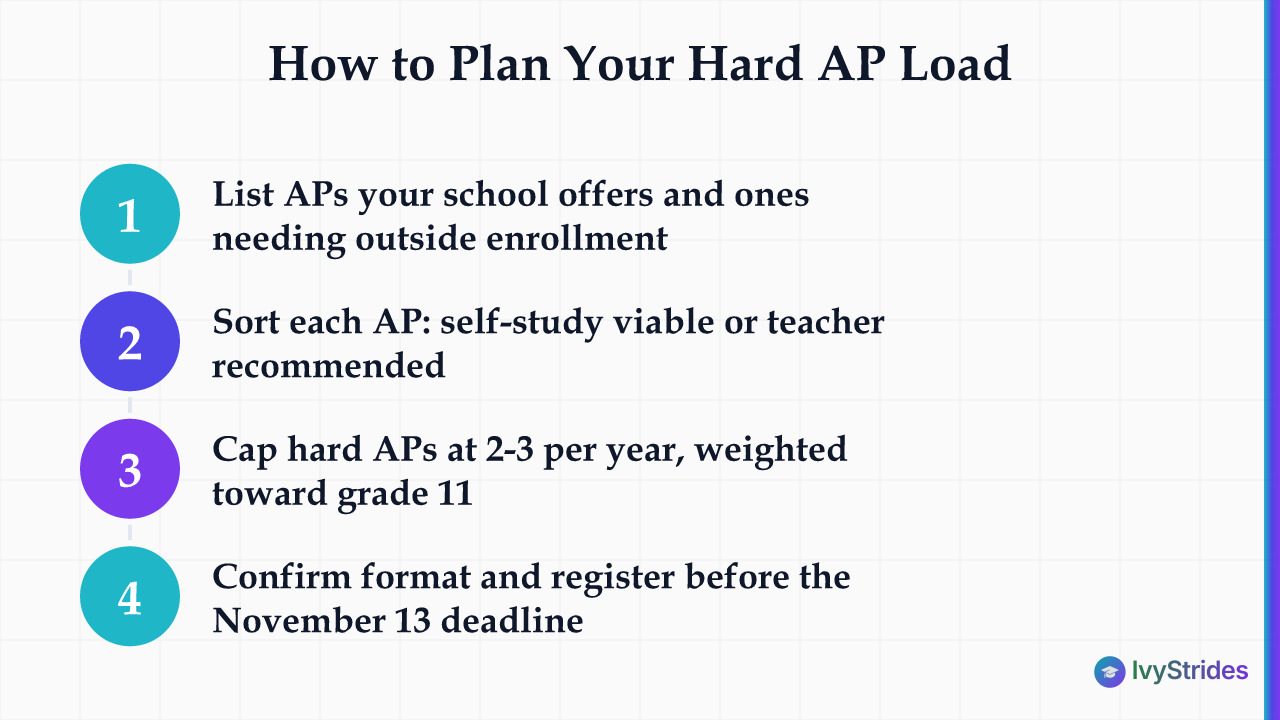
Difficulty is a reason to pick the right prep format, not to avoid a hard AP. Before you register:
- List the APs your school offers and the ones you would need to take elsewhere.
- Sort each one into self-study viable or teacher recommended, using the concept-density test.
- Cap your hard AP count at two to three for the year, weighted toward grade 11.
- Confirm your format and register through your school before the November 13 ordering deadline.
FAQ: Hardest AP Classes and Pass Rates
What are the top 5 easiest AP classes?
College Board does not rank AP courses by ease. By 2026 pass rate, the highest were AP Research (90%), AP Seminar (88%), AP 2D Art and Design and AP Chinese Language and Culture (85% each), and AP Drawing and AP Spanish Language and Culture, tied for fifth (83% each). A high pass rate reflects who takes an exam as much as how hard it is.
Which AP has the lowest pass rate?
AP Music Theory had the lowest pass rate in 2026, with 59% of students scoring 3 or higher on the AP score scale of 1 to 5. AP Statistics (62%) and AP Computer Science Principles (63%) came next. AP Physics 1 had the lowest rate in 2024, at 47.3%, but reached 68% in 2026.
What's the hardest AP to get a 5 on?
By 2026 5-rate, the lowest were AP 3D Art and Design (7%), AP Computer Science Principles and AP Seminar (10% each), and AP 2D Art and Design (12%). Among the courses in this guide, AP US History had 14% 5s, AP Biology and AP Chemistry 15%, and AP Physics 1 19%, while AP Calculus BC had 46%.
What are the 5 hardest AP classes?
College Board does not rank AP courses by difficulty. By concept load, lab or essay demands, and prerequisites, this guide treats AP Physics 1, AP Physics C: Electricity and Magnetism, AP Chemistry, AP Biology, and AP United States History as the five hardest to take without a teacher. Their 2026 pass rates ran from 68% to 75%.

Rajesh is a technology leader, entrepreneur, and angel investor with 28+ years in Business & Technology Leadership and Product & Solution Engineering. He is passionate about education, mentoring, and driving digital transformation.