
Is Early Decision II Worth It? What It Changes and Who Should Use It
On this page
- What Early Decision II Is and How Its Timeline Works
- Does Early Decision II Actually Increase Your Admission Chances?
- Who Should Use Early Decision II and Who Should Wait
- Is ED II Harder Than ED I, and What the Difference Means for Your Strategy
- FAQ: Early Decision II Worth It, Odds, and Binding Rules
- Does early decision II increase chances?
- Is ED2 harder than ED1?
- Should I apply early decision 2 or regular decision?
- Is early decision binding if you can't afford it?
- Your Next Step on Early Decision II
Early Decision II is worth it when a specific school is your clear top choice, you can commit to enrolling, and your finances allow it. ED II is a binding application plan with a January deadline and a February decision, and it typically yields higher acceptance rates than Regular Decision at the same school.
The boost is real, but it rarely matches ED I, since some seats are already filled by December. The binding commitment carries the same financial risk no matter which early round you use. This article walks through what ED II changes, whether it lifts your odds, and who should skip it.

What Early Decision II Is and How Its Timeline Works
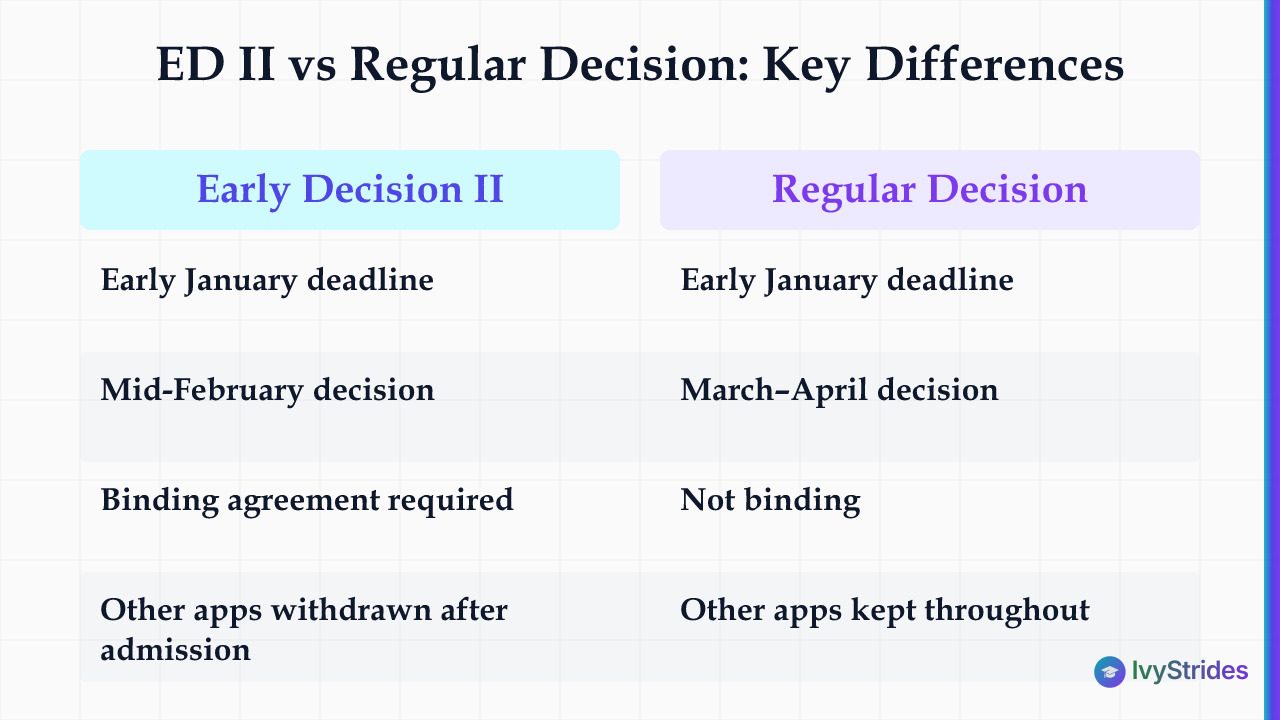
Early Decision II is a binding application plan with a January deadline and a mid-February decision. It works exactly like ED I, with one difference: the calendar. Apply ED II, and you sign the same agreement promising to enroll if admitted and to withdraw your other applications once admitted.
The timeline separates the three rounds, and exact dates vary by school. ED I deadlines usually fall in early November with decisions in mid-December. ED II deadlines usually land in early January with decisions around mid-February. Regular Decision often shares the January deadline but pushes your answer out to March or April.
| Round | Typical Deadline | Typical Decision | Binding? | Other Applications After Admission |
| ED I | Early November | Mid-December | Yes | Withdrawn (aid applicants: after the aid notice) |
| ED II | Early January | Mid-February | Yes | Withdrawn (aid applicants: after the aid notice) |
| Regular Decision | Early January | March–April | No | Yes |
One binding slot at a time. You can hold only one active ED application. That rule matters for the pivot we cover below, and it rules out hedging across two binding schools.
At many schools you submit ED II through the Common App, whose own definition is plain: you apply ED to one college, and if admitted, you withdraw your other applications. You complete the ED agreement inside the platform, and typically you, a parent or guardian, and your counselor all sign it.
Not every school offers an ED II round. Vanderbilt's admissions page describes its Early Decision I and II as binding plans for students committed to attending if admitted, while many selective schools run a single binding round in November or a non-binding early plan instead. The three rounds behave differently enough that Early Action, the non-binding early option, changes the math again. UChicago is a useful outlier: it offers non-binding Early Action alongside binding ED I and ED II in the same cycle.
Does Early Decision II Actually Increase Your Admission Chances?
Early Decision II increases your admission chances at most schools that offer it, because the binding commitment signals genuine fit and the applicant pool is smaller than Regular Decision.
The admissions boost is context-dependent, and a few schools say so plainly. Rice has published its own position that applying Early Decision does not necessarily improve your odds, a healthy reminder that round choice never rescues a weak application. Your file still competes on grades, rigor, essays, and fit.
Where a school reports its early round separately, you can measure the gap yourself: the Common Data Set asks each school for its early decision applicants and admits, and families comparing the Duke Early Decision acceptance rate with its overall rate are doing exactly that. Those counts combine ED I and ED II, so treat any gap as directional for the second round.
| What to compare | Where to find it | How to read it |
| Early decision applicants and admits | The school's Common Data Set | ED I and ED II combined |
| All applicants and admits | The same Common Data Set | The baseline rate |
| The school's own statement | Its admissions website | Outranks any gap you calculate |
Confirm the current numbers before you build a plan around them. Outcomes depend on the full application, not on the round you pick.
Who Should Use Early Decision II and Who Should Wait
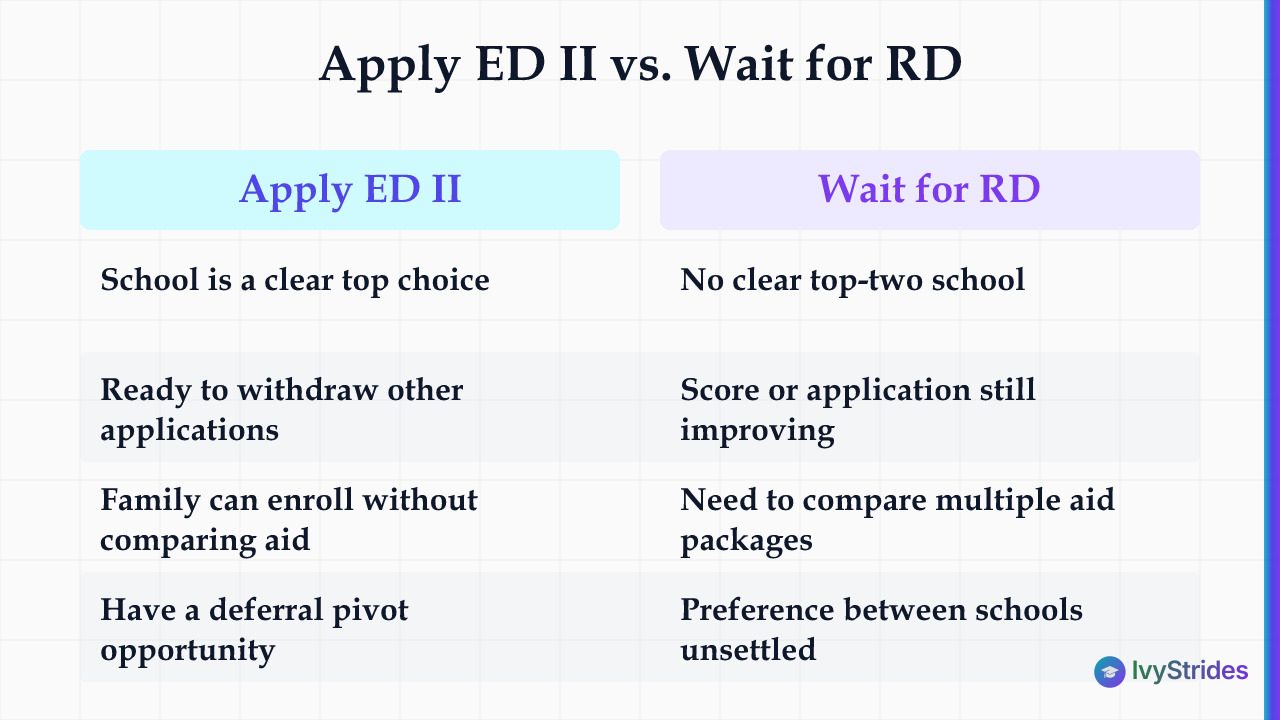
Use Early Decision II only when the school is a clear top choice, you are ready to commit, and your family can enroll without comparing financial aid offers. Building on the acceptance-rate gap above, the binding commitment is what earns the boost, which means it only pays off when you would genuinely enroll over every other option.
Daily SAT and ACT prep on YouTube: short strategy videos from IvyStrides. Subscribe to IvyStrides on YouTube.
The strongest ED II candidate has a clear top-two school and a reason to use the extra weeks. The January deadline lets you add fall senior grades, a December test score, or a new accomplishment that ED I applicants could not include.
A December test score is an option, not a strategy that reliably moves a decision. If your score sits near the school's 25th percentile, whether to commit via ED II intersects directly with whether that borderline score is strong enough to submit at all. Test-optional policies vary by school and year, so verify the current policy before you count on a score.
The deferral pivot. ED II is a legitimate strategic move after an ED I deferral or denial, not a fallback. The first school no longer holds you, and a genuine second choice is now your best binding slot.
| Criterion | Apply ED II | Wait for RD |
| School is a clear top choice | Yes | No |
| Ready to withdraw other applications | Yes | No |
| Family can enroll without comparing aid | Yes | No |
| Need to compare multiple aid packages | No | Yes |
| Score or application still improving | Maybe | Often |
| No clear top-two school | No | Yes |
Here's the part most students miss. The main trap is applying ED II to a school you are not sure about, which spends your one binding signal and locks you in without resolving your own preference. Settle your own preference first, because a binding agreement should confirm a choice you have already made, not force one.
The financial aid caveat deserves its own line every time the commitment comes up. Whether a school releases a student whose financial aid offer does not make attending possible depends on that school's own ED terms, so read its exact wording. Common App's agreement lets an aid applicant keep other applications open until the aid notice arrives; after that, you withdraw them. A binding offer means accepting one package without comparing others, so settle the full financial aid trade-off in any binding early application before you sign anything.
Within IvyStrides' college counseling plan, which runs from the summer before 9th grade to the deposit deadline, counselors help decide the college list and track every deadline, so the student weighs whether Early Decision II is worth it against the full list rather than in a January rush.
Is ED II Harder Than ED I, and What the Difference Means for Your Strategy

Photo by RDNE Stock project on Pexels
Early Decision II is usually slightly harder than ED I but still easier than Regular Decision at the same school. By the time ED II files land, a highly selective school has already filled a meaningful share of its class through ED I, which leaves fewer seats to offer in February.
That smaller pool partially offsets the shortage of seats, since fewer applicants pivot to ED II than crowd into ED I. Few schools publish ED II rates on their own, so treat that ordering as a general pattern rather than a rule. Use the rounds the way they are built. ED I is for your true first choice; ED II is for a genuine second choice, not a safety net you reach for because you can.
| Round | Rate vs. RD | Seats Available | Best Used For |
| ED I | Highest boost | Most open | Clear first choice |
| ED II | Moderate boost | Fewer remaining | Genuine second choice |
| RD | Baseline | Fewest, most competitive | Everything else |
One binding application, ever. You cannot hold an ED I and an ED II application to different schools at the same time; the moment one is active, the other is off the table. A single binding slot is the mechanic that makes the deferral pivot possible: you can never hold two pending Early Decision applications at once, so if an ED I decision comes back as deferral or denial, ED II opens up at a second school.
Several selective schools run both ED rounds, which is what makes the sequence usable: Vanderbilt and Rice among them. Michigan shows the other common setup, with one binding round in November: it pairs a binding Early Decision path with nonbinding Early Action in the same cycle, and choosing between them is a real strategic question. The through-line: ED II works as a planned second move, not an impulse.
FAQ: Early Decision II Worth It, Odds, and Binding Rules
Does early decision II increase chances?
Yes, at most schools that offer it. ED II acceptance rates are typically higher than Regular Decision rates at the same school, because the binding commitment signals genuine interest and the applicant pool is smaller. The boost is real but usually smaller than ED I, since ED I admits have already claimed some seats by December.
Is ED2 harder than ED1?
Generally yes, slightly. By the time ED II applications are reviewed, a school has filled part of its class through ED I, which leaves fewer seats for February. The smaller ED II pool softens that effect, but acceptance rates for ED II still tend to land below ED I rates at the same school.
Should I apply early decision 2 or regular decision?
Apply ED II if the school is a clear top choice, you are ready to commit, and your family can enroll without comparing aid offers. Wait for Regular Decision if you need to weigh multiple aid packages, your test score is still climbing, or you are not certain enough to withdraw every other application.
Is early decision binding if you can't afford it?
Release terms are set by each school: read its ED agreement for whether an aid offer that does not make attending possible frees you. Otherwise, the commitment is binding. Families who need to compare several aid offers should not apply ED in the first place.
Your Next Step on Early Decision II
ED II rewards conviction, not convenience. If you have a school you would choose over everything else and the money works, the January deadline gives you a real edge and a few extra weeks to strengthen the file. If any piece is shaky, Regular Decision keeps your options open.
- Confirm the school offers ED II and note its exact deadline and decision date.
- Check the current acceptance rates on the school's own Common Data Set.
- Model the financial aid scenario before anyone signs the agreement.
- Decide whether this is a true top choice or a placeholder, and act accordingly.
College admissions insights on LinkedIn: follow IvyStrides for application guidance and counseling updates.

Rajesh is a technology leader, entrepreneur, and angel investor with 28+ years in Business & Technology Leadership and Product & Solution Engineering. He is passionate about education, mentoring, and driving digital transformation.