
Can You Apply Early Decision to Two Colleges? What ED II Changes
On this page
- Can You Apply Early Decision to Two Schools at Once
- What Happens If You Apply Early Decision to Two Schools at Once
- How ED II Gives You a Second Binding Window Without Breaking the Rules
- Early Action and Restrictive Early Action: What You Can Apply to Alongside ED
- FAQ: Early Decision, ED II, and Early Action Rules
- What are the key differences between Early Decision 1 and 2?
- What happens if you apply to two schools early decision?
- Can you apply early decision and early action at the same time?
- Can you only apply to one school early action?
- Your Next Step on the Early Decision Rule
No, you cannot apply Early Decision to two schools at the same time. Early Decision is a binding commitment: you sign an agreement with your parent and counselor stating you'll enroll if accepted with adequate aid. ED II lets you commit to a second school only after the first one denies or releases you, and NACAC says a college should release you when its aid offer does not make attendance possible.
That one-school rule comes straight from College Board's BigFuture guidance, which states a student can apply early decision to only one college because the offer is binding. The real question most students bring here is whether ED II offers a legal second swing. It does, and the rest of this page shows how.

Can You Apply Early Decision to Two Schools at Once
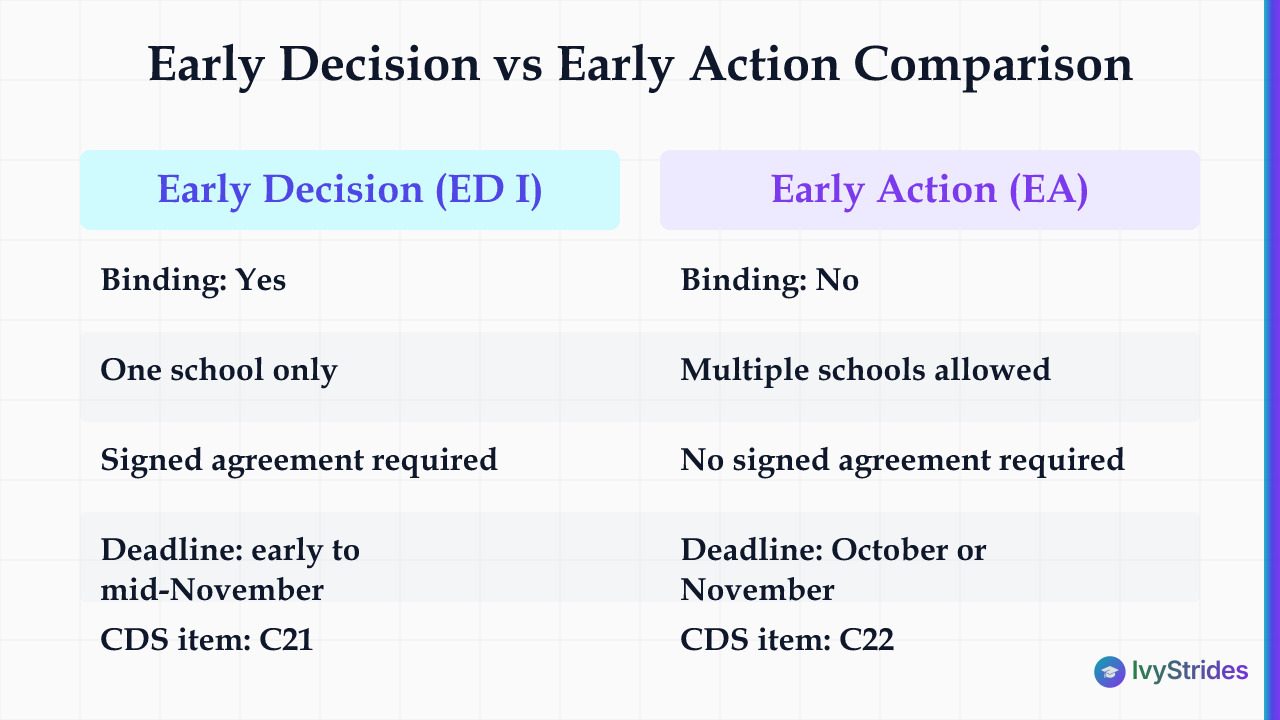
Early Decision is a binding single-school application plan, and you can hold exactly one active ED application at a time. College Board's BigFuture page says it plainly: unlike Early Action, you are not allowed to apply to multiple schools for Early Decision. The binding commitment is the reason the rule exists.
Who signs. The ED agreement carries three signatures: the student, a parent or guardian, and the high school counselor. That signed agreement is not a formality. Your counselor confirms advising you to abide by the commitment, and your parent or guardian promises to make sure you do.
So how would a college even know? Your counselor signs and submits each ED agreement, so a second one would cross the same counselor's desk.
In our college admissions counseling work, the most common ED mistake we see is students treating ED as a hedge rather than a genuine first-choice commitment, which puts the signed agreement at risk. A binding offer also means accepting one financial aid package without comparing others, so settle how the three plans compare when you need to weigh aid packages before the deadline.
Colleges report their ED data in one standardized place. CDS item C21 covers Early Decision: whether the plan exists, closing and notification dates, applications received, and applicants admitted, per Princeton's Common Data Set 2025-2026.
| Feature | Early Decision (ED I) | Early Action (EA) | Restrictive Early Action (REA) |
| Binding? | Yes | No | No |
| Schools at once | One only | Multiple allowed | One private early school; nonbinding public plans allowed |
| Signed agreement | Required | Not required | Not required |
| Typical deadline | Early to mid-November | October or November | November 1 at Harvard, Princeton, Yale, and Stanford |
| CDS item | C21 | C22 | C22 (restrictive question) |
What Happens If You Apply Early Decision to Two Schools at Once

Photo by Andy Barbour on Pexels
Applying Early Decision to two schools at once breaks the binding agreement you signed: once either school admits you, it requires you to withdraw every other application, the second ED school included. That signed commitment is what gives the one-school rule from the section above its force.
Counselor's role. NACAC's ethics guide tells counselors to warn students that having more than one pending Early Decision application is unethical. Your counselor signs last, after you and a parent or guardian, so settle any doubt about your first choice before asking.
Colleges can also learn of it from each other, because the agreement lets a college that admits you ED share your name and early commitment with other institutions.
A rescinded acceptance can leave you scrambling toward Regular Decision after your best early option is gone. Students tempted to apply ED to a safety school because their score feels uncertain face a different problem entirely, which we weigh in applying Early Decision with a borderline test score.
Before you submit an ED application, confirm the following:
- The ED agreement carries your signature, a parent or guardian's, and your counselor's
- No other Early Decision application of yours is pending
- None of your early schools runs a restrictive plan that bars ED elsewhere
Separately, the Common Data Set logs the reply policy for admitted applicants as item C17. Wait-list counts are a different item, C2.
How ED II Gives You a Second Binding Window Without Breaking the Rules
Early Decision II is a second binding window, typically closing in early January, that lets you commit to a different school after your first ED decision arrives. Because ED II runs sequentially, not simultaneously, it never puts two binding agreements in play at once. You sign the second agreement only after the first school denies you or releases you, including over an aid offer that does not make attendance possible.
Who qualifies for ED II. Three groups: students deferred from ED I, students denied from ED I, and students who never applied ED I at all. A denial releases you. Whether a deferral does depends on your ED I school's own policy, so read it before you sign a second agreement. ED II notifications typically arrive in mid-February.
Not every college offers ED II. Check the admissions site first, then CDS item C21, which per Princeton's Common Data Set 2025-2026 reports closing and notification dates for the first and any other round. The CDS describes a past year, so the admissions site has the final word for 2026-27.
One caveat on the numbers you'll find. The 2025-2026 Common Data Set reports data for the Fall 2025 entering class, not the fall 2027 class you are applying to join. Penn has no ED II, so Penn's early decision acceptance rate reflects a single November round.
Students eyeing ED II after a deferred ED I decision may be able to send a December SAT or ACT score with a January ED II application if that school accepts December scores.
| Feature | ED I | ED II |
| Typical deadline | Early to mid-November | Early January |
| Typical notification | Mid-December | Mid-February |
| Binding? | Yes | Yes |
| Schools at once | One | One |
| Who can apply | Any applicant | Released from ED I, or did not apply ED I |
Early Action and Restrictive Early Action: What You Can Apply to Alongside ED
Standard Early Action is non-binding, and you can hold it alongside one ED application and at as many EA schools as you want. That's the flip side of the ED II timeline from the section above: a binding plan limits you to one school, non-binding Early Action does not. You can also apply Regular Decision to other schools while your ED application sits pending.
The main exception is Restrictive Early Action (REA), also called Single-Choice Early Action (SCEA). It stays non-binding, but it limits where else you may apply early. Harvard, Princeton, Yale, and Stanford each run REA or SCEA plans, and each restricts early applications to other private colleges, with carve-outs that differ by school, so read the exact policy of the one you choose. Georgetown's Early Action is a different case: non-restrictive, but it bars binding ED anywhere else.
Verify before you file. CDS item C22 covers Early Action: whether the college runs a nonbinding plan, its dates, and whether the plan is restrictive, per Princeton's Common Data Set 2025-2026. And item C8A reflects a college's current test policy for Fall 2027 applicants, the cycle now under way, so read it before you lock in a plan.
In our college admissions counseling work with grades 11 and 12 students, mapping which schools get ED, which get EA, and which stay Regular Decision is one of the first planning decisions we work through, because the REA and ED rules interact in ways that can accidentally close off a school. Mapping that full list as a single coordinated strategy is the work IvyStrides' counselors do with students in grades 11 and 12, not three separate decisions.
Which plan limits you where is only half the picture, so weigh how the three plans differ on which schools offer each and how acceptance rates compare before you set your list. If your short list includes two or more REA schools, choosing which one to apply to early becomes its own decision.
| Application Type | Can You Apply Alongside ED? | Notes |
| Standard EA | Yes | Multiple schools allowed |
| Restrictive EA / SCEA | No, at Harvard, Princeton, Yale, and Stanford | Each restricts early plans at other private colleges; carve-outs vary by school |
| Regular Decision | Yes | No conflict with a pending ED |
| Second ED (same time) | No | Violates the binding agreement |
| ED II (after an ED I denial or release) | Yes | Sequential, one school only |
FAQ: Early Decision, ED II, and Early Action Rules
What are the key differences between Early Decision 1 and 2?
ED I typically closes November 1 or 15 with decisions in mid-December. ED II typically closes in early January with decisions in mid-February. Both bind you equally and limit you to one school. ED II opens to students deferred or denied ED I, or who never applied ED I. Not every college offers it, so confirm on its admissions site and cross-check CDS item C21.
What happens if you apply to two schools early decision?
Filing ED at two schools simultaneously breaks the binding agreement. Your high school counselor signs that form, and NACAC calls holding two pending ED applications unethical. If either school admits you, the agreement requires you to withdraw all other applications, the other ED application included. The agreement also lets a college that offers you ED admission share your name and early commitment with other institutions.
Can you apply early decision and early action at the same time?
Yes, in most cases. You can apply ED to one school and standard EA to several others at once. But if any of those schools runs an REA or SCEA plan, or an EA plan like Georgetown's that bars binding ED elsewhere, applying ED may break its terms. Check each school's own policy, not just CDS item C22.
Can you only apply to one school early action?
For standard Early Action, no. You can apply to as many EA schools as you like. The limit applies only to Restrictive Early Action or Single-Choice Early Action plans, which cap where else you apply early. Harvard, Princeton, Yale, and Stanford each run REA or SCEA plans. CDS item C22 states whether a school's plan is restrictive.
Your Next Step on the Early Decision Rule
You can hold exactly one binding Early Decision application at a time, and ED II opens a second window only after your ED I school denies or releases you, or if you skip ED I. Non-binding Early Action rides alongside, unless an REA, SCEA, or other EA school's rules say otherwise. No application plan guarantees admission, outcomes depend on your full application, and ED policies shift each cycle, so confirm each school's rules on its admissions site before you file.
- Pick one school for ED I, the one you'd attend without hesitation.
- Confirm ED II availability at a backup first choice on its admissions site.
- List your EA schools, then check each one's policy for REA, SCEA, or other limits on applying ED elsewhere.
- Fill out Regular Decision for everything else.
- Verify every deadline and test policy on each college's own admissions site before submitting.

Rajesh is a technology leader, entrepreneur, and angel investor with 28+ years in Business & Technology Leadership and Product & Solution Engineering. He is passionate about education, mentoring, and driving digital transformation.