
Applying Early Decision With a Borderline Test Score: Push or Wait?
On this page
- How to Tell If Your SAT Score Is Actually Borderline for Your ED School
- Does the ED Acceptance-Rate Boost Actually Help a Borderline SAT Score?
- How Test-Optional Status Changes the ED Score Decision
- Your Score, Your School, Your Deadline: Let's Map the Decision
- When Waiting for a Retake Is the Smarter ED Move
- Push ED Now or Prep for October? Get a Clear Answer in 15 Minutes
- FAQ: Early Decision and Borderline SAT Scores
- Is it possible to get into an Ivy with a low SAT score?
- What is considered a poor SAT score for college admissions?
- Should I apply ED test-optional or wait for a higher score and apply RD?
- Which Ivy League school has the lowest average SAT score?
- Your Next Step on the ED Decision
Applying Early Decision with a borderline SAT score helps if your score sits near your target school's 25th percentile and the rest of your application is strong. Early Decision is a binding application round, usually due November 1, that admits at higher rates than Regular Decision. At a test-optional school, withholding a weak score is often the stronger move.
The whole decision turns on one number: where your Digital SAT score lands inside your school's middle 50% range. That range comes from each school's Common Data Set, and it beats any generic "low score" label.

How to Tell If Your SAT Score Is Actually Borderline for Your ED School
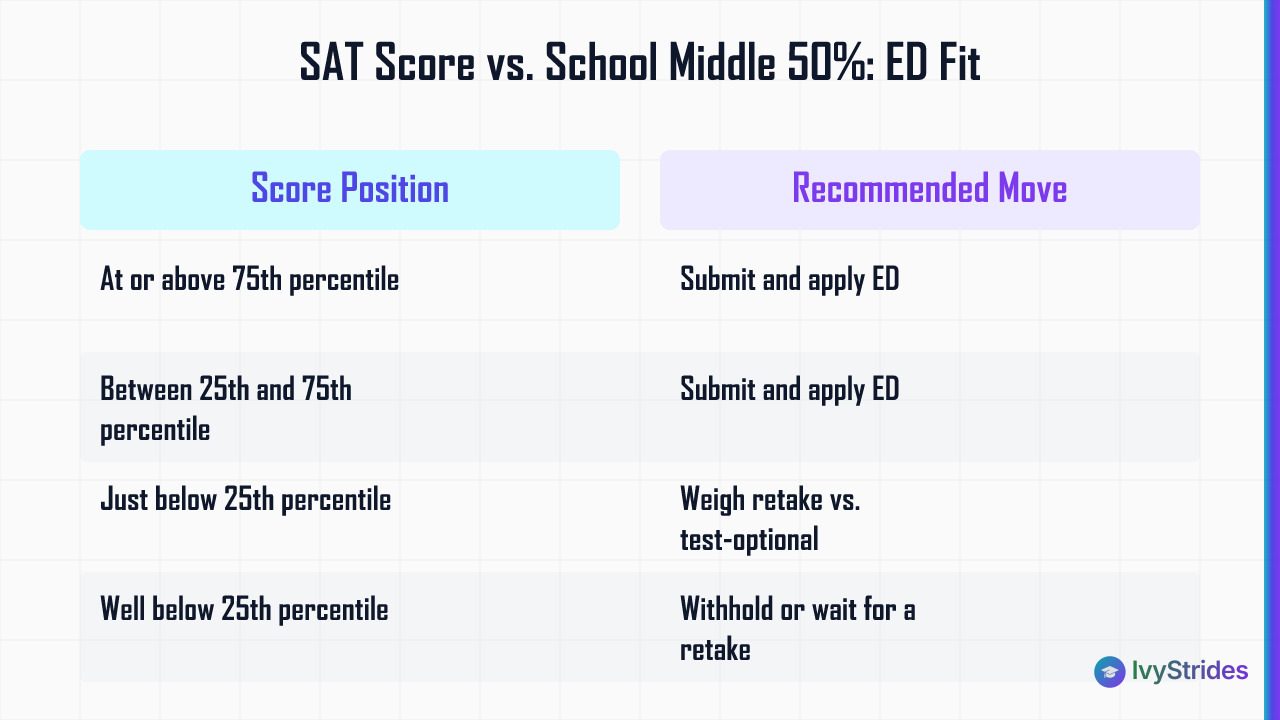
Start with your target school's middle 50% range, not a national average. The middle 50% range is the 25th to 75th percentile of SAT scores among enrolled students, and it's the practical benchmark for whether your score fits. Search "Common Data Set [School Name]" to find it, in field C9.
The Digital SAT scores on a 400 to 1600 scale, so every school's range sits inside that. Say a school reports a middle 50% of 1350 to 1530. A 1320 is borderline, close enough that a strong application can carry it. A 1250 at that same school is below-threshold, a red flag the rest of your file has to overcome on its own.
The 25th percentile is your floor. A quarter of admitted students scored at or below it, so a score right at that line is competitive, not disqualifying. The 75th percentile is the competitive ceiling; a score above it is a genuine asset.
In our coaching with students applying ED with borderline scores, the ones who get in are almost always at or above the 25th percentile, with a strong GPA and at least two well-researched supplemental essays behind them.
| Score vs. School's Middle 50% | ED Fit Signal | Recommended Move |
| At or above 75th percentile | Strong asset | Submit and apply ED |
| Between 25th and 75th | Competitive | Submit and apply ED |
| Just below 25th percentile | Borderline | Weigh retake vs. test-optional |
| Well below 25th percentile | Red flag | Withhold or wait for a retake |
Once you know what a good SAT score looks like against a school's range, you can classify your own score honestly instead of guessing.
Does the ED Acceptance-Rate Boost Actually Help a Borderline SAT Score?
The ED acceptance-rate boost is real, but it operates on your whole file, not as a score override. In published admissions data at many selective schools, ED acceptance rates run roughly double the Regular Decision rate. That gap comes from a smaller, self-selected, committed pool, not from admissions officers waving through weaker scores.
Because the boost works through your full application, a score well below the 25th percentile is not rescued by the binding commitment alone. Admissions reads ED as a signal that you'll enroll if admitted, which matters at the margins. It does not buy a pass on academic fit at a highly selective school.
Holistic review is where a borderline score gets offset. Colleges weigh GPA, course rigor, essays, extracurriculars, and recommendations alongside the score. A student with a strong GPA, a demanding AP schedule, and specific supplemental essays gives an admissions reader plenty to work with even when the SAT sits at the low edge of range.
AP scores do real work here. A record of 4s and 5s signals the same college-readiness a test score is supposed to measure, from a different angle. In our coaching, strong AP results paired with sharp essays can partially offset a borderline SAT. They cannot fully substitute for a score far below the 25th percentile at the most selective schools, and admissions outcomes always depend on the full application.
| Score Position | Percentile | What It Means for ED |
| Above 75th | Top quartile | Score strengthens the file |
| 25th to 75th | Middle range | Score is a non-issue |
| Just under 25th | Below median | Offset with GPA, APs, essays |
| Far below 25th | Bottom outlier | Score becomes a liability |
If you're leaning on academic rigor to offset a borderline score, our guide on how many AP classes for Ivy League and top colleges shows what course load signals. To see what "specific and well-researched" looks like, review these supplemental essay examples.
How Test-Optional Status Changes the ED Score Decision
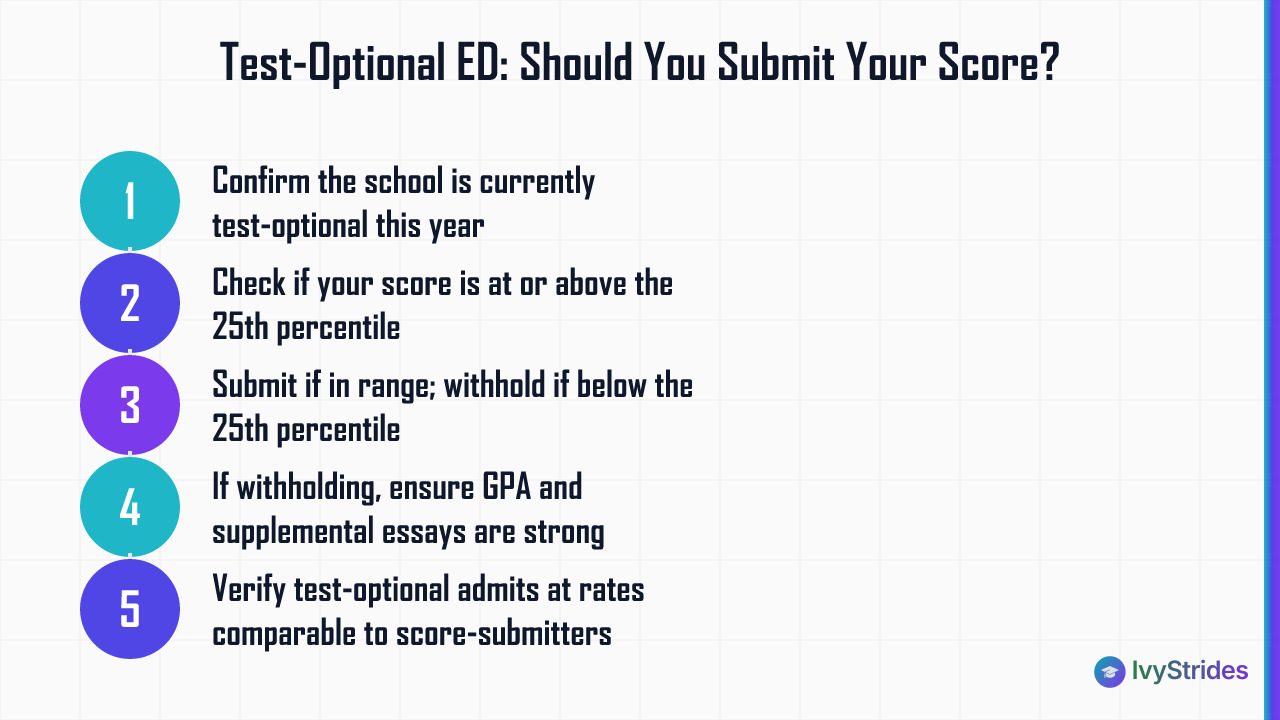
At a test-optional school, applying ED without submitting a below-range score is often the stronger move. Test-optional admissions lets applicants withhold SAT or ACT scores and be evaluated on GPA, essays, and extracurriculars instead. When your score sits below the 25th percentile, submitting it can actively hurt you.
The submission threshold is clean: submit if your score is at or above your school's 25th percentile, withhold if it's below. A score in range confirms academic fit. A score under range plants a doubt the rest of your file then has to argue against.
Verify the policy before you build the plan. Test-optional policies vary by school and year, and the landscape shifted for 2026. Several highly selective universities reinstated testing requirements or now strongly recommend scores, so a school that was test-optional two years ago may not be today. Check the current policy directly on the school's admissions page or against the FairTest tracker.
In our coaching with students applying test-optional ED, a strong GPA and specific supplemental essays carry more weight than a submitted score below the 25th percentile. When you withhold, those pillars have to be genuinely strong. If you want personalised help placing your score before a deadline, our 1-on-1 SAT prep coaches map exactly that call.
Before you decide whether to submit at a test-optional school, our guide on what test-optional means and when to submit SAT scores walks through the exact submission calculus.
Use this before you commit either way:
- Is the school currently test-optional? Confirm on its admissions page, not a two-year-old article.
- Does your score sit at or above the 25th percentile? Submit if yes.
- Is your GPA strong enough to lead the file without a score? Be honest.
- Do you have at least two specific, well-researched supplemental essays?
- Does the school's data show test-optional admits at rates comparable to score-submitters?
Your Score, Your School, Your Deadline: Let's Map the Decision
You have the framework. Applying it to your specific score, your target school's range, and the weeks left before your deadline is a different task. A free 15-minute call takes those three inputs and gives you a concrete recommendation on whether to submit, withhold, or wait.
When Waiting for a Retake Is the Smarter ED Move
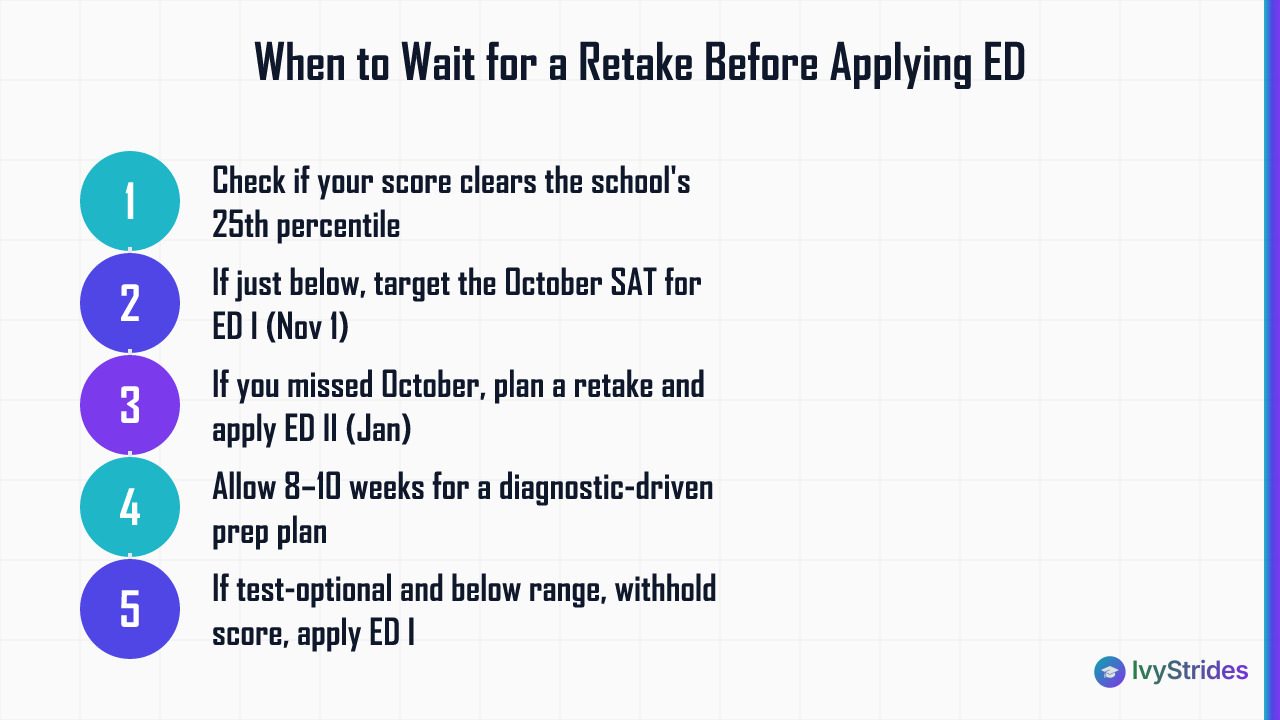
The October SAT is the practical last date for a November 1 ED deadline. College Board guidance is explicit: ED and EA applicants should sit the October SAT for scores to reach colleges in time, per its Early Decision and Early Action counselor page. Sit anything later, and your new score usually arrives after the file is read.
That leaves a tight window. The October SAT typically falls on the second Saturday of the month, and the November 1 deadline sits roughly two weeks later. IvyStrides calculates that gap from College Board's published October date and each school's published deadline. Two weeks is not prep time; it's the gap between test day and submission.
ED II is the real alternative when October is too soon. At schools that offer ED II, the deadline usually lands in January, giving you a November or December SAT date and a genuine retake window while keeping a binding, higher-rate round on the table. IvyStrides derives this figure from the inputs cited above. If you need one more test to clear the 25th percentile, ED II is often smarter than forcing a rushed October score.
A retake only helps if the prep is real. In our coaching, students who start a diagnostic-driven plan roughly 8 to 10 weeks before their test date are the ones who see meaningful movement; a rushed two-week cram rarely shifts a school-fit classification.
For students in our 1-on-1 SAT program, a 200-plus point gain is typical, but that comes from a diagnostic that pinpoints whether you're losing points in Reading and Writing Module 2 or the harder Math module, then targeted work and a spaced retest.
| Your Situation | Recommended Path | Key Deadline |
| Score in range, file strong | Submit, apply ED I | November 1 |
| Just below 25th, 8+ weeks out | Retake October, apply ED I | October SAT |
| Below range, missed October | Retake, apply ED II | January |
| Below range, test-optional school | Withhold, apply ED I | November 1 |
Confirm the exact windows against the current. Also worth reading: SAT test dates 2026 before you assume a retake is still possible. If a retake is the right call, a diagnostic-driven prep plan is the fastest route to a real gain. If you're still weighing which round fits, our breakdown of Early Decision vs. Early Action vs. Regular Decision covers the commitment and timing trade-offs.
Push ED Now or Prep for October? Get a Clear Answer in 15 Minutes
You have a deadline, a score, and a school in mind. A free 15-minute call reviews all three, checks the test window against your ED or ED II timeline, and tells you exactly which path gives you the better shot, with a concrete prep plan if a retake is the right move.
FAQ: Early Decision and Borderline SAT Scores
Is it possible to get into an Ivy with a low SAT score?
It's possible but uncommon. At the most selective Ivies, the middle 50% SAT range typically runs from roughly 1500 to 1580, so a score below the 25th percentile is a significant headwind. Test-optional applicants with exceptional GPAs and standout essays have been admitted, but the bar on the rest of the file rises sharply.
What is considered a poor SAT score for college admissions?
A score is effectively poor for a specific school when it falls below that school's 25th percentile in its Common Data Set. Nationally, the average SAT score sits around 1029, and below 1200 falls under the 25th percentile at many selective schools. The benchmark is always school-specific, never one national number.
Should I apply ED test-optional or wait for a higher score and apply RD?
Apply ED test-optional if your score is below the school's 25th percentile and the school genuinely evaluates test-optional applicants on equal footing. Wait and apply Regular Decision with a higher score if your score is close to the 25th percentile and you have a realistic retake window with 8 or more weeks of prep.
Which Ivy League school has the lowest average SAT score?
Cornell and Dartmouth typically report the lowest middle 50% SAT ranges among the Ivies, though all eight cluster between roughly 1500 and 1580 at the 75th percentile. Verify the current figures in each school's Common Data Set, since ranges shift year to year.
Your Next Step on the ED Decision
The decision is not "is my score low." It's "where does my score sit against this school's middle 50%, and what does the calendar allow." Work it in that order and the push-or-wait call gets a lot clearer.
- Look up your target school's middle 50% range in its Common Data Set.
- Place your score: above 25th percentile, borderline, or below.
- Confirm the school's current test-optional policy for 2026.
- If borderline and test-required, check whether the October SAT or an ED II window still fits.
- Decide: submit ED now, withhold at a test-optional school, or register for a retake and consider ED II.

Award-winning author (South Asian Book Award) and graduate of BITS Pilani and UCLA Luskin School of Public Affairs. Brings a published writer's eye to Common App essays and grammatical precision to SAT and ACT R&W instruction.