
Brown Early Decision Means Testing by October: What Else Changes
On this page
- What the Brown ED Testing Deadline Actually Means for Your Prep
- Does Brown Early Decision Increase Your Admission Chances?
- What the Brown ED Application Checklist Requires by November 1
- Brown ED for Special Programs: PLME and Brown-RISD Add Extra Essays
- FAQ: Brown Early Decision Deadlines, Scores, and Rules
- What day do Brown ED decisions come out?
- Does Early Decision increase chances at Brown?
- Does Brown have an Early Decision II round?
- Is Brown Early Decision binding even if I need financial aid?
- Your Next Step on Brown ED
Brown Early Decision is a binding application round with a November 1 deadline (11:59 p.m. your local time) and decisions in mid-December. If Brown admits you, you must enroll and withdraw all other applications, unless the financial aid package is unaffordable.
Here's the fact to plan around: Brown is test-required for the 2026-27 cycle, and Brown's standardized tests page says ED testing must be completed by the last October test date to ensure receipt of scores. Every Brown policy below traces to Brown's official admissions pages.

What the Brown ED Testing Deadline Actually Means for Your Prep

Photo by Andy Barbour on Pexels
Brown ED applicants must finish testing by the last October test date, so your SAT or ACT prep has to end before that sitting. Brown is test-required for the 2026-27 cycle (entry fall 2027), so a test taken too late arrives after the ED review has begun. That cutoff pulls your whole prep timeline earlier than most families plan for.
Plan backward from that cutoff, and treat any sitting after October as too late to count on for an ED application.
No minimums, but context matters. Brown publishes no score cutoff and reviews every score in context of educational background, socioeconomic status, home and school community, and test-center access. Brown states plainly that below-average scores should not deter an applicant from applying.
Superscore and Score Choice both apply. Brown superscores within the SAT and within the ACT, and accepts Score Choice, so you send the test dates that show your strongest results. One caveat worth holding onto: admissions outcomes at Brown depend on the full application, not test scores alone.
The digital SAT runs 98 questions (54 Reading and Writing plus 44 Math) across 2 hours 14 minutes of testing time, plus one 10-minute break, on a 400 to 1600 scale (College Board). The current ACT composite averages English, Math, and Reading only, with Science reported as a separate score; this reflects the Enhanced ACT launched in 2025, not the legacy format some readers may recall (ACT, Inc.). Either test satisfies Brown's requirement.
| Requirement | Detail |
| Testing status | Test-required, 2026-27 cycle (entry fall 2027) |
| Latest qualifying sitting (ED) | Last October test date |
| Accepted tests | SAT or ACT |
| Superscore | Within SAT and within ACT |
| Score Choice | Accepted |
| Minimum score | None published; reviewed in context |
A borderline score forces a specific choice before November 1, and whether your score is ready before Brown's cutoff is the question to settle first. If the window has passed, a later sitting still has a role: a December SAT or ACT retake fits ED II timelines, not Brown ED.
Does Brown Early Decision Increase Your Admission Chances?
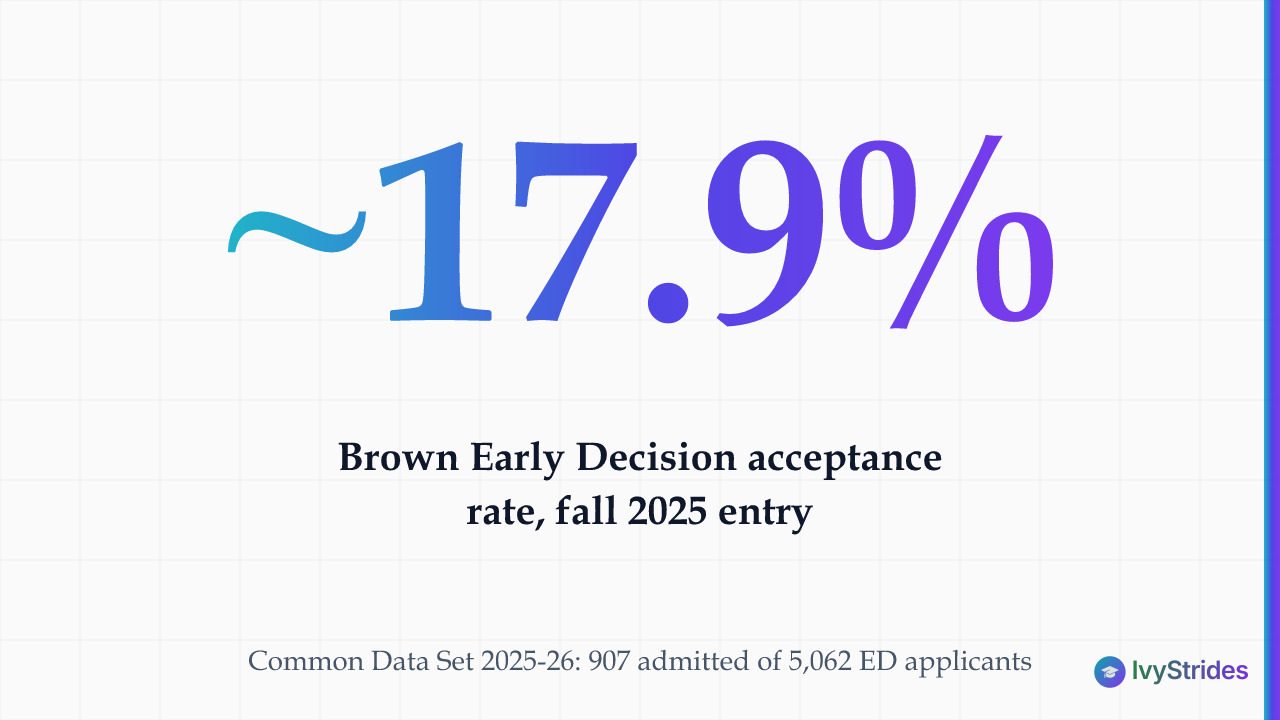
The Brown ED acceptance rate is higher than the Regular Decision rate, but much of the gap reflects who applies, not the round itself. That testing deadline you just read about is the price of admission to this stronger-rate pool, so the decision to apply ED is worth weighing against real numbers.
The most comparable hard count comes from the Common Data Set 2025-26 (fall 2025 entry): 5,062 ED applications and 907 admitted, an ED rate near 17.9%.
| Round | Applications | Admitted | Acceptance Rate |
| Early Decision (CDS 2025-26, fall 2025) | 5,062 | 907 | ~17.9% |
Why the gap is not a shortcut. Brown's Early Decision FAQ says its early pool tends to include a very high proportion of exceptionally talented students and that its higher ED admission rate reflects that. Brown also says ED does not imply an automatic advantage, and it admits ED applicants only when it would offer them admission in Regular Decision.
The binding commitment is the real cost. If Brown admits you ED, you must enroll and withdraw all other active applications. The one exception is financial aid: if the package seems insufficient, Brown's Office of Financial Aid will re-evaluate it with you, and if it is still truly unaffordable for your family after that review, Brown permits you to withdraw from your obligation.
Brown offers binding ED only. There is no Early Action and no ED II round, which makes the November 1 commitment more consequential than at schools where a non-binding early round exists. Some students weigh how binding ED compares across schools that offer a second early round before deciding. Brown also rates level of applicant's interest as Not Considered in its Common Data Set, so visiting or emailing earns you nothing; applying is itself taken as serious interest.
Committing Brown ED means the rest of your list bends around a single binding choice. That is why building a college list that uses Brown ED strategically is a counseling decision as much as an admissions one. IvyStrides' admissions counselors map that call against your full profile early, while there is still time to change course.
What the Brown ED Application Checklist Requires by November 1

Photo by Andy Barbour on Pexels
Brown ED requires a complete Common App with Brown essays (confirm the exact count in the live Common App) by November 1 (11:59 p.m. your local time), plus two teacher recommendations, a counselor recommendation, a school report and transcript, the signed Early Decision Agreement, and first-quarter grades as soon as they are available. Because that binding deadline is fixed, the pieces you control need to be ready weeks earlier than the date suggests.
All first-year applicants use the Common App only; the exceptions are US military veterans and Resumed Undergraduate Education applicants. The Common App personal essay runs to 650 words maximum; confirm the current prompt count and any changes on commonapp.org.
ED-specific grades. ED applicants must have their counselor send first-quarter or trimester grades as soon as they are available, a requirement RD applicants do not face. All applicants also send midyear grades later.
| Item | Notes |
| Common App | Required platform; personal essay 650 words max |
| Brown essays | Confirm exact count in the live Common App |
| Teacher recommendations | Two, from major academic subjects |
| Counselor recommendation | Plus a school report |
| First-quarter grades | Required for ED applicants |
| Arts supplement (optional) | Via SlideRoom, November 4 deadline for ED |
| Interview | None; alumni interviews ended 2019-20 |
| Deadline | November 1, 11:59 p.m. applicant local time |
| Decision | Mid-December |
Brown's How to Apply page lists four essays required of all first-year applicants for the 2026-2027 cycle: two of 150 to 250 words and two of 100 to 150 words. Brown also invites an optional video introduction of no more than 90 seconds, due November 4 for ED applicants.
Plan the writing load early. The Brown essays due November 1, on top of the Common App personal essay, need a drafting timeline that starts months before the deadline, ideally in the summer before senior year. That's why when to bring in an essay coach for the Brown supplemental drafts tends to surface too late. IvyStrides' essay coaches work the Brown prompts and the Common App personal essay as one coordinated set, so the voice stays consistent across the file.
Brown ED for Special Programs: PLME and Brown-RISD Add Extra Essays
Brown's PLME and Brown-RISD Dual Degree programs add essays on top of the standard application, and both hold to the same November 1 ED deadline. That drafting load you just saw grows further for these applicants, so plan the extra prompts in early.
The Program in Liberal Medical Education is an 8-year combined baccalaureate-MD program that requires three extra essays of 250 words each: why medicine, why PLME, and a quality beyond medicine that would make you a strong doctor. The Brown-RISD Dual Degree is a 5-year program requiring one additional essay of up to 650 words on integrating the two institutions' approaches.
| Program | Additional Essays | Word Limit Each | Same ED Deadline? |
| PLME | Three | 250 words | Yes |
| Brown-RISD Dual Degree | One | Up to 650 words | Yes |
| Standard first-year | Brown essays (confirm exact count in the live Common App) | Varies | Yes |
Two cautions for PLME and Dual Degree applicants. Brown's Common Data Set reports a single ED count for all first-year applicants and does not break out PLME, which enrolls about 50 students a year, so do not apply the general ED rate to a PLME decision. An ED applicant can also be admitted to Brown but not to PLME or the Dual Degree, and the ED agreement still binds that student to Brown.
FAQ: Brown Early Decision Deadlines, Scores, and Rules
What day do Brown ED decisions come out?
Brown releases Early Decision results in mid-December. You get an email when decisions are available, and you view yours by logging into your Brown Applicant Portal.
Does Early Decision increase chances at Brown?
The Common Data Set 2025-26 (fall 2025 entry) shows 5,062 ED applications and 907 admitted, an ED rate near 17.9%. Brown says its higher ED admission rate reflects an early pool with a very high proportion of exceptionally talented students, and that applying ED does not imply an automatic advantage.
Does Brown have an Early Decision II round?
No. Brown offers binding Early Decision only, with a November 1 deadline and mid-December decisions. There is no ED II round and no Early Action option. Applicants who miss the ED deadline apply Regular Decision, with a January 5 deadline and late-March decisions.
Is Brown Early Decision binding even if I need financial aid?
Yes, with one exception. The ED commitment binds you unless the aid package Brown offers is truly unaffordable for your family. Brown first asks you to contact its Office of Financial Aid, which will re-evaluate the package, and permits you to withdraw only if it is still unaffordable after that review. Check Brown's financial aid office page for its current aid policy, and model your expected costs before you commit.
Your Next Step on Brown ED
Brown ED rewards an early, organized file and punishes a late one, because the binding commitment and the testing cutoff leave no slack. Before you click Early Decision on the Common App dashboard, settle these four things.
- Confirm your SAT or ACT score comes from a qualifying sitting, using the latest date Brown's standardized tests page lists.
- Decide, honestly, whether your score is ready or whether RD serves you better.
- Finish all Brown essays (confirm count in the live Common App), plus any PLME or Brown-RISD prompts, with time to revise.
- Submit your application by November 1 at 11:59 p.m. your local time, and have your counselor send first-quarter grades as soon as they are available.

Rajesh is a technology leader, entrepreneur, and angel investor with 28+ years in Business & Technology Leadership and Product & Solution Engineering. He is passionate about education, mentoring, and driving digital transformation.