
USC Early Decision Expands for Fall 2027: Worth It Over Early Action?
On this page
- USC's Three Application Plans for Fall 2027: Deadlines and Decision Dates
- USC Early Decision vs Early Action: The Key Differences for Fall 2027 Applicants
- What USC Looks for in Early Decision and Early Action Applicants
- Which USC Applicants Should Choose Early Decision Over Early Action
- FAQ: USC Early Decision and Early Action for Fall 2027
- What day does the USC Early Decision come out?
- Does USC have an Early Decision?
- Does USC reject during Early Action?
- Can a 3.5 GPA get into USC?
- Your Next Step on the USC ED Decision
USC now offers binding Early Decision for Fall 2027 in nearly all undergraduate programs. USC Early Decision is a binding plan: the deadline is November 1, 2026, with decisions in mid-December 2026. Early Action shares that November 1 deadline but stays non-binding, with decisions in mid-to-late January 2027.
USC's provost announced the change on February 9, 2026, per the Office of the Provost. The harder question is not whether ED exists. It's whether committing early fits your profile, your first-choice conviction, and your family's need to compare aid offers before you sign.

USC's Three Application Plans for Fall 2027: Deadlines and Decision Dates
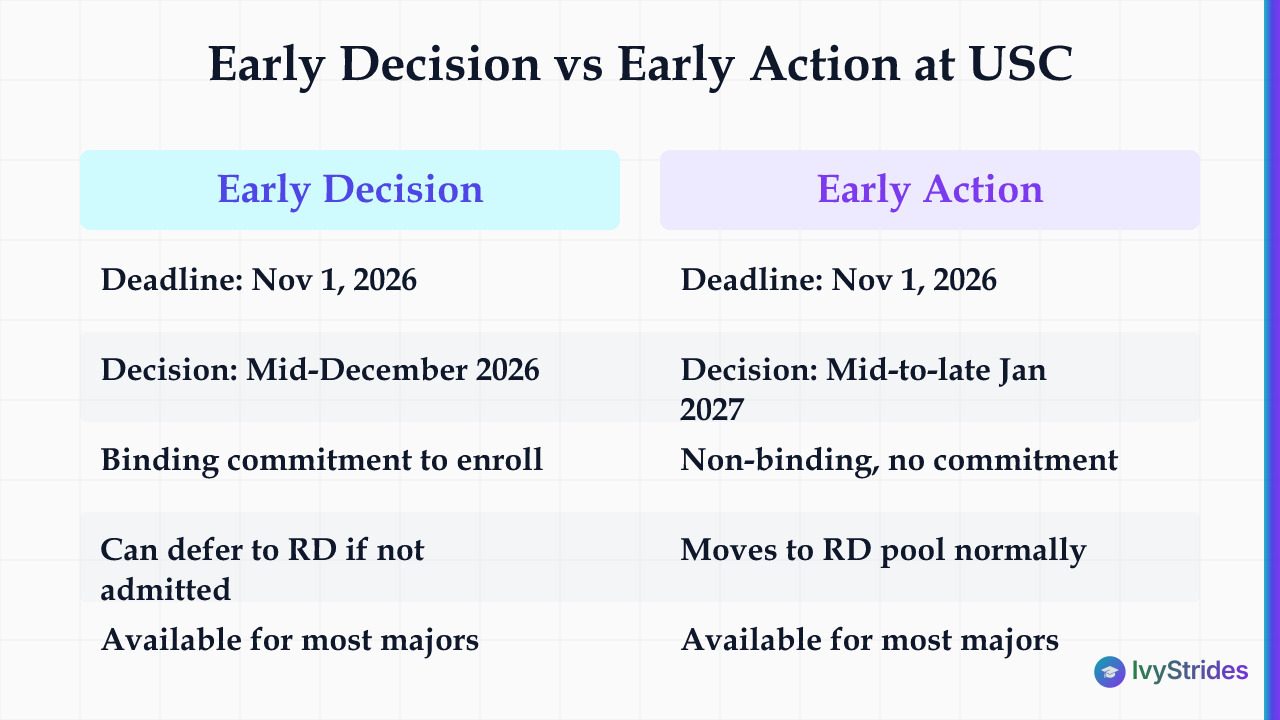
USC offers three application plans for Fall 2027 entry: Early Decision, Early Action, and Regular Decision. ED and EA share a November 1, 2026 deadline; Regular Decision runs to January 10, 2027. Only ED carries a binding commitment to enroll if USC admits you.
Here is every plan at a glance.
| Plan | Deadline | Decision Date | Binding? | Who Can Use It |
| Early Decision | Nov 1, 2026 | Mid-December 2026 | Yes | Most majors |
| Early Action | Nov 1, 2026 | Mid-to-late Jan 2027 | No | Most majors |
| Regular Decision | Jan 10, 2027 | By April 1, 2027 | No | Most majors |
| Performing arts | Dec 1, 2026 | By April 1, 2027 | No | Dance, Music, Dramatic Arts |
Performing arts is the exception. Applicants to the Kaufman School of Dance, the Thornton School of Music, and the School of Dramatic Arts cannot apply ED or EA for Fall 2027. December 1 Regular Decision is their only deadline, per USC's first-year admission page. One exception runs the other way: World Bachelor in Business applicants must apply by November 1, because that program no longer takes part in Regular Decision. Applicants to other portfolio programs should confirm their plan options with USC.
One mechanic matters before you choose. If USC does not admit you under ED, you can defer your application to the Regular Decision round, where USC considers it again within that admissions pool. The EA and RD timelines come from USC Viterbi's application plans page and the Dornsife apply page.
If you want the general framework for how these three plans behave across every college, our breakdown of Early Decision vs Early Action vs Regular Decision covers the rules that apply everywhere, not just at USC.
USC Early Decision vs Early Action: The Key Differences for Fall 2027 Applicants
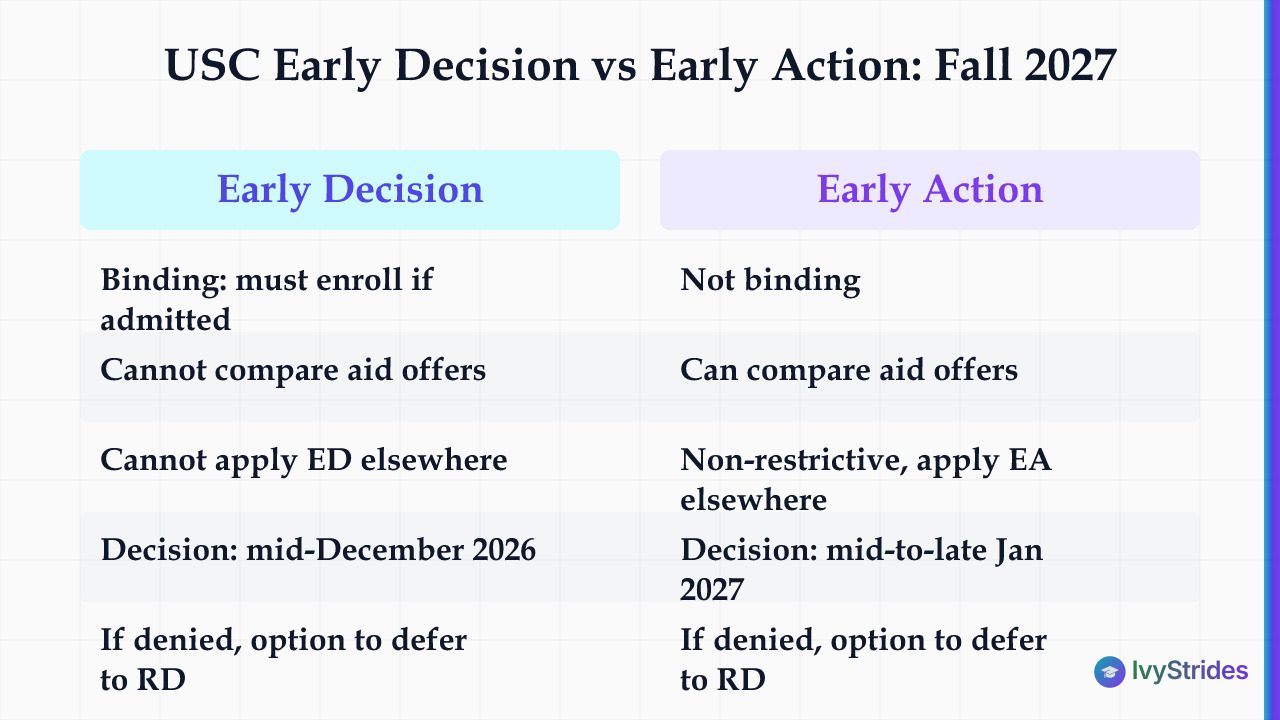
USC Early Decision and Early Action differ on one axis that drives everything else: the binding commitment.
| Factor | Early Decision | Early Action |
| Binding? | Yes, must enroll | No |
| Deadline | Nov 1, 2026 | Nov 1, 2026 |
| Decisions | Mid-December 2026 | Mid-to-late Jan 2027 |
| Compare aid offers? | No | Yes |
| Apply ED elsewhere? | No | Yes, EA is non-restrictive |
| If not admitted | Option to defer to RD | Option to defer to RD |
Binding means binding. If USC admits you under ED, you must enroll and withdraw your applications to other schools. You also may not apply ED anywhere else at the same time, per the provost's announcement. You gain a December answer and signal USC is your clear first choice; you give up the ability to weigh USC against other acceptances.
For financial-aid-sensitive families, the trade-off is concrete. USC considers ED applicants for merit scholarships and need-based aid, but you commit before you can set USC's package beside offers from other schools. Families who need to compare aid letters from multiple schools should lean toward EA, even when USC is a strong preference, because ED closes off that comparison. If aid math is tight, our guide on whether to apply Early Decision when you need financial aid walks through the calculation first.
Families with significant need should contact USC's financial aid office directly before committing to a binding plan. A binding yes is hard to undo.
And if your test score is still climbing? USC is test-optional, and October is the final SAT or ACT sitting it considers for both ED and EA, per USC's deadline FAQs. Students weighing applying Early Decision with a borderline test score should map that score decision against the full file first.
What USC Looks for in Early Decision and Early Action Applicants
USC evaluates ED and EA applicants on the same criteria; the plan you choose does not change what USC reads. USC rates five factors "Very Important" in its Common Data Set 2025-2026, which reports on the Fall 2025 entering class: rigor of secondary school record, academic GPA, application essay, recommendations, and character or personal qualities.
What USC does not weigh. The same Common Data Set rates class rank, interview, geographical residence, state residency, religious affiliation, and level of applicant's interest as "Not Considered." Demonstrated interest won't move your file, and USC's admission office conducts no interviews. USC's admissions readers, not formulas, conduct holistic review and look at how you earned your GPA, not just the number, per USC's admission blog.
That matters for the GPA question: course rigor, read in the context of your own school, counts as much as the figure. Admitted first-years typically took the most rigorous schedule available, and USC expects at least three years of math including advanced algebra, per USC's What We Look For page.
Use this as a readiness check before you commit.
| Component | What USC Weighs |
| Course rigor | Most rigorous schedule your school offers |
| Academic GPA | How it was earned, in context |
| Application essay | Your own voice, not AI-generated text |
| Recommendations | Values, character, contributions |
| Character | Willingness to go beyond requirements |
| Activities | Meaningful engagement, leadership |
USC names the personal traits it wants: willingness to go beyond the requirements, curiosity about the world and other peoples and cultures, and the potential to make an impact. On essays, USC asks applicants to use their own words, not AI-generated text. One recommendation is required, from either your school counselor or a teacher from your school.
No published ED rate. USC has not released an ED acceptance rate, because this is the first cycle ED exists university-wide. For the Fall 2026 entering class, USC's first-year student profile reports 79,331 applicants and 10,006 admits, a 12.6% admit rate. That's the overall rate, not an ED rate, and it predates university-wide ED.
If these five factors leave you unsure whether your file measures up, you can benchmark your number with our look at how USC reads a GPA in context before you decide.
Which USC Applicants Should Choose Early Decision Over Early Action
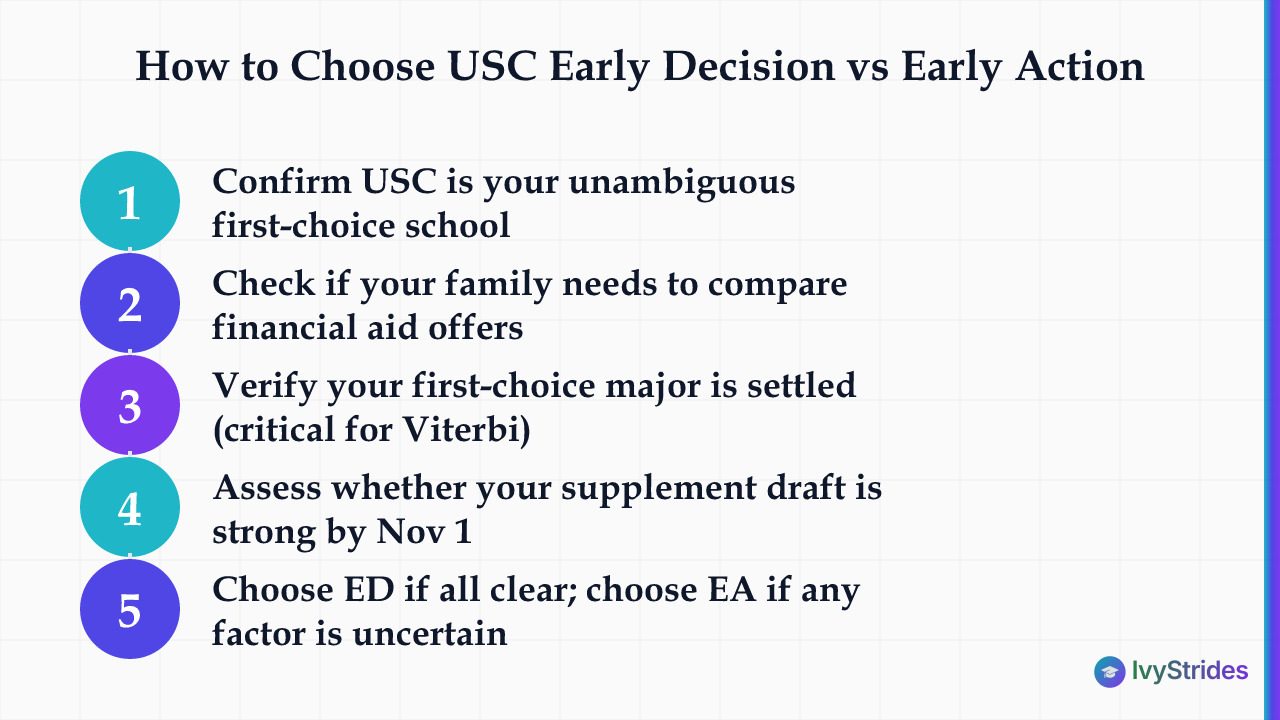
USC Early Decision fits applicants for whom USC is an unambiguous first choice, whose file is complete and strong by November 1, and whose family does not need to compare aid offers. Early Action fits everyone weighing those same factors who needs to keep options open.
| Your Situation | Recommended Plan | Reason |
| USC is a clear #1, aid not a constraint | Early Decision | Binding, December answer |
| Need to compare aid offers | Early Action | Preserves optionality |
| Score still improving, plan to submit | Early Action | Non-binding, so an October score that disappoints does not lock you in |
| Viterbi, first-choice major uncertain | Early Action | Only first-choice is read |
| Dance, Music, Dramatic Arts | Regular Decision | No ED or EA; December 1 deadline |
| Strong file, USC top choice, aid flexible | Early Decision | Process finishes by mid-December |
Viterbi applicants, read this. USC Viterbi only considers your first-choice major for admission, and it calls at least one year of calculus important preparation, per the Viterbi apply page. USC says to apply ED only if you're fully committed to the major on your application, so an unsettled first choice points to EA. If USC offers you ED admission to a different major, the ED agreement does not bind you.
Because USC rates the application essay as Very Important and asks for writing that sounds like you rather than AI-generated text, the strength of your supplement is a meaningful variable in the ED-versus-EA timing decision.
USC's writing supplement includes a short answer on your academic interests and how you plan to pursue them at USC. A supplement that isn't yet strong is a reason to hold off on ED, though EA does not allow more revision time. The November 1 deadline is identical for both plans, but a binding commitment changes how you approach a draft that still needs work. If yours does, our walkthrough on shaping a supplement that reads like you is the place to start.
On test scores. USC says applicants to the 2027-28 academic year need not send SAT or ACT scores and does not penalize applicants who withhold scores, per USC's test-optional FAQ. Whether to submit a 1480 or a 1400 is a separate decision from ED versus EA, mapped against your full profile.
Mapping your GPA, course load, supplement draft, and score decision against USC's five Very Important factors before November 1 is exactly the file audit our college admissions counseling for grades 11 and 12 runs. For a sense of how binding ED behaves at peer schools, the Columbia ED acceptance rate gives a concrete comparison point, though USC's own ED rate doesn't exist yet.
FAQ: USC Early Decision and Early Action for Fall 2027
What day does the USC Early Decision come out?
USC releases Early Decision results in mid-December 2026. USC has not published a specific calendar date. Watch your email and the USC applicant portal in mid-December after you submit by the November 1, 2026 deadline.
Does USC have an Early Decision?
Yes. USC introduced binding Early Decision for Fall 2027 applicants, announced February 9, 2026. The deadline is November 1, 2026, with decisions in mid-December 2026. ED covers nearly all undergraduate programs; Dance, Music, and Dramatic Arts majors cannot use it and apply by the December 1 Regular Decision deadline.
Does USC reject during Early Action?
USC says it does not expect to turn students away in the early rounds. Applicants it does not admit under Early Action or Early Decision get the chance to defer to Regular Decision, with a decision by April 1, 2027.
Can a 3.5 GPA get into USC?
USC weighs how you earned your GPA, not just the number, and reads course rigor in the context of your own school. A 3.5 in the most rigorous available curriculum, paired with strong essays, recommendations, and character, reads differently than a 3.5 in a lighter load. USC does not use GPA cutoffs.
Your Next Step on the USC ED Decision
USC's new binding Early Decision reshapes the Fall 2027 choice: a December answer and a clear first-choice signal, traded against the ability to compare aid and keep other options open. Everything hinges on how firmly USC is your top school and whether your file is ready by November 1.
Before you decide:
- Confirm your program qualifies for ED; performing arts majors use the December 1 Regular Decision deadline.
- If you need to compare financial aid offers, lean toward Early Action and contact USC's financial aid office.
- Check every deadline on USC's admission site before you submit, as policies can change year to year.

Hemant is a seasoned entrepreneur, investor, and growth strategist with deep ground in education and technology-driven learning. His core training is in Mathematics and Physics — he authored Physics for IB Diploma: Ultimate Revision Guide, recognized as a top student resource.