
Does Rice Early Decision Help Your Odds? Rice Says 'Not Necessarily'
On this page
- How Rice Early Decision I and II Work: Deadlines, Decisions, and the Binding Rule
- Does Rice Early Decision Increase Your Chances? What the Numbers Show
- What Rice Actually Weighs in an ED File: The Nine Very Important Factors
- Rice ED I vs ED II: Which Round Fits Your Timeline?
- FAQ: Rice Early Decision Rounds and Odds
- Does Rice have an Early Decision?
- What is the Early Decision acceptance rate at Rice University?
- Is Rice Early Decision binding?
- When does Rice Early Decision come out?
- Your Next Step on Rice Early Decision
Rice Early Decision is a binding first-choice application offered in two rounds: ED I closes November 1 with decisions by mid-December, and ED II closes January 4 with decisions by late January. Rice's own FAQ says ED does "not necessarily" improve your chances.
That last line matters more than any acceptance rate. The Rice FAQ frames ED as a commitment, not a shortcut, so the real question is whether Rice is your genuine first choice and whether your file is ready to submit early.

How Rice Early Decision I and II Work: Deadlines, Decisions, and the Binding Rule
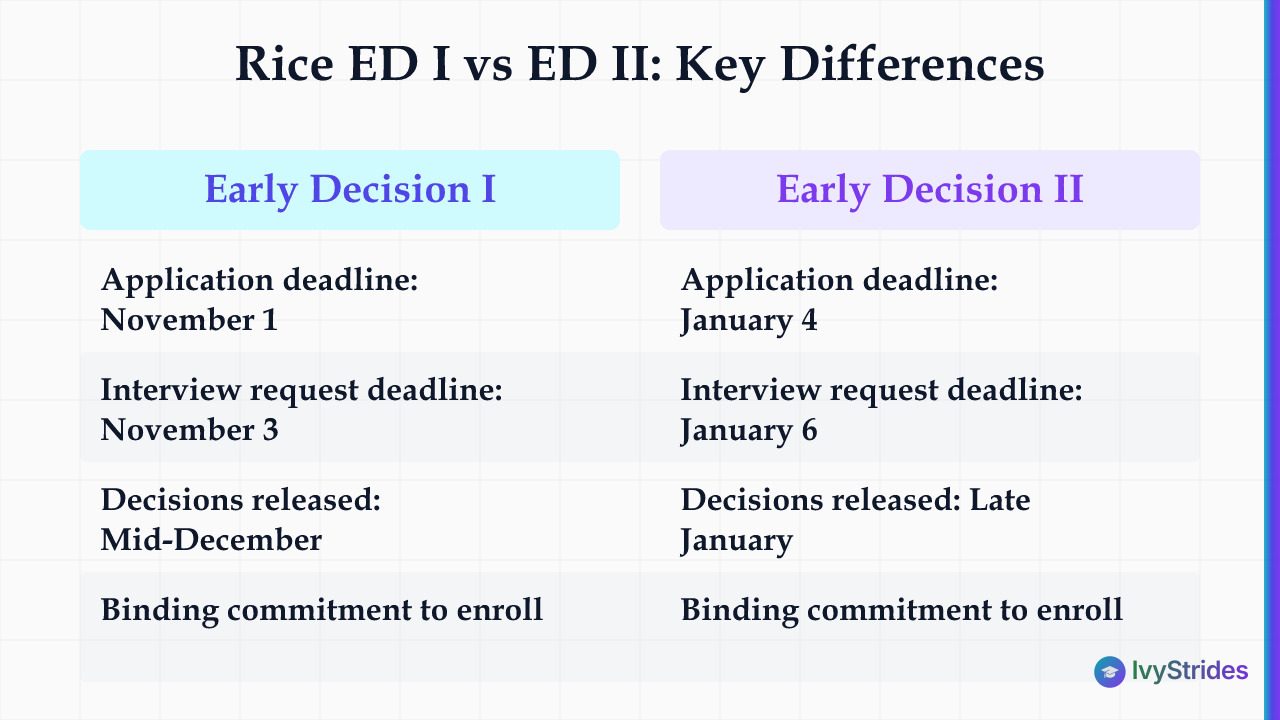
Rice Early Decision is a binding commitment to enroll if admitted. Apply under ED I or ED II, and if Rice admits you, you must withdraw every other active application and submit your enrollment deposit. The possible outcomes under both rounds are admit, defer, or deny.
Two binding rounds, two timelines. ED I closes November 1, with decisions released by mid-December. ED II closes January 4, with decisions by late January, per Rice's first-year applicant page. Rice does not offer a non-binding early plan, so if you want to apply early, binding is the only route.
| Round | Application Deadline | Interview Request Deadline | Decision Released | Binding? |
| Early Decision I | November 1 | November 3 | Mid-December | Yes |
| Early Decision II | January 4 | January 6 | Late January | Yes |
| Regular Decision | January 4 | December 16 (priority); January 6 (final) | By April 1 | No |
Rice takes applications through the Common App or the QuestBridge National College Match, and QuestBridge applicants who do not match can still apply ED or RD if they have not matched with another binding school. Rice recommends an interview but keeps it optional and not guaranteed; a Rice Alumni Volunteers for Admission (RAVA) member or a current student conducts it, and Rice holds every 2026-27 interview virtually. If Rice does not match you with an interviewer, that absence does not affect your decision.
One group cannot apply ED at all. Music applicants are not eligible for ED I, ED II, or QuestBridge. They apply Regular Decision, and their Common App, Rice Supplement, and Preliminary Submission or Audition Profile Form are all due December 1. Families who depend on aid should also weigh whether Early Decision is workable when you need financial aid before signing a binding agreement.
Does Rice Early Decision Increase Your Chances? What the Numbers Show
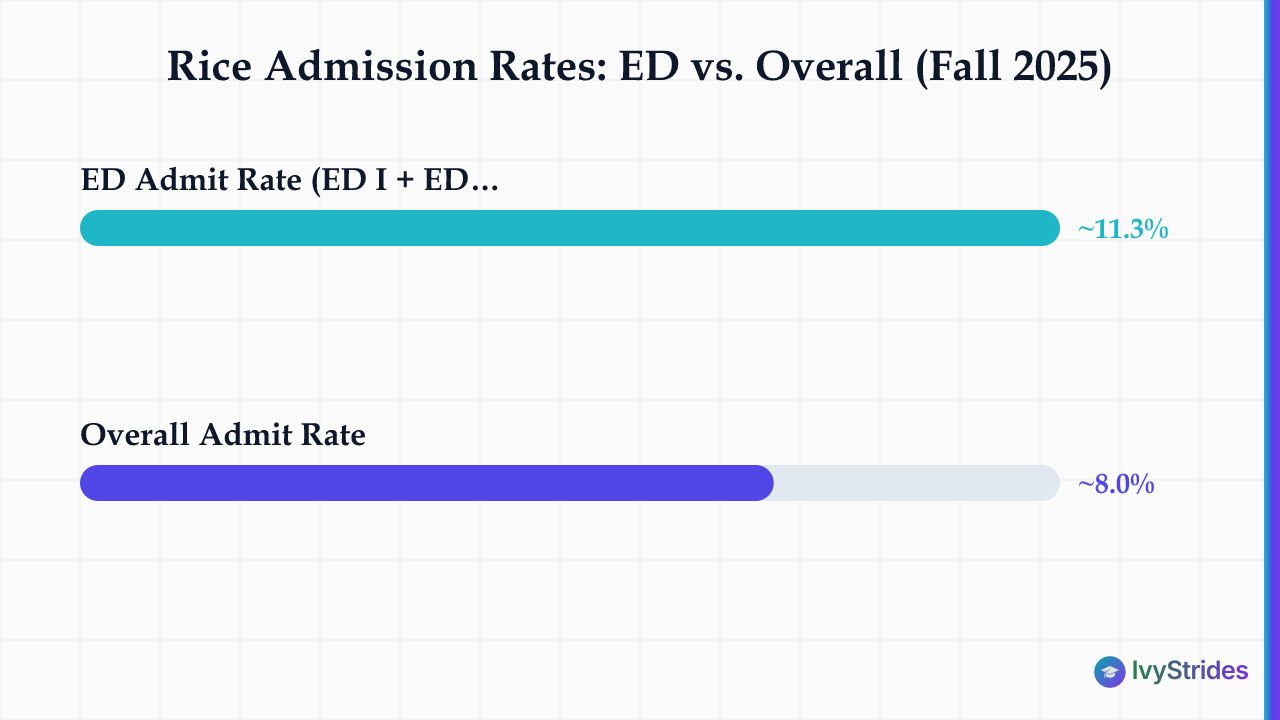
Rice's admission pages do not state an ED acceptance rate, and Rice's FAQ states plainly that applying ED does "not necessarily" improve your chances. So treat ED as a commitment signal, not a statistical lever.
The overall rate sets the context. IvyStrides' analysis of Rice's published Common Data Set 2025-26 figures, 2,948 admitted from 36,791 first-year applicants, puts the overall acceptance rate for the fall 2025 entering class at about 8.0%. By Rice's CDS section C21 counts, shown below, ED applicants were admitted at about 11.3%, but they choose themselves into that pool, so the gap does not show that applying ED raised anyone's odds.
| Figure | Value | Source |
| First-year applicants (fall 2025) | 36,791 | CDS 2025-26, C1 |
| Admitted | 2,948 | CDS 2025-26, C1 |
| Overall acceptance rate | about 8.0% | IvyStrides analysis of CDS 2025-26 |
| ED applications, ED I and ED II combined | 5,748 | CDS 2025-26, C21 |
| Admitted under ED | 647 | CDS 2025-26, C21 |
| ED admit rate | about 11.3% | IvyStrides analysis of CDS 2025-26 |
What ED does carry is a demonstrated-interest signal. Rice's CDS rates level of applicant's interest as "Considered," and a binding application tells Rice it is your first choice, though Rice does not say whether ED counts toward that factor. But the application philosophy page says Rice is careful not to overweight any single metric such as class rank, GPA, or test scores. The commitment does not substitute for a strong file.
If you set Rice beside a peer's figures, such as Penn's Early Decision acceptance rate, remember that Rice's CDS reports ED I and ED II as one combined pool. If your SAT or ACT sits below Rice's middle 50%, think through applying ED with a score below Rice's middle 50% before you commit.
Here's the part most students miss: ED only helps if the file behind it is ready. That is a question worth answering out loud before November 1.
What Rice Actually Weighs in an ED File: The Nine Very Important Factors

Rice's holistic review rates nine factors as "Very Important" in its CDS 2025-26, section C7, and a binding ED application does not change the weight of any of them. Those factors are the same whether you apply ED or RD.
| Factor | What to Confirm Before the ED Deadline |
| Rigor of secondary school record | Your transcript shows the hardest courses available to you |
| Class rank | Reported where your school provides it |
| Academic GPA | Final junior-year grades are strong |
| Standardized test scores | Submitted if they help your file |
| Application essay | Personal statement drafted and revised |
| Recommendations | One counselor, two core-subject teachers secured |
| Extracurricular activities | Your activity list reflects genuine depth |
| Talent/ability | Any portfolio or supplement is ready |
| Character/personal qualities | Your essays show who you are |
Two readers, two halves. Rice uses Committee-Based Evaluation, in place since 2017, pairing one officer focused on academics with one focused on personal elements. A file holds up under this review when the academic reader and the personal reader each find something specific and credible in their half of the file.
Choosing between ED I and ED II is one of the highest-stakes calls in the senior-year calendar, and a counselor who reviews your full file against Rice's nine factors works through the essays, the transcript, and the school-of-study fit with you before you submit.
Rice recommends submitting SAT or ACT scores if available for the 2026-27 cycle, which covers entry in fall 2027, and applicants who cannot or prefer not to submit still receive full consideration. Rice superscores both tests, taking the highest score from each section across all your test dates. Policies vary by year, so confirm the current rule on Rice's site before you decide.
Essay 2 asks specifically what elements of the Rice experience appeal to you, and the strength of that 150-word answer often separates a compelling ED file from a generic one. Knowledge of Rice is an explicit review factor, so what Rice's supplemental essays reward in Essay 2 carries real weight.
The two-reader split decides whose eyes land on which part of your file: one officer focuses on academic components such as transcripts, school profiles, and recommendations, and the other on personal components such as activities, honors, and essays. Knowing that division tells you where a weak essay or a thin activity list costs you most.
Rice ED I vs ED II: Which Round Fits Your Timeline?
Rice ED I and ED II carry the same binding commitment and run on different timelines. Both are binding, both yield admit, defer, or deny, and Rice added ED II beginning with the 2024-25 application cycle to give committed applicants a second binding window.
| Factor | Apply ED I (Nov 1) | Apply ED II (Jan 4) |
| Application readiness | Complete by November 1 | Needs more time to polish |
| Essays | All three drafted and revised | Still refining supplement |
| Test score timing | No further sittings planned | One more SAT or ACT sitting |
| First-choice confidence | High and settled | Confirming over the fall |
| Decision released | Mid-December | Late January |
| Binding | Yes | Yes |
Choose on readiness, not strategy. Some students choose ED II not because they are less committed to Rice, but because they want one more SAT or ACT sitting: Rice's testing deadlines are the September ACT and October SAT for ED I, and December for both tests under ED II. Rice designs both plans for fully committed applicants whose top choice is Rice, so ED II is a later deadline for an equally binding promise.
For students still deciding between binding and non-binding early plans across their full college list, the broader ED vs EA vs RD framework applies before narrowing to Rice.
Two groups follow different rules. Music applicants cannot use either ED round; they apply Regular Decision, with the full application due December 1. Architecture applicants submit a required portfolio, a PDF up to 15 MB with a cover page and up to 10 pages, alongside the standard application.
Students deferred from Rice ED I or ED II are considered with the Regular Decision pool, where Rice's testing deadline is December for both the SAT and ACT. A deferral is not a denial, so read what a Rice deferral signals and what to send next to decide what updates help most.
FAQ: Rice Early Decision Rounds and Odds
Does Rice have an Early Decision?
Yes. Rice offers two binding Early Decision rounds: ED I with a November 1 deadline and decisions by mid-December, and ED II with a January 4 deadline and decisions by late January. Rice does not offer a non-binding Early Action plan.
What is the Early Decision acceptance rate at Rice University?
Rice does not state an ED acceptance rate, but its CDS 2025-26, section C21, reports 647 admits from 5,748 Early Decision applications for the fall 2025 entering class, ED I and ED II combined, which works out to about 11.3%. The overall acceptance rate for the fall 2025 entering class was about 8.0%, based on IvyStrides' analysis of Rice's CDS 2025-26 figures, 2,948 admitted from 36,791 applicants. Rice's own FAQ states that applying ED does "not necessarily" improve chances.
Is Rice Early Decision binding?
Yes, both ED I and ED II are binding. If Rice admits you under either round, you must commit to attending, withdraw all other active college applications, and submit your enrollment deposit. The possible outcomes are admit, defer to Regular Decision, or deny.
When does Rice Early Decision come out?
ED I decisions are released by mid-December. For ED II, Rice's first-year applicant page says decisions come by late January, and a June 2026 Rice admission blog post says early February. Mid-February is the ED II enrollment deposit deadline, not a decision date. Rice has not published the exact day within those windows for the 2026-27 cycle, so check your Rice Admission Student Portal and the email address on file.
Your Next Step on Rice Early Decision
The decision is not which round gives you an edge, because Rice says applying ED does "not necessarily" improve your chances. It is whether Rice is your genuine first choice and whether your file is ready to carry a binding promise.
- Decide if Rice is truly your first choice before you sign any ED agreement.
- Confirm your essays, recommendations, and test-score plan against the nine Very Important factors.
- Pick ED I by November 1 if your file is complete, or ED II by January 4 if you need more time.
- If you are a Music applicant, check the December 1 deadline for your full application. If you are an Architecture applicant, check the portfolio requirements now.

Rajesh is a technology leader, entrepreneur, and angel investor with 28+ years in Business & Technology Leadership and Product & Solution Engineering. He is passionate about education, mentoring, and driving digital transformation.