
How to Find your Essay's Theme or 'so What': The Complete 2026 Playbook for a Top Score

On this page
- What a College Essay Theme Actually Is (and What It Is Not)
- How to Extract Your College Essay 'So What' in Three Questions
- The Four College Essay Theme Traps That Kill a Good Story
- How to Test Whether Your College Essay Theme Is Strong Enough
- FAQ: Finding Your College Essay Theme
- What is a theme for an essay?
- How do I find my college essay topic?
- Is ChatGPT good for college essays?
- What are the seven Common App essay prompts for 2026-27?
- Your Next Step on Your Essay Theme
Your college essay's theme is what your story reveals about who you are, not what happened. To find it, ask two questions: "Why do I still think about this?" and "What did this change about how I see myself or the world?" The answer, in one sentence, is your 'so what'.
That method comes from thousands of essay drafts read across admissions cycles, and it works inside a fixed constraint: the Common App personal statement runs to 650 words. The hard part is not the story. It is naming the meaning underneath it clearly enough that an admissions reader can repeat it after one read.
What a College Essay Theme Actually Is (and What It Is Not)
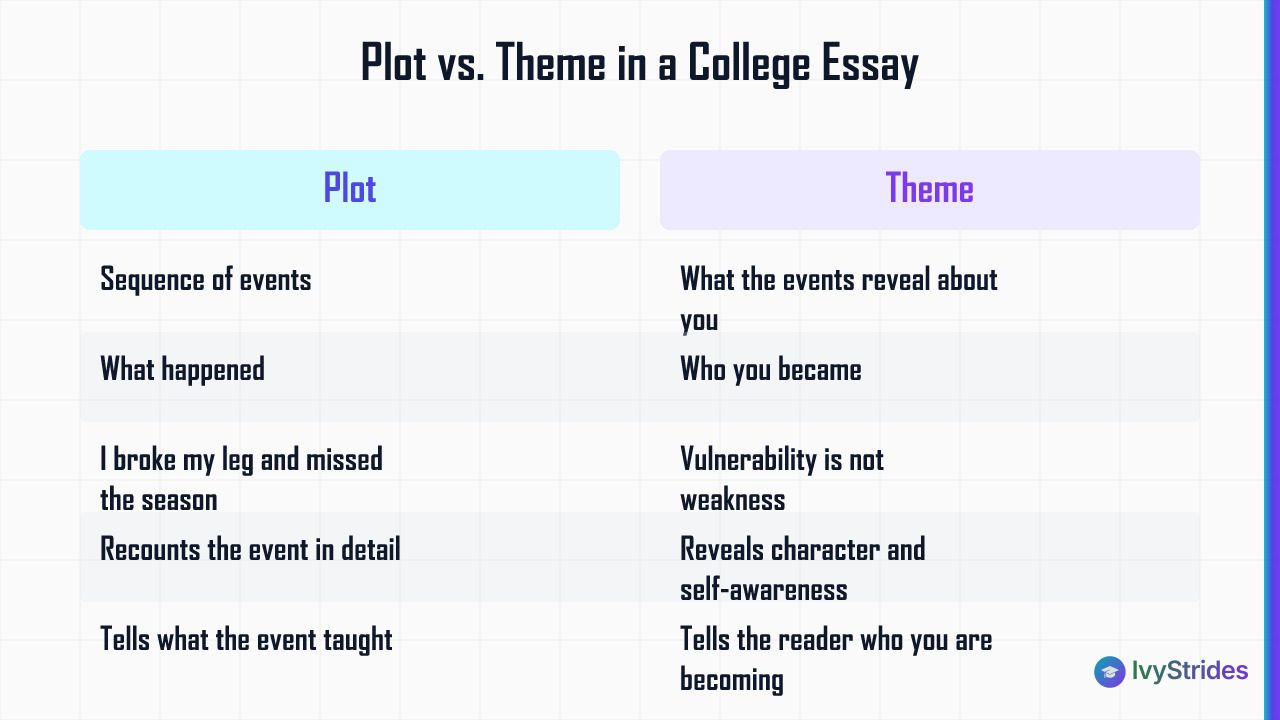
A college essay theme is the insight or value your story reveals about you, stated in a single sentence. It is not the topic, and it is not the plot. The topic is the subject. The plot is the sequence of events. The theme is what those events mean for who you are, which is the only layer an admissions reader scores for character revelation and self-awareness.
Plot versus theme, made concrete. Take one story: you broke your leg at regionals. The plot is the sequence, "I broke my leg at regionals and missed the season." The theme is what it meant, "I learned that vulnerability is not weakness." Same event, two different essays. One recounts what happened. The other reveals who you became. Most drafts stall at the plot and narrate the break in detail, which is why they read flat.
The theme has to be yours, not the story's moral. A lesson like "I learned teamwork" is a generic moral any player could recite. An identity-rooted theme sounds different: "I am someone who finds meaning in the invisible labor others overlook." That second sentence names a value, a way of seeing, something true about your character. The test is simple. A lesson tells the reader what the event taught; a theme tells the reader who you are becoming.
Why the reader can't guess. An admissions reader cannot infer a theme you never made explicit. Based on admissions officer accounts, IvyStrides estimates your personal statement receives roughly three to four minutes of focused reading in a typical review cycle. A clear theme lowers the reader's cognitive load. A buried one asks a busy stranger to do your interpretive work. Babson College's admissions guidance makes the same point: pick a topic that reveals who you are, not just the event.
| Element | What it answers | Example from a single story |
| Topic | What is the essay about? | Breaking my leg at regionals |
| Plot | What happened? | I got hurt and missed the season |
| Theme | So what does this reveal about me? | Vulnerability is not weakness |
If you're still deciding which story to center, brainstorming comes before theme extraction; see our guide on how to brainstorm college essay ideas for a full memory-mining exercise. If you haven't landed on a story at all, start with college essay ideas that work, then come back here to pull the meaning out.
How to Extract Your College Essay 'So What' in Three Questions
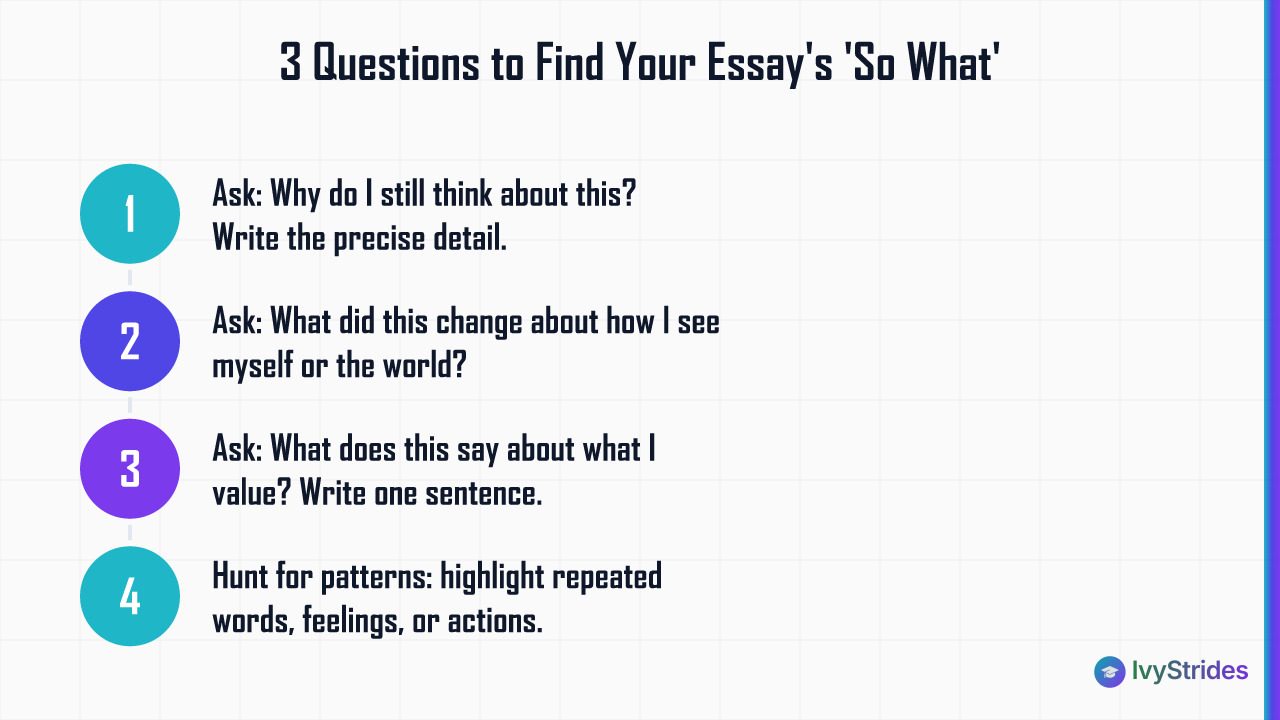
Pull your college essay 'so what' out of any story by running it through three questions in order. This is the method, and it produces a one-sentence theme before you draft a paragraph. Answer each in writing, not in your head.
The trick is to keep drilling. Ask "why does this moment matter?" then take that answer and ask "why does THAT matter?" then push once more, "why does THAT matter to who I am becoming?" Each layer strips away surface event and moves you toward an insight rooted in your character. The three questions below formalize that drill.
-
Why do I still think about this? Write down the specific reason the memory sticks. Not "because it was hard." Because of what, exactly.
-
What did this change about how I see myself or the world? Name the before and the after. If nothing changed, the story may be plot with no theme underneath it.
-
What does this say about what I value? The answer to this is usually your theme sentence in raw form.
| Step | Question to ask | What to write down |
| 1 | Why do I still think about this? | The precise detail that won't leave you alone |
| 2 | What did this change about how I see the world? | The shift, stated as before and after |
| 3 | What does this say about what I value? | One sentence, no event named |
Then hunt for patterns. Once you have rough answers, read your notes and highlight every repeated word, feeling, or action. Patterns you did not plan are the surest signal of your real theme. University of Cincinnati's admissions guidance is blunt: specific, ordinary stories that reveal how you think beat impressive-sounding topics every time.
In our coaching, students who write a theme sentence before drafting produce first drafts that need fewer structural revisions, because they stop wandering. Frame the theme around growth, not achievement. "I won the award" is plot. "I stopped needing the award to feel like the work mattered" is a 'so what'. After you have your sentence, the next craft task is rendering it in scene, which is where show, don't tell in college essays takes over.
The Four College Essay Theme Traps That Kill a Good Story
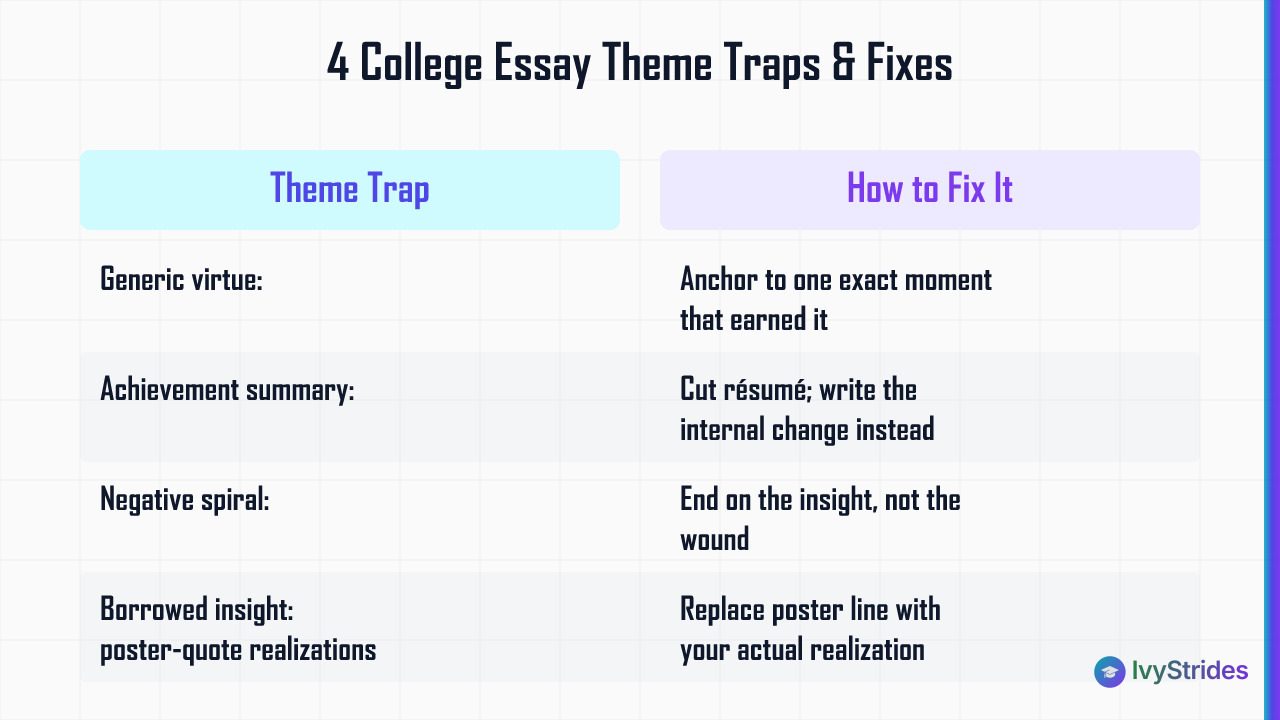
Four theme traps sink otherwise good college essays: the generic-virtue trap, the achievement-summary trap, the negative-spiral trap, and the borrowed-insight trap. Each one produces a 'so what' a stranger could have written. That stranger problem is exactly the identity gap from the last section: a borrowed lesson names no one, while a real theme names you. Across hundreds of drafts, the most common failure we see is a virtue stated without the specific moment that earned it. Sarah Arberson's admissions guidance names the same dos and don'ts of topic choice: a lesson has to be lived, not announced.
Run your theme sentence through the stranger test. If a stranger could write the same sentence about their own life, it isn't specific enough yet.
| Theme trap | What it sounds like | How to fix it |
| Generic virtue | "I learned resilience and hard work" | Anchor it to one exact moment that earned the value |
| Achievement summary | "My awards show my dedication" | Cut the résumé; write the internal change instead |
| Negative spiral | "Everything went wrong and I gave up" | End on the insight, not the wound |
| Borrowed insight | "Failure is just success in progress" | Replace the poster line with your actual realization |
Some story types make a strong theme nearly impossible to land. Our list of college essay topics to avoid explains which subjects, sports victories, mission trips, and hardship-summary immigration narratives among them, consistently produce generic 'so whats'.
Here's the part that's hard to do alone: you cannot always tell whether your own theme clears the stranger test, because you know the story too well to read it cold. That's the exact review our college essay coaching provides, an admissions essay coach reading your theme sentence against the specificity standard before you spend hours drafting the wrong essay.
How to Test Whether Your College Essay Theme Is Strong Enough
Test a college essay theme against four checks before you draft. A theme that passes all four is specific, personal, defensible, and aimed at a real prompt. A theme that fails even one produces the flat draft you were trying to escape. Those trap patterns from the section above are exactly what these four checks catch before they reach the page.
- Names a value or insight, not a generic virtue. "I value precision" beats "I learned to work hard."
- Could only have been written by you. Run the stranger test one more time.
- Answers 'so what?' without naming the event. If you have to describe the injury to explain the theme, the theme isn't standing on its own yet.
- Aligns with at least one 2026-27 Common App prompt. The seven prompts are unchanged for 2026-27 per the Common App's announcement, though prompts are confirmed annually, so check each cycle.
Pick the prompt after the theme, not before. Match your theme sentence to whichever prompt fits most naturally, whether that's the one on challenge, on questioning a belief, or the open topic-of-your-choice. In our coaching, students who lock the prompt before drafting are less likely to blow past the 650-word limit chasing details that serve the story but not the theme. See the Common App word limit guide for the exact rules.
To decode all seven prompts with strategy, see how to answer each 2026-27 Common App prompt. Once your theme sentence is locked, the next decision is where to place it; our guide on how to structure a Common App essay covers the two frameworks that work best for a clear 'so what'. One caveat worth holding: a strong theme raises the quality of your essay, but the personal statement is one part of a holistic application, and no theme guarantees admission.
FAQ: Finding Your College Essay Theme
What is a theme for an essay?
In a college admissions essay, the theme is the central insight or value your story reveals about you, not the topic and not the event. It answers "so what did this mean for who I am?" in one sentence. A working theme is specific to you, not a universal lesson anyone could claim.
How do I find my college essay topic?
Start with specific memories, not impressive achievements. List five moments when you felt most like yourself, most challenged, or most changed. Run each through the three-question method: why you still think about it, what it changed, and what it says about what you value. The memory that yields the most specific answer is your topic.
Is ChatGPT good for college essays?
AI tools can help you brainstorm or check grammar, but they cannot supply your specific lived experience or authentic voice, which is exactly what admissions readers evaluate. Essays generated or heavily shaped by AI tend to produce generic themes and flat phrasing, and admissions officers flag them for that lack of specificity. Use AI as a sounding board for ideas, never as a drafter. The 'so what' has to come from you.
What are the seven Common App essay prompts for 2026-27?
The seven 2026-27 Common App prompts are unchanged from the prior cycle, per the Common App's official announcement. They cover background and identity, challenge and failure, a belief you question, problem-solving, personal growth, a topic that captivates you, and a topic of your choice. Align your theme to at least one prompt before you begin drafting.
Your Next Step on Your Essay Theme
You now have a repeatable way to move from a story you lived to a sentence that says what it meant. The work from here is short and specific:
- Run your story through the three questions and write one theme sentence.
- Apply the stranger test: could someone else claim the same sentence?
- Check it against the four-point strength list.
- Match it to one 2026-27 Common App prompt before you draft.
Do those four things and your next draft starts from meaning instead of summary, which is the whole difference between an essay that recounts and one that reveals.

Award-winning author (South Asian Book Award) and graduate of BITS Pilani and UCLA Luskin School of Public Affairs. Brings a published writer's eye to Common App essays and grammatical precision to SAT and ACT R&W instruction.