
How to Answer Each 2026-27 Common App Prompt (All 7, With Strategy)
On this page
- The Short Answer: What You Actually Need to Know First
- The 7 Common App Prompts for 2026-27 at a Glance
- How to Pick Your Topic Before You Pick Your Prompt
- Prompt-by-Prompt Strategy: How to Answer Each of the 7
- Prompt 1: Background, Identity, Interest, or Talent
- Prompt 2: Challenge, Setback, or Failure
- Prompt 3: A Questioned or Challenged Belief
- Prompt 4: Gratitude
- Prompt 5: Accomplishment, Event, or Realization
- Prompt 6: A Topic That Captivates You
- Prompt 7: Topic of Your Choice
- The Hardest Part: Choosing When You Feel Like You Have No Story
- The Personal Statement vs. Supplemental Essays: What Goes Where
- Revision: The Step Most Students Skip
- Where the Common App Essay Fits in Your Broader Admissions Strategy
- FAQ
- Do you have to answer all seven Common App essay prompts?
- Which Common App prompt do most students choose?
- How many Common App essays are required in total?
- What are the five qualities of a strong college essay (sometimes called the 5 Ds)?
- Is it bad to use Prompt 7 (topic of your choice)?
- What is a strong example of a Common App Prompt 1 essay?
- How do I approach Common App Prompt 6 (the passion or intellectual curiosity prompt)?
You answer exactly one of the seven 2026-27 Common App essay prompts in a personal statement of 250 to 650 words. The prompts are unchanged from 2025-26. Pick the prompt that best fits the story you most want admissions officers to read, then write a specific, scene-driven essay that reveals your character instead of restating your resume. Most competitive essays land between 550 and 650 words. Supplemental essays for individual schools are separate and must cover different ground.
Those specifics come straight from the official prompt announcement. What follows is the coaching side of the work: how to pick your prompt, how to structure each of the seven, and how to revise so the essay sounds like you.
The Short Answer: What You Actually Need to Know First
One prompt. One essay. 250 to 650 words, per commonapp.org. You submit that single personal statement through the Common App writing section, and every one of the 1,000+ Common App member schools on your list reads the same essay. You don't write seven essays. You write one.
The 2026-27 prompts are confirmed unchanged from the prior cycle. That's genuinely useful, because example essays and coaching frameworks from the last cycle still apply to yours.
A distinction worth locking in now: the personal statement is one document sent to all schools. Supplemental essays are additional, school-specific prompts (things like "Why our university?" or "Describe a community you belong to"), and they vary widely. Some schools require zero supplementals. Others require three or four. Once your personal statement is drafted, your next task is the supplemental essays, which are school-specific and must tell a different story than your Common App essay; see our guide on how to write supplemental essays for a prompt-by-prompt breakdown.
One more piece of context. Prompt 7, topic of your choice, is the most-used option, chosen by roughly 28% of applicants in recent cycles. That doesn't make it easier or harder. It just tells you a lot of essays lack an external constraint, so the burden of focus falls on you.
The 7 Common App Prompts for 2026-27 at a Glance
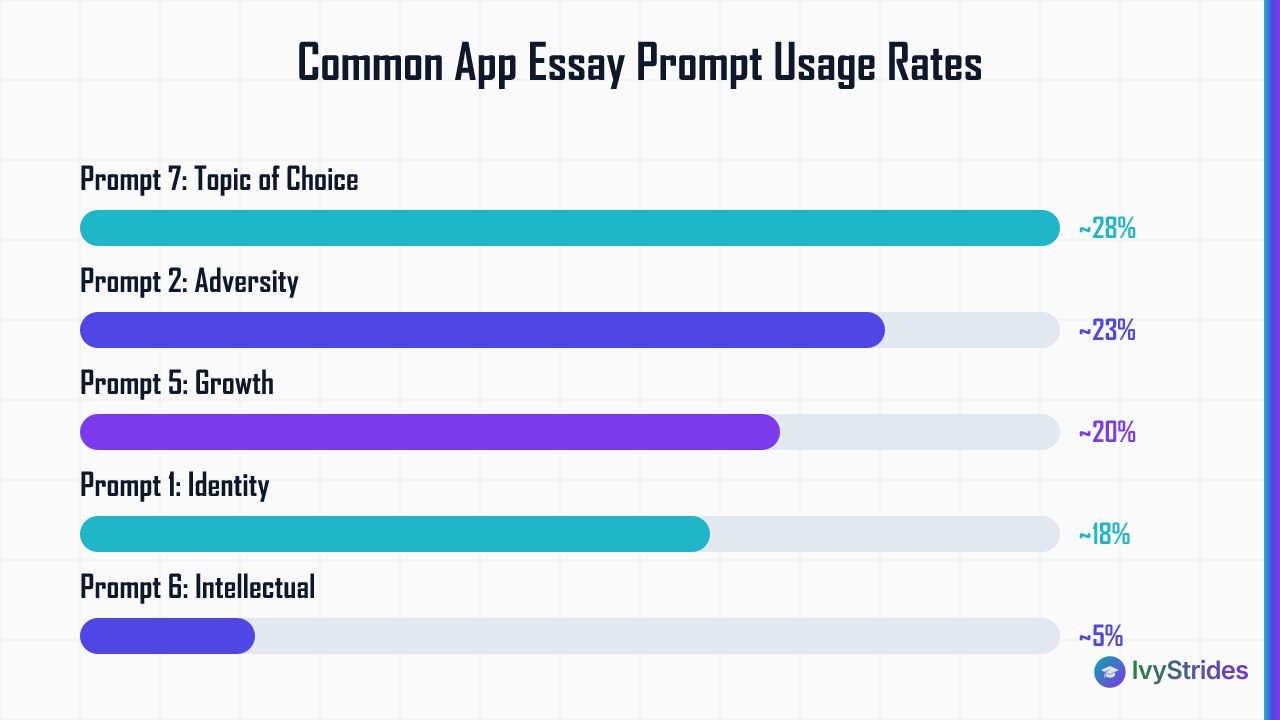
Here are all seven prompts as they appear on commonapp.org, with a strategic label for each and rough usage patterns from Common App's published applicant data. The 2026-27 prompts are confirmed unchanged from the prior cycle, per Common App's official announcement.
Prompt 1 (the identity essay, roughly 18% of applicants): Some students have a background, identity, interest, or talent that is so meaningful they believe their application would be incomplete without it. If this sounds like you, then please share your story.
Prompt 2 (the adversity essay, roughly 23%): The lessons we take from obstacles we encounter can be fundamental to later success. Recount a time when you faced a challenge, setback, or failure. How did it affect you, and what did you learn from the experience?
Prompt 3 (the challenged-belief essay, roughly 3%): Reflect on a time when you questioned or challenged a belief or idea. What prompted your thinking? What was the outcome?
Prompt 4 (the gratitude essay, roughly 3%): Reflect on something that someone has done for you that has made you happy or thankful in a surprising way. How has this gratitude affected or motivated you?
Prompt 5 (the growth essay, roughly 20%): Discuss an accomplishment, event, or realization that sparked a period of personal growth and a new understanding of yourself or others.
Prompt 6 (the intellectual passion essay, roughly 5%): Describe a topic, idea, or concept you find so engaging that it makes you lose all track of time. Why does it captivate you? What or who do you turn to when you want to learn more?
Prompt 7 (topic of your choice, roughly 28%): Share an essay on any topic of your choice. It can be one you've already written, one that responds to a different prompt, or one of your own design.
Word limit across all seven: 250 to 650. Popularity shouldn't drive your choice. The prompt that best fits your story should. If you want to think harder about topic before prompt, our guide to the best college essay topics in 2026 walks through what resonates with admissions officers and what to avoid.
How to Pick Your Topic Before You Pick Your Prompt
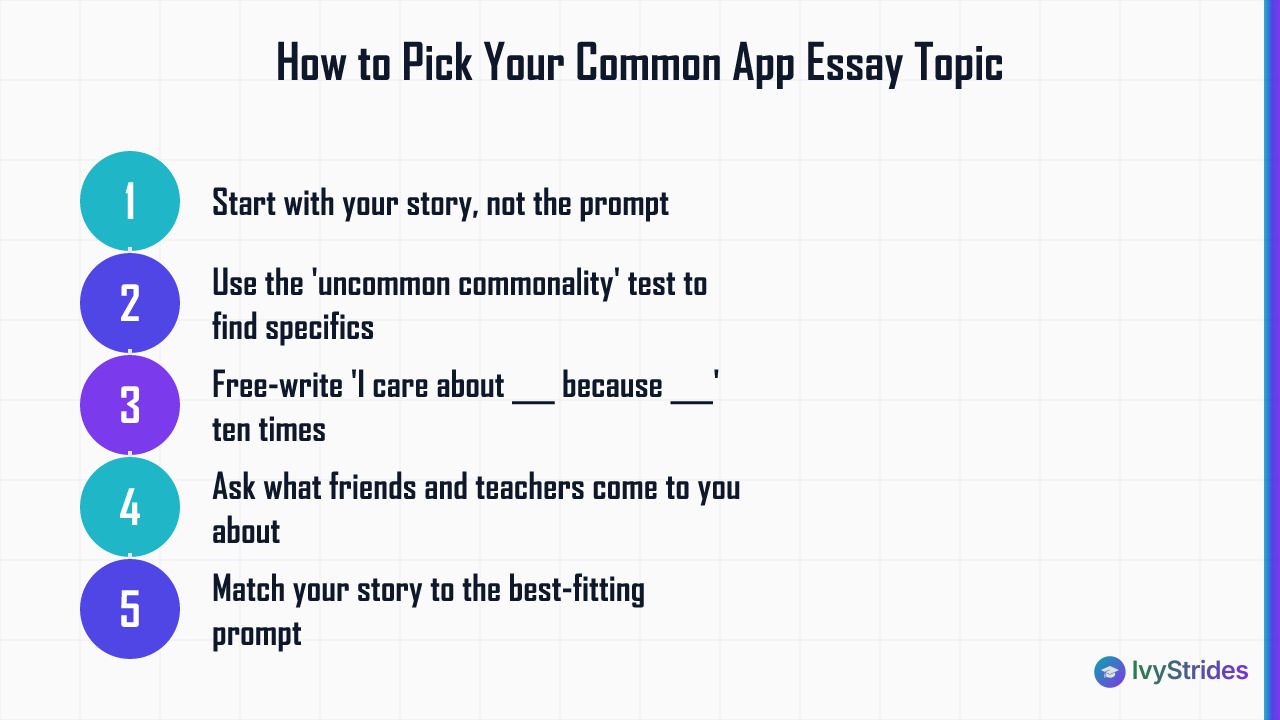
Here's the mistake we watch students make every August. They open Common App, read the seven prompts, decide which one "sounds like them," and then try to reverse-engineer a story to fit. The essay comes out generic because the prompt is doing the driving instead of the story.
Flip it. In our essay coaching work, students who start with a topic and then find the matching prompt write stronger first drafts than those who start by reading the prompts. Your job in week one isn't to choose a prompt. It's to find the one story only you could tell.
Three brainstorming methods that actually produce material:
The "uncommon commonality" test. What do you do or think about that would surprise your classmates if they knew? Not exotic. Just specific. A student who spends every Sunday cooking with a grandparent has an uncommon commonality. A student who ranks the acoustics of every classroom in the building has one too.
The five-minute free-write. Set a timer. Write "I care about ______ because ______" and finish it ten different ways without stopping. Don't edit. The tenth answer is usually more honest than the first.
The "what do people ask you about" test. What do friends, teachers, and family come to you about? That thing is often the identity or interest that anchors a Prompt 1 or Prompt 6.
Most stories fit more than one prompt. A student passionate about competitive chess could use Prompt 1 (chess as identity), Prompt 6 (chess as intellectual obsession), or Prompt 7 (open canvas). The core story is the same. The framing changes what the reader notices. If you can name a date, a place, and one sensory detail attached to your topic, it's specific enough to anchor an essay. If you can't, keep brainstorming.
If you want a deeper walkthrough of the full drafting process from blank page to final version, our step-by-step guide on how to write a personal statement covers structure, voice, and opening hooks in detail. For personalized help, a common app essay tutor can accelerate the topic-selection stage.
Prompt-by-Prompt Strategy: How to Answer Each of the 7
Each prompt has an emotional center and a structural approach that fits it best. Here's how to think about all seven.
Prompt 1: Background, Identity, Interest, or Talent
Emotional center: who you are when no one is grading you.
Structural approach: anchor to one specific scene that embodies the identity, then zoom out. Don't open with "I have always loved…" Open in the middle of the action.
Most common mistake: the essay becomes a life summary that skims across five interests without landing on one.
Micro-example: a student who repairs vintage electronics could open with the moment a broken 1970s transistor radio hissed back to life on their workbench, then use that scene to reveal a family connection to their grandfather's engineering career and a broader relationship with restoring things others discard. The identity is shown through action, not declared.
Prompt 2: Challenge, Setback, or Failure
Emotional center: what you did after the thing went wrong.
Structural approach: event, impact, lesson, forward application. Roughly 30% event, 20% impact, 50% lesson and forward application. In our coaching work, the most common Prompt 2 mistake is spending about 70% of the word count on the setback and only about 30% on the growth. Flip that ratio.
Most common mistake: the victim narrative. If a reader finishes and remembers only what happened to you, you wrote it wrong. They should remember what you did next.
Micro-example: a student who failed to make the state math competition finals rebuilt their approach to problem-solving by working backwards from solutions instead of forwards from problems, and the shift changed how they now tutor younger students. The failure is the setup. The rebuilt method is the essay.
Prompt 3: A Questioned or Challenged Belief
Emotional center: intellectual courage without preaching.
Structural approach: small-scale personal belief works better than global controversy. Show the process of changing your mind, not the conclusion. Admissions officers are reading for nuance, not political alignment.
Most common mistake: picking a topic that reads as a political statement rather than a thinking process.
Micro-example: a student who challenged their family's assumption that a four-year university was the only legitimate path to success, after researching trade apprenticeship programs for a school project, and ultimately came back to college with a clearer reason for choosing it. The belief was small. The reasoning is what stands out.
Prompt 4: Gratitude
Emotional center: how someone else's action reshaped you.
Structural approach: the gift is a lens, not the subject. Spend a small share on what happened, most of the word count on how it changed your behavior. If a reader could substitute a different benefactor and the essay still works, you wrote about the wrong person: yourself needs to be the subject.
Most common mistake: the tribute essay. Beautiful writing about a grandmother that reveals nothing about the applicant.
Micro-example: a teacher who returned a marked-up draft with a single marginal note ("say the harder thing") changed how a student approached every piece of writing afterward, including college interviews and student council speeches. The note is the hinge. The student's evolving voice is the story.
Prompt 5: Accomplishment, Event, or Realization
Emotional center: the internal shift, not the external win.
Structural approach: name the before-and-after understanding explicitly. What did you believe before? What do you believe now? What specifically caused the change?
Most common mistake: the trophy-case essay. Listing the award, the ranking, the trip. Admissions officers already see those in your activities list.
Micro-example: a student realized during a robotics build that failure is iterative, not final, after a gripper mechanism broke three times in the two weeks before regionals. The mechanism is a footnote. The mental reframe (breakage as data, not verdict) is the essay.
Prompt 6: A Topic That Captivates You
Emotional center: obsession in action.
Structural approach: show what you actually do with the interest. The books you seek out at 11pm. The experiments you run. The people you cold-emailed. Keep the camera on you, not on the topic.
Most common mistake: the class report. A well-written explanation of urban planning theory tells the reader nothing about the applicant.
Micro-example: a student obsessed with urban planning spent a summer mapping pedestrian traffic patterns in their neighborhood on foot, then presented the findings at a local city council meeting where the average attendee was three decades older. The obsession isn't stated. It's demonstrated.
Prompt 7: Topic of Your Choice
Emotional center: whatever you decide, done with discipline.
Structural approach: treat Prompt 7 as Prompt 1 with full creative latitude. The lack of constraint is the challenge, not the gift. Roughly 28% of applicants pick this prompt, so it isn't unusual, but a rambling Prompt 7 is more common than a rambling Prompt 2 because there's no external structure to lean on.
Most common mistake: treating it as easier. It isn't. It requires the same narrative discipline as any other prompt.
Micro-example: a student writes a hybrid essay that reads as a letter to their younger self, threading three moments across ten years that all revolved around one recurring habit (packing and unpacking a suitcase after each family move). The form is inventive. The specificity carries it.
Once you have a first draft of any of these, the next step is real revision. Our guide on how to edit a college essay covers the specific cuts that matter. For direct feedback, our essay review service puts a coach on your draft with line-level notes.
The Hardest Part: Choosing When You Feel Like You Have No Story
Look, this is the part every August rolls around and every rising senior hits. "My life is too ordinary. I haven't survived anything. I haven't won anything national. Why would anyone care?"
Reframe. Admissions officers aren't looking for dramatic trauma or extraordinary achievement. They read hundreds of essays per cycle. What differentiates the memorable ones isn't the size of the event. It's the specificity of the voice and the honesty of the self-awareness. A well-written essay about a Tuesday afternoon habit beats a poorly written essay about surviving a hurricane. Every time.
In our essay coaching work, students who describe themselves as having nothing interesting to write about often produce the most distinctive essays once they focus on a single recurring habit, object, or relationship rather than a peak achievement. Peaks are what your resume shows. Habits and relationships are what an essay can uniquely reveal.
Three exercises when you feel stuck:
Exercise 1: list five things you do every week that most of your classmates don't. Pick the one you could talk about for 30 minutes without running dry. That's your topic.
Exercise 2: ask a parent or close friend what story they'd tell about you to a stranger at a dinner party. The answer is often your essay. Parents especially notice the through-lines you can't see in yourself.
Exercise 3: think of a moment in the last two years when you changed your mind about something. Not a global belief. A small one. That moment is a Prompt 3, Prompt 2, or Prompt 5 essay waiting to be written.
The personal statement is a character-reveal document, not a highlight reel. If you keep the standard low ("show one honest thing about how I actually think") instead of high ("prove I deserve to get in"), the writing gets easier and better at the same time. If you want one-on-one help for common app essay work, a coach can help you find the story you can't see from inside your own life.
The Personal Statement vs. Supplemental Essays: What Goes Where
Here's the split. The personal statement is submitted once through the Common App writing section and sent to every school on the list, per commonapp.org. Supplemental essays are school-specific. Some schools require none. Others require three, four, or more, and word counts range from 50-word short answers to 650-word secondary essays. The number varies by school and application cycle.
The no-overlap rule is where most students slip. Your personal statement covers "who I am as a person." Supplementals cover "why this school" and "why this major" and "what community means to me at this specific college." If your personal statement is about your love of neuroscience, your Why Major supplemental for a neuroscience program can't rehash the same story. It needs different material. Admissions officers read the whole file at once. Repetition wastes your one shot at revealing something new.
In our essay coaching work, the most common structural mistake is writing a personal statement about a student's academic passion and then writing a Why Major supplemental that covers the same territory. Split the material deliberately. If neuroscience is your Why Major, make the personal statement about something else, maybe the way you take care of your younger brother or the way you catalogue everything in your room by system.
For a full walkthrough by school type, see our guide on how to write supplemental essays.
Revision: The Step Most Students Skip

Photo by RDNE Stock project on Pexels
First drafts are supposed to be bad. That's not the problem. The problem is when students submit the first draft as the final draft.
The 550 to 650 word sweet spot exists for a reason. Essays under 500 words often feel underdeveloped, like the student ran out of material. Essays that hit 650 with no filler signal a student who had something real to say and used every word. Common App doesn't penalize you for using the full 650. Use it.
Four revision tests:
The read-aloud test. Read the essay aloud. If you stumble on a sentence, rewrite it. If you sound like a robot, cut the SAT vocabulary. Your voice should be your voice.
The prompt-check test. Cover the prompt label and read only the essay. A reader should be able to guess which of the seven prompts you chose from the content alone. If they can't, your essay is too vague or you picked the wrong prompt.
The throat-clearing cut. Look at your first paragraph. In our essay coaching work, the most common structural problem in first drafts is a generic opening paragraph that could belong to any applicant. The real essay usually starts in paragraph two. Delete paragraph one. See how it reads.
The resume test. If any sentence in your essay could be replaced by a line from your activities list, cut it. The essay's job is to reveal what the resume cannot.
After your first draft is complete, revision is where most essays improve the most; our guide on how to edit a college essay without losing your voice covers the specific cuts and rewrites that matter.
Where the Common App Essay Fits in Your Broader Admissions Strategy
The personal statement is one component of holistic review, not the whole file. Admissions officers read your transcript, your test scores (where submitted), your AP scores, your activities list, your recommendations, your supplementals, and your personal statement as a connected picture. A strong essay doesn't compensate for a weak academic record. A strong academic record doesn't compensate for a weak essay. Both matter.
Test-optional context is worth naming here. At schools with test-optional policies, the essay carries even more weight in the holistic review, making a strong personal statement especially important for applicants who choose not to submit scores. That said, test-optional policies vary by school and year. Check each school's current policy at their admissions site or through FairTest before deciding whether to submit. And college admissions outcomes depend on the full application, not any single component, no matter how well-written.
This is why IvyStrides runs essay coaching alongside SAT, ACT, and AP coaching under one roof. Our essay coaches work with our test prep coaches so students build both components of the application on the same timeline. If your SAT is 200 points below your target and your essay is still a blank Google doc in September of senior year, the fall gets brutal. A connected plan solves it. For a deeper walkthrough of the drafting process itself, see our guide on how to write a personal statement.
FAQ
Do you have to answer all seven Common App essay prompts?
No. You choose exactly one prompt from the seven and write a single personal statement of 250 to 650 words. That one essay is submitted through the Common App writing section and sent to every Common App member school on your list. Supplemental essays for individual schools are separate and additional, but the personal statement itself requires only one prompt response.
Which Common App prompt do most students choose?
Prompt 7 (topic of your choice) is the most popular at roughly 28% of applicants, followed by the adversity prompt at about 23% and the personal growth prompt at about 20%. The intellectual passion, gratitude, and challenged-belief prompts each draw a much smaller share. Popularity shouldn't drive your choice, though. Admissions officers don't weight prompts by rarity. The prompt that best fits your story is the right one.
How many Common App essays are required in total?
Every applicant submits one personal statement of 250 to 650 words through the Common App writing section. Beyond that, individual colleges may require zero to several supplemental essays, and the number varies by school and application cycle. Once you add a school to your Common App list, its specific writing requirements appear in the writing section for that school. Check every school on your list before you plan your essay timeline.
What are the five qualities of a strong college essay (sometimes called the 5 Ds)?
The 5 Ds framework used in some college counseling contexts typically stands for: Distinctive (a story only you could tell), Detailed (specific scenes and sensory details rather than generalizations), Direct (a clear narrative arc without meandering), Demonstrated (character shown through action, not stated), and Differentiated (content that doesn't repeat what's already in your activities list or transcript). It's a useful revision checklist, not an official Common App or College Board standard. Use it as a coaching tool, not a rulebook.
Is it bad to use Prompt 7 (topic of your choice)?
No. Prompt 7 is the most-used option and isn't penalized by admissions officers. The risk is that without a built-in constraint, some students write unfocused essays. Treat Prompt 7 exactly as you would Prompt 1: anchor to one specific story, write in your own voice, and stay within 650 words. The freedom is a tool, not a shortcut.
What is a strong example of a Common App Prompt 1 essay?
A strong Prompt 1 essay opens with a specific scene that embodies the identity or interest, rather than a broad statement like "I have always loved science." For example, an essay about a student's obsession with fermentation might open with the moment a jar of homemade kimchi exploded in the family refrigerator, then zoom out to explain what that obsession reveals about the student's patience, curiosity, and relationship with their heritage. The identity is shown through action and detail, not declared. That contrast, between declaring and demonstrating, is the whole game.
How do I approach Common App Prompt 6 (the passion or intellectual curiosity prompt)?
Start with a specific moment when the topic grabbed your attention, not a general statement about how much you love it. Show what you actually do with the interest: the books you seek out, the experiments you run, the communities you join, the questions you keep asking. The risk with Prompt 6 is writing an essay that reads like a class report on the topic itself. The fix is keeping the camera on you and your behavior, not on the topic. The topic is the setting. You are the story.
Pick a prompt that fits a story only you could tell. Write a specific first draft anchored to one scene. Revise until it sounds exactly like the way you actually talk. That's the whole assignment.

Award-winning author (South Asian Book Award) and graduate of BITS Pilani and UCLA Luskin School of Public Affairs. Brings a published writer's eye to Common App essays and grammatical precision to SAT and ACT R&W instruction.