
Rice Counts Demonstrated Interest and UT Austin Does Not: What Changes
On this page
- How Rice Actually Tracks Demonstrated Interest in Your File
- Why UT Austin Does Not Track Demonstrated Interest and What to Do Instead
- What Type of Student Does Rice Look For Beyond Demonstrated Interest
- What to Do Differently at Rice Versus UT Austin Before Each Deadline
- FAQ: Rice and UT Austin Demonstrated Interest
- Does Rice University track interest?
- Is 1480 a good SAT score for Rice?
- What type of student does Rice look for?
- Where can you check whether Rice tracks demonstrated interest?
- Your Next Step on Rice and UT Austin Engagement
Rice University tracks demonstrated interest and rates it "Considered" in its 2025-26 Common Data Set. UT Austin says it does not use demonstrated interest in its holistic review. Demonstrated interest is the engagement a student shows toward a school.
Those two policies pull a Texas applicant's time in opposite directions. The same weekend spent emailing a UT Austin admissions officer moves nothing in that file, while at Rice an interview, if you are matched, and a specific supplement essay both go into the review.

How Rice Actually Tracks Demonstrated Interest in Your File
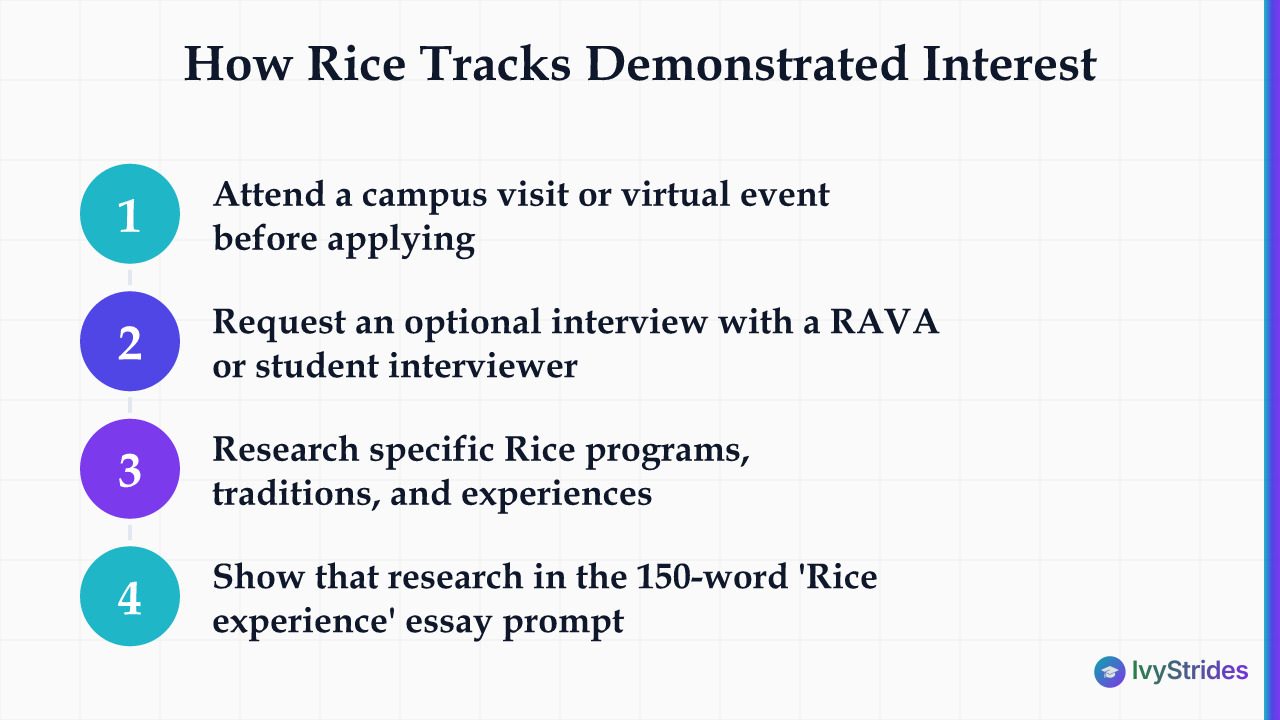
Rice suggests visits, virtual or in-person events and the optional interview as ways to learn about Rice, and wants that knowledge to show in the supplement. Its 2025-26 Common Data Set rates "level of applicant's interest" as Considered in section C7. That is a real rating, below the nine factors Rice marks Very Important, but explicitly on the list rather than Not Considered.
Where the signals land. Rice has used Committee-Based Evaluation since 2017, and its application philosophy page describes pairs of officers reading each file: one focused on academics, one on personal elements like activities, honors, and essays. Rice says the pair assesses your "knowledge of the Rice undergraduate experience." That same page names knowledge of Rice as an explicit review factor, so the research you do shows up as evaluated content, not as a logged visit alone.
The highest-use signal is written, not logged. The 150-word prompt asking what elements of the Rice experience appeal to you is the single best place to demonstrate that you have done the research Rice wants.
The Rice supplement also includes a 150-word academic essay on what draws you to your selected academic areas, and a 500-word essay for which you choose one of two prompts: (A) the life experiences or unique perspectives you look forward to sharing with fellow Owls in the residential college system, or (B) the perspectives shaped by your background that inspire you to join Rice's community of change agents.
Rice's own advice is to "do your research, be genuine and share what specific aspects of Rice excite you," and naming a program or tradition is where what Rice's supplement essays reward separates a researched answer from a generic one.
Interviews carry the same logic. Rice recommends an interview for first-year applicants, conducted by a Rice Alumni Volunteers for Admission (RAVA) member or a current student, all virtual for 2026-27. Interviews are optional and not guaranteed, Rice's CDS rates them Considered, and Rice's first-year applicant page says not being matched with an interviewer will not affect your decision. If you are weighing whether Early Decision at Rice fits your timeline, note the ED I interview request deadline falls on November 3, two days after the application closes on November 1.
| Engagement Channel | What Rice Says | Deadline or Timing |
| Campus visit or virtual event | Suggested; register or complete a prospective student form | Before you apply |
| Interview request (ED I) | Recommended, optional | November 3 |
| Interview request (RD priority) | Recommended, optional | December 16 (apply by December 14) |
| Interview request (ED II / RD) | Recommended, optional | January 6 |
| Supplement essay 2 (150 words) | Researched, specific content | With application |
Why UT Austin Does Not Track Demonstrated Interest and What to Do Instead
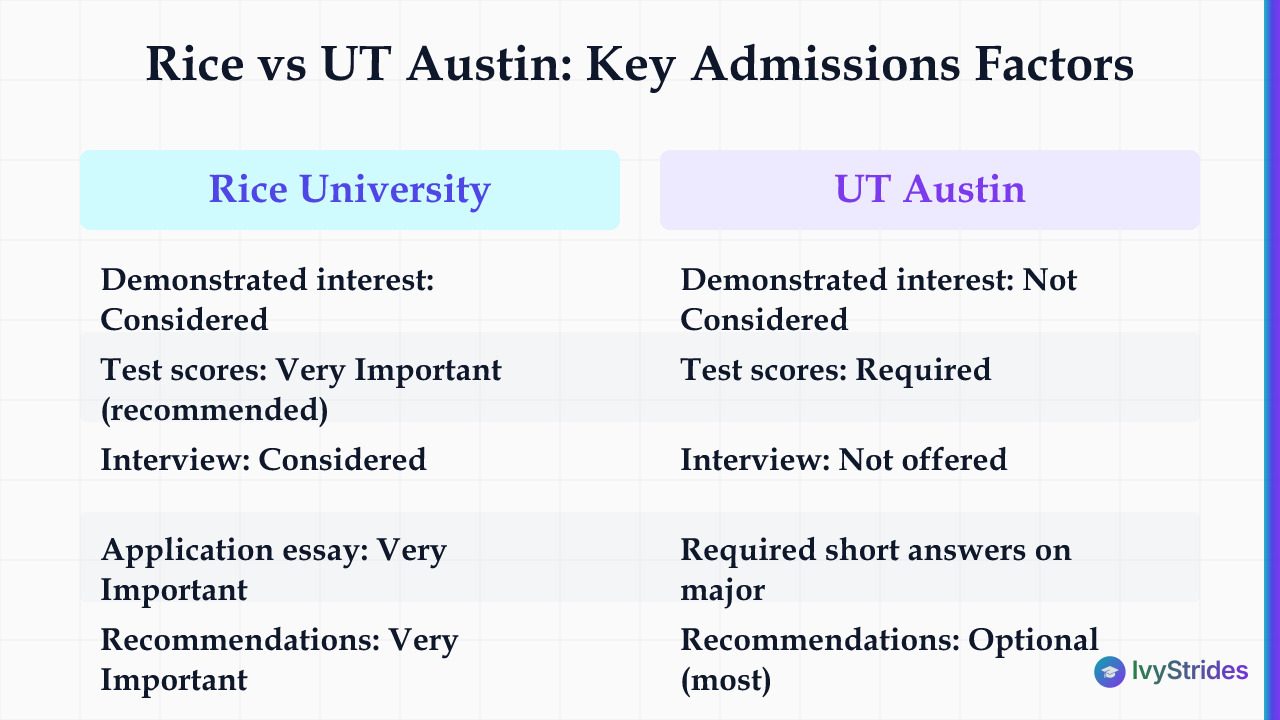
UT Austin's admissions FAQ says it "does not utilize demonstrated interest in the holistic review process," so an info session or an email to admissions changes nothing in that file. Its review and decision process page lists what the holistic read actually weighs: class rank, strength of academic background, test scores, achievements, honors and awards, special accomplishments plus work and service in and out of school, essays, optional recommendations, and the competitiveness of the major you applied to. UT also does not offer interviews for general admission, and its 2025-26 Common Data Set rates "level of applicant's interest" as Not Considered.
At UT Austin, the energy that would go into a "Why UT" essay is better spent on the required short answer about your first-choice major, which is a named review factor. The essays and short answers page confirms that required short answer 1 asks why you are interested in your first-choice major.
Test scores, not visits. UT Austin is test-required for the 2026-27 cycle. The freshman application page tells applicants to send at least one official SAT or ACT score from the testing agency, due October 22 for Early Action and December 10 for the regular deadline.
The major-alignment answer is where the redirected hours pay off, and UT Austin's supplemental essay prompts show exactly what that short answer has to carry.
| Review Factor | Rice (CDS 2025-26) | UT Austin (Named Factor?) |
| Rigor of secondary record | Very Important | Yes |
| Class rank | Very Important | Yes |
| Test scores | Very Important (recommended, not required) | Yes (required) |
| Application essay | Very Important | Yes |
| Short answers | No separate CDS factor | Yes (required short answers) |
| Recommendations | Very Important | Optional for most; required for some honors programs |
| Interview | Considered | Not offered |
| Level of applicant's interest | Considered | No (CDS: Not Considered) |
| Fit with first-choice major | Preparedness and alignment to selected majors | Yes (competitiveness of the major) |
What Type of Student Does Rice Look For Beyond Demonstrated Interest
Rice looks for students it describes on its admissions page as "voracious lovers of life" with "unquenchable curiosity about the world," diverse thinkers who bring different experiences to campus. Demonstrated interest is one Considered signal inside that holistic read, not the thing that decides it.
Nine factors carry the most weight. Rice's CDS 2025-26 rates these as Very Important: rigor of secondary record, class rank, academic GPA, standardized test scores, application essay, recommendations, extracurriculars, talent or ability, and character or personal qualities. Rice rates rigor of secondary record as Very Important alongside test scores, which is why how colleges read your transcript alongside test scores matters as much as the number itself.
Context over any single metric. Rice's application philosophy page says it is careful not to overweight class rank, GPA, or test scores, reading the breadth of a student's accomplishments against their life experiences. Fit matters too: applicants pick one of seven schools of study and up to three majors, and Rice's FAQ says Rice assesses students on their preparedness and alignment to the majors they selected.
On testing, Rice recommends submitting scores if available and gives full consideration to applicants who do not submit. It superscores both the SAT and the ACT, taking the highest section score across dates. That policy, plus the fit-based read, is why whether applying to Rice fits your academic profile is worth settling before you commit a supplement to it.
- Rigor of secondary record: confirm your transcript shows your school's most demanding courses
- Class rank and GPA: check that the Common App reports both accurately
- Test scores: decide whether to submit, since Rice recommends scores if available but gives full consideration without them
- Application essay: write a focused, specific essay
- Recommendations: one counselor plus two core-subject teachers
- Extracurriculars, talent, character: show depth, not a padded list
- Fit with chosen school and majors: name specifics in the 150-word academic essay
What to Do Differently at Rice Versus UT Austin Before Each Deadline
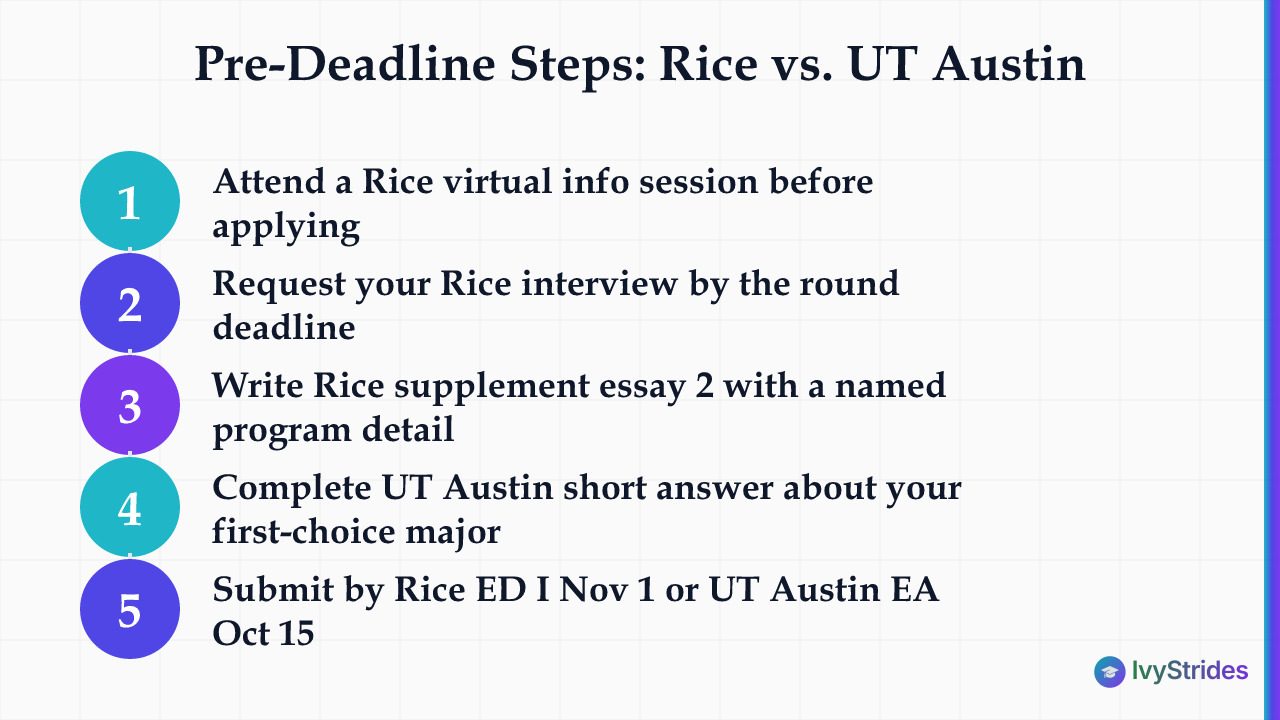
The two applications need different pre-deadline work, because Rice considers demonstrated interest and UT Austin does not. Students managing both applications benefit from a counseling timeline that sequences Rice and UT Austin deadlines across grades 11 and 12.
Both officers in Rice's paired review assess your knowledge of the Rice undergraduate experience. For Rice, attend a virtual event, request the interview by your round's deadline, and write supplement essay 2 with a named program or residential college detail. Rice's ED I deadline is November 1; ED II and Regular Decision both close January 4.
UT Austin runs on a different clock. Early Action closes October 15 with materials due October 22; the regular deadline is December 1 with materials due December 10. Early Action is non-binding and, UT says, gives no advantage in review. The payoff there is the required short answer about your first-choice major, not any gesture of interest.
| Action | Rice (Do This) | UT Austin (Skip or Redirect) |
| Virtual info session | Attend before applying | Skip |
| Interview request | Request by round deadline | Not offered for general admission |
| Supplement essay | Specific 150-word "Why Rice" | Redirect to major short answer |
| Test scores | Recommended if available; superscored | Required |
| Earliest deadline | ED I November 1 | EA October 15 |
| Binding? | ED rounds are binding | EA non-binding |
FAQ: Rice and UT Austin Demonstrated Interest
Does Rice University track interest?
Yes. Rice's 2025-26 Common Data Set rates "level of applicant's interest" as Considered. Rice suggests visits, virtual events and the optional interview as ways to learn about Rice, and its supplement asks what elements of the Rice experience appeal to you. Both officers in its paired Committee-Based Evaluation assess your knowledge of Rice.
Is 1480 a good SAT score for Rice?
Rice recommends submitting scores if available and gives full consideration to applicants who do not submit, so submitting a 1480 is a judgment call. Rice superscores both the SAT and ACT. IvyStrides' analysis of Rice's published CDS 2025-26 counts, 2,948 admitted from 36,791 applicants, puts the overall acceptance rate at roughly 8.0%, so a 1480 is one piece of a holistic file. Rice's CDS reports a middle 50% SAT range of 1510 to 1560 for fall 2025 enrollees who submitted scores, which puts a 1480 below that range.
What type of student does Rice look for?
Rice describes its ideal students as "voracious lovers of life" with "unquenchable curiosity about the world." Its holistic review weighs nine Very Important factors including rigor, GPA, essays, and character, always in the context of a student's life experiences. Rice also assesses fit with the chosen school of study and looks for genuine, specific knowledge of Rice.
Where can you check whether Rice tracks demonstrated interest?
The authoritative source is Rice's own Common Data Set, which rates "level of applicant's interest" as Considered in C7. That weight sits below Very Important, but it is explicitly on the list, and Rice's application philosophy page names knowledge of Rice as a review factor.
Your Next Step on Rice and UT Austin Engagement
The two policies ask for two different kinds of work from the same student. Rice considers the research you show in a 150-word essay and in an interview, if you are matched. UT Austin rewards a sharp major-alignment short answer and a score sent by the deadline. Treat them as one plan with two tracks.
- Confirm your nearest deadline: Rice ED I November 1, UT Austin EA October 15 or regular December 1
- Request the Rice interview by your round's deadline and attend one virtual event
- Draft Rice supplement essay 2 with a named program or residential college detail
- Write the UT Austin short answer on your first-choice major, not a "Why UT"
- Send UT Austin's official SAT or ACT score by October 22 or December 10

Hemant is a seasoned entrepreneur, investor, and growth strategist with deep ground in education and technology-driven learning. His core training is in Mathematics and Physics — he authored Physics for IB Diploma: Ultimate Revision Guide, recognized as a top student resource.