
What Rice's Supplemental Essays Reward: Proof You Know Rice
On this page
- What Rice's Three Supplemental Essays Ask and Why Each Prompt Exists
- How Rice Reads Each Supplemental Essay in Its Committee Review
- How to Write Rice's 150-Word "Why Rice" Essay Without Sounding Generic
- Does Your Rice Essay 2 Pass the Knowledge-of-Rice Test?
- How to Choose and Write Rice's 500-Word Community Essay
- FAQ: Rice Supplemental Essays 2026-27
- What should I upload to the Rice box?
- How many essays for Rice University?
- How to make Rice essay?
- Does Rice require supplemental essays?
- Your Next Step on Rice's Supplements
Rice asks Common App applicants for three supplemental essays in 2026-27: a 150-word academic interest essay, a 150-word "why Rice" essay, and a 500-word community essay. On the QuestBridge application, Rice marks that 500-word essay optional. The Rice supplemental essays are a knowledge-of-Rice test. Applicants also upload one image called The Box.
Every prompt text and word limit below comes from Rice's official first-year applicant page for the 2026-27 cycle. The harder question is what "knowledge of Rice" means in practice, because praise any selective university would accept does not prove it.
What Rice's Three Supplemental Essays Ask and Why Each Prompt Exists
Rice's three supplemental essays ask you to explain your academic draw, your specific appeal to Rice, and what you would contribute to its community. Each prompt tests the same thing from a different angle: whether you actually researched Rice, or whether you could swap in any university's name without changing a word.
The Rice supplements go through the Common App alongside your personal essay; the Rice-specific prompts are separate fields with their own word limits. They also add to the total number of supplemental essays across your college list, so plan your writing time early.
The Box is different. Every applicant uploads a two-dimensional image of something that appeals to them, via the Common App or the Rice portal. Rice states the image is not used for evaluative purposes. It exists to show who you are beyond your achievements.
Rice describes its ideal students as "voracious lovers of life" with "unquenchable curiosity about the world," diverse thinkers who bring different life experiences to campus. The essays are where you prove the curiosity is real and specific, not asserted.
| Essay | Word Limit | What It Tests | Key Requirement |
| Academic interest | 150 | Fit with your major and school of study | Select a school of study and up to three academic areas of interest |
| Why Rice | 150 | Genuine knowledge of Rice | Cite specific Rice programs or traditions |
| Community (choose A or B) | 500 | Contribution to the Rice community | Anchor in a concrete personal story |
| The Box | Image | Personality beyond achievements | Two-dimensional image, non-evaluative |
Rice rates the application essay "Very Important" in its 2025-26 Common Data Set, so these essays are not tiebreakers.
How Rice Reads Each Supplemental Essay in Its Committee Review
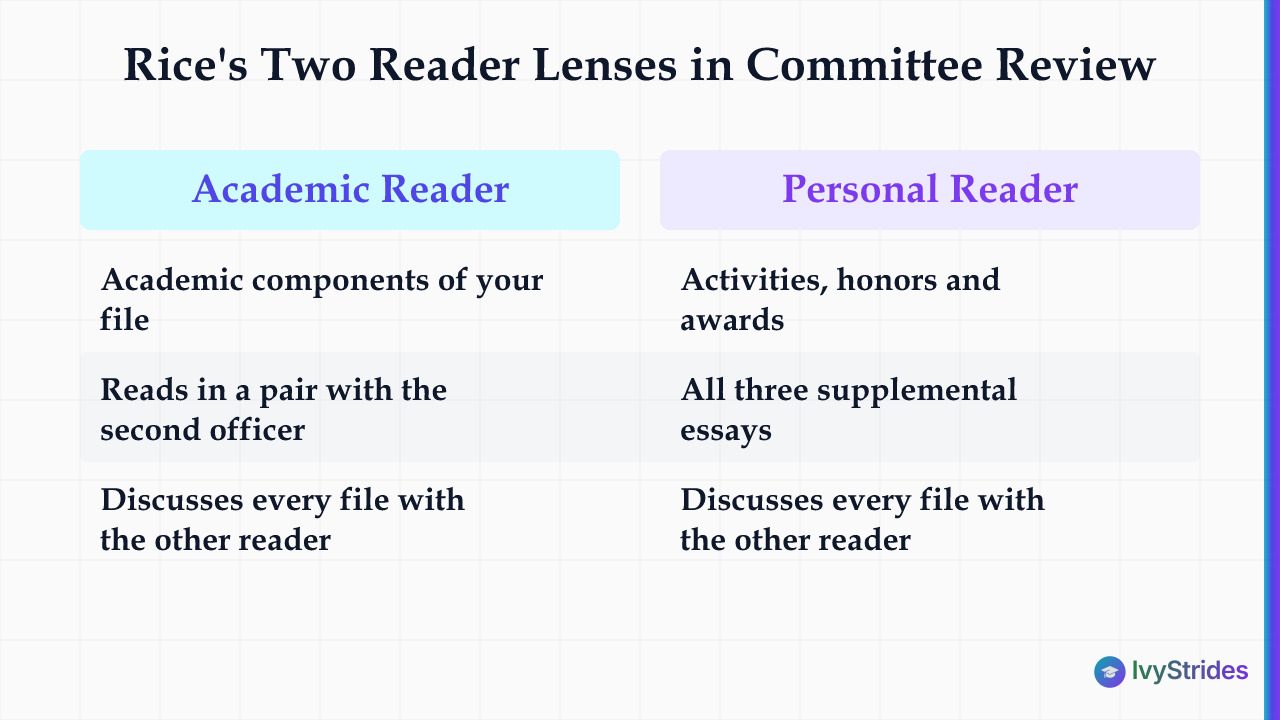
Rice's Committee-Based Evaluation pairs two admission officers on every file, one focused on academic components and one on personal components. Because at least two officers discuss each file together, all three supplements have to hold up in that conversation.
Two readers, two lenses. One reader focuses on the academic side of your file. The other works through your activities, honors and awards, and essays. Rice says the pair assesses your "articulation and alignment" to your academic interests and your "knowledge of the Rice undergraduate experience." All three essays sit with the second reader, among the personal components. The academic interest essay is where you show the first quality, the "why Rice" essay the second, and the community essay what you would add.
Rice rates nine factors Very Important in its 2025-26 Common Data Set, so the application essay holds the same top rating as standardized test scores and extracurricular activities. Rice evaluates the breadth of students' accomplishments "within the context of their life experiences," and says it is careful not to emphasize any single academic metric, such as class rank, GPA, or test scores. This is holistic review in its literal sense.
| Factor | Rice Rating (CDS C7 2025-26) |
| Rigor of secondary school record | Very Important |
| Class rank | Very Important |
| Academic GPA | Very Important |
| Standardized test scores | Very Important |
| Application essay | Very Important |
| Recommendation(s) | Very Important |
| Extracurricular activities | Very Important |
| Talent/ability | Very Important |
| Character/personal qualities | Very Important |
| Level of applicant's interest | Considered |
Knowledge of Rice is an explicit review factor. Rice names visits, virtual events, and optional interviews as ways to learn about Rice, and it rates level of applicant interest as Considered. That is where demonstrated interest shows up in the file.
On test scores. Rice is test-optional for the 2026-27 cycle (entry fall 2027): its first-year page says SAT or ACT scores are "recommended but not required," and applicants who cannot or prefer not to submit still get full consideration. Rice superscores both the SAT and the ACT. If you apply without scores, the rest of your file, essays included, has to make your case. Policies can change for future cycles, so confirm on Rice's site before you apply.
How to Write Rice's 150-Word "Why Rice" Essay Without Sounding Generic
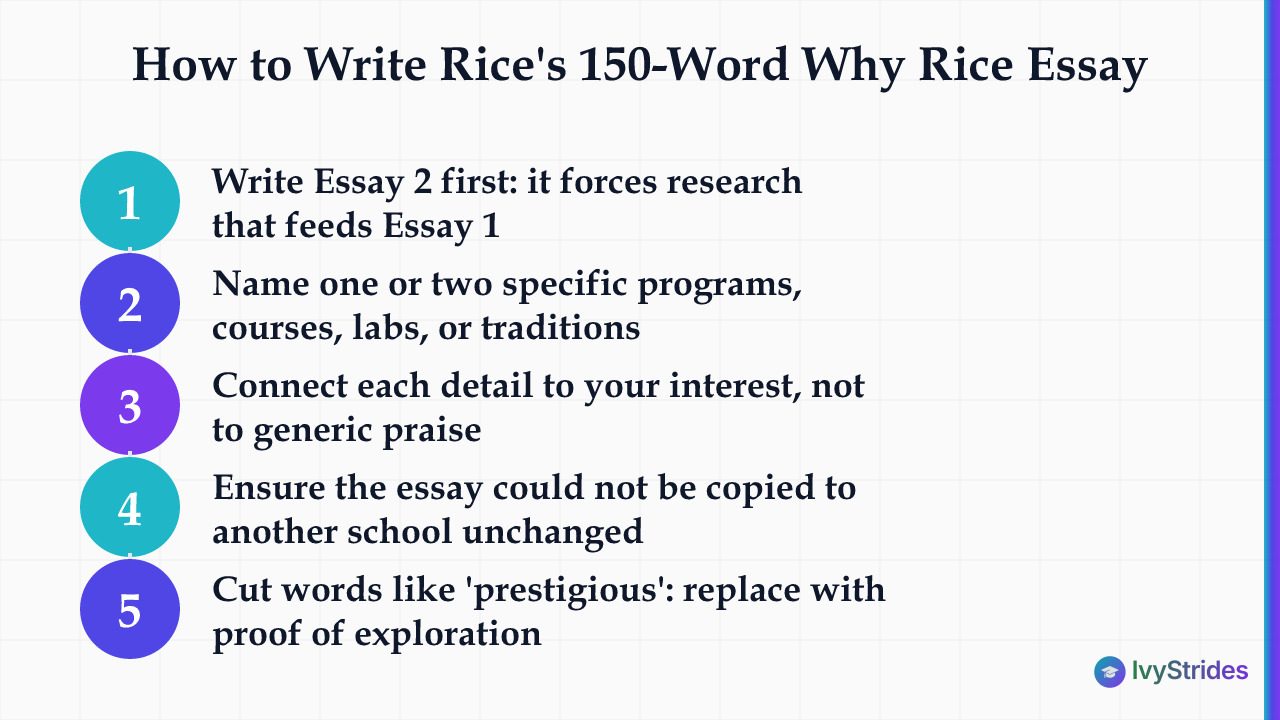
Rice's 150-word Essay 2 asks: "Based upon your exploration of Rice University, what elements of the Rice experience appeal to you?" Essay 2 is Rice's version of the "why us" prompt, but at 150 words it rewards precision: name one or two specific programs, courses, or traditions correctly instead of writing a paragraph of general praise.
The prompt assumes you have explored Rice, so your essay should carry proof of it. Do not praise Rice's "collaborative culture" or "small size" without naming something you actually researched. Any applicant can write that sentence, and it shows no knowledge of Rice.
What "specific" looks like. A named course on the Rice catalog. A research lab and the professor who runs it. A tradition like Beer Bike, tied to who you are. For the "Why This College" essay pattern applied to Rice's tight limit, you want depth on one or two anchors, not a tour of five.
Essay 1, the 150-word academic interest essay, asks what draws you to your selected academic areas and how you hope to explore them at Rice. You pick one of seven schools of study (architecture, business, engineering and computing, humanities and arts, music, natural sciences, social sciences) and up to three academic areas of interest (majors, minors, or pre-professional tracks).
Rice assesses your preparedness and alignment to the majors you select, and says its academic schools look for different strengths. This is the same task as the "Why This Major?" essay: connect a real interest to a Rice-specific resource that would let you pursue it.
Write Essay 2 first. The research it forces feeds directly into Essay 1.
Does Your Rice Essay 2 Pass the Knowledge-of-Rice Test?
- Names at least one Rice program, course, professor, lab, or tradition by its actual name
- Connects that detail to your specific interest, not to generic praise
- Could not be copied onto another university's application unchanged
- Shows evidence of real exploration (a campus visit, a virtual event, the optional interview)
- Spends none of its 150 words on words like "prestigious" without proof
- Reads like you, not like a template
How to Choose and Write Rice's 500-Word Community Essay
Rice's 500-word community essay gives you two options, and you choose one. Option A asks: "What life experiences and/or unique perspectives are you looking forward to sharing with fellow Owls in the residential college system?" Option B asks: "What perspectives shaped by your background, experiences, upbringing, and/or cultural identity inspire you to join our community of change agents at Rice?" Both run 500 words.
The residential college system is the social context for this essay, and Option A names it outright. Rice randomly assigns every new student to one of its 12 residential colleges, the community you'd live and grow in. Your essay should show what you'd contribute to that community.
| Option | Prompt Focus | Best Fit For | Common Mistake to Avoid |
| A | Experiences you'd share with fellow Owls | A concrete story about something you do or have lived | Listing qualities instead of showing one |
| B | Background and identity as change-agent fuel | A specific identity that drives a specific action | Writing abstract claims about "diversity" |
How to choose. Option B needs a concrete personal story, or it slides into abstraction; Option A asks for life experiences directly, which anchors your response in a specific moment. Pick the option whose story you can tell most concretely.
Use narrative, not assertion. Open on a moment, let the reader see it, then draw the contribution out of it. The "show, don't tell" method turns "I value community" into a scene a reader remembers. End forward-looking: name what you'd bring to a residential college specifically.
And The Box? Rice doesn't score it, but it does ask for an image that speaks for itself. Choose one that shows a side of you the essays cannot.
The 500-word essay is the longest piece in the Rice supplement, and the hardest to self-diagnose. An outside reader can see where your story stays abstract while you still feel it's vivid. That gap is where essay coaching earns its place: a coach with supplemental-essay experience helps you choose the stronger option and revise toward specificity before you submit.
FAQ: Rice Supplemental Essays 2026-27
What should I upload to the Rice box?
Upload any two-dimensional image of something that genuinely appeals to you: a photograph, a piece of artwork, a diagram, a page from a book. Rice does not use The Box to evaluate your application. Its job is to show who you are beyond your achievements, so pick an image that speaks for itself and needs no explanation.
How many essays for Rice University?
Common App applicants write three supplemental essays for 2026-27: a 150-word academic interest essay, a 150-word "why Rice" essay, and a 500-word community essay where you choose one of two options. QuestBridge applicants see that third essay marked optional. Architecture applicants add two extra essays and a portfolio. Music applicants apply Regular Decision only and must submit everything, including a Preliminary Submission or Audition Profile Form, by December 1. All applicants also upload The Box.
How to make Rice essay?
Start with Essay 2, the "why Rice" prompt, because it forces you to research Rice specifically. Identify one or two programs, courses, or traditions tied to your real interests. Then write Essay 1 using the same research. Draft the 500-word essay last, choosing the option whose story you can tell most concretely.
Does Rice require supplemental essays?
Yes. Rice requires three supplemental essays from first-year Common App applicants in 2026-27: two at 150 words each and one at 500 words. For QuestBridge applicants, Rice marks the 500-word essay optional. These are separate from the Common App personal statement. Architecture and music applicants carry additional requirements on top of the three standard essays.
Your Next Step on Rice's Supplements
Rice's supplements reward proof, not enthusiasm. Every prompt checks whether you know Rice specifically. Work in this order:
- Research Rice first: find one or two named programs, courses, labs, or traditions tied to your interests.
- Draft Essay 2 (why Rice), then Essay 1 (academic interest) using the same research.
- Choose the 500-word option whose story you can tell most concretely, and write it as a scene.
- Pick a Box image that speaks for itself, and confirm Rice's deadlines and test policy on its official site before submitting.

Award-winning author (South Asian Book Award) and graduate of BITS Pilani and UCLA Luskin School of Public Affairs. Brings a published writer's eye to Common App essays and grammatical precision to SAT and ACT R&W instruction.