
Deferred? Whether to Send a New Test Score, and When It Helps
On this page
- What a Deferral Means for Your Test Score Strategy
- When Sending a New SAT or ACT Score After a Deferral Actually Helps
- Not Sure If Your New Score Clears the Bar for Your School?
- How to Actually Send a New SAT or ACT Score After Being Deferred
- Pairing a Score Update with a Letter of Continued Interest for Maximum Effect
- Score Update Ready. Letter Still Needs Work?
- FAQ: Sending a New Test Score After a Deferral
- How rare is a 1420 on your SAT?
- Is a 1480 SAT or 34 ACT better for a deferred applicant?
- Can I send SAT scores after the early action deadline if I was deferred?
- What if my new score is only slightly higher than the one I already submitted?
- Your Next Step on a Deferral Score Update
Yes, you can send a new SAT or ACT score after a deferral, and it helps when the score reaches or crosses your school's 75th-percentile mark. A score update is the official test result a deferred applicant submits during the regular-decision window. Check the school's portal, order the report, and pair it with a short letter of continued interest.
The mechanics differ by test. College Board and ACT, Inc. run separate score-sending portals, and each school sets its own rule on whether it wants an official score report or a self-reported number in the applicant portal. That policy detail, more than the score itself, decides your first move.

What a Deferral Means for Your Test Score Strategy
A deferral moves your early-action or early-decision application into the regular decision pool for a second read; it is not a rejection. The committee saw enough to keep your file open. That distinction matters, because a deferred applicant still holds real use before the regular-decision deadline, and a test score is one of the few levers you can pull in a three-to-eight-week window.
A deferral means the committee saw enough to keep your file open, not that your score was the deciding factor; understanding what the deferral actually signals helps you decide which update carries the most weight. Some schools publish exactly what they want. The University of Michigan Application Changes page shows portal-based instructions for deferred students submitting updated materials.
Three levers, not one. In our coaching, deferred students have three realistic ways to strengthen a file before the second read. Each sends a different signal to the admissions office.
| Update lever | What it signals | When it helps most |
| Updated SAT/ACT score | Academic profile beats the file | New score clears 75th percentile |
| Letter of continued interest | The school is a genuine top choice | Sent early, kept brief |
| New mid-year achievement | Momentum since you applied | A concrete award, grade, or role |
Students who applied early with a borderline score are often the ones now holding a new result and wondering whether it changes the picture. If that's you, read what a deferral actually signals first, then weigh the score decision here. For a low starting score, see applying early decision with a borderline test score.
When Sending a New SAT or ACT Score After a Deferral Actually Helps
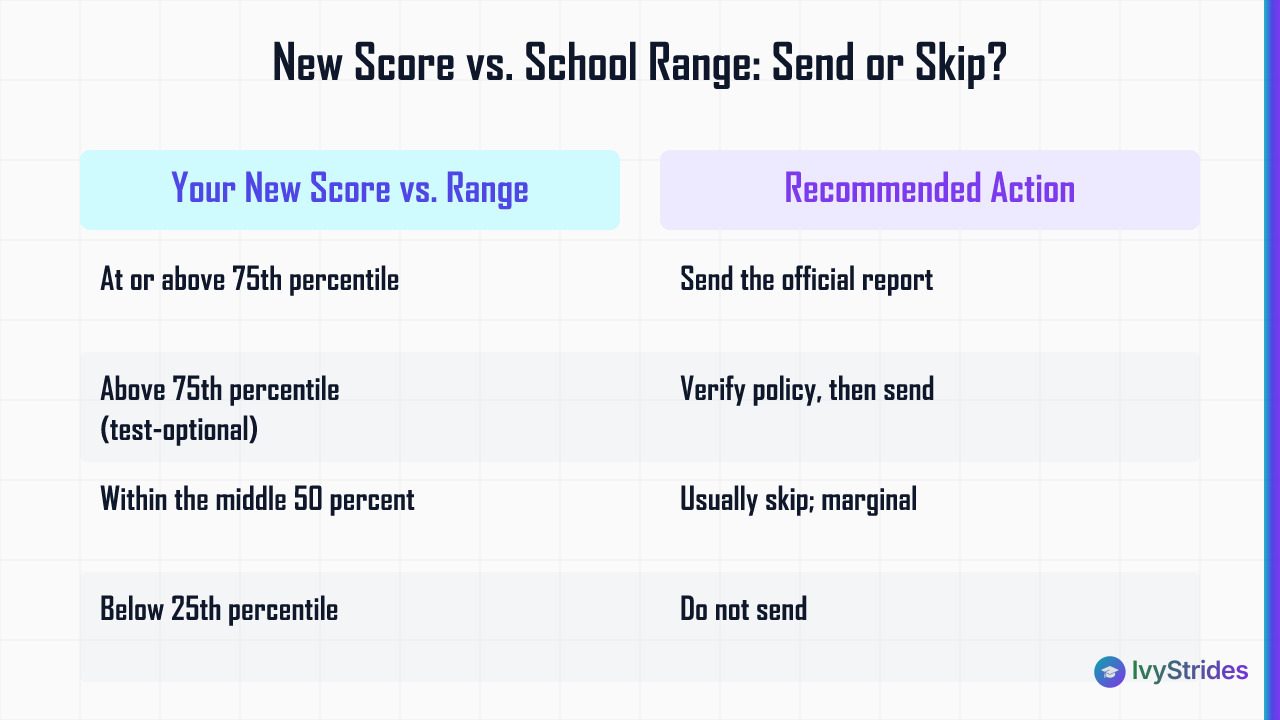
A new score helps when it reaches or crosses your target school's 75th percentile; below that, it rarely moves the read. The benchmark is the school's middle 50 percent, the 25th-to-75th percentile SAT or ACT range for admitted students, published in each school's Common Data Set. Search "Common Data Set" plus the university name, find the range, and measure your new number against it.
The delta that matters. A jump from below the median to above the 75th percentile is worth sending. A 20-point SAT bump that leaves you in the same quartile is noise. In our coaching, students whose new score reaches or crosses the school's 75th percentile see the clearest benefit after a deferral. That's the bar, not simply "higher than before."
Watch the downside. Students who send a score below the school's 25th percentile occasionally prompt an admissions office to re-read the file downward, since the number now sits on record. If your new result still lands under the 25th percentile, hold it.
| Your new score vs. range | Test-optional status | Recommended action |
| At or above 75th percentile | Applied with scores | Send the official report |
| Above 75th percentile | Applied test-optional | Verify policy, then send |
| Within the middle 50 percent | Either | Usually skip; marginal |
| Below 25th percentile | Either | Do not send |
If you applied test-optional and now have a strong score, the calculus changes. Test-optional policies vary by school and year, and several schools shifted policy across 2025 and 2026, so confirm the current rule on the FairTest tracker and the school's own site before you add a number. If the school superscores, even a one-section gain can lift your composite above a threshold, worth checking before you decide.
Knowing when to send is one thing; sending it correctly is next, and how to send SAT scores to colleges walks the full mechanics. A section-specialist coach can also tell you whether your new number reflects a genuine skill gain or a good test day before you spend the report fee. If you're weighing that, our 1-on-1 SAT prep team reviews the score against the school's range first.
Not Sure If Your New Score Clears the Bar for Your School?
A free 15-minute call checks your number against the school's middle 50 percent, tells you whether it's worth the report fee, and maps out what else to include in your regular-decision update.
How to Actually Send a New SAT or ACT Score After Being Deferred
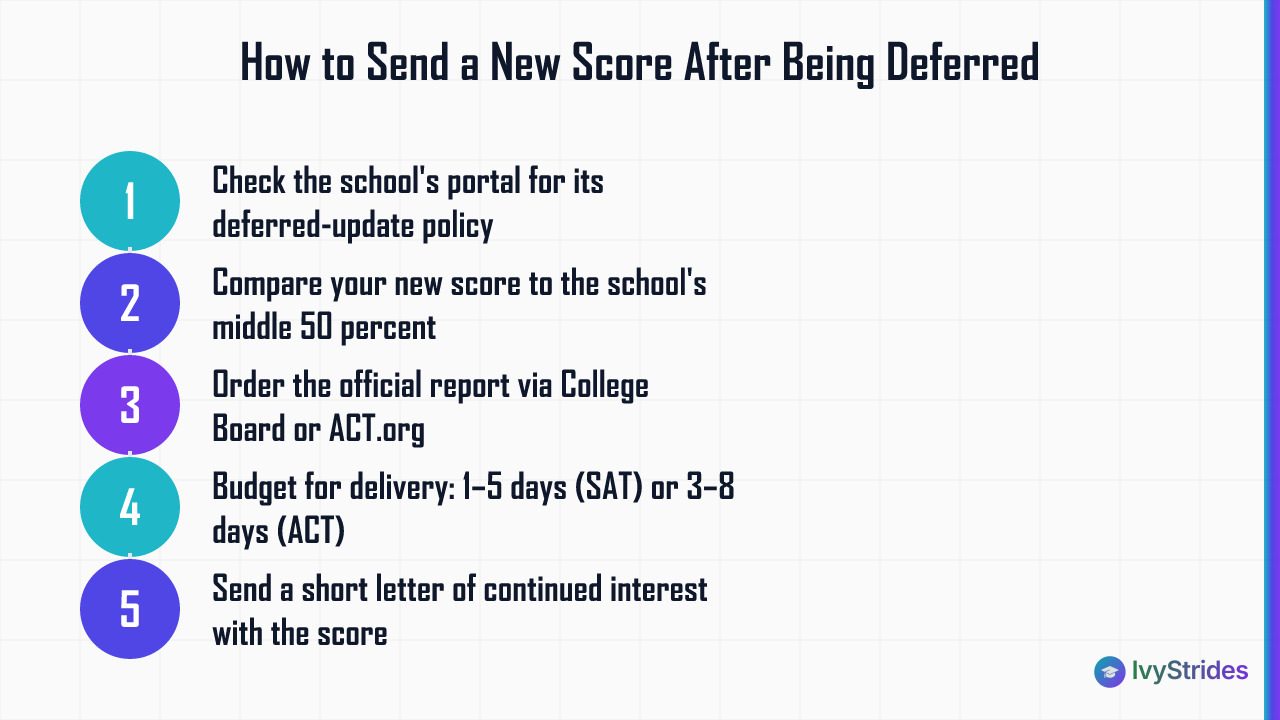
You send a new score through the College Board or ACT.org score-sending portal, after checking whether the school wants an official report or a self-reported number in the applicant portal. Some schools accept a self-reported update through the Common App portal; others require an official report from the testing agency. The school's website tells you which.
Ordering an official score report works the same whether you're sending scores for the first time or updating after a deferral. Score choice lets you pick which test dates go out, so you control what the office sees.
If you took a December SAT or ACT specifically to have a stronger score ready for this window, the question of whether to send it is exactly what this article addresses; the timing decision that led there sits in how a December retake fits an early decision timeline. If you don't yet have a new score, check whether a SAT test date still fits your regular-decision deadline.
-
Check the school's portal and admissions site for its deferred-update policy: official report, self-report, or no updates accepted.
-
Compare your new score to the school's Common Data Set middle 50 percent before you pay for anything.
-
Order the official report. College Board sends SAT reports through satsuite.collegeboard.org; ACT sends through ACT.org.
-
Budget for delivery time. College Board electronic reports typically arrive in about 1 to 5 business days; ACT reports typically take about 3 to 8 business days. Order with margin.
-
Send a short letter of continued interest alongside the score, through the applicant portal or by email to your regional admissions counselor.
The cost, on the ACT side. Each additional ACT score report costs $20 per recipient, so sending one updated score to one school runs $20. IvyStrides notes that's the only fee for a single updated ACT report to one college. College Board charges its own per-report fee through the SAT Suite portal.
Pairing a Score Update with a Letter of Continued Interest for Maximum Effect
A letter of continued interest, or LOCI, is a 200-to-300-word note to the admissions office that reaffirms the school as your top choice and highlights new achievements, including your updated score. A score sent alone is a data point; a score paired with a brief LOCI is a signal. In our coaching, students who pair a score update with a specific LOCI that names one new achievement tend to get more substantive responses than those who send a report by itself.
The letter carries the score, not the reverse. Name one concrete update since you applied, a semester GPA, a new role, a competition result, then state plainly why the school remains your first choice. Submit it through the applicant portal's update section or by email to your regional admissions counselor.
Skip the padding. Don't re-narrate your original application, and don't over-explain the score gap. The LOCI overlaps with the "Why this college" writing you already know, so supplemental essay examples work as a model. how colleges track demonstrated interest explains why the letter matters at all.
LOCI + score update checklist:
- Restate the school as your clear first choice, once, specifically.
- Name one new achievement since you applied.
- Reference the updated score briefly, without over-explaining.
- Give one concrete, school-specific reason it fits your goals.
- Keep it to 200 to 300 words.
- Send through the portal update section or to your regional counselor.
- Skip repeating your original application content.
- Skip apologizing for the deferral or the score.
Writing a focused LOCI under a deadline is where students stall, and admissions outcomes depend on the full application, not the score alone. Our essay coaching team helps you write a school-specific letter that pairs with the score instead of duplicating your file.
Score Update Ready. Letter Still Needs Work?
Turning a score report and a blank page into a LOCI that moves the needle for your specific school takes a different kind of help. A free 15-minute call reviews your score, your school, and your timeline, then hands you a concrete next step.
FAQ: Sending a New Test Score After a Deferral
How rare is a 1420 on your SAT?
A 1420 places a student roughly in the 95th percentile of test-takers, meaning about 5 percent score at that level or higher. Whether it's strong enough to send after a deferral depends entirely on the specific school's middle 50 percent range, not the national percentile. Check the school's Common Data Set before deciding.
Is a 1480 SAT or 34 ACT better for a deferred applicant?
A 1480 SAT and a 34 ACT are roughly concordant, both around the 98th-to-99th percentile. For a deferred applicant, the real question isn't which is higher in the abstract but which one clears the target school's 75th-percentile mark. Check the school's Common Data Set for both the SAT and ACT ranges, then send the one that clears the bar.
Can I send SAT scores after the early action deadline if I was deferred?
Yes. A deferral keeps your file active for regular decision, and most schools accept updated reports submitted before the RD deadline. Check the school's applicant portal or admissions site for its instructions, then order an official report through College Board or ACT.org with enough lead time for delivery.
What if my new score is only slightly higher than the one I already submitted?
A marginal gain, say 20 to 30 points on the SAT or 1 point on the ACT, rarely changes the committee's assessment unless it crosses a real threshold like the school's 75th percentile. In our coaching, we advise students to send the update only when the new score moves them into or above the school's middle 50 percent range.
Your Next Step on a Deferral Score Update
A deferral kept your file open, so treat the next few weeks as a second chance to strengthen it, not a verdict. The decision comes down to one number against one range, plus a short letter that carries it.
- Find your target school's middle 50 percent in its Common Data Set.
- Confirm the school's deferred-update policy in its portal.
- Send an official report only if your score reaches or crosses the 75th percentile.
- Pair the score with a 200-to-300-word letter of continued interest.
- Order the report with delivery-time margin before the regular-decision deadline.