
How a December Retake Fits an Early Decision Timeline
On this page
- How the ED I and ED II Calendars Interact with December Test Dates
- Why a December Retake Cannot Help an ED I Application
- December Score Too Late for ED I? Here Is What to Do Instead.
- How ED II Makes a December Retake Score Viable
- What to Do Before You Register for a December SAT or ACT Retake
- Six Weeks to December: Is Your Score Ready to Move?
- FAQ: December Retake and Early Decision Timing
- Does EA give you a better chance?
- What is the early decision deadline for most colleges?
- Will colleges accept the December SAT for early decision?
- Should I apply early decision before retaking the SAT?
- Your Next Step on a December Retake
A December SAT or ACT retake is too late for Early Decision I, which closes around November 1 and reviews files before December scores release. It fits Early Decision II, which closes around January 1 and returns decisions in mid-February. Which round you are in decides everything.
Those two calendars, the test-score calendar and the application-round calendar, rarely line up the way students assume. College Board publishes the SAT release window and each college publishes its ED deadlines separately, so the gap between them is something you have to calculate before you pay the registration fee. This article maps exactly where they align and where they collide.
How the ED I and ED II Calendars Interact with December Test Dates
Early Decision is a binding application round: if a college admits you, you agree to enroll and withdraw your other applications. ED I and ED II are the same commitment offered at two different deadlines. That two-deadline structure is the whole reason a December retake works for one round and fails the other.
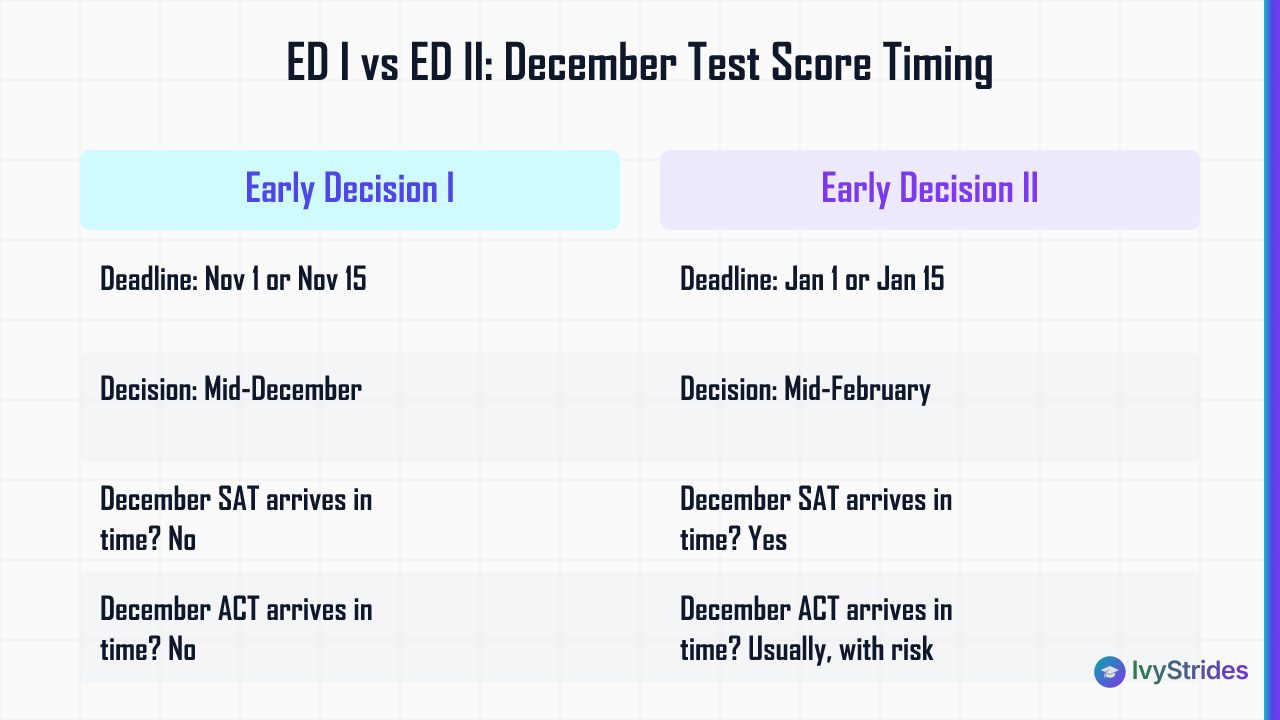
ED I deadlines cluster around November 1 or November 15, with decisions released in mid-December, typically around December 15, per BigFuture from College Board. IvyStrides derives this figure from the inputs cited above. Notre Dame, for instance, tells its Restrictive Early Action applicants to expect a decision by mid-December. ED II deadlines cluster around January 1 or January 15, with decisions in mid-February.
Score release is the other half. College Board releases most Digital SAT scores about two weeks after test day, per College Board. ACT, Inc. releases ACT scores roughly three to eight weeks after test day, per ACT, Inc. That ACT range is wide, and the wide part matters for a January 1 deadline.
| Application Round | Typical Deadline (IvyStrides) | Decision Released | December SAT Arrives in Time? | December ACT Arrives in Time? |
| Early Decision I | Nov 1 or Nov 15 | Mid-December | No | No |
| Early Decision II | Jan 1 or Jan 15 | Mid-February | Yes | Usually, with risk |
| Early Action | Nov 1 or Nov 15 | Mid-December to Jan | No | No |
| Regular Decision | Jan 1 to Feb 1 | March to April | Yes | Usually |
If you are still deciding which round to apply in, the full comparison of ED, EA, and Regular Decision is covered in our Early Decision vs Early Action vs Regular Decision guide. For the full application deadline calendar across all rounds and schools, see our college application deadlines for fall 2026 guide. Deadlines shift year to year, so confirm each date on the school's own admissions page.
Why a December Retake Cannot Help an ED I Application
A December retake cannot help an ED I application because the score arrives after the file is already under review. ED I closes around November 1. Admissions officers begin reading in early November and finish in early December, and the December SAT does not release until mid-December, per College Board. The score lands after the decision is made.
In our coaching with seniors weighing a December retake, the most common mistake is exactly this: registering for the December SAT with an ED I application already submitted, not realizing the score will never reach the reader before the review window closes. The registration fee and six weeks of prep go toward a round that closed on paper the day the file was submitted.
So what are your real options if your ED I score feels light? There are three, and the table below sorts them by what they cost you.
| Option | Timing Fit | Trade-off |
| Apply ED I with current score | Fits Nov 1 | No December score benefit |
| Self-report a later score | Varies by school | Only some schools allow it |
| Shift target to ED II | Fits Jan 1 | Different school list, binding |
Self-reporting is the one exception worth checking. Some colleges let applicants self-report scores in the applicant portal, and a few update files as scores arrive. Most do not extend the ED I review to wait for you. Verify the specific policy on the school's admissions page before you assume a December score can be added late.
One caveat holds across every option here: admissions outcomes depend on the full application, not the test score alone. A stronger December number does not rescue a thin activities list or a rushed essay, and a school that admits ED I is weighing all of it. If your score is borderline for your target school right now, the decision of whether to push ED with that score or wait is covered in detail in our guide to applying Early Decision with a borderline test score.
December Score Too Late for ED I? Here Is What to Do Instead.
You have a score, a school, and a deadline. A free 15-minute strategy call reviews all three, checks whether ED II or a different round fits your timeline, and gives you a concrete prep plan if a December retake is the right move.
How ED II Makes a December Retake Score Viable
Early Decision II is where a December retake earns its place. ED II deadlines fall around January 1 or January 15, with decisions in mid-February, so a December score has room to arrive and be read. That later review window, the same one that closes too soon for ED I, is what makes the December test viable here.
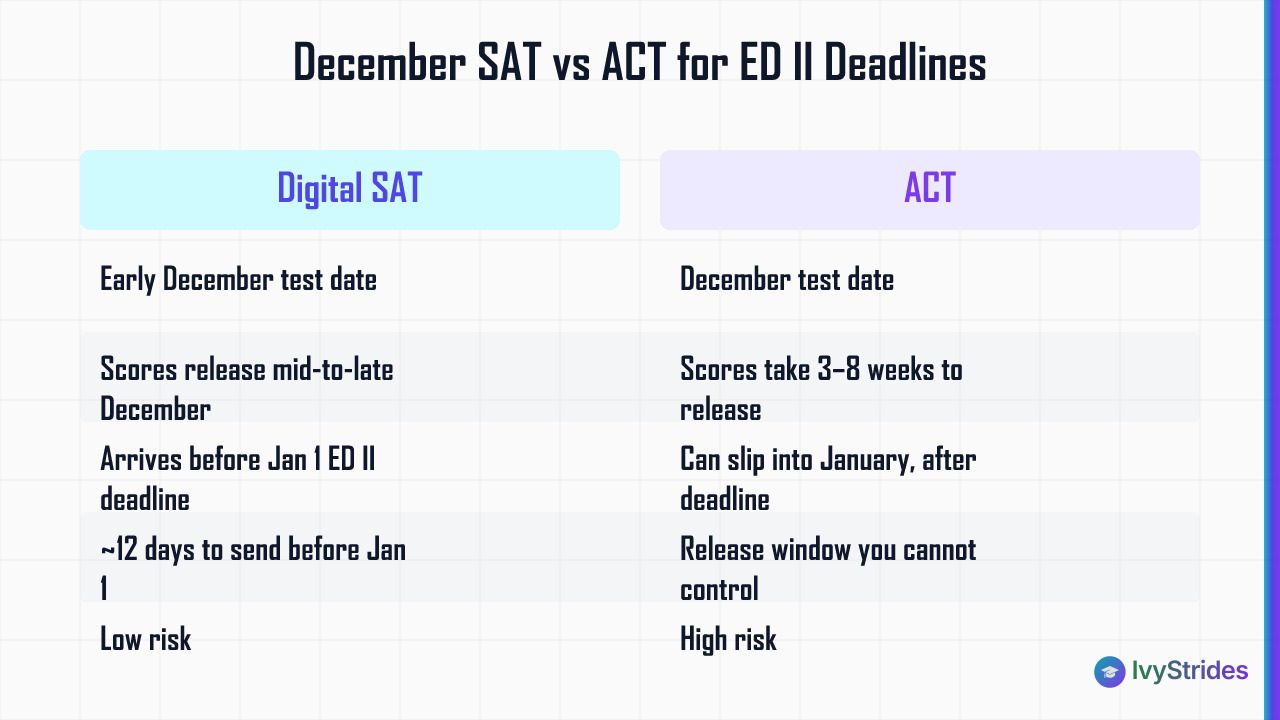
The SAT fits cleanly. December SAT scores release about two weeks after an early-December test day, per College Board, placing them in mid-to-late December, ahead of a January 1 ED II deadline. IvyStrides computes this gap from the two published dates. Count it out: a score landing around December 20 leaves roughly 12 days to send or self-report before January 1. Narrow, but workable.
The ACT is the risk. ACT scores take three to eight weeks, per ACT, Inc. A December ACT score can slip into January, after a January 1 ED II deadline has already passed. That is not a certainty either way, which is the problem: you are betting the deadline on a release window you cannot control.
| Test | December Test Date | Typical Score Release | Before Jan 1 ED II? | Risk Level |
| Digital SAT | Early December | Mid-to-late December | Yes | Low |
| ACT | December | Late Dec to late Jan | Sometimes | High |
Many schools offer ED II, including NYU, Boston University, Emory, and Tulane, though the roster changes each cycle.
Check the superscore policy too. A December retake can raise your superscore even when the single sitting is not your highest, but only at schools that superscore, and those policies vary; confirm each on the school's admissions page or its Common Data Set. If your target school is test-optional, whether to submit a December score at all is a separate question covered in our what is test-optional and should you submit SAT scores guide.
What to Do Before You Register for a December SAT or ACT Retake
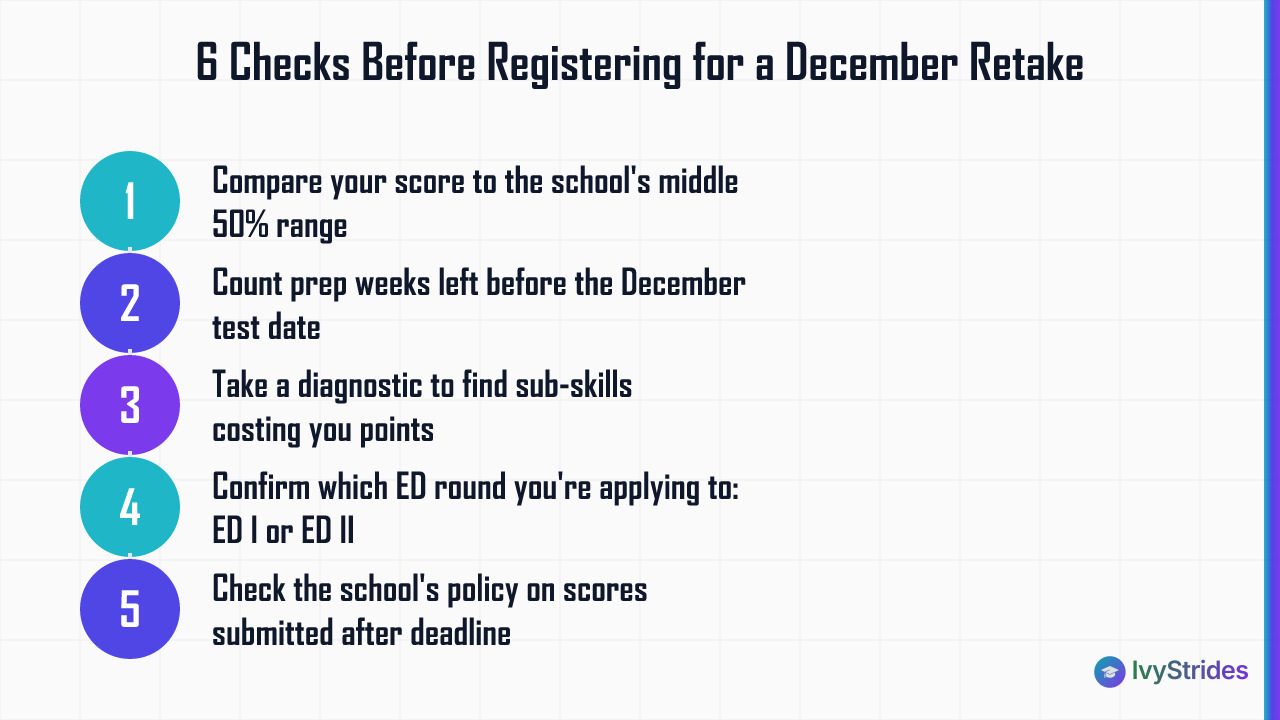
Before you register, run six checks that tell you whether the December date is worth the fee and the prep hours. The score gap comes first: pull your target school's middle 50 percent range and compare it to your current score. NCES College Navigator publishes the 25th-to-75th-percentile ranges per institution, so you can see exactly where you sit rather than guessing at "competitive."
Prep time decides the rest. A meaningful score move takes real weeks, not a weekend. In our coaching, students who use the ED II window strategically pair a December retake with a January 1 deadline and give themselves roughly six to eight weeks of targeted work between their last score and the December test. For students completing the IvyStrides 1-on-1 program, a typical gain is 200+ points on the SAT or 4+ ACT composite points, though your starting band and hours put in both move that number.
Here is the six-point checklist:
-
Compare your current score to the school's middle 50 percent range.
-
Count the prep weeks left before the December test date.
-
Take a diagnostic to find the specific sub-skills costing you points.
-
Confirm which ED round you are applying to, ED I or ED II.
-
Check the school's policy on scores submitted after the deadline.
-
Verify whether the school superscores and whether it is test-optional.
Start from a diagnostic, not a syllabus. A real practice test tells you whether your points are leaking from the SAT Reading and Writing modules or from the second, harder Math module, and a section-specialist coach targets that instead of re-teaching everything.
That is what turns the checklist into a plan, and it is what our SAT 1-on-1 prep is built to do. If you have decided the retake fits, our guide on how to improve your SAT score walks the weeks between now and test day. One last caveat: test-optional policies vary by school and by year, per FairTest, so confirm before you assume a December score is even required.
Six Weeks to December: Is Your Score Ready to Move?
You have the checklist. Turning it into a week-by-week prep plan tied to your actual score gap takes a different conversation. A free 15-minute strategy call does exactly that, for students and parents both.
FAQ: December Retake and Early Decision Timing
Does EA give you a better chance?
Early Action acceptance rates often run higher than Regular Decision rates at the same school, partly because EA pools skew toward stronger, earlier-organized applicants. EA is non-binding, so it preserves your options. The advantage is usually smaller than ED I, where the binding commitment meaningfully raises admit rates at many selective schools. A December score, though, is too late for either EA or ED I.
What is the early decision deadline for most colleges?
Most ED I deadlines fall on November 1 or November 15, with decisions released around December 15. A handful of schools set slightly different dates, so verify each school's admissions page directly rather than trusting a general rule.
Will colleges accept the December SAT for early decision?
For ED I, no: December SAT scores release after ED I files are already under review. For ED II, yes: December SAT scores typically release about two weeks after test day, landing in mid-to-late December, ahead of a January 1 ED II deadline. Confirm the specific school's policy on late score submission before you count on it.
Should I apply early decision before retaking the SAT?
If your current score sits within or close to your target school's middle 50 percent, applying ED I with that score is often the stronger move. If your score is meaningfully below the range and a December retake fits an ED II timeline, waiting for ED II with a stronger score can be the better path. The answer depends on your specific score gap and your school list.
Your Next Step on a December Retake
The timing question has a clean answer once you know your round. A December score is a dead end for ED I and a live option for ED II, with the ACT carrying more calendar risk than the SAT. From here:
- Confirm your ED round and pull the school's actual deadline.
- Compare your current score to the middle 50 percent range.
- Verify the December score release date for your chosen test.
- Decide whether six to eight prep weeks can close the gap you found.

Award-winning author (South Asian Book Award) and graduate of BITS Pilani and UCLA Luskin School of Public Affairs. Brings a published writer's eye to Common App essays and grammatical precision to SAT and ACT R&W instruction.