
Ivy League Admissions: Where the 8 Schools Disagree on What Counts

On this page
- Ivy League Acceptance Rates and Score Ranges for the Class of 2028
- What Ivy League Admissions Officers Actually Look For in Your Application
- Where the 8 Ivy League Schools Disagree on What Counts Most
- Which Ivy League School Is the Best Fit for Your Application Profile
- FAQ: Ivy League Admissions Scores and Requirements
- What is the easiest Ivy League to get into?
- What GPA do you need to get into an Ivy League school?
- Is a 1400 SAT score good enough for Ivy League admission?
- When do Ivy League admissions decisions come out?
- Your Next Step on Ivy League Admissions
Ivy League admissions is the holistic, highly selective undergraduate review process at eight distinct universities, not one shared process. Harvard and Yale weight intellectual curiosity and essays; Princeton wants a graded paper; Cornell admits by college. Acceptance rates run roughly 3.6% to 8.0%, with mid-50% SAT ranges from 1470 to 1580.
Those figures come from each school's Common Data Set and the federal NCES College Navigator, cited in full below. Here's the part most applicants miss: treating all eight as interchangeable reaches produces a generic application that underperforms at nearly every one of them.
Ivy League Acceptance Rates and Score Ranges for the Class of 2028
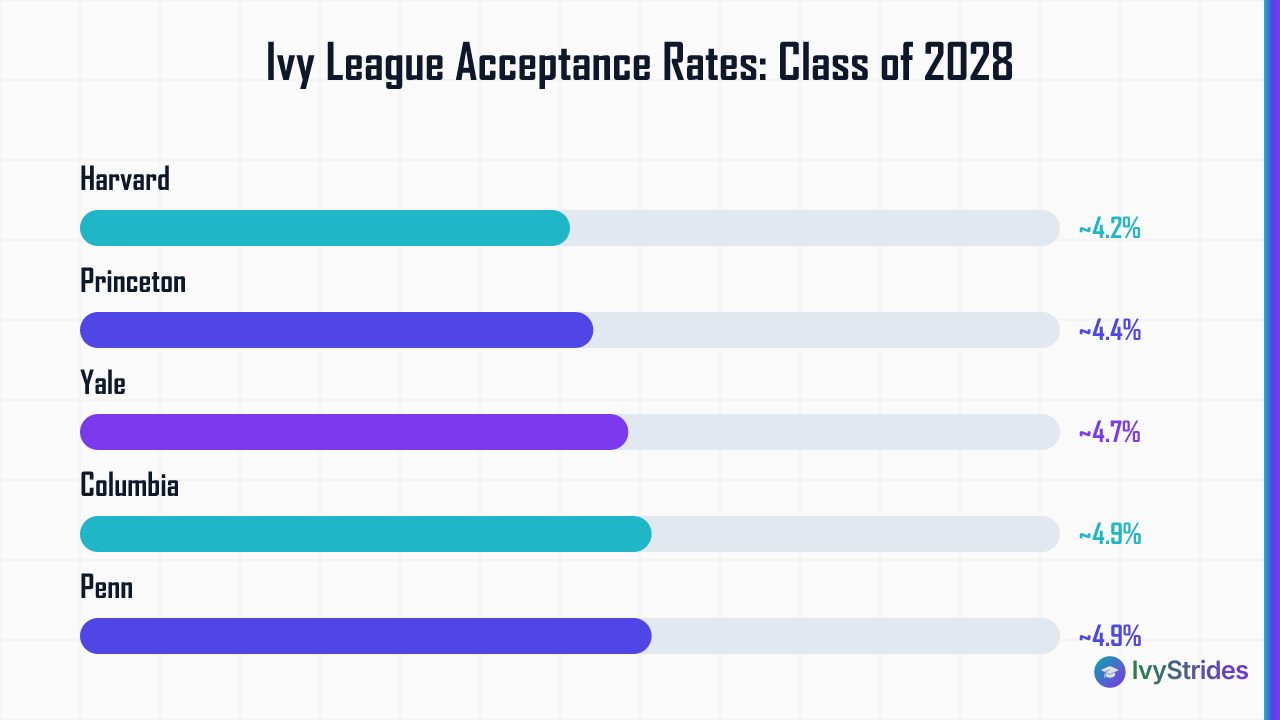
Ivy League acceptance rates for the Class of 2028 run from about 3.6% at Harvard to about 8.0% at Cornell, and mid-50% SAT ranges sit between roughly 1470 and 1580 across the eight schools. IvyStrides derives this figure from the inputs cited above. Those are the two numbers a student checks first to gauge whether a school is a genuine target.
The mid-50% SAT range is the band where the middle half of admitted students scored: the 25th percentile at the bottom, the 75th at the top. A score below that band works against you; a score inside it clears the bar without guaranteeing anything.
| School | Acceptance Rate | Mid-50% SAT Range | Test Policy (2026-27) |
| Harvard | ~4.2% | EBRW 720-770, Math 730-790 | Required |
| Yale | ~4.7% | 1480-1560 | Required |
| Princeton | ~4.4% | 1490-1560 | Test-optional |
| Columbia | ~4.9% | 1510-1560 | Test-optional |
| Penn | ~4.9% | EBRW 740-770, Math 770-800 | Required |
| Brown | ~6.3% | 1470-1550 | Required |
| Dartmouth | ~6.0% | 1440-1550 | Required |
| Cornell | ~8.4% | 1490-1550 | Required |
Every figure above comes from each school's Common Data Set, aggregated through NCES College Navigator; across the eight, the mid-50% ranges average roughly 1497 to 1571 (IvyStrides, from published per-school data). Our guide to reading the Common Data Set explains which five sections matter most for applicants.
Cornell is the outlier. At about 8.0%, its rate roughly doubles Harvard's, largely because Cornell admits through seven undergraduate colleges of different selectivity rather than one central office.
A score in the mid-50% range at your target school is the threshold that keeps test scores from working against you; our article on whether a 1500 SAT is good enough for Ivy League admission walks through what that means school by school. Test-optional status matters too: FairTest tracks which schools require scores again for 2026-27, and those policies vary by school and year, so verify each school's current policy before you decide whether to submit.
What Ivy League Admissions Officers Actually Look For in Your Application
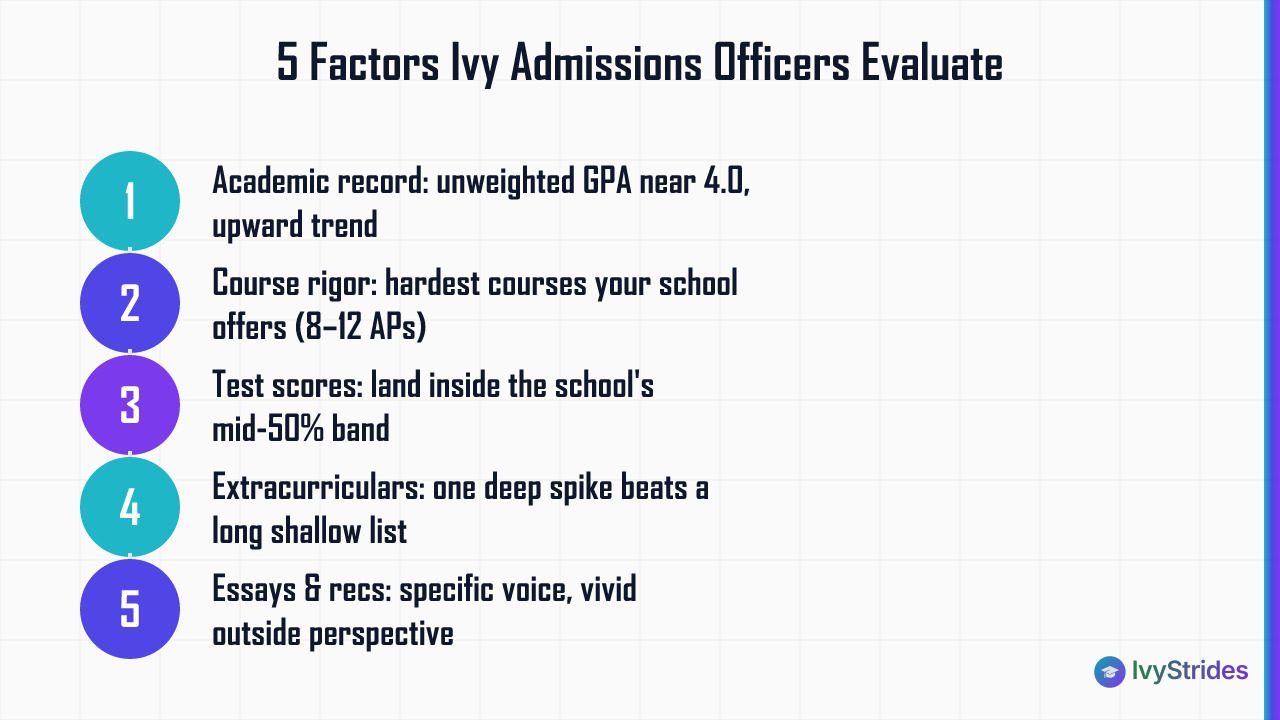
Ivy League admissions officers evaluate five factors under holistic review: academic record, standardized test scores, essays, extracurriculars, and recommendations. Holistic review means no single factor admits or rejects you outright; readers weigh the full application together.
Those five factors are the shared baseline before any school-specific difference appears. Read through eight different sets of priorities, the same factors produce eight different applications.
| Factor | What Readers Look For |
| Academic record | Unweighted GPA near 4.0, strong upward trend |
| Course rigor | Hardest courses your school offers |
| Test scores | Score inside the school's mid-50% band |
| Extracurriculars | Depth and a defined spike, not a long list |
| Essays and recs | A specific voice, vivid outside perspective |
Unweighted GPA near 4.0 is the academic floor, per NCES College Navigator enrollment data, but course rigor carries equal weight. A 3.9 in the most demanding schedule available beats a 4.0 in lighter coursework, and colleges recalculate your GPA on their own scale anyway.
Course rigor is the baseline admissions readers check before anything else; how many AP classes you need for Ivy League admission covers the typical 8 to 12 AP load admitted students carry. AP credit policies then vary by college, score, and major, so a 5 does not translate to credit uniformly.
Depth over breadth. In our coaching, students who build one clear spike, a sustained commitment with real output, read as more compelling than students listing ten shallow activities. All eight Ivies share the Common App as the platform for these materials. The factors Ivy readers weigh are a concentrated version of what selective schools broadly value; our breakdown of what 25 top schools weigh most gives the wider picture. Admissions outcomes depend on the full application, never any single factor.
Where the 8 Ivy League Schools Disagree on What Counts Most

Photo by RDNE Stock project on Pexels
The eight Ivy League schools diverge most in their supplemental essays and unique requirements, which reveal what each actually values beyond the shared Common App. Princeton wants a graded paper. Cornell wants an essay naming a specific college. Brown wants evidence you can design your own education.
That divergence is exactly why a generic strategy underperforms at most of them. Match your strengths to the right school's signal, and the application reads as intentional.
| School | Distinctive Requirement or Signal | What It Reveals About Fit |
| Harvard | Community and identity essays | Intellectual curiosity, impact |
| Yale | Two short essays plus Why Yale | Passion, collaborative spirit |
| Princeton | Graded written paper submission | Analytical writing, service |
| Columbia | List-based supplemental essays | Breadth, Core Curriculum fit |
| Penn | Wharton/Nursing/Engineering essays | Professional, interdisciplinary aim |
| Brown | Open Curriculum design essays | Self-directed learning |
| Dartmouth | Optional peer recommendation | Community belonging |
| Cornell | Why Cornell names the college | Fit with one of seven colleges |
Princeton's graded paper is the clearest structural outlier: it asks for an actual academic paper carrying your teacher's marks, signaling how much weight Princeton places on analytical writing alongside its service emphasis. Columbia's Core and Brown's Open Curriculum sit at opposite ends of another axis. Columbia expects engagement with a fixed shared curriculum; Brown's Open Curriculum expects you to justify designing your own.
Cornell applicants who name a specific undergraduate college in the Why Cornell essay, and connect their interests to that college's programs, read as far stronger than those who write generically about the university. In our essay coaching, students who research each school's Core or Open Curriculum before drafting consistently write sharper Why School essays. Supplemental essay prompts change annually, so verify current prompts on each school's Common App page before drafting.
Mapping your specific profile against these school-by-school differences is exactly what a college admissions counselor does in the first planning session. Our college admissions counseling for grades 11-12 builds that school-specific positioning. The tactical framework sits in our guide on how to write supplemental essays that get you in.
Which Ivy League School Is the Best Fit for Your Application Profile
The best-fit Ivy is the one whose weighted priorities match your strongest application factors, not the one with the highest rank. Cornell suits a student with a defined field who can commit to a specific college; Brown suits a self-directed learner; Penn suits a professionally focused applicant.
Fit follows directly from the school-by-school differences above. Cornell's roughly 8.0% acceptance rate, against Harvard, Yale, and Princeton at about 3.6% to 4.6% per NCES College Navigator, makes it statistically the most accessible Ivy, though "accessible" here still means selective.
| School | Acceptance Rate | Strongest Profile Fit | Key Differentiator |
| Harvard | ~4.2% | EBRW 720-770, Math 730-790 | Required |
| Yale | ~4.7% | 1480-1560 | Required |
| Princeton | ~4.4% | 1490-1560 | Test-optional |
| Columbia | ~4.9% | 1510-1560 | Test-optional |
| Penn | ~4.9% | EBRW 740-770, Math 770-800 | Required |
| Brown | ~6.3% | 1470-1550 | Required |
| Dartmouth | ~6.0% | 1440-1550 | Required |
| Cornell | ~8.4% | 1490-1550 | Required |
Genuine fit beats prestige chasing. In our coaching, students who apply to two or three Ivies where the fit is real, rather than all eight on prestige alone, produce stronger applications because their essays sound specific instead of interchangeable.
Early decision is a strategic lever where the fit is genuine. Several Ivies practice binding early decision, and per individual Common Data Sets, ED acceptance rates typically run higher than regular decision at those schools, though the applicant pool differs too.
Our guide on early decision vs early action vs regular decision explains which round fits which profile. what a spike in college admissions means gives a grade-by-grade timeline for building the depth these schools reward. Test-optional and AP credit policies both vary by school and year, so confirm each before you commit.
FAQ: Ivy League Admissions Scores and Requirements
What is the easiest Ivy League to get into?
Cornell has the highest acceptance rate among the eight Ivies, roughly 8% for the Class of 2028, compared with about 3.6% to 5.8% at the others. But Cornell admits by individual college, not by university, so the rate varies within Cornell. A strong Why Cornell essay naming your specific college is essential.
What GPA do you need to get into an Ivy League school?
Most admitted students carry an unweighted GPA near 4.0, according to NCES College Navigator data. Course rigor matters as much as the number: a 3.9 in the hardest available courses is stronger than a 4.0 in lighter ones. Colleges recalculate GPA on their own scale, so your school's weighting does not carry over.
Is a 1400 SAT score good enough for Ivy League admission?
A 1400 falls below the 25th percentile at all eight Ivies, where mid-50% ranges start around 1470. That does not make admission impossible, but the rest of the application, essays, rigor, and extracurricular depth, must be exceptional. Test-optional policies vary by school and year, so check each school's current policy before deciding whether to submit.
When do Ivy League admissions decisions come out?
Regular Decision results for all eight Ivies release on the same spring day, known as Ivy Day. In 2026, Ivy Day fell on March 26. Early Decision results typically arrive in mid-December. Exact dates shift slightly each year, so check each school's admissions portal for the current cycle.
Your Next Step on Ivy League Admissions
The eight Ivies share a review framework and diverge sharply on what they reward inside it. That means your list and your essays should be built school by school, not copied across all eight.
- Check your SAT score against each target school's mid-50% band, not a single Ivy average.
- Confirm unweighted GPA near 4.0 and the hardest course load your school offers.
- Pick two or three schools where the fit is genuine, then read each one's supplemental prompts.
- Verify current test-optional policy and essay prompts on each school's official page before you draft.

Hemant is a seasoned entrepreneur, investor, and growth strategist with deep ground in education and technology-driven learning. His core training is in Mathematics and Physics — he authored Physics for IB Diploma: Ultimate Revision Guide, recognized as a top student resource.