
What Is a Spike in College Admissions? Examples, Timeline & How to Build One
On this page
- What a College Admissions Spike Actually Is and Why It Matters
- Real College Admissions Spike Examples Across Five Domains
- Grade-by-Grade Timeline for Building a College Admissions Spike
- Spike-Building Checklist by Grade
- How to Write About Your Spike Across the College Application
- FAQ: College Admissions Spikes
- What does the term "spike" mean?
- Is the spike a myth or does it actually matter for college admissions?
- Can a spike in college applications be more than one activity?
- What is a spike for college if I am already a junior with no clear one?
- Your Next Step on Building a Spike
A spike in college admissions is one area of exceptional, externally validated depth that makes an applicant stand out at selective colleges. It is a single domain, not a list of clubs. Think published research, a national competition title, or a founded organization with real reach.
Those descriptions come from how admissions officers read files, and the Medium / College Admissions Central framing puts it well: a spike is a vertical peak on a graph, not a flat line of scattered activities. The harder question, the one this article settles, is whether your current activities qualify and what to do next.

What a College Admissions Spike Actually Is and Why It Matters
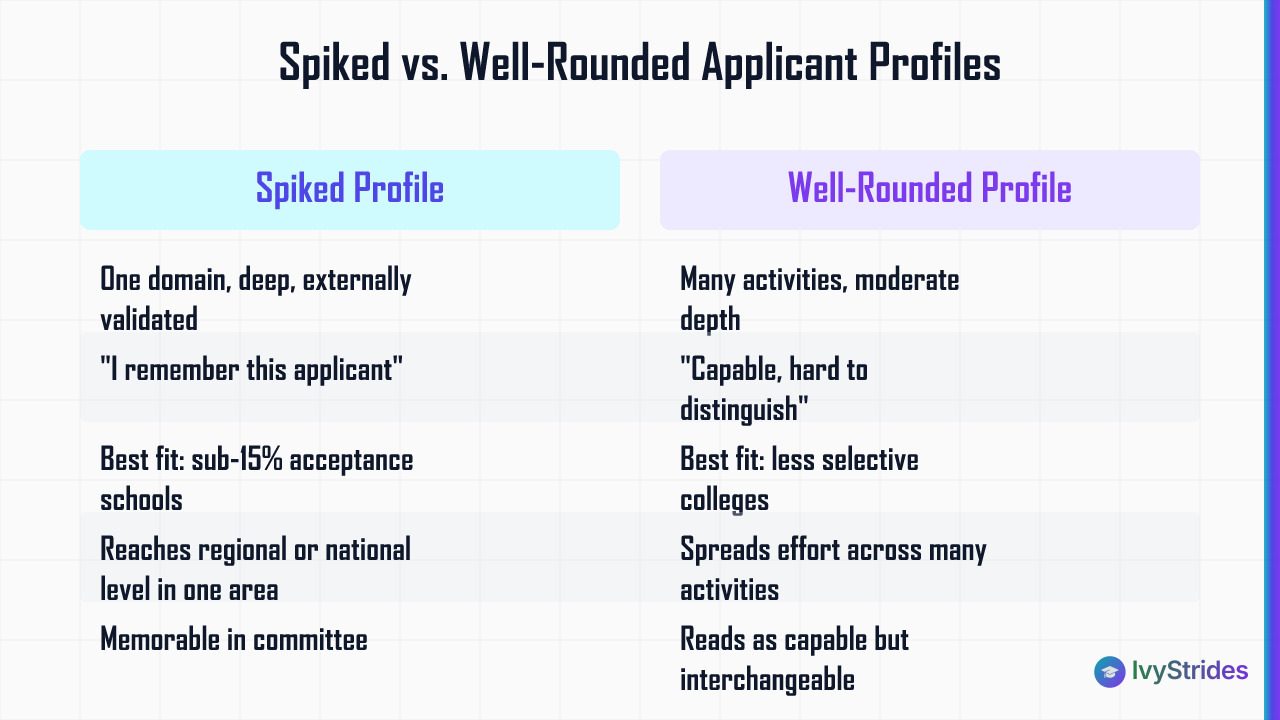
A spike is a single domain of exceptional, externally validated depth that an admissions officer can point to as evidence of genuine mastery. Not eight clubs at moderate involvement. One area, taken far enough that someone outside your school, a competition, a journal, a real audience, has confirmed it.
Depth over breadth is the whole idea. A well-rounded applicant spreads effort across many activities and reads as capable but interchangeable. A spiked applicant reaches a regional or national level in one thing and becomes memorable. At schools with acceptance rates below roughly 10 to 15 percent, memorable is what gets you advocated for in committee.
Why does this matter more at the top of the pool? Because thousands of applicants there already clear the academic bar. Strong SAT or ACT scores clear the threshold that gets an application read; the spike is what makes it remembered. To see how the rest of the academic record gets read, our piece on how colleges read your transcript walks through rigor and grade trends.
One honest caveat before you panic or over-invest: a spike raises your odds at highly selective schools, but admissions decisions rest on the full application, not the spike alone. Well-rounded profiles remain viable at plenty of very good colleges.
| Profile type | Activity pattern | Admissions officer takeaway | Best fit |
| Spiked | One domain, deep, externally validated | "I remember this applicant" | Sub-15% acceptance schools |
| Well-rounded | Many activities, moderate depth | "Capable, hard to distinguish" | Less selective colleges |
| Hybrid | One clear spike plus a few supports | "Depth with range" | Broad, works widely |
Real College Admissions Spike Examples Across Five Domains

Photo by https://kaboompics.com/ on Pexels
A real spike shows up as a named external result, not years of quiet participation. The pattern that repeats across strong files: the student can name a competition placement, a publication, a title, or a launched project with users or reach. That line separates a spike from a hobby.
Below are five domains where a spike for college most often forms. Map your own interest against them and look hard at the third column, because that milestone separates demonstrated excellence from long involvement.
| Domain | Example activity | External validation milestone | Where it shows in the application |
| STEM | Independent lab research | Peer-reviewed publication or national science competition placement | Activities list, personal statement |
| Arts | Youth orchestra, writing | Principal chair, published work, regional or national award | Portfolio, supplemental essays |
| Entrepreneurship | Founded nonprofit or product | State-level reach or a product with active users | Activities list, "Why this major" |
| Humanities | Journalism, essay contests | Nationally recognized award or published journalism | Personal statement |
| Competition math | AMC, AIME, olympiad | AMC 10/12 qualifying score, AIME invitation, USAJMO/USAMO | Activities list, honors section |
Competition mathematics is the cleanest example because the validation is unambiguous. An AIME invitation or a USAJMO qualification is a fact, not a self-report. Academic recognition works the same way; a strong PSAT/NMSQT Selection Index that reaches National Merit standing, decided by the National Merit Scholarship Corporation, is external validation the file carries on its own. If math is your domain, our competition mathematics programs like AMC 10/12 and AIME build toward exactly those milestones.
What does not count: four years in a club with no title and no outcome, or an officer role with nothing measurable attached. Duration is not depth. AP courses in your domain help here too, and our guide on how many AP classes for the Ivy League covers how much rigor selective schools expect.
Grade-by-Grade Timeline for Building a College Admissions Spike
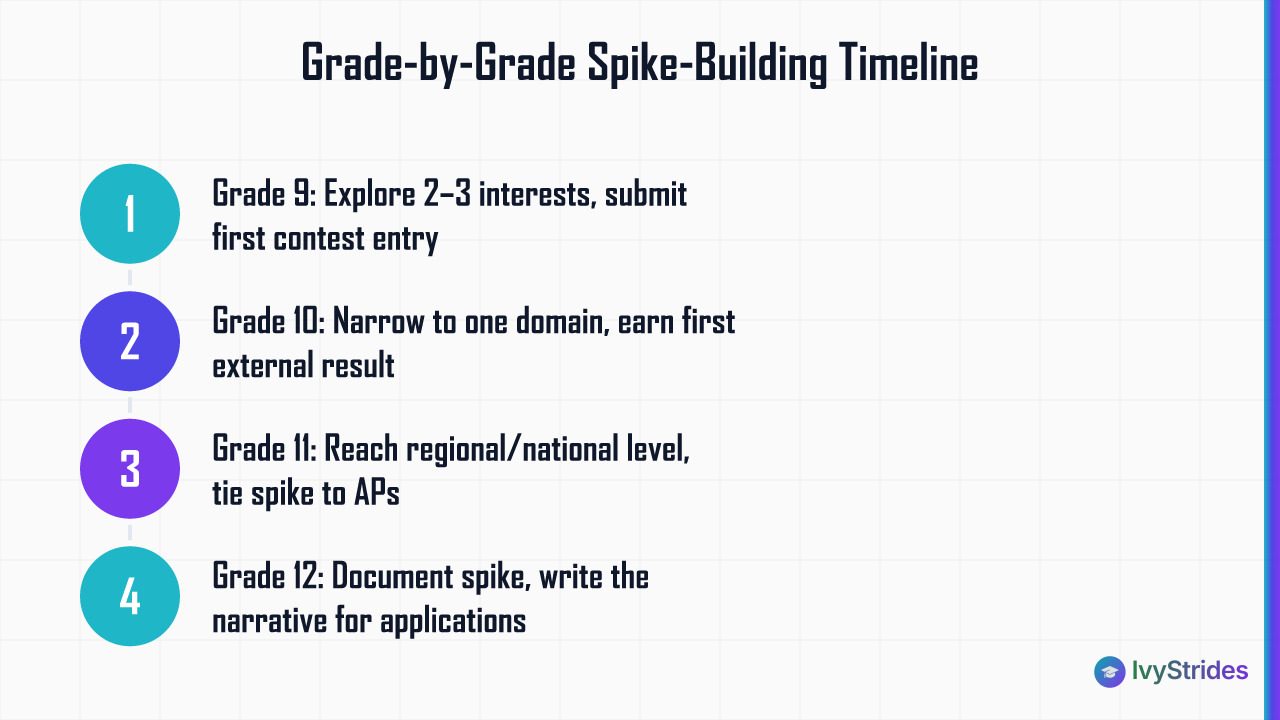
A college admissions spike is most credible when built over multiple years, which is why the grade you start in matters. A student who commits to one domain by 10th grade has roughly 24 months before Early Decision deadlines in 12th grade to build an external record. IvyStrides derives that window from the standard November 1 ED deadline set on the Common App and a 10th-grade start point; neither publishes it as a prep window.
A grade-by-grade counseling plan is the fastest way to identify which activities have spike potential and which are filling space on the activities list.
Spike-Building Checklist by Grade
| Grade | Key action | Target milestone |
| 9 | Explore 2-3 genuine interests, enter low-stakes competitions | First submitted work or contest entry |
| 10 | Narrow to one domain, chase first external result | Local or first-round competition result |
| 11 | Reach regional or national level, tie spike to AP choices | Regional/national validation, essay brainstorm |
| 12 | Document it, write the spike narrative | Finalized activities list and personal statement |
About the late start. If you are already a junior or senior with no clear spike, you are not out of the game. Drop the low-commitment activities now and pour that time into one external validation milestone before applications open: a competition entry, a published piece, a project with a measurable outcome.
In our coaching, students who identify a spike domain by 10th grade and reach a regional milestone by 11th produce materially stronger application narratives than those who diversify through junior year. A late-built spike with one strong result still beats a long list of shallow involvements.
When professional guidance is worth adding is a fair question at any grade; our piece on when to hire a college counselor answers it. For families who want the plan executed with structure, college counseling from grades 9 through 12 maps the milestones to your target schools.
How to Write About Your Spike Across the College Application
Your spike should thread through the whole college application: the personal statement, the supplemental essays, and the activities list all point to the same domain. That coherence is the test. If an admissions officer read only your activities list and your personal statement, would they immediately know what you are about?
Once the spike is clear, the personal statement becomes the place to show the depth behind it, not just list the achievements. Use show-don't-tell to put the reader inside one moment of the work; our method for show, don't tell in college essays gives the technique. The Common App personal statement runs 250 to 650 words, so every sentence has to earn its place.
Supplemental essays carry the spike further. In our coaching, across hundreds of supplemental drafts, the strongest "Why this major" essays name a specific project, competition result, or publication from the spike domain inside the first two sentences. The activities list matters just as much. Those 150-character activity descriptions on the Common App are where the spike's external validation gets its first formal statement, and spike activities should anchor the top of your ten slots. For the tactical how-to, see how to write strong activities list descriptions.
AP courses seal the case. Choosing AP courses in the spike domain, and earning strong scores in them, signals to admissions officers that the interest is academically serious, not just extracurricular. Course grade tends to matter more than the exam score here, though both help.
| Application component | How the spike shows up | Common mistake to avoid |
| Personal statement | Narrative spine, one moment shown in depth | Listing achievements instead of showing them |
| Supplemental essays | "Why this major" names a specific result | Generic passion with no evidence |
| Activities list | Spike anchors top slots, leads with validation | Burying the spike below filler clubs |
| AP courses | Rigor in the spike domain | Random AP load with no through-line |
Translating a spike into essays that show depth is the step most students find hardest to do alone. Our college essay coaching helps you build the narrative before deadlines close in.
FAQ: College Admissions Spikes
What does the term "spike" mean?
In college admissions, a spike means one area of exceptional, externally validated depth that distinguishes an applicant. It is not a general theme or a cluster of loosely related activities. It is a single domain where you have reached a level of achievement an admissions officer can point to as evidence of genuine mastery.
Is the spike a myth or does it actually matter for college admissions?
The spike is real at highly selective colleges, roughly those with acceptance rates below 10 to 15 percent, where thousands of applicants share similar GPAs and scores. At those schools, a documented spike gives an officer a reason to advocate for you in committee. At less selective colleges, a well-rounded profile is often enough.
Can a spike in college applications be more than one activity?
A spike is one domain, not necessarily one activity. Several activities can reinforce the same spike. A student whose domain is computational biology might compete in science fairs, take AP Biology and AP Computer Science, and run independent research. The point is that all of them aim at the same area of depth.
What is a spike for college if I am already a junior with no clear one?
Focus on depth over breadth immediately. Drop low-commitment activities and pursue one external validation milestone before applications open, such as a competition entry, a published piece, or a project with a measurable outcome. A late-built spike with one strong result is more credible than a long list of shallow involvements.
Your Next Step on Building a Spike
A spike is one thing done deeply and confirmed by someone outside your school. That is the whole concept, and it is enough to act on today.
- Pick the one domain on your activities list with the most genuine interest and the clearest path to external validation.
- Find the nearest milestone in that domain: a competition round, a publication, a project you can launch.
- Map backward from your Early Decision deadline to the grade you are in now, and cut what does not serve the spike.
- Keep your GPA and test scores strong; they get the file read so the spike can do its work.

Rajesh is a technology leader, entrepreneur, and angel investor with 28+ years in Business & Technology Leadership and Product & Solution Engineering. He is passionate about education, mentoring, and driving digital transformation.