
Ivy League Admissions Consultants: What They Can Change, What They Cannot, and How to Vet One
On this page
- What an Ivy League Admissions Consultant Can Actually Change in Your Application
- What an Ivy League Admissions Consultant Cannot Change, and Why That Matters
- What an Ivy League Admissions Consultant's Engagement Should Include
- Five Questions to Vet Any Ivy League Admissions Consultant Before You Pay
- FAQ: Ivy League Admissions Consultants
- Is a college admissions consultant worth it?
- What should a consultant's written agreement include?
- Who are the best college admissions consultants?
- Is a lower GPA a dealbreaker for the Ivy League?
An Ivy League admissions consultant is an independent advisor who helps with college list strategy, essay coaching, activity positioning, and application timing. No consultant can change a GPA already earned, a test score only a retake can raise, or extracurricular depth built over years.
Can you trust one? Whether you are the student applying or the parent helping, check five things: credentials, acceptance-rate claims, essay authorship, conflicts of interest, and what happens after a deferral or rejection. Those checks matter because some firms advertise Ivy acceptance rates without showing who they counted.
Hiring one helps most when a student has a strong record but presents it poorly. IvyStrides sells college counseling, so read this as a checklist to hold any provider to, us included, not as a neutral ranking. Admissions outcomes depend on the full application, not any single service.

What an Ivy League Admissions Consultant Can Actually Change in Your Application
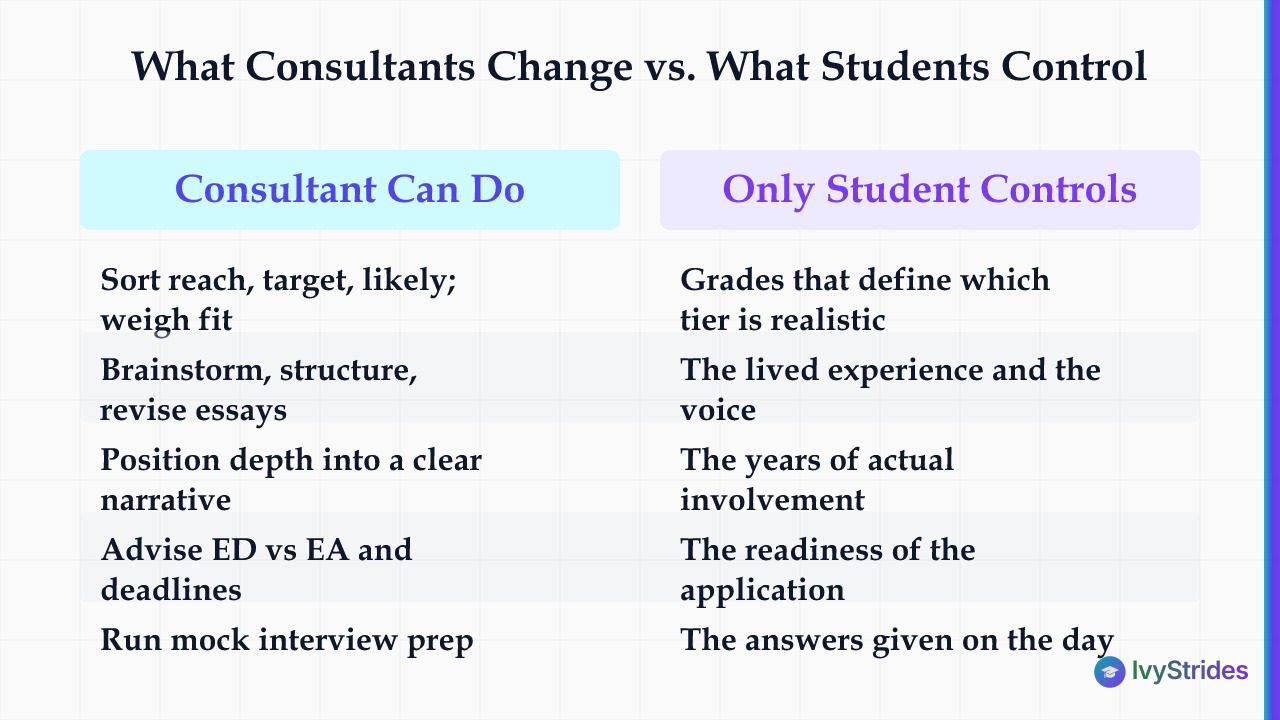
An Ivy League admissions consultant shapes four main things: the college list, the essays, the activity narrative, and the application timing.
Start with the college list. A consultant sorts schools into reach, target, and likely tiers, then pressure-tests whether each one fits academically, socially, and financially. Because test-optional policies vary by school and year, the list also decides where sending a score is a choice at all: for fall 2027 entry, Princeton and Columbia are test-optional among the Ivies, while the other six require the SAT or ACT; those two require scores from fall 2028.
Essays, not ghostwriting. The Common App personal statement caps at 650 words across seven prompts, unchanged for 2026-27. That short limit leaves room for one story in a student's own voice, which is why good consultants ask questions rather than rewrite sentences. Supplemental essays, which some of the more than 1,200 Common App member colleges add with their own prompts and word limits, work the same way.
IvyStrides essay coaches often see supplemental drafts that say what a student thinks the school wants to hear rather than what is specific to their own experience. A consultant's job is to surface that specificity, not supply it.
Timing is a real lever. Binding Early Decision, which Brown, Columbia, Cornell, Dartmouth, and Penn offer, demands an honest read on financial aid needs and whether the application is ready. Harvard, Princeton, and Yale instead offer non-binding Restrictive or Single-Choice Early Action, an earlier read without the commitment, though it limits early applications to other private colleges. All eight set November 1 as the early deadline for fall 2027 entry, so a senior who has not applied early to one of them now works toward Regular Decision.
Activity positioning helps most when a student has depth in one area but has not yet articulated why it matters to a specific school. A consultant can also help a family read the best extracurricular activities for Ivy League admission as a coherent spike rather than a scattered list. Interview preparation rounds out the set: mock questions and coached delivery.
Hiring a consultant before senior year leaves time to shape courses, testing, and activities, not just present them, which is why grade-by-grade college counseling from 9th through 12th matters. IvyStrides' College Admissions Counseling runs grades 9 through 12 as one connected plan.
| Area | What a Consultant Can Do | What Only the Student Controls |
| College list | Sort reach, target, likely; weigh fit | Grades that define which tier is realistic |
| Essays | Brainstorm, structure, revise | The lived experience and the voice |
| Activities | Position depth into a clear narrative | The years of actual involvement |
| Timing | Advise ED vs EA, deadlines | The readiness of the application |
| Interview | Run mock prep | The answers given on the day |
What an Ivy League Admissions Consultant Cannot Change, and Why That Matters
An Ivy League admissions consultant cannot touch the foundation of an application: the grades already on the transcript, the courses already completed, or the years of extracurricular depth behind a genuine spike. A consultant edits presentation but cannot create the underlying record.
Course rigor is the clearest example. A consultant cannot retroactively add AP courses to a transcript, which is why how many AP classes Ivy League applicants typically complete matters as a benchmark long before senior fall. Activity depth works the same way: a leadership role built over three years reads differently from one added in September.
One variable is still live. SAT and ACT scores can still move in the months before applications are due. A consultant who ignores a student's score gap relative to a school's published range leaves the most actionable lever untouched. If an SAT retake is on the table, whether a retake is worth it before your application deadline deserves its own analysis.
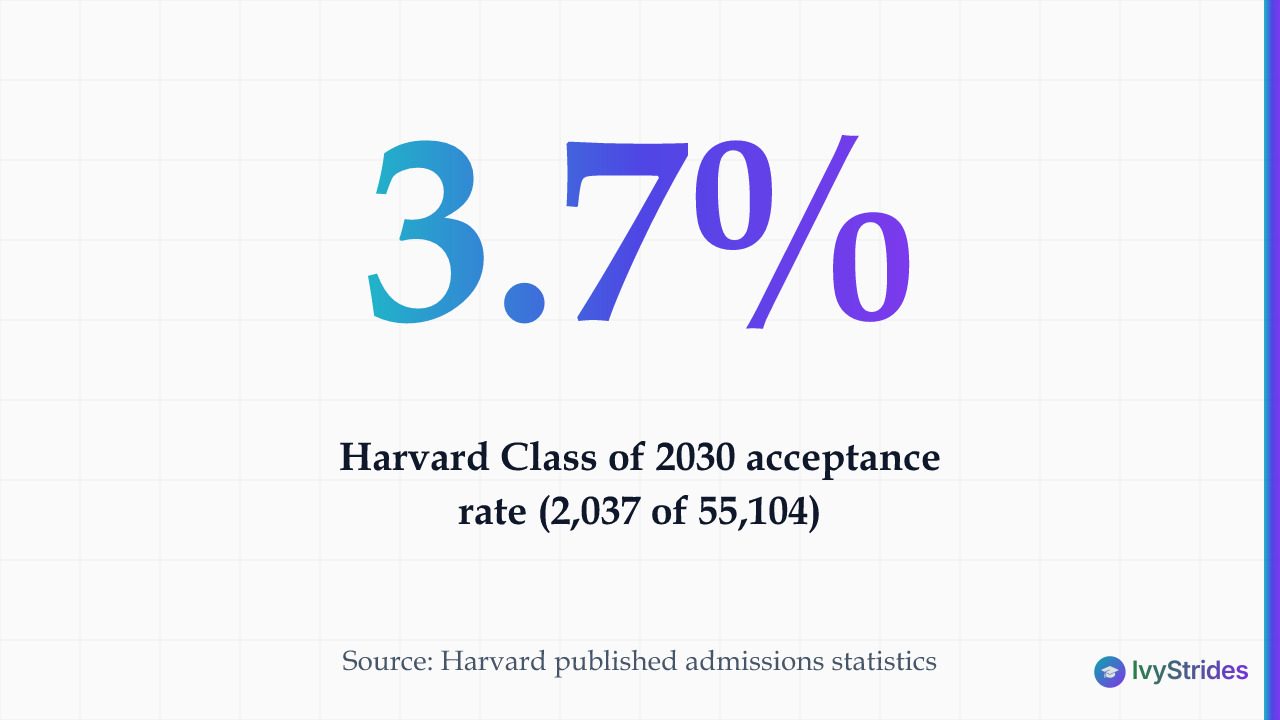
IvyStrides' analysis of Harvard's published counts, 2,037 admitted from 55,104 applicants, puts the Class of 2030 acceptance rate at 3.7%, and Dartmouth reports 5.8% for the same class. At that level, holistic review weighs GPA, course rigor, scores, essays, activities, and recommendations together, and no part of it carries a guarantee. A consultant who implies otherwise sells certainty that does not exist.
Where each input stands:
- GPA: grades already earned cannot be rewritten.
- Course rigor: completed courses stay; the senior schedule still counts.
- Activity depth: built over years, not months.
Daily SAT and ACT prep on YouTube: short strategy videos from IvyStrides. Subscribe to IvyStrides on YouTube.
What an Ivy League Admissions Consultant's Engagement Should Include
A credible Ivy League admissions consultant puts the engagement in writing before any money changes hands. That scope should name who actually works with the student, the essay authorship policy, how the consultant builds the college list, how often you meet, and what the engagement excludes or never promises. A comprehensive package typically covers the list, essays, and timeline together; an hourly engagement covers only the deliverables you book.
The authorship policy is the line that matters most. Every Common App applicant certifies that everything submitted "is my own work, factually true, and honestly presented," and false information can bring "admission revocation." That is the ethical boundary between essay coaching and ghostwriting: a coach gives structural feedback, and the student writes every sentence. Common App's fraud policy covers "intentionally misrepresenting as one's own original work" another person's language or ideas, so the authenticity risk falls on the student.
The National Association for College Admission Counseling (NACAC), in its 2026 Guide to Ethical Practice in College Admission, tells members to counsel students that submitting "false, plagiarized, or fraudulent statements" is unethical. The Independent Educational Consultants Association (IECA) goes further: members "shall not write application essays or any portion of an essay for students."
Who does the work. A senior name on a website may not be the person who works with the student, so a written agreement names the person. Knowing what a college counselor delivers grade by grade helps a family see whether a proposed engagement fits their timeline. Families who already have a counselor sometimes want specialist help only with the personal statement and supplements, so the question becomes when to bring in an essay coach and what can still change.
| Item | What to Look For | Warning Sign |
| Scope | Written, specific deliverables | Vague "full support" |
| Who works with student | Named person | A brand name, no person |
| Essay policy | Coaching only, in writing | Silence on authorship |
| College list | Built from the student's record | A preset list of brands |
| Promises | No admission guarantee | "We get students into the Ivies" |
Five Questions to Vet Any Ivy League Admissions Consultant Before You Pay
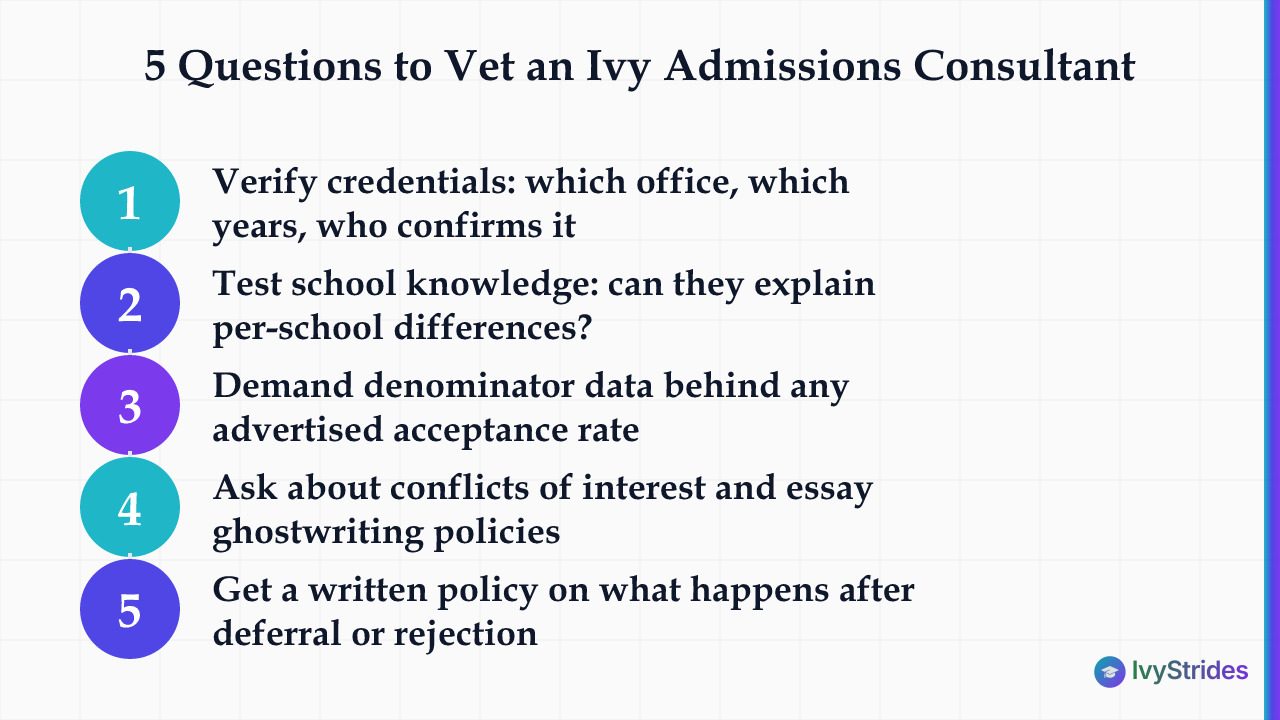
Five questions separate a credible Ivy League admissions consultant from a misleading one.
Credentials come first. A consultant's background shapes what they can offer: a former admissions officer has read files for a committee, an experienced counselor knows the process end to end, and a subject specialist helps with one piece. Verify the claim: which office, which years, who can confirm it.
A consultant who cannot explain where each Ivy League school weighs applicants differently is not equipped to position an application for a specific school. Yale, for one, marks "level of applicant's interest" as Not Considered in its 2025-26 Common Data Set, so demonstrated interest is no lever there.
The acceptance-rate trap. Some firms advertise a striking Ivy acceptance rate. Without denominator data, that number tells you little: the base may leave out clients who never applied to an Ivy, stopped reporting back, or left midway. Ask how many clients sit in the base, which years it covers, and who outside the firm checked it. Treat any rate without those answers as marketing.
Ask about conflicts of interest, such as referral fees or school relationships: NACAC's guide says members should not be "compensated by commissions, bonuses, or other incentive payments" tied to how many students are referred, recruited, admitted, or enrolled. Then ask in writing what happens on a deferral or rejection. IECA members pledge that they "neither guarantee placement nor outcomes," and no honest consultant promises admission.
IvyStrides' college admissions counselors publish their own answers, so test them the same way: counseling for grades 11 and 12 runs on a monthly student call, a written deliverable at every decision point such as the college list, and essays coached draft by draft, never ghostwritten. No one can guarantee admission, and that includes us. This vetting process overlaps with how to choose a college counselor with seven questions to ask, so a family evaluating a consultant can reuse most of it.
| Question | What a Strong Answer Looks Like | Red Flag |
| Credentials? | Verifiable admissions office or counselor background | Vague claims of long experience |
| Acceptance rate? | Shows the client count and years behind any rate | A headline rate with no count behind it |
| Who writes the essay? | Student does; coach gives feedback | Offers to draft it |
| Any conflicts? | Discloses referral or school ties | Evades the question |
| If rejected? | Clear written policy | No answer, no refund terms |
College admissions insights on LinkedIn: follow IvyStrides for application guidance and counseling updates.
FAQ: Ivy League Admissions Consultants
Is a college admissions consultant worth it?
A consultant adds value when a student has a strong underlying record but needs help presenting it clearly. They cannot manufacture a record that does not exist.
What should a consultant's written agreement include?
It should name who works with the student, the essay authorship policy, how the consultant builds the college list, how often you meet, and a plain statement that no one can promise admission.
Who are the best college admissions consultants?
No audited ranking exists. The most reliable signals are a verifiable background, a clear written policy on essay authorship, and no guaranteed-acceptance claims. Ask for references from families whose student had a similar profile.
Is a lower GPA a dealbreaker for the Ivy League?
Not automatically. Dartmouth says each application "is reviewed holistically, regardless of GPA, class rank, and test scores," though Harvard's 2025-26 Common Data Set reports a 4.22 average high school GPA for enrolled fall 2025 first-years who submitted one. No consultant can change a GPA already on the transcript; the honest conversation is which schools fit the full profile.

Rajesh is a technology leader, entrepreneur, and angel investor with 28+ years in Business & Technology Leadership and Product & Solution Engineering. He is passionate about education, mentoring, and driving digital transformation.