
Best Extracurricular Activities for Ivy League: What Each Ivy Rewards

On this page
- What Tier 1 Extracurriculars for Ivy League Actually Look Like
- What Each Ivy League School Actually Rewards in Extracurriculars
- What Sports Are Best for Ivy League Admission and How the Recruited Athlete Path Works
- How to Build an Ivy-Worthy Extracurricular Spike Before You Apply
- FAQ: Ivy League Extracurricular Activities
- What are Tier 1 extracurriculars?
- What extracurriculars does Harvard look for?
- What sports are best for Ivy League admission?
- How many extracurriculars should I have for Ivy League?
- Your Next Step on Your Ivy Extracurricular Profile
The best extracurricular activities for Ivy League admissions show exceptional depth in one area, a coherent spike, not a long list of unrelated clubs. Ivy League extracurricular evaluation is the holistic review readers use to score impact, leadership, and initiative. Tier 1 activities carry the most weight.
Those Tier 1 signals, original research, national competition placements, and founding a sustained organization, are rare, and rarity is exactly why they move an admissions reader. Every Ivy weighs them slightly differently, but all eight prioritize depth and impact over breadth. This page maps that framework against your own profile.
What Tier 1 Extracurriculars for Ivy League Actually Look Like
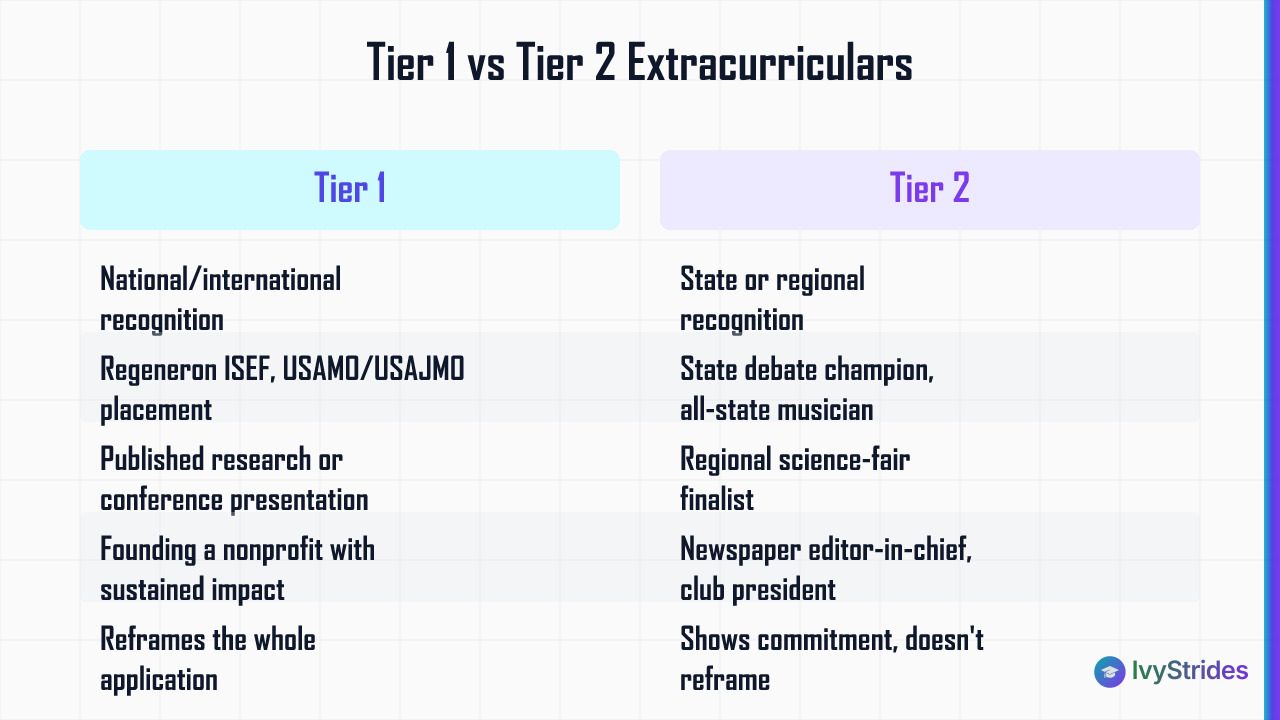
A Tier 1 extracurricular is an activity with national or international recognition, original research, or founding impact. A Tier 2 extracurricular tops out at state or regional recognition, or a significant leadership role inside a school organization. The gap between the two is what an admissions reader notices first, and it decides how the rest of your application reads.
A spike is the single thread that connects your strongest activities, and Ivy admissions readers look for it across every section of the application. Tier 1 results give that thread a natural anchor. A student who qualifies for the AIME, publishes a research paper, or founds a nonprofit with measurable regional reach hands the reader a story that writes itself.
Concrete examples span several domains. In STEM, that means placing at Regeneron ISEF, reaching USAMO or USAJMO, or ranking at Science Olympiad nationals. On the math track, the MAA sets AIME qualifying scores of 100 on the AMC 10 and 85 on the AMC 12, so an AIME invitation is a clean, verifiable Tier 1 signal. Original research with a publication or conference presentation counts too, as does founding an organization that sustains real impact past its first year.
Tier 2 is where most strong applicants live. State debate champion, editor-in-chief of the school newspaper, regional science-fair finalist, section leader in a competitive orchestra: these show commitment and a leadership role, and they matter. They just don't reframe an application the way a single national result does.
In our coaching with students applying to Ivy League schools, the most common mistake is stacking ten unrelated clubs instead of deepening in one area. A long, flat list reads as participation. An AP Scholar Award adds a minor academic-depth signal alongside the spike, but it supports the story rather than carrying it.
| Tier | Defining Characteristic | Example Activities | Admissions Signal |
| Tier 1 | National/international recognition | Regeneron ISEF, USAMO/USAJMO placement | Reframes the whole application |
| Tier 1 | Original research | Published paper, conference presentation | Signals independent scholarship |
| Tier 1 | Founding impact | Nonprofit with sustained regional reach | Signals initiative and grit |
| Tier 2 | State-level recognition | State debate champion, all-state musician | Strong depth, not rare |
| Tier 2 | School leadership | Newspaper editor-in-chief, club president | Leadership over participation |
| Tier 2 | Regional placement | Regional science-fair finalist | Solid supporting role |
You can pursue the STEM Tier 1 route through structured programs; see our guide to science competitions and research programs for high schoolers for the ranked list. If the spike idea is new to you, start with what is a spike in college admissions.
What Each Ivy League School Actually Rewards in Extracurriculars
Each Ivy League school rewards a slightly different extracurricular emphasis, and the differences are real enough to shape which activities you prioritize. Because that Tier 1 versus Tier 2 framework isn't applied identically everywhere, the same national result reads differently at Harvard than at Dartmouth. Each school signals its own priorities through the admissions factors it weights.
Every Ivy publishes a Common Data Set with importance ratings for admissions factors, including extracurriculars and character. That's the closest thing to an official map of what a school values. Read alongside each school's public admissions guidance, a pattern emerges.
| School | Strongest Signal | Aligned Activities | Nuance |
| Harvard | Intellectual initiative | Research, academic competitions | Wants a spike tied to intended study |
| Princeton | Service leadership | Sustained community impact | Depth of commitment over titles |
| Yale | Artistic, creative depth | Arts, civic engagement | Values genuine creative voice |
| Columbia | Urban civic engagement | Journalism, policy, activism | New York context matters |
| Penn | Pre-professional leadership | Business, entrepreneurship | Rewards applied ambition |
| Brown | Self-directed projects | Interdisciplinary initiatives | Open Curriculum favors independence |
| Dartmouth | Outdoor, service leadership | Work in underserved areas | Values place-based commitment |
| Cornell | Applied research | Agricultural, engineering competitions | College-specific fit matters |
AP course rigor and activity depth are evaluated together: a student with 10 APs and no leadership signal reads differently from one with 6 APs and a national competition result. If you're calibrating course load alongside activities, see how many AP classes do you need for the Ivy League and the full 8 Ivy League schools and their SAT requirements.
Two caveats hold across all eight. Admissions outcomes depend on the full application, GPA, scores, essays, and recommendations, not activities alone. And test-optional policies vary by school and year, per FairTest, which makes a strong activity spike relatively more important when scores are off the table.
What Sports Are Best for Ivy League Admission and How the Recruited Athlete Path Works
Sports help Ivy League admission most through the recruited-athlete pathway, and the sports with more roster spots per school offer the better statistical path. Where the Common Data Set maps academic and civic priorities, athletics runs on a parallel track: a coach advocates for you, and admissions weighs that advocacy against a minimum academic threshold.
A recruited athlete is a student a coach actively supports through admissions, often with a likely letter. The Ivy League binds every recruit to an academic index, a formula combining GPA and test scores that sets a floor no recruit may fall below. So the athletic path never bypasses academics; it runs alongside them.
| Sport Category | Roster Spots | Recruitment Timeline | Admissions Advantage |
| Crew, rowing | More spots | Contact by junior year | Meaningful with coach support |
| Fencing, squash, sailing | More spots | Contact by junior year | Meaningful, less saturated |
| Track, swimming | Moderate | Sophomore to junior year | Depends on times/marks |
| Football, basketball | Fewer spots | Early, competitive | High bar, limited slots |
| Lacrosse | Fewer spots | Early | Regionally competitive |
| Casual participation | None | No recruitment | Tier 2 or lower signal |
In our coaching with students who play sports, the ones who convert athletics into an admissions edge start coach contact early, typically by junior year, with realistic times or marks in hand. Casual participation without recruitment still shows commitment, but it reads as a Tier 2 activity at best, not a hook.
How athletics sits among other factors is covered in what do colleges look for in students. One caveat: athletic admission depends on coach advocacy and the full application, not the sport alone.
How to Build an Ivy-Worthy Extracurricular Spike Before You Apply
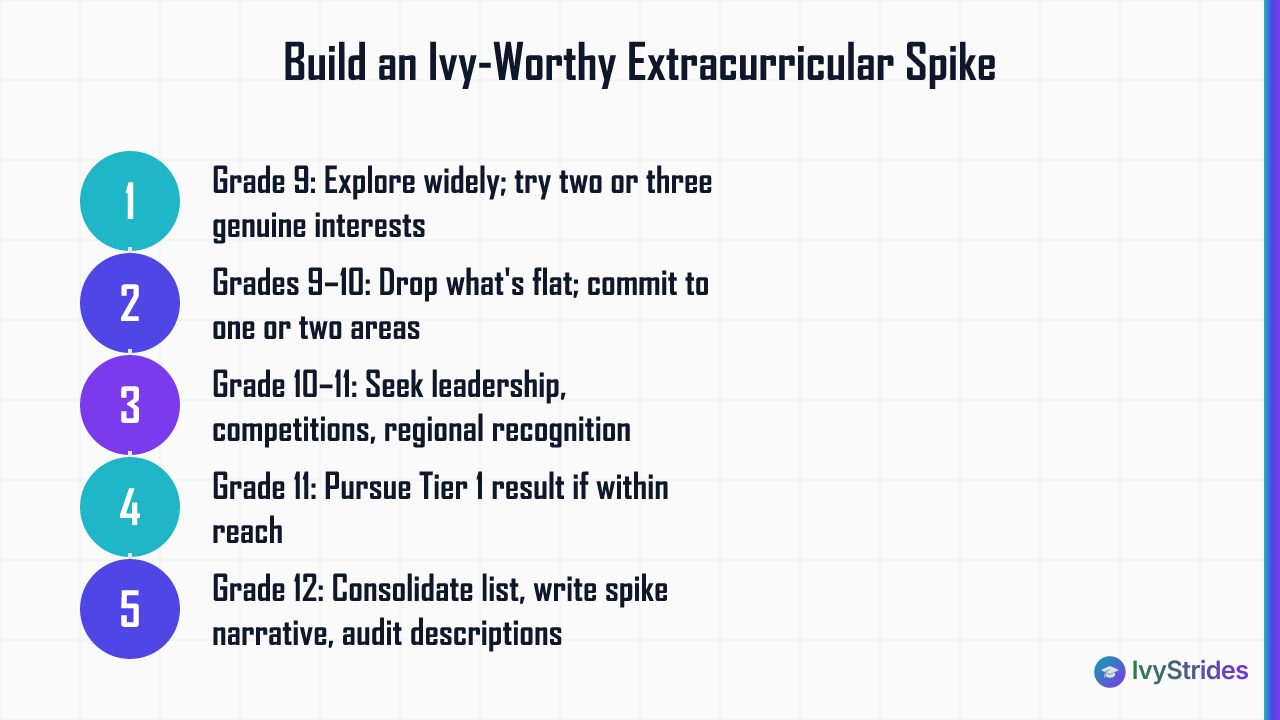
Building an Ivy-worthy spike means choosing one area, going deep, and presenting that depth cleanly on the Common App activities section. It's a grade-by-grade process, not a senior-year scramble, and the earlier you commit to a direction, the more room you have to reach a Tier 1 or strong Tier 2 result.
Once your activity profile has a clear spike, the extracurricular essay is where you translate that depth into a narrative admissions readers remember. Getting there starts with an honest audit of where you are now.
| Grade | Action |
| 9 | Explore widely; try two or three genuine interests |
| 9-10 | Drop what's flat; commit to one or two areas |
| 10 | Seek early leadership or a first competition entry |
| 11 | Deepen: leadership role, regional or national recognition |
| 11 | Pursue the Tier 1 result if it's within reach |
| 12 | Consolidate and write the activities list |
| 12 | Connect the spike to your essay narrative |
| 12 | Audit descriptions for impact, not participation |
The Common App gives you 10 activity slots and 150 characters per description, with fields for position/leadership, hours per week, and weeks per year. That's 1,500 characters of total budget to convey an entire profile, a figure IvyStrides sums from the slot count and the character limit. Curation matters as much as participation.
Impact, not participation. Each of the 10 Common App activity slots gives you 150 characters to show impact, not just participation, and the phrasing of those descriptions shapes how readers score your spike. See how to write strong activities list descriptions for the playbook. how to write the extracurricular essay for the narrative step.
In our coaching with students building their activity profiles, the 150-character description is where most students undersell their leadership role, describing what the club does rather than what they personally achieved. Use action verbs and quantify: "Founded, grew to 40 members, raised $6K" beats "member of service club." Admissions outcomes still depend on the full application, so the activities list supports the story, it doesn't replace it.
If your list has no coherent spike yet and deadlines are close, a personalized audit is the fastest way to find the one area worth deepening. That's what IvyStrides college admissions counseling delivers: a grade-by-grade activity review mapped to your target schools.
FAQ: Ivy League Extracurricular Activities
What are Tier 1 extracurriculars?
Tier 1 extracurriculars are activities with national or international recognition: placing in a national competition like Regeneron ISEF, USAMO, or Science Olympiad nationals, publishing original research, or founding an organization with measurable regional impact. They're rare, which is why they move the needle. Most applicants have Tier 2 activities, so a single Tier 1 result reframes the entire application.
What extracurriculars does Harvard look for?
Harvard's admissions materials emphasize intellectual initiative: original research, founding a project that solves a real problem, or achieving national recognition in an academic competition. In our coaching with students admitted to Harvard, the common thread is a coherent spike that connects their strongest activity to their intended area of study, not a long list of clubs.
What sports are best for Ivy League admission?
Sports with more roster spots per school, such as crew, fencing, squash, and sailing, give recruited athletes a statistically better path than high-profile sports like football or basketball. The recruited-athlete pathway needs early coach contact, typically by junior year, and every Ivy recruit must meet the academic index threshold. Casual participation without recruitment adds limited weight.
How many extracurriculars should I have for Ivy League?
Quality and depth matter far more than quantity. The Common App gives you 10 activity slots, but most competitive applicants fill 8 to 10 with a mix of one or two Tier 1 or strong Tier 2 activities and several supporting roles. Admissions readers prefer three to four deeply pursued activities over 10 superficial memberships.
Your Next Step on Your Ivy Extracurricular Profile
Your activities matter most when they point in one direction. Before junior year ends, take an honest look at your current list and decide where the depth is.
- Sort your activities into Tier 1 and Tier 2 against the framework above.
- Pick the one area where you can build genuine depth this year.
- Map that spike to the specific Ivies on your list and their emphases.
- Rewrite each Common App description to show impact, not membership.

Rajesh is a technology leader, entrepreneur, and angel investor with 28+ years in Business & Technology Leadership and Product & Solution Engineering. He is passionate about education, mentoring, and driving digital transformation.