
How to Get Into an Ivy League School as an International Student
On this page
- How Hard Is It for International Students to Get Into an Ivy League School
- What Ivy League Schools Actually Require From International Applicants
- How the College Essay Works Differently for International Applicants
- How to Build a Balanced College List as an International Applicant
- FAQ: Ivy League Admissions for International Students
- Can Harvard accept international students?
- How do Ivy League schools read a GPA from outside the US?
- How can I get into an Ivy League college?
- Which Ivy League school accepts the most international students?
International students get into Ivy League schools every year, but applicants from abroad are admitted at lower rates than US applicants at every Ivy that reports both. An Ivy League school is one of the eight members of the Ivy League, a US athletic conference: Brown, Columbia, Cornell, Dartmouth, Harvard, Penn, Princeton, and Yale.
What moves the needle from abroad: a strong SAT or ACT score, top marks in a demanding curriculum, and essays that translate your non-US context for an American reader. Princeton says it is familiar with the education systems of most countries, but your file still has to show what a mark or a prize means where you study.

How Hard Is It for International Students to Get Into an Ivy League School
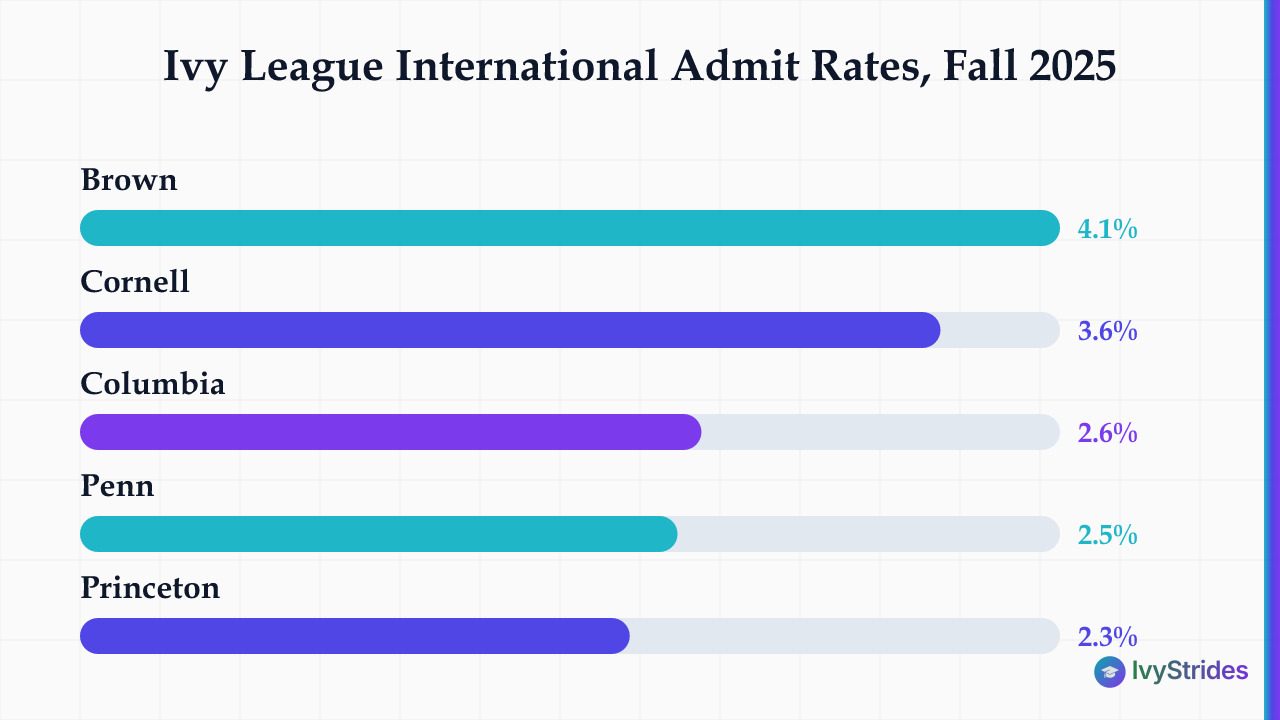
Very hard. IvyStrides' analysis of the five Ivy fall 2025 Common Data Sets that report it puts the admit rate for applicants from abroad between 2.3% at Princeton and 4.1% at Brown, below the US rate at all five. Cornell's Common Data Set shows 3.6% from abroad against 10.0% from the US (5,413 of 53,957). Those counts follow address at application, not citizenship.
Country context matters, but not as a quota. Harvard says it has "no quotas or limits of any kind" and considers all students "in the same pool." Princeton evaluates applicants abroad "with their immediate context and opportunities in mind."
Each Ivy weighs the pieces of a file differently, so settle where the eight Ivies disagree on what counts most before you commit to a list. Aid also shapes the list.
| School | Need Policy for Internationals | Admitted From Abroad, Fall 2025 | International Share of Undergraduates |
| Harvard | Need-blind | Not reported | 15.3% |
| Yale | Need-blind | Not reported | 10.6% |
| Princeton | Need-blind | 2.3% (241 of 10,567) | 13.1% |
| Dartmouth | Need-blind | Not reported | 14.5% |
| Brown | Need-blind since Class of 2029 | 4.1% (404 of 9,861) | 12.9% |
| Columbia | Need-aware | 2.6% (407 of 15,380) | 17.1% |
| Penn | Need-aware | 2.5% (441 of 17,882) | 13.4% |
| Cornell | Need-aware | 3.6% (664 of 18,566) | 9.5% |
Need-blind means asking for aid does not affect the decision; need-aware means it can. Brown turned need-blind for international students with the Class of 2029. All eight meet 100% of demonstrated need for admitted students and award only need-based aid, no merit scholarships. Shares count fall 2025 nonresidents among degree-seeking undergraduates; Columbia's covers Columbia College and Columbia Engineering. Aid policies can change.
What Ivy League Schools Actually Require From International Applicants

Photo by cottonbro studio on Pexels
Ivy League schools ask international applicants for largely the same core file as domestic students, plus documents that make a non-US record legible: transcripts in English, a school profile, and, at most Ivies, proof of English proficiency.
Test policy for fall 2027 entry. Six of the eight Ivies require the SAT or ACT: Harvard, Yale, Penn, Dartmouth, Brown, and Cornell, whose return to required testing followed a multi-year study. Harvard accepts other exam results only in exceptional cases, Penn offers a hardship waiver, and Dartmouth accepts three AP exams or IB, A-Level, or national results from schools outside the US. Princeton and Columbia applicants for fall 2027 entry choose whether to submit; both require scores from fall 2028.
Score ranges. Middle 50% SAT scores for enrolled first-years who sent one, in each 2025-26 Common Data Set, were 1510 to 1560 at Columbia, 1490 to 1560 at Princeton, 1490 to 1550 at Cornell, 1480 to 1560 at Yale, 1470 to 1550 at Brown, and 1440 to 1550 at Dartmouth, on the 400 to 1600 scale. Harvard and Penn publish section ranges only. ACT composite ranges on the 1 to 36 scale were 34 to 35 at Columbia, Princeton, and Penn. These describe enrolled students, not cutoffs, and holistic review means outcomes depend on the full application.
In our admissions counseling, we find that international students often underestimate the school profile, which tells a reader whether a 17 out of 20 is routine or near-perfect at your school.
| Item | Notes for International Applicants |
| Transcripts | Official, in your school's grading system; Yale and Penn require certified translations |
| SAT or ACT | Fall 2027 entry: required at six Ivies, optional at Princeton and Columbia |
| English proficiency | Required unless exempt at Yale, Penn, Dartmouth, Cornell, Columbia, and Princeton; recommended at Brown; not required at Harvard |
| Teacher recommendations | Two at seven Ivies; one at Penn |
| Counselor recommendation | One, from a counselor or school official |
| Common App | Accepted at all eight; 1,200+ member colleges |
AP as a rigor signal. When your home curriculum is unfamiliar to US readers, AP courses give them a shared benchmark, though Princeton says it has "no preference or advantage" for any system. The College Board AP Program scores exams 1 to 5, and credit policies vary by college. If your school doesn't offer AP, you can still show rigor by taking AP courses online from outside the US.
Daily SAT and ACT prep on YouTube: short strategy videos from IvyStrides. Subscribe to IvyStrides on YouTube.
English tests differ most. Harvard does not require one. Brown highly recommends one and expects an IELTS of at least 8.0 in most cases. The other six ask for one based on first language and English-medium schooling: two years at Yale and Dartmouth, three at Princeton and Penn, four at Cornell. Columbia waives it with 700 on SAT Reading and Writing or 29 on ACT English or Reading. Columbia requires an IELTS of 7.5 and Cornell lists 7.5 as its competitive minimum; Yale and Penn look for 7 or above, and Dartmouth says most successful applicants score above 7.
IvyStrides coaches can start with a timed Bluebook diagnostic, then target the Reading and Writing or Math domains costing the most points, which is why 1-on-1 SAT prep fits an international student closing a gap before the application deadline.
How the College Essay Works Differently for International Applicants

Photo by https://kaboompics.com/ on Pexels
For international applicants, the Common App personal statement translates your academic and personal context into a story a US admissions reader can weigh. You answer one of seven prompts in no more than 650 words, and the Common App keeps those prompts unchanged for 2026-27.
A test score and a school profile tell a reader what you did; the essay tells them what it meant. A common gap for international applicants is underexplaining achievements that are obvious at home but opaque to a US reader.
An applicant without a US-experienced counselor can work with an essay coach who maps a draft against that context gap well before an application deadline; the work is line-by-line revision of how you explain each achievement.
| Approach | Why It Works | Common Mistake to Avoid |
| Explain the stakes of a local achievement | Reader can weigh it fairly | Assuming the reader knows the context |
| Write in your own voice | Reads as authentic | Mimicking an "American" tone |
| Show one specific moment | Memorable and concrete | Summarizing your whole résumé |
| Connect context to who you are | Answers the prompt | Listing credentials already elsewhere |
Where a supplement asks why you chose that school, a 'Why This College' essay that works names courses, professors, and programs, not rankings. Once you know what changes for an international applicant, the writing process itself is the same step-by-step job you'd follow to draft any Common App essay.
How to Build a Balanced College List as an International Applicant
A balanced college list for an international applicant places schools by financial aid policy first, then by admit rate and international enrollment. Every Ivy is a reach at these admit rates, so the list also needs schools outside the eight.
Aid policy sorts the tiers. When we build lists with international families, we flag the need-aware versus need-blind distinction early. If aid is essential, need-aware Columbia, Penn, and Cornell carry added risk; Harvard, Yale, Princeton, Dartmouth, and Brown (since the Class of 2029) read international files need-blind. Request aid when you apply: Penn says a request made after admission "cannot be considered," and Cornell closes aid to international students who miss its deadline.
Early rounds differ. Brown, Columbia, Cornell, Dartmouth, and Penn use binding Early Decision, which means accepting one aid package without comparing others. Harvard's Restrictive Early Action and Single-Choice Early Action at Princeton and Yale are non-binding. Applicants across time zones benefit from mapping every deadline from SAT registration to Common App submission at least 18 months out.
Depth beats breadth on the activities list, so learn what each Ivy rewards in extracurricular activities. If your school offers AP, weigh how many AP courses Ivy applicants typically complete against what it actually offers.
| Grade | Testing Priority | Essay and Application Priority | Extracurricular Priority |
| 9 | Build reading and math foundations | None yet | Explore, find a genuine interest |
| 10 | First timed SAT/ACT diagnostic | None yet | Deepen one or two activities |
| 11 | SAT/ACT prep and first sittings; AP exams | Draft personal statement; research schools | Lead or build an extracurricular spike |
| 12 | Final retests; TOEFL/IELTS | Finalize essays; submit Common App | Document and frame your spike |
Start where the gap is widest for you:
College admissions insights on LinkedIn: follow IvyStrides for application guidance and counseling updates.
- Run a timed SAT or ACT diagnostic against the ranges at your target schools.
- Check whether your schooling exempts you from an English test at each one.
- Draft your personal statement early, with context translation as the first job.
Many families work with a counselor who reads your list against each college's requirements to set the tiers.
FAQ: Ivy League Admissions for International Students
Can Harvard accept international students?
Yes. International students are 15.3% of Harvard's degree-seeking undergraduates in its fall 2025 Common Data Set. Admission is need-blind, and Harvard meets 100% of demonstrated need. Its international applicants page says the admissions and aid processes are the same regardless of nationality or citizenship.
How do Ivy League schools read a GPA from outside the US?
You should not convert it yourself. Cornell says grades "should not be converted" to a US GPA, and Penn says they "should not be recalculated." Report marks as your school issues them.
How can I get into an Ivy League college?
Ivy League admission rewards top marks in the most rigorous curriculum available to you, an SAT or ACT score in line with enrolled students' ranges where you submit one, extracurricular depth, strong recommendations, and essays that show who you are. International applicants also have to translate their non-US academic context for a US reader. Outcomes depend on the full application.
Which Ivy League school accepts the most international students?
Among the five Ivies that report it, Cornell admitted the most applicants from abroad for fall 2025: 664. Columbia enrolls the largest share, 17.1% of degree-seeking undergraduates in Columbia College and Columbia Engineering, followed by Harvard at 15.3%. Cornell's 1,523 international undergraduates are the largest head count in these files but the smallest share, 9.5%.

Rajesh is a technology leader, entrepreneur, and angel investor with 28+ years in Business & Technology Leadership and Product & Solution Engineering. He is passionate about education, mentoring, and driving digital transformation.