
What Do Colleges Look For in Students? What 25 Top Schools Weigh Most

On this page
- What Colleges Look For Most: GPA, Test Scores, and Course Rigor
- What Colleges Look For in Extracurricular Activities and Personal Qualities
- What Colleges Look For in Your College Essay and Application Essays
- How to Strengthen Each Factor Before Your Application Deadline
- FAQ: What Colleges Look For in Students
- What do colleges look for the most?
- Do colleges look at a 4.0 or 5.0 GPA when reviewing applications?
- Is a 2.7 GPA too low for college admission?
- What personal qualities do colleges look for in students?
- Your Next Step on Admissions Criteria
Colleges weigh six factors in holistic review: GPA and course rigor, SAT or ACT scores, the college essay, extracurricular depth, recommendation letters, and demonstrated interest. College admissions criteria are the ranked signals an admissions officer reads to decide whether a student fits the class. At most selective schools, GPA and rigor carry the most weight.
Holistic review means colleges build a class rather than rank applicants by one number, so no single factor guarantees admission. That reframes the practical question. Not "am I good enough" but "which of the six factors is holding my profile back, and can I close that gap before my deadline."
What Colleges Look For Most: GPA, Test Scores, and Course Rigor
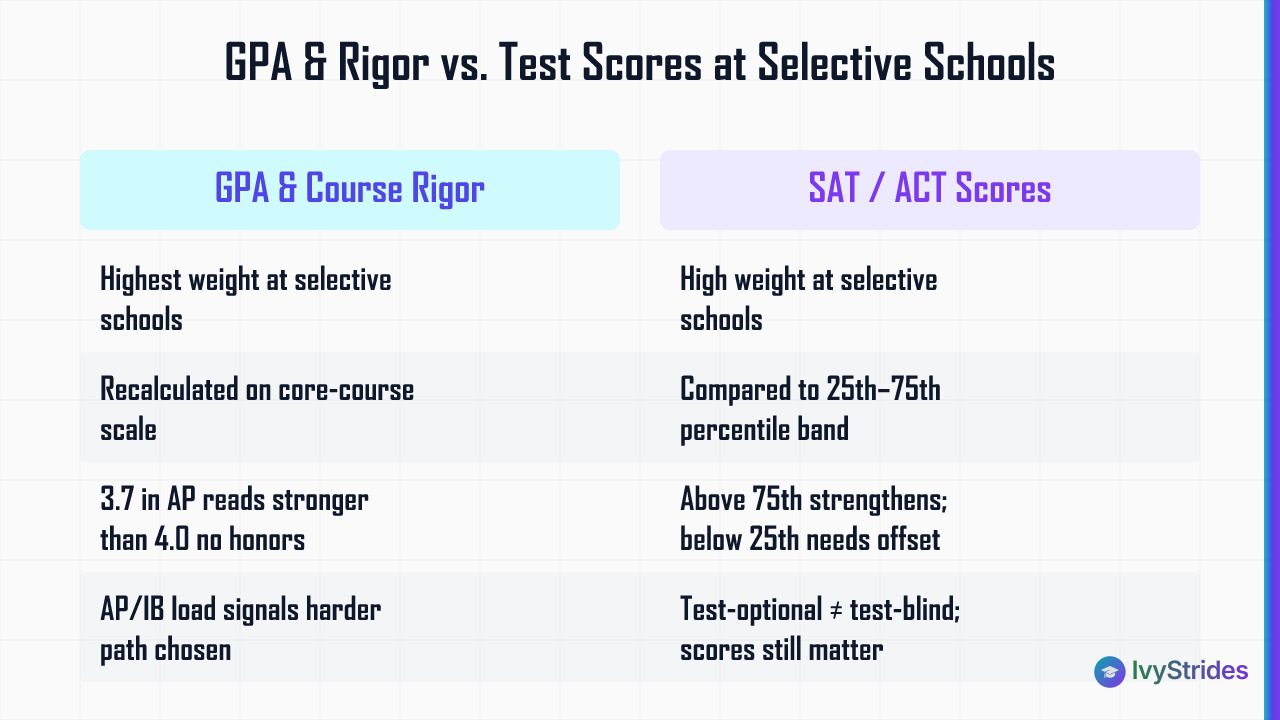
GPA and course rigor are the first filter at nearly every selective school, and standardized test scores are the second. Admissions officers read your transcript before anything else, then check whether your scores land inside the range of already-admitted students. Everything softer, essays, activities, letters, gets read in that academic context.
Rigor beats a clean number. Colleges recalculate your GPA on their own core-course scale, stripping electives and often stripping the weighting your school added. A 3.7 unweighted GPA in Advanced Placement courses typically reads stronger than a 4.0 on a schedule with no honors or AP load.
AP and IB course counts signal that you chose the harder path, and admissions officers read that signal before any AP exam score arrives. AP exams score on a 1 to 5 scale, but credit policies vary by college and do not affect the admissions signal itself.
For a deeper look at how admissions officers move through your transcript line by line, see how colleges read your transcript. If your target schools are highly selective, the question of how many AP classes you need for the Ivy League and top colleges has a more specific answer.
Scores still matter, even test-optional. The Digital SAT scores on a 400 to 1600 scale and the ACT composite runs 1 to 36. The operative benchmark is not a single cutoff but the 25th-to-75th percentile band of admitted students at each school, which the federal NCES College Navigator publishes per institution. Score above the 75th percentile and you strengthen the profile; land below the 25th and you likely need another factor to compensate.
Test-optional is not test-blind. Test-optional means you choose whether to submit; test-blind means the school ignores scores even if sent. Policies vary by school and year, tracked by FairTest, and a strong score still supports merit aid at many schools that don't require one for admission. Whether to submit is its own decision; the full framework is in our guide on what test-optional actually means.
| Factor | Weight at Selective Schools | What Officers Actually Check |
| GPA and course rigor | Highest | Core-course GPA, AP/IB load, grade trend |
| SAT or ACT scores | High | Score vs. 25th-75th percentile band |
| College essay | High | Voice, specific detail, intellectual fit |
| Extracurriculars | Medium-high | Depth and leadership in one spike |
| Recommendation letters | Medium | Specific classroom examples |
| Demonstrated interest | Low-medium | Visits, contact, only where tracked |
If you don't know whether your current score falls inside or outside the band at your target schools, a diagnostic is the fastest way to find out. Our 1-on-1 SAT and ACT prep starts there, mapping your current score band and the gap to close.
What Colleges Look For in Extracurricular Activities and Personal Qualities
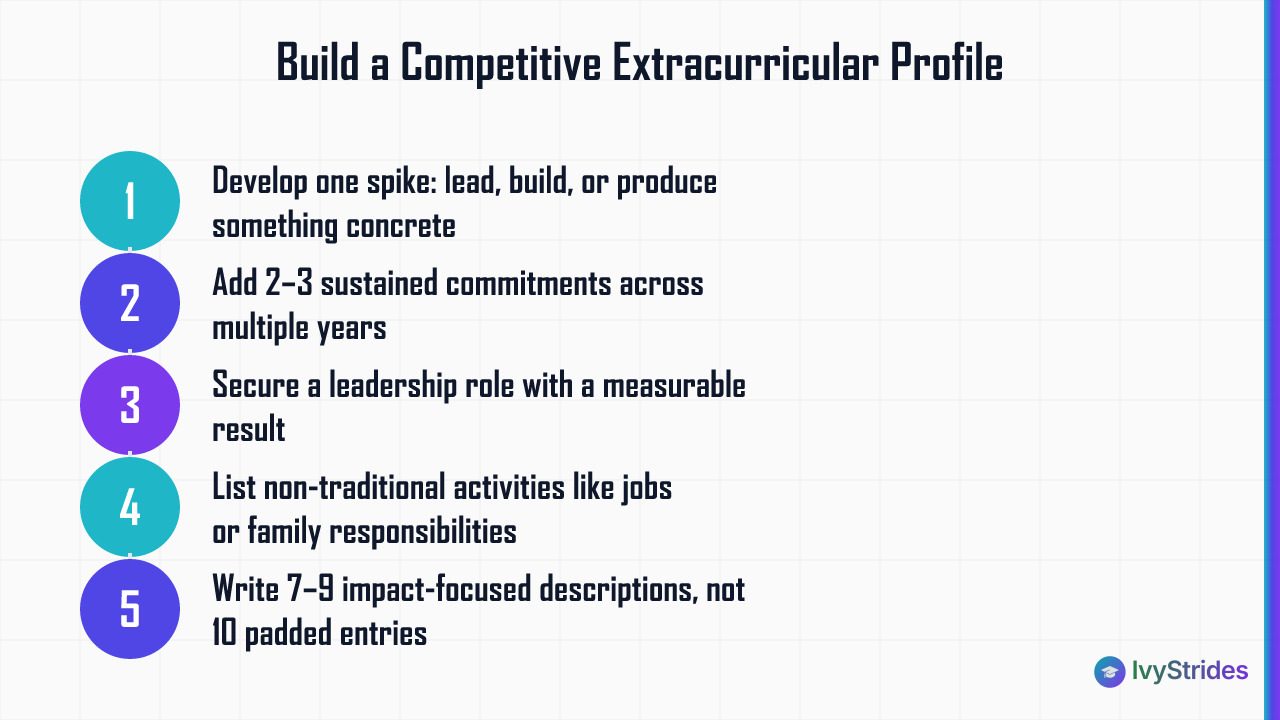
Extracurricular depth outweighs breadth at selective schools, and one area of exceptional depth, a spike, is more compelling than a list of clubs. That academic profile you just built matters most alongside evidence that you did something real outside class. A spike is one domain where you went far enough to lead, build, or produce something others noticed.
Depth over a padded list. The Common App activities list allows up to 10 entries with 150-character descriptions. IvyStrides derives this figure from the inputs cited above. Most competitive applicants fill roughly 7 to 9 with substantive work rather than padding all 10 with minor memberships. In our coaching, students with one sustained, leadership-level activity in a single domain are more competitive at selective schools than students with 8 to 10 surface-level club memberships. Building the kind of depth that stands out takes a deliberate plan; the spike framework explains how to develop it grade by grade.
Non-traditional counts. A part-time job, caring for a younger sibling, or a family business all belong on the activities list. Admissions officers read them as evidence of responsibility and time management, not as lesser than a debate trophy. The list is where impact goes, so tactical guidance on how to write strong activities list descriptions that convey scope in 150 characters matters more than the raw count of entries.
The qualities behind the list. Selective schools name intellectual curiosity, resilience, initiative, and community contribution as the traits that distinguish applicants. You demonstrate these through the essay and letters, not by asserting them. Admissions outcomes depend on the full application, not any single factor.
Use this to audit your own profile:
- One spike where you led, built, or produced something concrete
- Two or three sustained commitments over multiple years
- A leadership role with a measurable result
- Non-traditional activities (job, family responsibility) listed
- Descriptions that show impact, not just titles
- 7 to 9 substantive entries rather than 10 padded ones
- Evidence of a quality: curiosity, resilience, or contribution
What Colleges Look For in Your College Essay and Application Essays
The college essay is where admissions officers read for authentic voice, values, and intellectual fit. That evidence of personal qualities the activities list only hints at gets made explicit here. The Common App personal statement runs 250 to 650 words, and supplemental essays vary by school in both prompt and length.
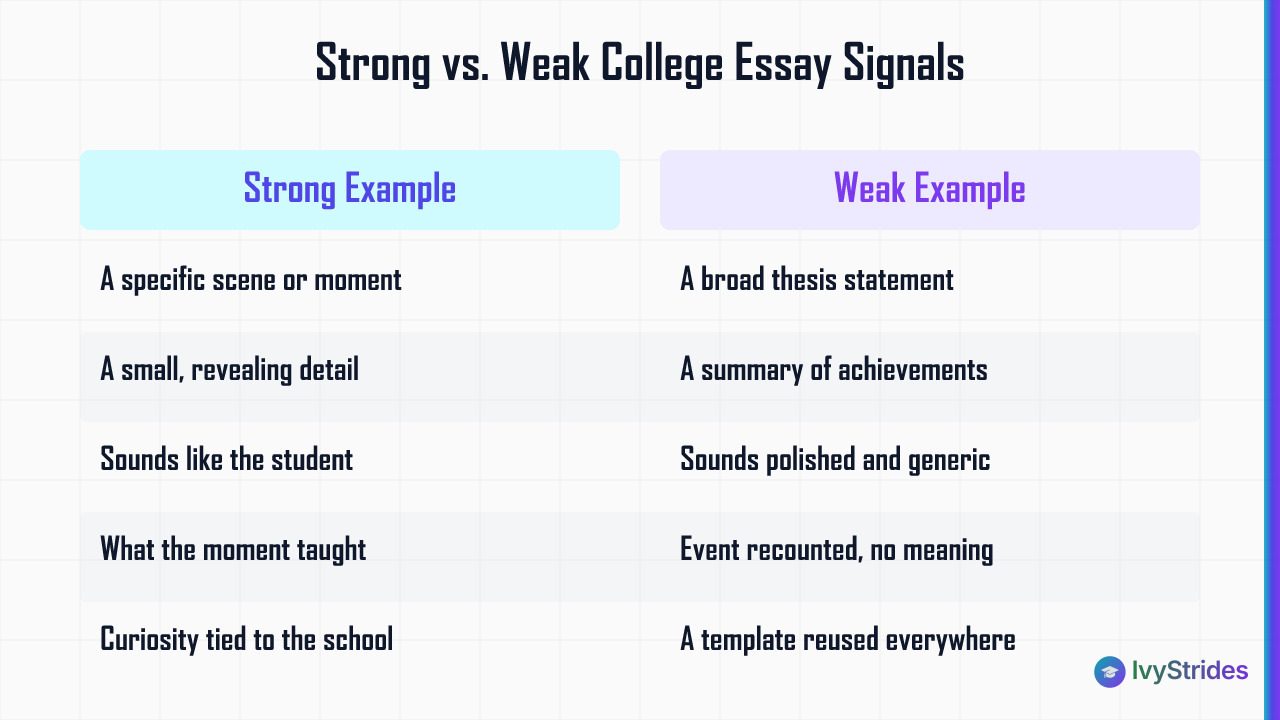
Show, do not summarize. In our coaching, essays that open with a specific scene or moment hold reader attention longer than essays that open with a broad statement. An admissions officer reading their two-hundredth essay of the day notices concrete detail and skims abstraction. The most common weakness we see in first drafts is a restatement of the activities list rather than a revealing of character.
What sinks an essay. Generic topics, resume recaps, and an AI-flat tone all read as missed opportunities. So does a tragedy recounted without reflection. Essay advice must respect each college's actual prompts and word limits, and no essay promises admission.
| Signal Type | Strong Example | Weak Example |
| Opening | A specific scene or moment | A broad thesis statement |
| Subject | A small, revealing detail | A summary of achievements |
| Voice | Sounds like the student | Sounds polished and generic |
| Reflection | What the moment taught | Event recounted, no meaning |
| Fit | Curiosity tied to the school | A template reused everywhere |
Once you know what admissions officers are reading for, the next step is finding the story that shows it; college essay ideas that work walks through that process. If you have a draft but no expert feedback on whether it lands, our college essay coaching reads for exactly these signals.
How to Strengthen Each Factor Before Your Application Deadline
Strengthen the weakest factor first, and sequence the rest by grade. That connected strategy, test scores, AP rigor, and essays as one profile rather than isolated tasks, is what separates a reactive senior fall from a planned one. Start with a diagnostic to identify which factor falls below the 25th-percentile benchmark at your target schools, then build from there.
Grades 9 and 10 are for course selection and activity depth. Choose the harder course when you can handle it, and commit to the one or two activities that could become a spike. Grade 11 is the testing year: the PSAT/NMSQT is the National Merit qualifying test taken this year, alongside your first SAT or ACT sitting and AP exams. A meaningful score gain typically takes about 3 to 6 months of focused prep, so start early. Grade 12 is your retake window plus essay drafting and recommendation requests.
| Grade | Priority Factor | Key Action | IvyStrides Service |
| 9-10 | Rigor and activities | Pick hard courses; build a spike | College Counseling |
| 11 | Test scores | PSAT, first SAT/ACT, AP exams | 1-on-1 SAT/ACT Prep |
| 12 | Essay and scores | Retake, draft essays, request letters | Essay Coaching |
| All | Full profile | Grade-by-grade plan | College Counseling |
For the data-backed case on why scores still matter even at test-optional schools, see how much the SAT matters for college admission. And because your action plan has to map to real dates, check the college application deadlines for fall 2026 before you sequence anything.
College admissions counseling is the connective tissue across all four years, linking test prep, AP planning, and essay timeline into one plan rather than four separate scrambles. Admissions outcomes depend on the full application, so the value is in the sequencing, not any single fix.
FAQ: What Colleges Look For in Students
What do colleges look for the most?
GPA and course rigor are the most heavily weighted factors at selective schools. A strong GPA in AP, IB, or dual-enrollment courses signals both ability and willingness to push academically. Standardized test scores are the second most influential factor, followed by the essay, extracurriculars, and letters of recommendation.
Do colleges look at a 4.0 or 5.0 GPA when reviewing applications?
Most colleges recalculate your GPA on their own unweighted 4.0 scale, regardless of whether your school uses a weighted 5.0 scale. What matters is your performance in core academic courses. A 3.8 unweighted in rigorous AP classes typically reads stronger than a 4.5 weighted on an easier schedule.
Is a 2.7 GPA too low for college admission?
A 2.7 GPA sits below the median at most four-year colleges but is not a universal barrier. Many regional universities and community colleges admit students with a 2.7. At schools with acceptance rates below 30 percent, a 2.7 is a significant obstacle unless offset by exceptional scores, a compelling essay, or unusual circumstances.
What personal qualities do colleges look for in students?
Admissions officers consistently name intellectual curiosity, resilience, initiative, and genuine community contribution as the qualities that distinguish strong applicants. Students demonstrate these through the essay, recommendation letters, and the activities list, not by stating them directly. Authenticity matters more than fitting a template.
Your Next Step on Admissions Criteria
You now have the ranked map: GPA and rigor first, scores second, then the essay, extracurriculars, letters, and demonstrated interest, all read inside holistic review. The move is to find your weakest factor and close that one gap before your deadline.
- Pull the 25th-to-75th percentile band for your target schools from NCES College Navigator.
- Compare your GPA, scores, and spike against those numbers.
- Name the single factor that falls short.
- Build a grade-appropriate plan to raise it first.

Hemant is a seasoned entrepreneur, investor, and growth strategist with deep ground in education and technology-driven learning. His core training is in Mathematics and Physics — he authored Physics for IB Diploma: Ultimate Revision Guide, recognized as a top student resource.