
Johns Hopkins Is Not Test Optional: How to Use Its Superscore Policy
On this page
- Johns Hopkins Is Test-Required for Fall 2027: What Changed and What It Means
- How Johns Hopkins Superscores the SAT and ACT
- Johns Hopkins Test Score Targets and the ED Deadline Calendar
- What Johns Hopkins Looks at Beyond Your Test Score
- FAQ: Johns Hopkins Testing and Superscore
- What SAT score do you need for Johns Hopkins?
- Does Johns Hopkins require all SAT scores?
- Is Johns Hopkins test optional for transfer students?
- Is Johns Hopkins test optional for fall 2027?
- Your Next Step on the Hopkins Testing Requirement
Johns Hopkins University is not test optional for fall 2027 entry. First-year applicants must submit SAT or ACT scores. The requirement has applied since the fall 2026 entering class and covers fall 2027 applicants too. Transfer applicants are exempt. Hopkins superscores both tests.
Those facts come from Hopkins' own standardized testing page, cited throughout below. The harder question is what the requirement does to your plan: how many sittings to book, which score to submit, and whether a retake still fits before the January 2, 2027 deadline for Early Decision II and Regular Decision.
Johns Hopkins Is Test-Required for Fall 2027: What Changed and What It Means
Johns Hopkins University is test-required for fall 2027 first-year applicants, meaning every applicant must submit SAT or ACT scores to be considered. The Hopkins Insider states plainly: "For students applying for Fall 2026 and beyond, standardized testing is required." Fall 2027 entry, the live cycle for students applying during the 2026-27 school year, falls squarely inside that window.
What counts. For the SAT, Hopkins requires the Math and Evidence-Based Reading and Writing sections. For the ACT, it requires the Math, Reading, and English sections. Science and Writing on the ACT are optional and not considered.
Hopkins reinstated this after reviewing three years of test-optional admissions data. If you built your Hopkins plan assuming you could apply without scores, that plan no longer holds.
One exemption. Transfer applicants are not required to submit scores. The requirement is for first-year applicants only. If you are a transfer, check the Hopkins admissions site for your materials list instead.
Because policies at other schools on your list may differ, a reader comparing Hopkins against a test-optional university should understand how the same score reads differently at each before deciding where to spend prep time.
| Question | Answer |
| Is Johns Hopkins test optional for fall 2027? | No. Scores are required. |
| Which SAT sections are required? | Math and Evidence-Based Reading and Writing |
| Which ACT sections are required? | Math, Reading, English |
| Does Hopkins superscore? | Yes, both SAT and ACT |
| Are transfer applicants exempt? | Yes |
| Is there a minimum score? | No published minimum |
How Johns Hopkins Superscores the SAT and ACT
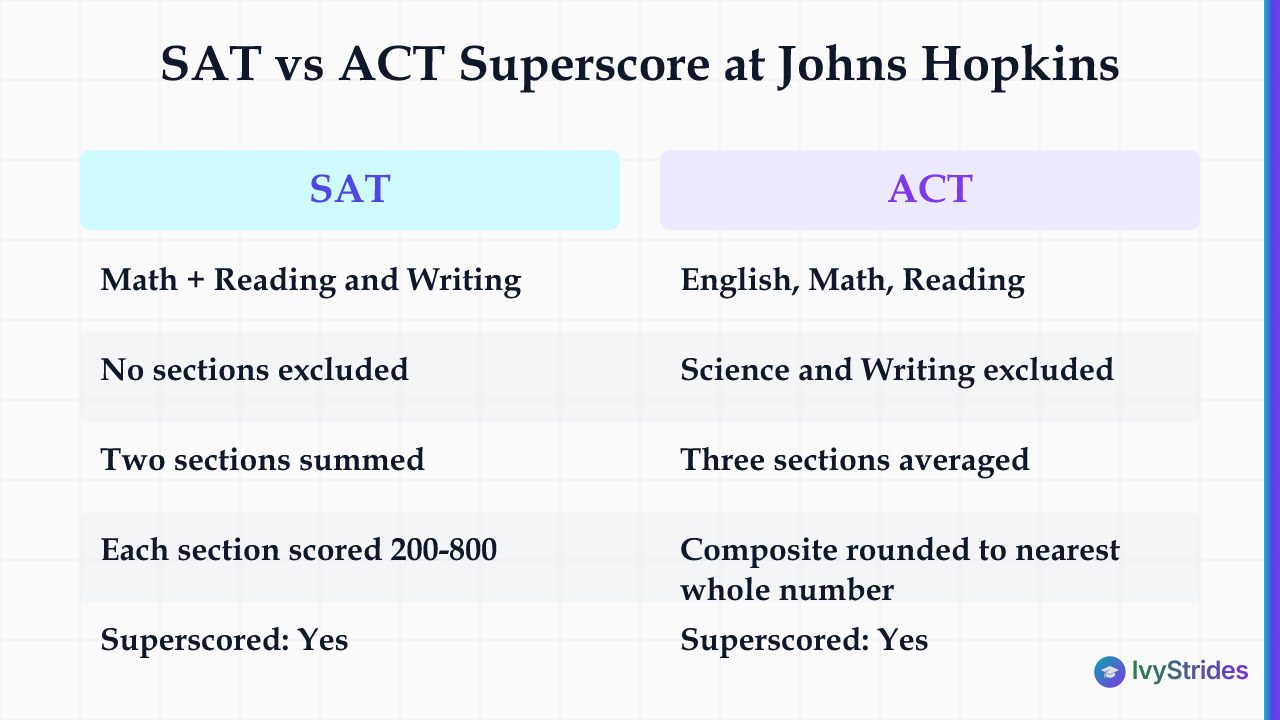
Johns Hopkins superscores both the SAT and the ACT, meaning it takes your highest section scores across all the test dates you submit. That same requirement that forces you to test also hands you a lever: uneven section scores across sittings become an asset, not a liability.
The Hopkins FAQ states it directly: "if you take the SAT or ACT more than once and submit multiple scores, we consider your highest section scores across all test dates."
What that looks like in practice. Each SAT section is scored 200 to 800. If your best Math came on one test date and your best Reading and Writing on another, Hopkins adds those two section scores into one superscore, which beats either single-sitting total whenever your strengths fell on different dates.
Report every score. Hopkins asks applicants to "report all available scores" and says it will "consider your most competitive testing profile." Because it superscores, a weaker sitting does not cancel a stronger section score from another date. Students who have tested more than once should settle how colleges combine section scores across sittings before planning a retake.
The two tests build a superscore differently, which shapes whether the SAT or ACT builds the stronger superscore for you.
| Test | Sections That Count | Excluded from Superscore | Superscored |
| SAT | Math + Reading and Writing | None (both count) | Yes |
| ACT | English, Math, Reading | Science, Writing | Yes |
The Digital SAT runs 98 questions across 2 hours 14 minutes of testing. On the ACT, the Composite is the average of the English, Math, and Reading scores, rounded to the nearest whole number, so Science and Writing sit outside it.
Get your Daily IV Dose on Instagram: quick study tips and test-day advice for high school students. Follow @ivy.strides.
A superscore never stands alone, though. Hopkins reads it against your transcript and course rigor, so how scores and course rigor combine in holistic review matters as much as the number itself.
Johns Hopkins Test Score Targets and the ED Deadline Calendar
Johns Hopkins publishes no minimum score, and it states that scores are "never the only thing that matters," read in context with your transcript, activities, essays, and recommendations. So "what score do I need" has no cutoff answer. What it has is a benchmark and a calendar.
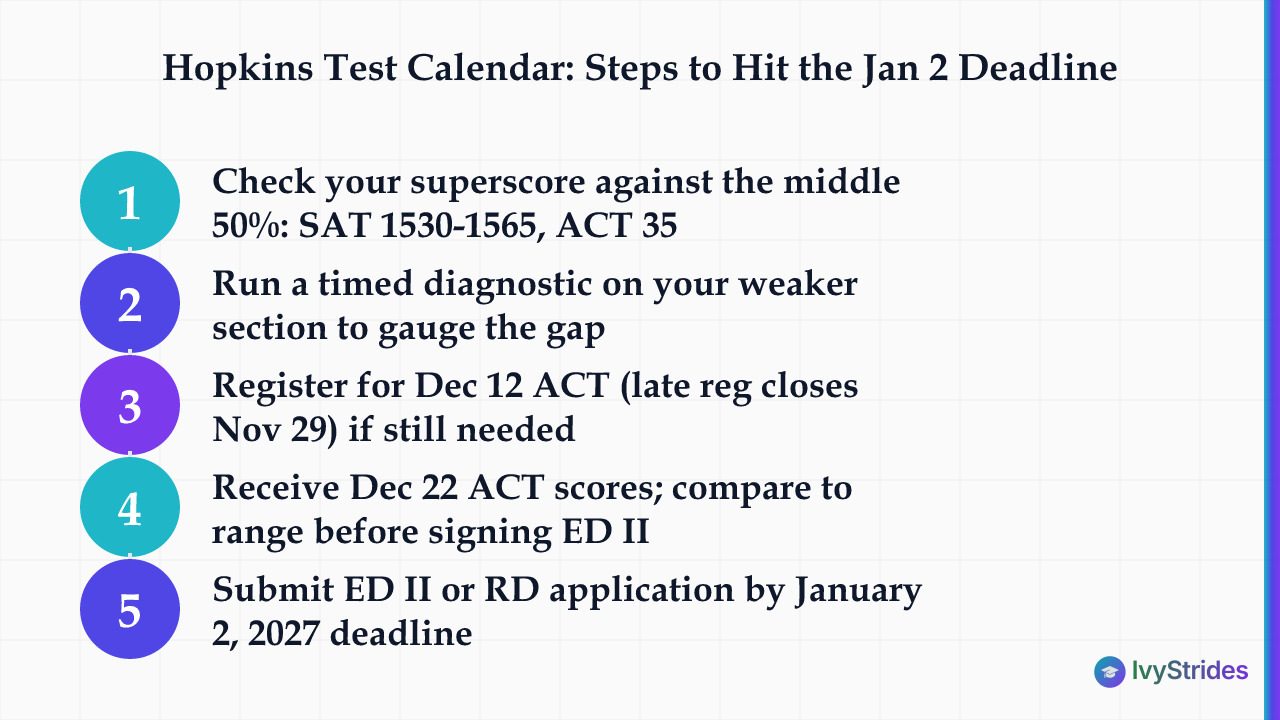
The clearest benchmark is Hopkins' own entering class. Its Common Data Set 2025-26 puts the middle 50% of enrolled first-years who submitted the SAT at 1530 to 1565, and the ACT Composite at 35 at the 25th, 50th and 75th percentiles. Those figures describe enrolled students who sent scores, not a cutoff, and no score alone decides admission.
The deadlines set the real constraint. Hopkins offers only Early Decision, not Early Action, in two binding rounds. With Early Decision I closed on November 1, 2026, the January 2, 2027 deadline shared by Early Decision II and Regular Decision now sets your test calendar.
| Round | Application Deadline | Decision Date |
| Early Decision I | November 1, 2026 (closed) | December 11, 2026 |
| Early Decision II | January 2, 2027 | February 12, 2027 |
| Regular Decision | January 2, 2027 | March 24, 2027 |
Hopkins encourages Early Decision applicants to finish testing no later than October of senior year and Regular Decision applicants by December, and asks anyone planning a later sitting to note that intention on the application. Early Decision II and Regular Decision both close on January 2, 2027.
Registration for the December 5, 2026 SAT closed with the November 24 late deadline, so that date helps only students who already registered. For everyone else, the one December sitting still open is the December 12, 2026 ACT, which takes late registration until November 29, with initial scores released December 22. The ED agreement is binding and needs parent and counselor signatures, so check your score against the range above before committing to Early Decision II.
If your section scores are uneven across sittings, the superscore policy makes a second sitting aimed at the weaker section the retake worth planning, and a timed diagnostic on that section shows how far it sits from the range above. For structured preparation, IvyStrides live online SAT prep classes meet twice a week in small groups, with Bluebook-style adaptive practice tests and weekly tutor review of each practice trajectory.
Students whose superscore sits just below the competitive range face a specific choice about whether a borderline score is worth submitting before an Early Decision deadline. Because scores are one of several required components, mapping the full Johns Hopkins admission requirements and what each one shows helps you spend prep time where it moves the application most.
What Johns Hopkins Looks at Beyond Your Test Score
Johns Hopkins reads every application through three named dimensions: Academic Character, Impact and Initiative, and Overall Match. A strong score clears the test requirement, but it never carries the application alone, which is exactly why the holistic context above sets your realistic target rather than a cutoff.
Academic Character is how you pursue your academics and contribute to the learning environment. The Hopkins admissions criteria place it in your transcript, activities list, recommendations, and test scores. Impact and Initiative is the roles and impact you have had in clubs, jobs, internships, or your family and community, shown through the activities list, recommendations, and essays. Overall Match is how your values and goals line up with Hopkins, shown mainly in the supplemental essay, personal statement, and the application as a whole.
What Hopkins does not count. Hopkins offers no admissions interviews, does not track demonstrated interest, and states that legacy has no bearing on admissions. Because Hopkins offers no interview and does not track demonstrated interest, the supplemental essay, the personal statement, and the overall application carry the weight of showing Overall Match.
That single supplemental essay has a 350-word limit and asks about community built through dialogue and engaging across differences. The prompt rewards process over outcome, so read what the Hopkins bridge-building supplemental essay actually asks closely before you draft. The personal statement comes through the Common App at a 650-word maximum, and because Impact and Initiative lives in your activities list, how to write strong activities list descriptions that show impact matters as much as the activities themselves.
| Component | Holistic Dimension It Serves |
| Transcript | Academic Character |
| Test scores | Academic Character |
| Activities list | Impact and Initiative |
| Two teacher evaluations (different subjects) | Academic Character, Impact and Initiative |
| Counselor recommendation + school profile | Academic Character |
| 350-word supplemental essay | Overall Match |
| Personal statement | Overall Match |
One structural note for applicants: your listed major is not binding at Hopkins, except Biomedical Engineering, where you name it as your first choice and admission depends on credentials and space.
FAQ: Johns Hopkins Testing and Superscore
What SAT score do you need for Johns Hopkins?
Hopkins publishes no minimum SAT score. It reads scores in context with the transcript, essays, activities, and recommendations, and superscores your strongest section scores across all sittings. Its Common Data Set 2025-26 puts the middle 50% of enrolled SAT submitters at 1530 to 1565, a benchmark rather than a cutoff.
Does Johns Hopkins require all SAT scores?
Hopkins asks applicants to report all available scores and says it will consider the most competitive testing profile. Because it superscores, it takes your highest Math from one date and your highest Reading and Writing from another, so a weaker sitting does not cancel a stronger section score.
Is Johns Hopkins test optional for transfer students?
Yes. Transfer applicants to Johns Hopkins are not required to submit standardized test scores. The test-required policy applies to first-year applicants only. Transfer students should check the Hopkins admissions page for the full list of required transfer materials.
Is Johns Hopkins test optional for fall 2027?
No. Johns Hopkins requires SAT or ACT scores from all first-year applicants for fall 2027 entry. The requirement returned with the fall 2026 entering class and covers fall 2027 applicants too. You must submit the SAT (Math and Evidence-Based Reading and Writing) or the ACT (Math, Reading, and English).
Your Next Step on the Hopkins Testing Requirement
Johns Hopkins is test-required for fall 2027, it superscores both tests, and its January 2, 2027 deadline for Early Decision II and Regular Decision now governs your test calendar. The strategic question was never whether to submit, but which score to build and when.
- Confirm your current SAT or ACT section scores from your most recent sittings.
- Check whether an uneven profile means a targeted retake raises your superscore.
- Map your last viable test date against the January 2, 2027 deadline for Early Decision II and Regular Decision.
- Treat the score as one required component, then give the supplemental essay and activities list the weight Hopkins assigns them.
Daily SAT and ACT prep on YouTube: short strategy videos from IvyStrides. Subscribe to IvyStrides on YouTube.

Hemant is a seasoned entrepreneur, investor, and growth strategist with deep ground in education and technology-driven learning. His core training is in Mathematics and Physics — he authored Physics for IB Diploma: Ultimate Revision Guide, recognized as a top student resource.