
How Scores and Rigor Combine in Admissions: A Data-Backed Answer for Fall 2027 Applicants
On this page
- How Admissions Readers Actually Weigh Scores and Rigor Together
- Which Score Bands Actually Change the Admissions Read of Your Transcript
- What Happens to the Score-Rigor Balance at Test-Optional Colleges
- How to Build a Profile Where Scores and Rigor Reinforce Each Other
- FAQ: Scores and Rigor in College Admissions
- How much do test scores matter in college admissions?
- Do colleges care more about course rigor or GPA?
- Does a strong SAT or ACT score offset a lighter course load?
- Is a 4 a bad AP score for college admissions?
- Your Next Step on Scores and Rigor
Scores and rigor are read as a pair in holistic admissions review. Many selective colleges rate the rigor of secondary school record and academic GPA as Very Important in their Common Data Set, while test scores range from Very Important to Considered depending on the school. The two signals confirm or contradict each other.
A strong score on a thin transcript raises a question, and a rigorous transcript with a below-median score raises a different one. The source for each school's stated weighting is its own Common Data Set ratings for each admissions factor. The harder work is reading your own profile honestly before you decide where to spend the next semester.

How Admissions Readers Actually Weigh Scores and Rigor Together

Photo by Kaboompics.com on Pexels
Holistic admissions review weighs academic and non-academic factors together rather than ranking one above all. Each college publishes its own Common Data Set, and its Section C rates every factor as Very Important, Important, Considered, or Not Considered. The University of Rochester's 2025-2026 Common Data Set, for example, lists rigor of secondary school record and academic GPA as Very Important and standardized test scores as Considered.
Rigor is relative, not absolute. Course rigor is defined against what your high school offers, not a fixed national AP count. Your counselor submits a school profile that tells the reader which AP, IB, honors, and dual-enrollment courses exist at your school. A student taking four of four available AP courses has maximized rigor; a student taking four of twenty has not. The transcript is always read beside that profile.
Here is where the two signals diverge. Your SAT or ACT score is a context-independent academic signal: a 1500 means the same thing whether you attend a large public school or a small rural one. The transcript is school-relative. Readers use the score to calibrate the transcript, which is why a thin course load with a high score prompts the question of whether the student chose comfort over challenge.
| Admissions Factor (2025-26 Common Data Set, C7) | MIT | Georgia Tech | University of Rochester |
| Rigor of secondary school record | Important | Very Important | Very Important |
| Academic GPA | Important | Very Important | Very Important |
| Standardized test scores | Important | Considered | Considered |
The same three factors get different weights at each school, which is why the rating on your own target list matters more than any general rule.
Taking AP courses signals rigor, but the AP exam score is what confirms mastery to a reader who cannot otherwise verify how demanding the class was. Selective colleges read how many AP courses you took against what your school offered, not a fixed number.
Which Score Bands Actually Change the Admissions Read of Your Transcript
A test score strengthens a rigorous transcript when it lands within or above the middle-50% range of your target colleges, and it complicates that transcript when it sits well below. Because rigor and scores are read together, a score inside the middle-50% range of enrolled students who sent one confirms the academic story; one far beneath it invites the reader to wonder why.
Use national percentiles as your yardstick. On the SAT (scale 400 to 1600), College Board's SAT user percentiles put a 1500 at the 97th percentile, 1440 at the 95th, 1400 at the 93rd, and 1350 at the 89th. Since the 2025 ACT enhancements, the ACT Composite (scale 1 to 36) averages English, math, and reading, with science reported separately; a 33 lands at the 98th national rank, 30 at the 94th, 28 at the 91st, and 25 at the 83rd (ACT national ranks).
| Where Your Score Sits in a College's Middle-50% Range | Effect on the Rigor Read |
| Above the 75th percentile | Reinforces a rigorous transcript |
| Between the 25th and 75th percentiles | Fits the admitted group, so rigor carries the read |
| Below the 25th percentile | May complicate a strong transcript |
Those middle-50% ranges describe enrolled students who sent a score, as each college reports in its Common Data Set, not a guarantee line. A 1500 is a strong national result, yet at the most selective colleges it can fall at or below the bottom of the middle-50% range, which shapes whether a 1500 SAT is strong enough for Ivy League admission.
Daily SAT and ACT prep on YouTube: short strategy videos from IvyStrides. Subscribe to IvyStrides on YouTube.
AP scores are the third signal. A 4 or 5 on the 1-to-5 AP score scale confirms you mastered the rigorous course rather than merely surviving it; a 1 or 2 on a course you list as a strength can complicate the narrative. AP credit and placement policies vary by college, so a high score is an admissions signal first and a credit question second.
Score bands matter beyond admissions too: many award thresholds tie to how ACT scores affect merit scholarship thresholds, independent of the transcript. Knowing whether your current score clears the bar at each school is the hardest judgment to make alone.
What Happens to the Score-Rigor Balance at Test-Optional Colleges
Test-optional policies shift weight toward the transcript and essays when no score is submitted, but they do not remove the rigor question. Readers still see your transcript and the school profile, so a thin course load without a score to offset it carries more risk than a thin course load with a strong one.
A common rule of thumb, not a published college policy, is to submit a score at or above a school's 25th percentile of enrolled students who sent one and to weigh withholding below it. At test-optional schools the transcript is read either way, so your course load does the heavy lifting whether or not a score sits beside it.
| Question to Ask | If Yes | If No |
| Is my score at or above the 25th percentile? | Submit | Consider withholding |
| Does my course load read as rigorous? | Submit a borderline score | A strong score partly offsets a lighter load |
| Do I have AP 4s or 5s confirming rigor? | Score matters less | A strong score adds a signal |
These rows apply to test-optional schools. A test-required school needs a score from every applicant, and a test-blind school does not consider scores even when sent. Policies vary by school and year, so confirm each college's current stance on its own admissions page. Some colleges let applicants self-report AP exam scores, which gives the reader an external data point when you withhold the SAT or ACT. Settle what test-optional means and how to decide whether to submit scores before each deadline.
How to Build a Profile Where Scores and Rigor Reinforce Each Other
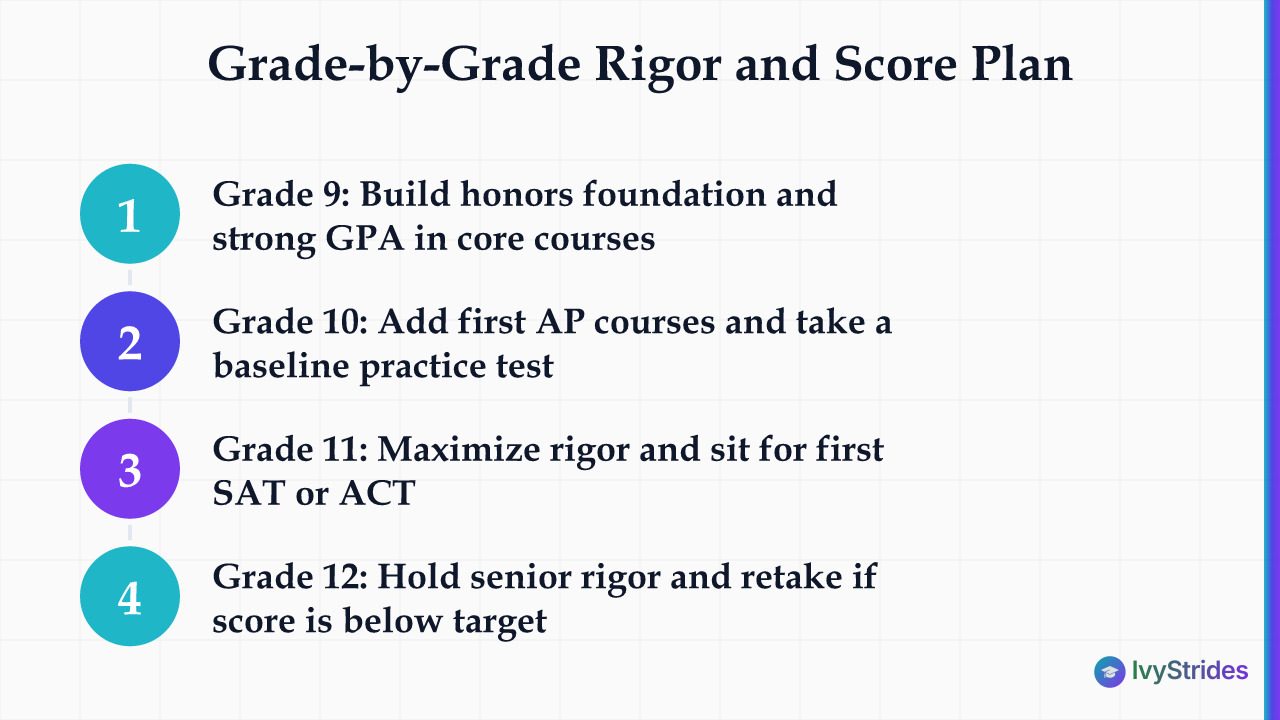
The strongest profiles sequence course rigor and test prep so both signals point the same way by the time applications open. The same middle-50% ranges from the test-optional check set your target: build a course load that reads as rigorous for your school, then aim your score at or above the median of your list.
Grade by grade, the priorities shift. The PSAT/NMSQT has 54 Reading and Writing questions in 64 minutes and 44 Math questions in 70 minutes, the same section lengths as the SAT (College Board PSAT/NMSQT), so junior-year PSAT results give you a real diagnostic for both score readiness and rigor planning.
| Grade | Rigor Priority | Score Priority | Key Milestone |
| 9 | Build honors foundation | None yet | Strong GPA in core courses |
| 10 | Add first AP courses | Baseline practice test | Plan the AP sequence |
| 11 | Maximize rigor for your school | First SAT or ACT sitting | PSAT/NMSQT as diagnostic |
| 12 | Hold rigor senior fall | Retake if below target | Final score and AP results in |
A 4 or 5 on an AP exam confirms the rigor claim in your transcript, so report those scores where they help; the mechanics of how AP scores are reported on college applications matter because each college sets its own rule for when official scores are due. When the next semester forces a choice between an added AP course and a retake, IvyStrides' month-by-month college planning from the summer before 9th grade to the deposit deadline plans the transcript and testing together, the two sides of how scores and rigor combine in admissions.
Admissions outcomes depend on the full application, not test scores or course rigor alone. Treat this plan as a way to make your academic signals agree, not a guarantee of any result.
FAQ: Scores and Rigor in College Admissions
How much do test scores matter in college admissions?
Even among test-required colleges the rating differs: Dartmouth's 2025-26 Common Data Set rates test scores Very Important, while MIT's rates them Important. At test-optional schools, scores are often rated Considered or Not Considered, which shifts weight to the transcript and essays. Scores matter most when they confirm or contradict the transcript.
Do colleges care more about course rigor or GPA?
Many selective colleges rate both rigor of secondary school record and academic GPA as Very Important. A high GPA in easy courses reads weaker than a slightly lower GPA in the most rigorous courses your school offers. Readers see both together.
Does a strong SAT or ACT score offset a lighter course load?
Partially, but not fully. A high score signals academic ability, but readers also check whether you challenged yourself. A 1500 SAT on a transcript with no AP courses raises a question a 1500 with four APs does not. The strongest profiles show both signals pointing the same way.
Is a 4 a bad AP score for college admissions?
No. A 4 on the 1-to-5 AP scale means you are very well qualified and is a strong confirming signal for the rigor claim in your transcript. A 1 or 2 on a course you list as a strength can complicate the narrative. AP credit policies vary by college.
Your Next Step on Scores and Rigor
Neither signal wins alone; they are read together, and your job is to make them agree. Before your next registration deadline, work through these:
- Pull each target school's Common Data Set and note the middle-50% SAT or ACT range and how it rates test scores.
- Check your course load against your school profile: are you near the top of what your school offers?
- Decide whether the next semester calls for a retake, an additional AP, or both.
- Plan AP exams so a 4 or 5 confirms the rigor your transcript claims.
- Confirm each school's current test-optional stance on its own admissions page before you commit to submitting.
College admissions insights on LinkedIn: follow IvyStrides for application guidance and counseling updates.

Rajesh is a technology leader, entrepreneur, and angel investor with 28+ years in Business & Technology Leadership and Product & Solution Engineering. He is passionate about education, mentoring, and driving digital transformation.