
SAT or ACT? Which Test Superscores Better for Your Score Pattern
On this page
- How SAT and ACT Superscoring Actually Work: The Mechanics Side by Side
- Which Score Pattern Points to the SAT and Which Points to the ACT
- Your Score Pattern Has an Answer. Find It in 15 Minutes.
- How to Verify Your College List's Superscore Policies Before You Register
- Putting It Together: A Decision Framework for SAT vs ACT Superscoring
- Test Chosen. Now Close the Gap Before the Deadline.
- FAQ: SAT vs ACT Superscore Questions
- Is a 1400 SAT or 31 ACT better?
- Is a 29 ACT or 1350 SAT better for college admissions?
- Do Ivy League schools accept SAT and ACT superscores?
- Can you superscore across the SAT and ACT together?
- Your Next Step on the SAT vs ACT Superscore Decision
The SAT superscores more effectively for most students because it has only two sections: your best Reading and Writing score plus your best Math score. One strong retake can move the total by 50 to 100 points. IvyStrides derives this figure from the inputs cited above. The ACT averages four sections, so a single improved score shifts the composite far less.
That two-versus-four difference is the whole decision. The right choice still depends on your own score pattern and on whether your target colleges superscore that test, so verify each school's policy before you register for anything. The sections below give you the mechanics, a pattern-matching guide, and a five-step policy check.

How SAT and ACT Superscoring Actually Work: The Mechanics Side by Side
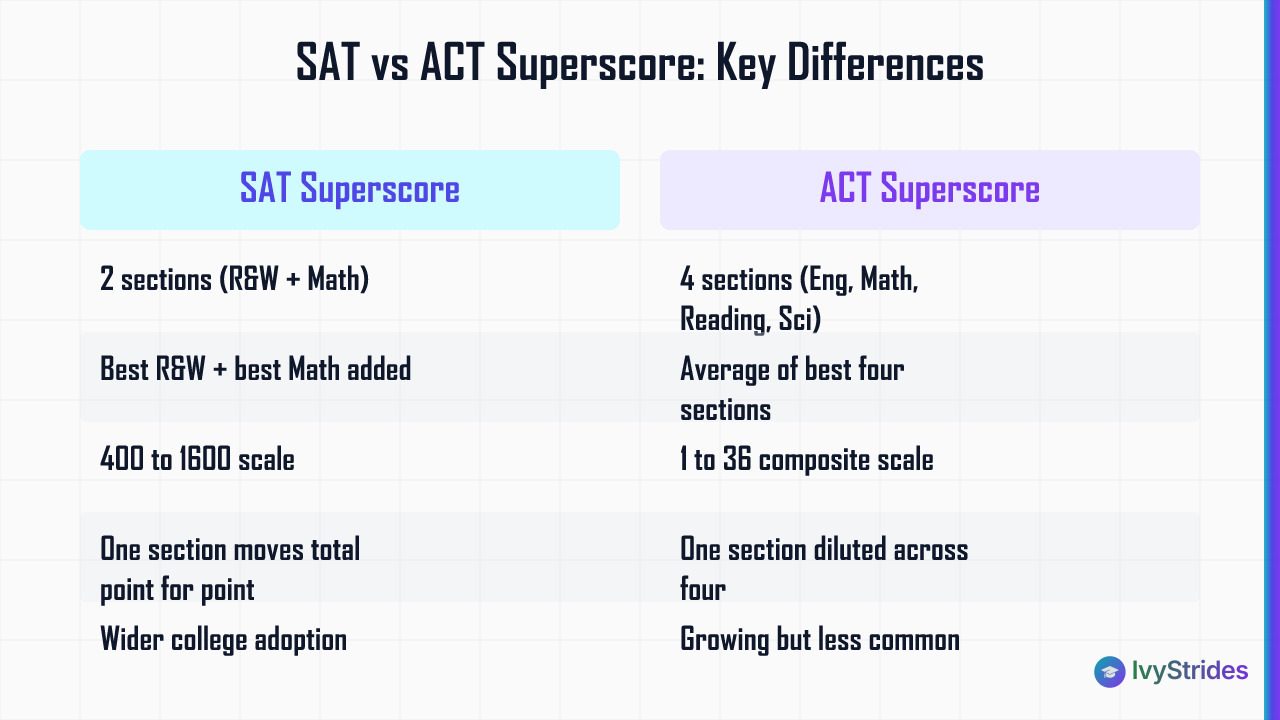
A superscore is the highest section-level score a college combines across your test dates, and the SAT and ACT build it very differently. The SAT superscore is your best Reading and Writing section score plus your best Math section score, even when they come from different sittings, per College Board. The ACT superscore averages your best English, Math, Reading, and Science scores across attempts, per ACT, Inc.
Two sections versus four. That structural gap is why the SAT rewards a targeted retake more. Move one weak SAT section up 60 points and the whole total climbs 60 points. Move one weak ACT section up 3 points and, averaged across four, the composite rises by less than a single point.
The formats behind those scores matter too. The Digital SAT runs 54 Reading and Writing questions in 64 minutes and 44 Math questions in 70 minutes, 98 questions in about 2 hours 14 minutes of testing, on a 400 to 1600 scale, per College Board.
The Enhanced ACT core runs English 50 questions in 35 minutes, Math 45 in 50 minutes, and Reading 36 in 40 minutes, 131 questions in 125 minutes, per ACT, Inc. Only English, Math, and Reading feed the ACT composite; Science and Writing stay optional and scored separately.
| Feature | SAT Superscore | ACT Superscore |
| Sections combined | 2 (R&W, Math) | 4 (English, Math, Reading, Science) |
| Calculation | Best R&W + best Math | Average of best four sections |
| Scale | 400 to 1600 | 1 to 36 composite |
| One-section use | High, moves total point for point | Low, diluted across four |
| Section-adaptive | Yes, two modules per section | No |
| College adoption | Wider | Growing, less common |
Don't confuse superscoring with Score Choice. Score Choice lets you pick which whole test date a college sees; superscoring stitches together your best sections regardless of date. If you haven't sat either exam yet, the broader ACT vs SAT comparison covers format and difficulty side by side. For how colleges receive submissions, see our guide to superscoring explained.
Which Score Pattern Points to the SAT and Which Points to the ACT
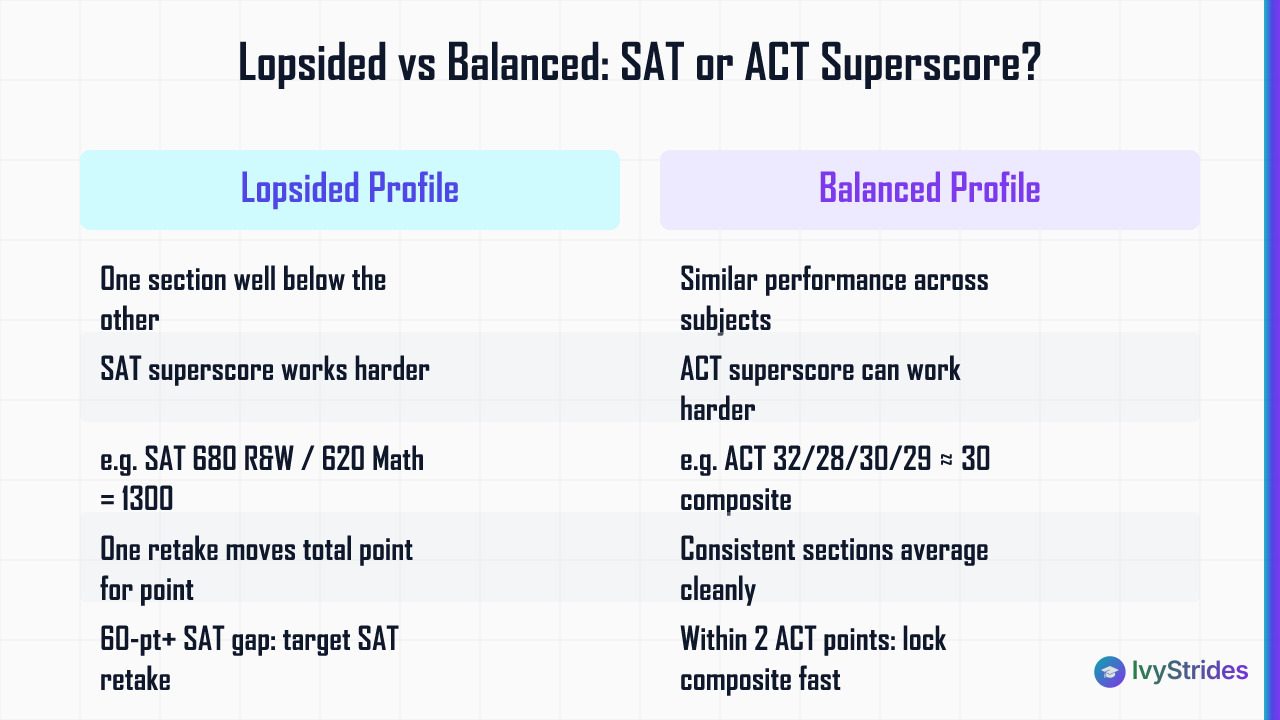
Your score pattern, not test difficulty, decides which superscore works harder for you. Because the SAT moves point for point on a single section while the ACT averages four, a lopsided profile favours the SAT and a balanced profile can favour the ACT. A lopsided profile means one section sits well below the other; a balanced profile means similar performance across every subject.
The lopsided case. Take a student sitting at 680 Reading and Writing and 620 Math, a 1300. IvyStrides calculates this from the published figures cited above. SAT sections run 200 to 800 each, per College Board, so a focused Math retake to 680 lifts the superscore to 1360 in one sitting. A balanced student at 650/650 has no single weak section to attack, so each retake spreads gain thinly.
The balanced case. An ACT profile of 32 English, 28 Math, 30 Reading, 29 Science averages to about 30. Pull Math to 31 and the composite barely nudges. But a student already scoring within about 2 composite points of target across every section builds a clean ACT superscore quickly, because there's nothing lopsided to fix.
| Score Pattern | Example | Better Superscore Test | Why |
| Lopsided | SAT 680 R&W / 620 Math | SAT | One retake moves total point for point |
| Balanced (SAT) | SAT 650 / 650 | Either | No single weak section to target |
| Balanced (ACT) | ACT 32/28/30/29 | ACT | Consistent sections average cleanly |
| Near-target ACT | Within 2 points across sections | ACT | Small gains lock a composite fast |
For cross-test reference, a 1400 SAT is roughly equivalent to a 31 ACT on College Board concordance tables, and those tables give approximate equivalences, not exact ones. In our coaching, students with a 60-point-plus gap between SAT sections typically gain more from a targeted SAT retake than from switching tests, while students already within 2 composite points of their ACT target usually benefit more from ACT superscoring than from starting over on the other exam.
Start from a real diagnostic, not a guess. Once you've named the pattern, our guide on how many times to sit the SAT when colleges superscore maps the sitting count by score band. Superscoring doesn't help every student equally, and when superscoring does not help names four patterns that stay flat even across multiple sittings.
Your Score Pattern Has an Answer. Find It in 15 Minutes.
You have section scores, a college list, and a registration window closing soon. A free 15-minute call maps your current distribution against each test's superscore mechanics, identifies which test gives you the larger gap to close, and tells you whether a retake is the right move before the next deadline.
How to Verify Your College List's Superscore Policies Before You Register
A college superscore policy can differ by test at the same school, so verify each one before you commit a prep cycle. Your score pattern points you toward a test, but the policy check confirms it: a school may superscore the SAT and not the ACT, or accept only your single best sitting. Two sources settle it, the school's own admissions page and its Common Data Set.
The elite-school landscape. As of the 2024-2025 cycle, Ivy League schools generally superscore both the SAT and the ACT. MIT and Stanford both superscore the SAT; confirm each one's ACT stance on its admissions page, since those change year to year. Not every college superscores the ACT, per ACT, Inc., which is exactly why the check matters.
Test-optional status doesn't erase the value of a strong superscore. Test-optional policies vary by school and year, per FairTest, and a superscore that lands inside a school's middle-50 range can still strengthen an application. To see where your number sits, pull the 25th-to-75th percentile ranges from NCES College Navigator for each target.
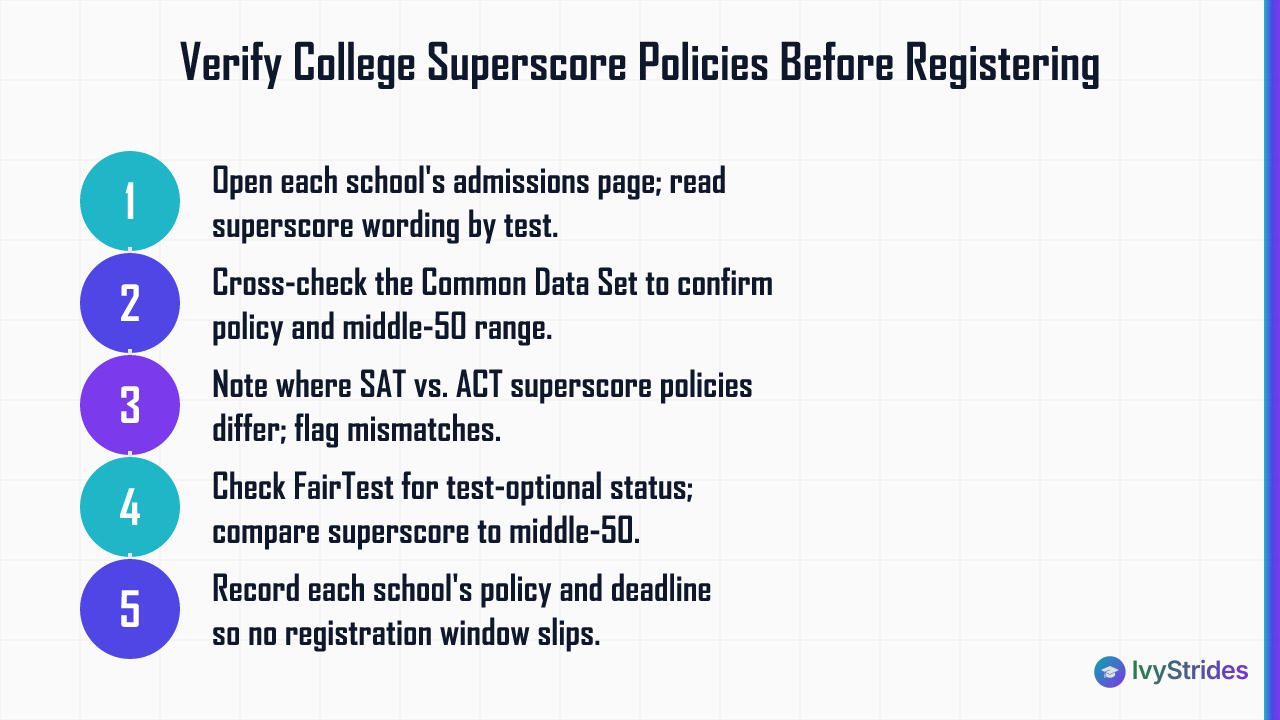
Here's the check to run before you pay a registration fee:
- Open each school's admissions testing page and read its exact wording on superscoring, by test.
- Cross-check the Common Data Set for that school to confirm the policy and pull the middle-50 range.
- Note where the policy differs by test, SAT versus ACT, and flag any school that superscores only one.
- Confirm test-optional status on FairTest, then decide whether your superscore beats the middle-50 floor.
- Record the policy and the deadline for each school so no registration window slips past.
For a worked example, does Stanford superscore the ACT walks through its policy, codes, and deadlines. And before booking a retake, is a second SAT sitting worth it runs the numbers on whether the expected gain justifies the prep time. Admissions outcomes depend on the full application, not scores alone, so treat the superscore as one lever among several.
Putting It Together: A Decision Framework for SAT vs ACT Superscoring
The SAT-or-ACT superscore decision resolves to three inputs: your score pattern, your college list's policies, and how many sittings you have left before the application window closes. Run all three and the answer usually names itself. If you haven't sat both tests, a full-length diagnostic for each is the honest starting point, not a self-assessment.
When to choose the SAT. A lopsided profile and a college list that mostly superscores the SAT points there. One targeted retake of your weaker section moves the whole total.
When to choose the ACT. A balanced profile with target schools that superscore the ACT (or superscore it and not the SAT) points that way.
When to do both. Only when time and budget allow and your schools superscore both. Splitting prep across two tests without a diagnostic first tends to improve neither meaningfully.
| Your Situation | Choose SAT Superscore | Choose ACT Superscore |
| Lopsided sections | Yes | No |
| Balanced sections | Optional | Yes |
| Schools superscore SAT only | Yes | No |
| Schools superscore ACT only | No | Yes |
| Around 1350 SAT / 29 ACT band | Verify list first | Verify list first |
For reference, a 1350 SAT is roughly concordant with a 29 ACT, and a 1400 with a 31, on College Board's tables. Once you've chosen, build the superscore with full-length practice: our SAT practice tests or ACT practice tests libraries fit either path. When scores are in, how to send SAT scores to colleges covers getting them to each school correctly. Test-optional policies vary by school and year, so keep verifying as your list firms up.
Test Chosen. Now Close the Gap Before the Deadline.
You have the framework: score pattern identified, college policies checked, test selected. Building that into a week-by-week plan tied to your actual section scores and your next registration window takes a focused conversation. A free 15-minute call names the specific sections to target and the timeline to close the gap.
FAQ: SAT vs ACT Superscore Questions
Is a 1400 SAT or 31 ACT better?
A 1400 SAT and a 31 ACT are roughly equivalent on College Board concordance tables. Which is stronger for your application depends on your target schools' middle-50 ranges and whether they superscore both tests. Check each school's Common Data Set to see which number sits higher inside its admitted-student range, then favour the test you can superscore there.
Is a 29 ACT or 1350 SAT better for college admissions?
A 29 ACT and a 1350 SAT are approximately concordant. The better choice depends on your college list's superscore policies and your own section distribution. If your SAT sections are lopsided, the SAT superscore may reach a higher effective number than a 29 ACT composite across multiple sittings, since the SAT moves point for point.
Do Ivy League schools accept SAT and ACT superscores?
Policies can shift year to year, so verify on each school's admissions page before submitting. Harvard, Yale, Princeton, and Columbia all published superscore-friendly policies for recent application cycles, but confirm the current wording yourself.
Can you superscore across the SAT and ACT together?
No. Superscoring combines your best section scores within one test only, best SAT sections across SAT dates, or best ACT sections across ACT dates. Colleges don't mix SAT and ACT sections into one combined number. You submit your best SAT superscore and your best ACT superscore separately, and each school evaluates them on its own scale.
Your Next Step on the SAT vs ACT Superscore Decision
The decision comes down to matching your section pattern to the test that rewards it, then confirming your colleges superscore that test. Work it in order and you avoid spending a prep cycle on the wrong exam.
- Run your current section scores through each test's superscore calculation.
- Name your pattern: lopsided leans SAT, balanced leans ACT.
- Check each target school's policy on its admissions page and Common Data Set.
- Identify the test with the larger gap one focused retake can close.
- If you haven't sat both, book a full-length diagnostic for each before choosing.

Award-winning author (South Asian Book Award) and graduate of BITS Pilani and UCLA Luskin School of Public Affairs. Brings a published writer's eye to Common App essays and grammatical precision to SAT and ACT R&W instruction.