
Is the SAT Worth Taking in a Test-optional Era? The Straight Answer for 2026-27 (and What to Do Next)
On this page
- Which Colleges Still Require the SAT for Fall 2027 Entry, and Which Are Truly Optional
- When the SAT Is Worth Taking Even at a Test-optional School
- Does SAT Superscore Matter at Test-optional Colleges?
- How to Decide Whether to Take the SAT: A Score-band Decision Framework
- FAQ: SAT Submission in a Test-optional Era
- Is the SAT an optional test?
- Does SAT superscore matter?
- Should I submit my SAT score to a test-optional school?
- Can I get merit scholarships without an SAT score?
- Your Next Step on the SAT Submission Decision
Yes, the SAT is worth taking for most students in the 2026-27 admissions cycle. The SAT is a digital, adaptive exam scored 400 to 1600. A score above a school's 25th-percentile floor can strengthen an application at test-optional colleges, and dozens of selective schools now require scores again.
The policy details in this guide come from the colleges' own admissions pages and a U.S. Department of Education press release. The real decision is not whether to take it. It's whether to submit, and that turns on one comparison: your score against each school's published floor, checked against current policy before you apply.

Which Colleges Still Require the SAT for Fall 2027 Entry, and Which Are Truly Optional
For fall 2027 entry, colleges fall into three main tiers: test-required, test-optional, and score-blind. Test-optional is the trap most students misread. The policy means a college will not penalize you for leaving scores off; it does not mean the college ignores scores you send. USC's test-optional FAQ leaves the choice with the applicant: you decide whether your SAT or ACT scores are considered, and applicants who leave them off are not penalized.
The reversal matters most here. A U.S. Department of Education press release says dozens of top universities have ended test-optional admissions. Six of the eight Ivies (Harvard, Yale, Penn, Brown, Cornell, and Dartmouth) require scores for fall 2027 entry. The other two, Princeton and Columbia, are both test-optional for fall 2027 and both require scores from fall 2028 (Princeton's testing policy), so all eight Ivies require them from fall 2028.
Score-blind is the third tier. The University of California, including Berkeley and UCLA, does not consider SAT or ACT scores when making admissions decisions or awarding scholarships. That differs from test-optional, where a strong score still counts.
| Policy tier | What it means for applicants | Example schools (fall 2027 entry; not a full list) |
| Test-required | You must submit an SAT or ACT score | Harvard, Yale, Penn, Brown, Cornell, Dartmouth, MIT, Johns Hopkins |
| Test-optional | You choose; sent scores count | Duke, Northwestern, NYU, USC; Princeton and Columbia for fall 2027 entry only |
| Score-blind | Scores are never considered | University of California (Berkeley, UCLA) |
Policies shift year to year, so check each school's admissions page before you decide. NYU has said it will stay test-optional through the 2027-2028 application cycle. Columbia reinstates its testing requirement for the 2027-2028 cycle, which makes 2026-2027 Columbia's last test-optional cycle and fall 2027 applicants the last who can withhold scores there. If you're weighing the SAT against the ACT, the same submission logic applies: a score above the school's 25th percentile helps, and a score below it is better withheld.
When the SAT Is Worth Taking Even at a Test-optional School
Take the SAT whenever your score clears a school's 25th-percentile floor, qualifies you for merit aid, or strengthens your standing in a competitive applicant pool. Those three reasons stand on their own, and any one of them justifies the prep hours that the policy tiers above make worth spending.
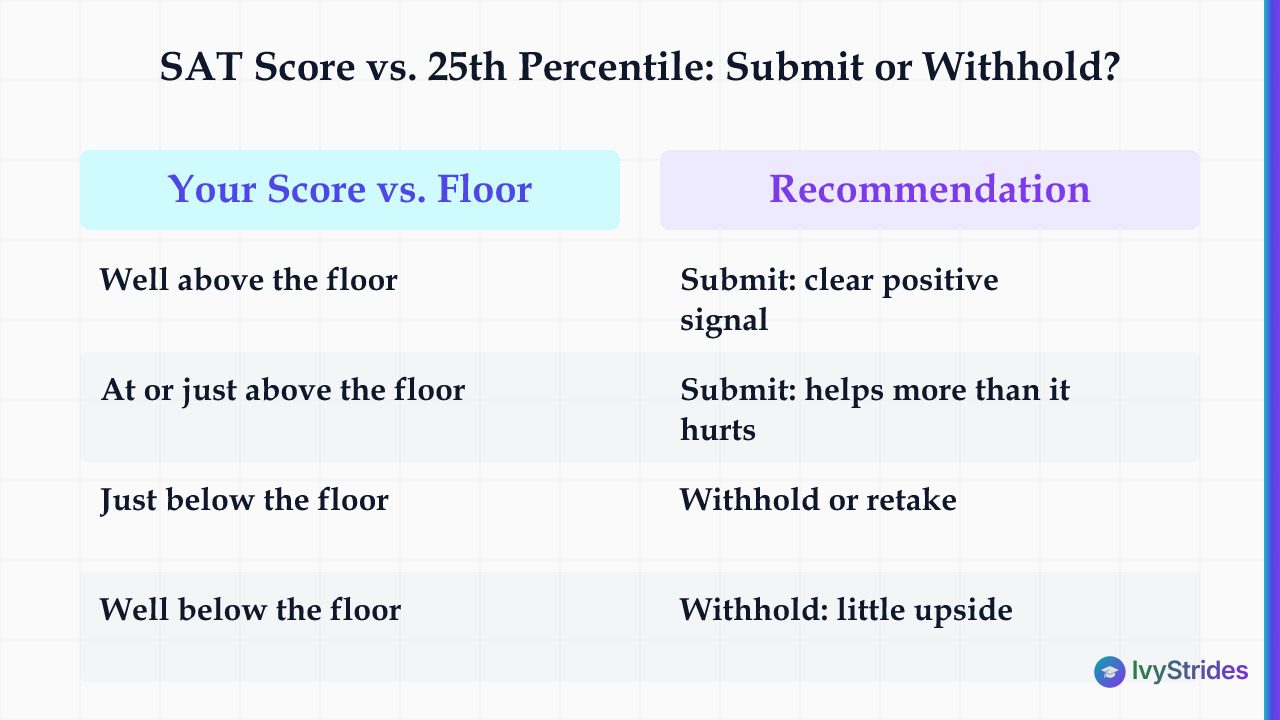
The submission threshold rule. Submit when your score sits at or above a school's published 25th-percentile figure, the bottom of its middle-50% score range, which you find in section C9 of its Common Data Set. Above that floor, the score reads as a positive signal in holistic admissions review. Below it, you're usually better off withholding, because a below-range number pulls the reader's attention to the gap instead of your strengths.
Score bands help you judge where you stand. On College Board's user group percentile table, a 1400 total sits at the 93rd percentile and a 1500 at the 97th. A percentile ranks you against all test takers, while a college's floor ranks you against its own enrolled class. An IvyStrides comparison of that table with Columbia's 2025-26 Common Data Set shows the gap: a 1400 sits 110 points below Columbia's 25th-percentile SAT composite of 1510, and a 1500 is still 10 points short. A competitive SAT score at each college tier depends on the school, not a single magic number.
Merit aid is the reason most families overlook. At many universities, a score above a published threshold unlocks automatic merit awards tied to SAT thresholds that require no separate application. Even where a college makes the score optional for admission, the scholarship may still require it, so skipping the test can take an award off the table. Scholarship criteria vary by college and sit separately from admissions policy, so check both.
The costly mistake is to assume test-optional means the score will not matter, then find that a target school has returned to requiring it or that an award needs a qualifying number.
| Your score vs. the 25th percentile | Submission recommendation | Reasoning |
| Well above the floor | Submit | Clear positive signal |
| At or just above the floor | Submit | Helps more than it hurts |
| Just below the floor | Withhold or retake | Shifts focus to the gap |
| Well below the floor | Withhold | Little upside, real downside |
Does SAT Superscore Matter at Test-optional Colleges?
Yes, SAT superscoring matters at every college that uses it, and it lowers the risk of sitting the test more than once. Colleges that superscore take your best Reading and Writing section score and your best Math section score across all your sittings and add them into one total.
At a college that superscores, the submission threshold gets easier to clear, because a second sitting can only hold or raise the number that college uses. If a second attempt improves only one section, the superscore still rises. Score Choice lets you select which test dates you send, though some colleges ask for all scores.
The structure makes targeted retakes practical. The SAT runs 98 questions in 2 hours 14 minutes of testing: Reading and Writing is 54 questions in 64 minutes, and Math is 44 questions in 70 minutes. Each section has two modules, and your performance on the first sets the difficulty of the second.
If your first sitting left Math below the floor, a second SAT sitting lets you prep that one section rather than re-studying everything, and the superscore does the rest.
Before you register for a second sitting, verify:
- The college superscores the SAT (confirm on its admissions page).
Get your Daily IV Dose on Instagram: quick study tips and test-day advice for high school students. Follow @ivy.strides.
-
Which section, Reading and Writing or Math, sits furthest below the floor.
-
The upcoming test date that lands before your application deadline.
-
Whether the college requires all scores rather than Score Choice.
-
That scores typically post 2 to 4 weeks after the test, so you have time to send them.
The 2027 U.S. weekend dates to plan around are March 6, May 1, and June 5, 2027.
How to Decide Whether to Take the SAT: A Score-band Decision Framework

Photo by Andy Barbour on Pexels
Deciding whether to take the SAT comes down to four checks you can run on your own college list. The framework converts everything above, the policy tiers, the 25th-percentile floor, and superscoring, into one sequence.
-
Check each school's current policy. Test-required, test-optional, or score-blind, verified on the admissions site this cycle.
-
Find the 25th-percentile floor in each school's Common Data Set.
-
Compare your current or projected score against that floor.
-
Decide: prep and submit if you're at or above it, prep and retake if you're close, or skip if the school is score-blind.
Admissions readers weigh test scores and course rigor together, so a score above the threshold persuades most beside a demanding transcript. A 1400 sits at the 93rd percentile of College Board's user group, but whether a 1400 is worth submitting depends on the specific school's floor.
Watch the calendar. Registering after a test date's regular deadline adds a $38 late fee, and scores typically post 2 to 4 weeks after the test, so count back from each application deadline before you pick a sitting. If your score sits below the threshold, IvyStrides' 1-on-1 SAT prep starts with a diagnostic test and a custom roadmap that is re-evaluated weekly, and each of its 10 Bluebook-style adaptive mocks is followed by a tutor review session. Once you've picked a date, your next move is reviewing your practice-test mistakes so the prep hours target the right question types.
FAQ: SAT Submission in a Test-optional Era
Is the SAT an optional test?
It depends on the college. Many schools are test-optional, meaning you choose whether to submit. Others, including Harvard, Yale, and Dartmouth, require scores for fall 2027 entry, and Princeton joins them for fall 2028. Score-blind schools like the University of California do not consider scores at all. Check each school's current policy on its admissions page before you decide.
Does SAT superscore matter?
Yes, at colleges that superscore. Superscoring combines your best Reading and Writing section score and your best Math section score across all sittings into one composite. That makes a second sitting low-risk: if you improve only one section, the superscore still rises. Confirm each school's superscore policy before registering for a retake.
Should I submit my SAT score to a test-optional school?
Submit if your score is at or above the school's published 25th-percentile floor, which you'll find in its Common Data Set. A score above that threshold is a positive signal. A score below it is usually better withheld, because submitting a below-range score shifts the reader's attention to the gap rather than your strengths.
Can I get merit scholarships without an SAT score?
At many universities, automatic merit scholarships require a qualifying SAT score. Without one on file, you may not be considered for those awards, even if the school is test-optional for admission. Check each school's merit aid criteria separately from its admissions policy, because the two often differ.
Your Next Step on the SAT Submission Decision
The SAT still moves the needle for most students, but only you can run the comparison that settles it. Admissions outcomes depend on your full application, not a single score, so treat the test as one strong, improvable signal among several.
- List your target schools and label each test-required, test-optional, or score-blind this cycle.
- Pull the 25th-percentile SAT range from each school's current Common Data Set.
- Put your current or projected score next to each floor.
- If you're above the floor, plan to submit; if you're close, pick a test date that leaves room for scores to post before your deadline.
Daily SAT and ACT prep on YouTube: short strategy videos from IvyStrides. Subscribe to IvyStrides on YouTube.

Rajesh is a technology leader, entrepreneur, and angel investor with 28+ years in Business & Technology Leadership and Product & Solution Engineering. He is passionate about education, mentoring, and driving digital transformation.