
Is There a Why Johns Hopkins Essay? How to Show Fit in Its One Prompt
On this page
- Why the Hopkins Prompt Is Not a Why Us Essay, and What It Is Instead
- What the Johns Hopkins Application Actually Requires Beyond the Essay
- How to Write the Hopkins Bridge-Building Essay in 350 Words
- What Johns Hopkins Does Not Count, and Why That Raises the Essay's Stakes
- FAQ: The Johns Hopkins Supplemental Essay
- Does Johns Hopkins have demonstrated interest?
- Does Johns Hopkins require an essay?
- Does Johns Hopkins do interviews?
- What is the Johns Hopkins essay word limit?
Johns Hopkins does not have a traditional "Why Us" essay. For 2026-27, Hopkins asks one supplemental essay of up to 350 words: drawing on your own experiences, what you have learned about engaging across differences, and how it has shaped the way you think about building bridges, enhancing community, and working with others. It reads fit, not reasons to attend.
The harder question is what the admissions office actually listens for, because a student who answers it like a reasons-to-attend list has written the wrong essay well.
Why the Hopkins Prompt Is Not a Why Us Essay, and What It Is Instead
The Johns Hopkins supplemental essay is a single bridge-building prompt, not a reasons-to-attend list. The 2026-27 prompt starts from the idea that community at Hopkins is built through dialogue, collaboration, and a willingness to engage across differences, then asks what your own experiences have taught you about doing that (Johns Hopkins Admissions). The whole response fits inside a 350-word limit.
So why swap out the classic format? The essay speaks most directly to one of three stated criteria: Overall Match. Hopkins says it typically finds Overall Match, your values and goals and how they align with the opportunities at Hopkins, in your supplemental essay, personal statement, and overall application (Johns Hopkins Admissions). Listing research labs and professors does not answer that.
Three criteria, one essay. Hopkins evaluates applicants on Academic Character, Impact and Initiative, and Overall Match. The supplemental essay is one of the main places Hopkins looks for the last one.
| Criterion | What Hopkins Looks For | Where Hopkins Typically Finds It |
| Academic Character | How you pursue academics, add to the learning environment, and follow interests beyond class | Transcript, activities list, recommendations, test scores |
| Impact and Initiative | Roles and impact in clubs, jobs, family, community | Activities list, recommendations, essays |
| Overall Match | Values and goals aligned with what Hopkins offers | Supplemental essay, personal statement, overall application |
A second reason the essay matters more here than at some peers: Hopkins offers no interviews, and it does not track demonstrated interest, so your level of engagement during the admissions process, from a campus visit to an email, does not influence its decisions (Johns Hopkins Admissions). The essay is where your voice lands.
A different school's traditional Why Us prompt still needs its own treatment, so the structure and examples that make a Why This College prompt work apply there, not here. The Hopkins supplement is a different animal, and treating it like a Why Us essay answers a question Hopkins did not ask.
What the Johns Hopkins Application Actually Requires Beyond the Essay
The Johns Hopkins application for 2026-27 requires the supplemental essay plus a full set of other components, so the essay sits alongside recommendations, scores, and the personal statement rather than standing alone. While the two essays speak most directly to Overall Match, the rest of the file does heavy lifting on the other two criteria.
Required components. Hopkins asks for the Hopkins supplement; a personal statement through the Common App or Coalition on Scoir; an activities list that includes family and work responsibilities; a secondary school report with your counselor recommendation, transcript, and high school profile; two teacher evaluations from different academic subjects; a mid-year report due in mid-February; and test scores (Johns Hopkins Admissions).
Test-required and superscored. Applicants for fall 2027 entry, in the 2026-27 cycle, must submit the SAT or ACT, and Hopkins superscores, considering your highest section scores across all test dates (Johns Hopkins Admissions). It sets no minimum score.
| Round | Deadline | Decision Date | Binding? |
| ED I | Nov 1, 2026 | Dec 11, 2026 | Yes |
| ED II | Jan 2, 2027 | Feb 12, 2027 | Yes |
| RD | Jan 2, 2027 | Mar 24, 2027 | No |
Those deadlines matter for parents especially. The Early Decision agreement is binding and needs signatures from a parent or guardian and your school counselor, so settle the family conversation about committing, aid included, before the ED I deadline of November 1, 2026, or the ED II deadline of January 2, 2027. Scores and grades speak to Academic Character, so Hopkins' score ranges and other admission requirements deserve as much planning as the essay.
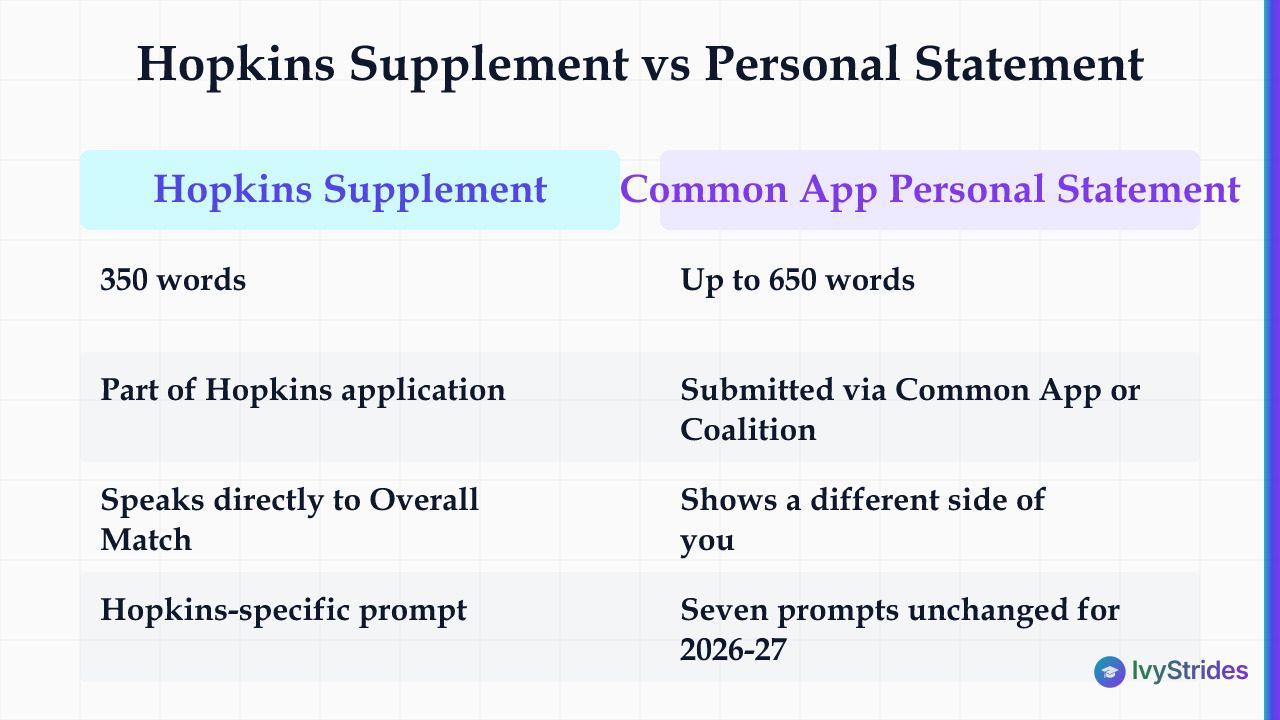
The personal statement is separate. On the Common App, the personal essay runs up to 650 words, and Common App kept its seven prompts unchanged for 2026-27 (Common App). It is a distinct document from the 350-word supplement, and the two should show different sides of you.
A few special programs add their own steps. The optional Direct Matriculation Programs, a master's in International Health, International Relations, or an MBA, each need a short essay after the main application, and you may apply to only one. The Peabody Double Degree needs separate applications to the university and to the Peabody Institute, plus an audition for Peabody, and runs through Early Decision I or Regular Decision only. If you list Biomedical Engineering as your first-choice major, admission to BME depends on credentials and space available; you can be admitted to Hopkins without a BME place.
How to Write the Hopkins Bridge-Building Essay in 350 Words
A strong Hopkins supplemental essay opens on one concrete moment of engaging across differences, shows what you learned, and closes on how that shapes the way you build bridges with others. The 350-word limit is the discipline: it leaves little room for a survey of experiences and favors a single story that earns every line.
Start by reading "engaging across differences" broadly. Hopkins' own admissions blog names differences in problem-solving approaches, communication styles, life experiences, cultural or religious backgrounds, and political or philosophical viewpoints (Hopkins Insider). A disagreement with a teammate over a project's direction, a tutoring session where a younger kid thinks nothing like you, a family member whose values you had to work around, all count. The same post says there does not need to be conflict or resolution, and small, one-time moments can carry weight. Hopkins wants the learning, not the drama.
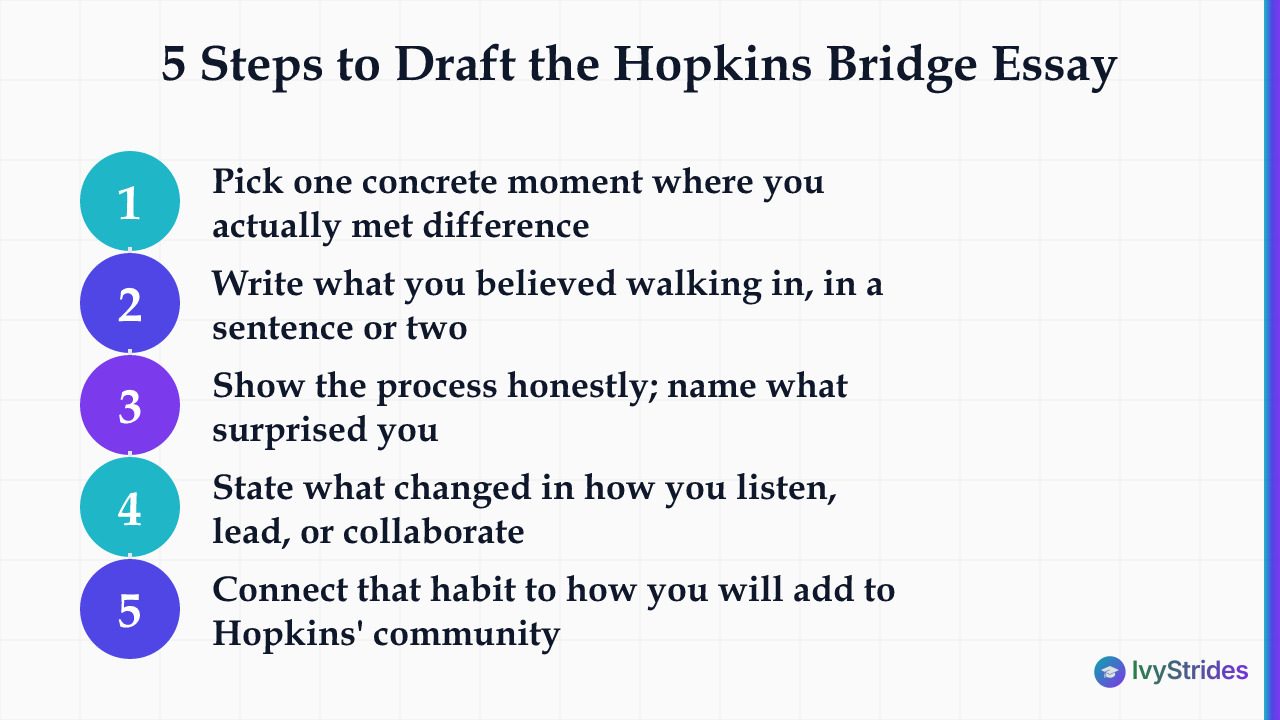
Five steps to draft.
-
Pick one concrete moment where you actually met difference, not a theme.
-
Write what you believed walking in, in a sentence or two.
-
Show the process honestly, not a neat resolution; name what surprised you.
-
State what changed in how you listen, lead, or collaborate.
-
Connect that habit to how you will add to Hopkins' community.
Commit to one moment. Resist the urge to explain why you want to attend Hopkins, and build the essay around a single moment of engaging across difference. Hopkins' admissions blog advises focusing on the process rather than the outcome, and being honest and specific.
A specific scene shows more than a survey of three activities can, and it leaves room in 350 words to show what changed. If you cannot find the scene or compress it, IvyStrides' one-on-one college essay coaching works through the Hopkins supplement with you, from narrowing a broad topic to the one moment that carries the prompt to cutting the draft to 350 words.
Watch how one average essay line becomes a specific scene that makes a reader feel something.
More videos like this one: follow IvyStrides on YouTube for daily SAT and ACT preparation tips.
Avoid these three. Do not list Hopkins' research reputation or faculty names; that is the Why Us essay Hopkins did not ask for. Do not repeat the story from your personal statement; the two are read together, so they should show different facets of you. And do not make vague claims about valuing diversity without a scene that proves it.
A moment that seems small, even a single conversation, can carry the essay, because an ordinary topic turns compelling once the writing shows what changed in you. IvyStrides' analysis of the limits on the two essays every Common App applicant sends Hopkins, 350 words for the supplement and 650 for the personal essay, puts the supplement at 35% of their combined 1,000-word maximum. Make each of those 350 words work.
What Johns Hopkins Does Not Count, and Why That Raises the Essay's Stakes
Johns Hopkins does not weigh interviews, demonstrated interest, or legacy, which puts more of the fit signal on the supplemental essay and personal statement. Hopkins states plainly that it offers no interviews, does not track demonstrated interest, and that "legacy has no bearing on the admissions process" (Johns Hopkins Admissions). Its 2025-26 Common Data Set matches, rating the application essay Very Important and listing interview, alumni/ae relation, and level of applicant's interest as Not Considered.
Because those three levers are gone, the essay carries a weight it would not at a school with alumni interviews or visit tracking. At schools that do track it, campus contact can count, so how colleges weigh demonstrated interest and whether it moves a decision matters for your other applications; Hopkins removes that lever entirely. Here, your writing is the most direct line to the reader.
Scores are read in context. Hopkins says it considers test scores in context with your transcript, activities, essays, and letters of recommendation, and that scores are "never the only thing that matters" (Johns Hopkins Admissions). A strong score does not substitute for a weak essay on Overall Match, and a strong essay cannot guarantee admission; the full application decides.
Read your draft against all three criteria, because a draft that nails voice but misses Overall Match is the quiet way this essay fails.
College admissions insights on LinkedIn: follow IvyStrides for application guidance and counseling updates.
Run this check before you submit:
- One concrete moment, not a list.
- Real difference, shown honestly, with no need for a neat resolution.
- A clear line from what you learned to how you work with others.
- A close that connects to Hopkins' community, not its ranking.
- No overlap with your personal statement.
- No reasons-to-attend paragraph.
- 350 words or fewer.
- Your actual voice, not an admissions-speak impression of it.
FAQ: The Johns Hopkins Supplemental Essay
Does Johns Hopkins have demonstrated interest?
No. Hopkins states it does not track demonstrated interest, so your level of engagement during the admissions process, such as campus visits or emails, does not influence its decisions (Johns Hopkins Admissions). That is part of why the supplemental essay and personal statement carry so much of the fit signal.
Does Johns Hopkins require an essay?
Yes. Hopkins requires one supplemental essay of up to 350 words for 2026-27, on community, dialogue, and engaging across differences (Johns Hopkins Admissions). You also submit a personal statement through the Common App or Coalition on Scoir as a separate required piece; on the Common App it runs up to 650 words.
Does Johns Hopkins do interviews?
No. Hopkins does not offer interviews as part of admissions and cannot grant meeting requests (Johns Hopkins Admissions). With no interview and no demonstrated-interest tracking, your essays are the most direct place to show values alignment.
What is the Johns Hopkins essay word limit?
The supplemental essay has a 350-word limit for 2026-27 (Johns Hopkins Admissions). The Common App personal essay, a separate required piece, has a 650-word maximum. The tight 350-word cap is best spent on one specific, concrete story rather than a survey of experiences.

Rajesh is a technology leader, entrepreneur, and angel investor with 28+ years in Business & Technology Leadership and Product & Solution Engineering. He is passionate about education, mentoring, and driving digital transformation.