
Johns Hopkins Admission Requirements, and What Each One Has to Show
On this page
- How Hopkins Reads the File: Three Criteria, One Holistic Review
- Johns Hopkins SAT and ACT Requirements for Fall 2027
- What the Johns Hopkins Supplemental Essay Has to Show
- Johns Hopkins Application Deadlines and Decision Rounds
- FAQ: Johns Hopkins Admission Requirements and Scores
- What GPA do you need for Johns Hopkins?
- How difficult is it to get into Johns Hopkins?
- Can you get into Johns Hopkins with a 3.7 GPA?
- What ACT score do I need to get into Johns Hopkins?
Johns Hopkins is a test-required research university that reads every first-year file holistically for fall 2027 entry. It requires the SAT or ACT, a transcript, two teacher evaluations, a counselor recommendation, a personal statement through the Common App or Coalition on Scoir, a 350-word supplemental essay, and a mid-year report. Hopkins superscores both tests.
The harder work is understanding what each piece has to demonstrate, because Hopkins reads them together, not as a scorecard. The one accelerated round is binding Early Decision; Hopkins does not offer an Early Action plan.
How Hopkins Reads the File: Three Criteria, One Holistic Review
Johns Hopkins admission requirements rest on three published holistic review criteria: Academic Character, Impact and Initiative, and Overall Match. Hopkins weighs the transcript, scores, essays, and recommendations as one picture, and it states that scores are "never the only thing that matters".
| Criterion | What Hopkins Is Looking For | Where It Shows in the Application |
| Academic Character | How you pursue academics, contribute to the learning environment, and engage with interests beyond the classroom | Transcript, activities list, recommendations, test scores |
| Impact and Initiative | Roles and impact in clubs, jobs, internships, family, and community | Activities list, recommendations, essays |
| Overall Match | How your values and goals line up with what Hopkins offers | Supplemental essay, personal statement, whole application |
Academic Character starts with the transcript, and Hopkins advises taking the most rigorous curriculum available at your high school. Colleges read how much your transcript matches the rigor your school actually offered, and Hopkins' 2025-26 Common Data Set rates course rigor, class rank, academic GPA, test scores, the application essay and recommendations all Very Important.
What Hopkins does not count. The FAQ is explicit: Hopkins does not track demonstrated interest, says legacy has no bearing on admissions, and offers no interviews. Its 2025-26 Common Data Set matches, listing interview, alumni/ae relation and level of applicant's interest as Not Considered. So skip campus-visit tracking and alumni connections, and put that energy into the parts of the file Hopkins reads.
Mapping which criterion each part of your file addresses is the kind of audit that benefits from a counselor who knows the whole application across grades 11 and 12 and can spot a gap before you submit. IvyStrides' admissions counselors run that criterion-by-criterion audit on Hopkins files, flagging where two components tell the same story and leave a criterion thin.
Johns Hopkins SAT and ACT Requirements for Fall 2027
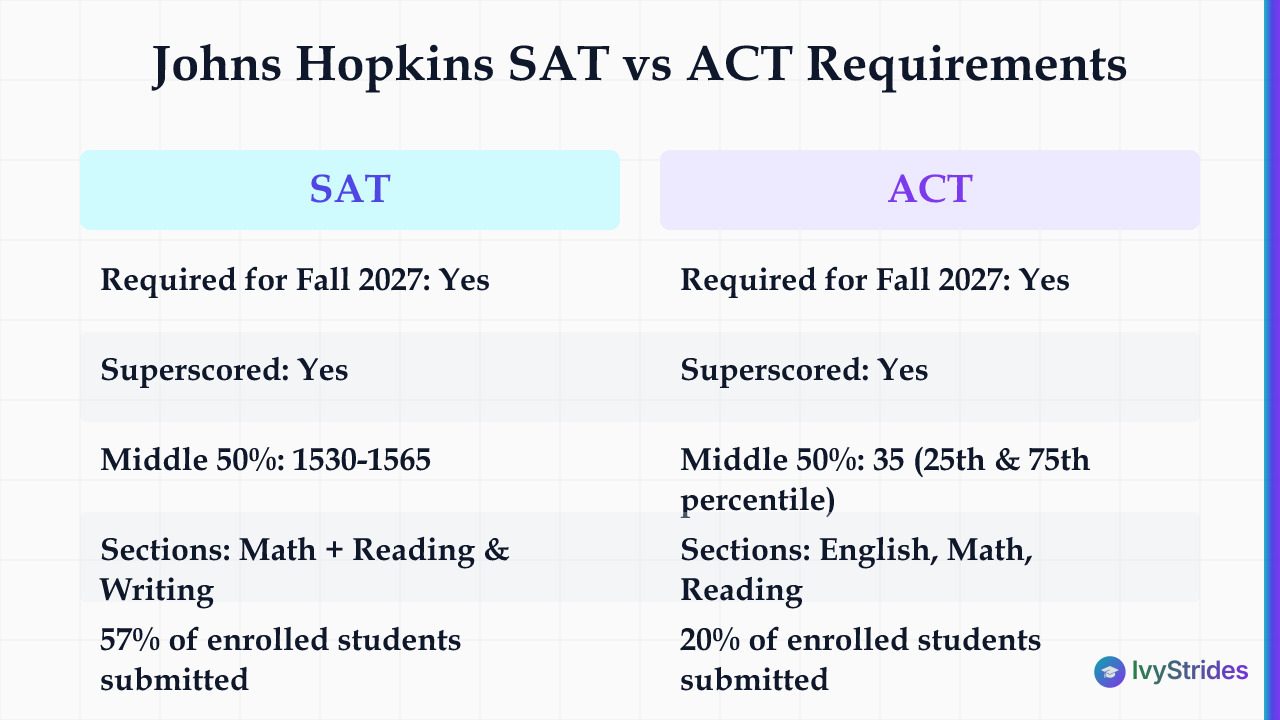
Johns Hopkins SAT requirements and ACT requirements both start from one fact: Hopkins requires first-year applicants for fall 2027 entry to submit SAT or ACT scores. A Hopkins Insider post on testing says that "for students applying for Fall 2026 and beyond, standardized testing is required," and the official testing policy exempts transfer applicants.
Hopkins superscores both tests, combining your highest section scores across all test dates: the Math and Reading and Writing sections of the SAT, and Math, Reading, and English on the ACT.
| Test | Required for Fall 2027 Entry? | Superscored? | Middle 50% of Enrolled Score Senders (CDS 2025-26) | Score Covers |
| SAT | Yes | Yes | 1530–1565 | Math plus Reading and Writing (400–1600) |
| ACT | Yes | Yes | 35 at both the 25th and 75th percentile | English, Math, Reading (composite) |
Those ranges come from Hopkins' 2025-26 Common Data Set and describe enrolled first-years who sent scores: 57% submitted an SAT and 20% an ACT, and the SAT median was 1550.
SAT format. The Digital SAT runs 98 questions across 2 hours 14 minutes of testing: Reading and Writing is 54 questions in 64 minutes, Math is 44 questions in 70 minutes, on a 400–1600 scale.
ACT format. Under the enhanced ACT, the composite averages English, Math, and Reading only; Science and Writing are separate add-on sections with their own scores. Hopkins does not require either one or count them in its superscore, though it says they can add value when they highlight strength in an area you plan to study.
Because Hopkins superscores, a student who sits more than once can bank the best Reading and Writing score from one date and the best Math score from another. That changes how many sittings are worth planning, and it bears on whether Early Decision works when your score still has room to grow. IvyStrides' SAT coaches build a diagnostic-first plan for Hopkins applicants, timed to the testing window of the round you choose.
What the Johns Hopkins Supplemental Essay Has to Show

Photo by https://kaboompics.com/ on Pexels
The Johns Hopkins supplemental essay is a single 350-word response on bridge-building. Hopkins lists it first among the places where Overall Match shows. The 2026-27 prompt opens with "At Johns Hopkins, community is built through dialogue, collaboration, and a willingness to engage across differences," then asks what you have learned about engaging across differences and how it has shaped the way you think about building bridges, enhancing community, and working with others.
The bridge-building essay needs to do more than describe a club or a friendship; it has to reveal how you think across difference, so a draft that lists activities misses the prompt. Hopkins also looks for Impact and Initiative in your essays, so an essay that retells your activities list spends 350 words on ground the file already covers.
Daily SAT and ACT prep on YouTube: short strategy videos from IvyStrides. Subscribe to IvyStrides on YouTube.
| Component | Limit | What It Has to Show |
| Supplemental essay | 350 words | Overall Match: how you engage across differences |
| Common App personal statement | 650 words | Overall Match and Impact and Initiative, in your own voice |
| Two teacher evaluations | n/a | Academic Character and Impact and Initiative, from teachers of two different academic subjects |
| Counselor recommendation | n/a | Context, sent with your transcript and high school profile |
The personal statement carries your voice. The Common App kept its seven prompts unchanged for 2026-27 and caps the essay at 650 words.
The bridge-building prompt asks for a specific kind of self-awareness, which is why supplemental essays that show genuine fit start from how you think, not what you have done. Because Hopkins reads both essays for Overall Match, the two should show different sides of you rather than one story told twice. In IvyStrides' essay coaching, coaches plan the Hopkins supplement and the personal statement together, mapping each draft to the criterion it serves before revision starts.
Johns Hopkins Application Deadlines and Decision Rounds
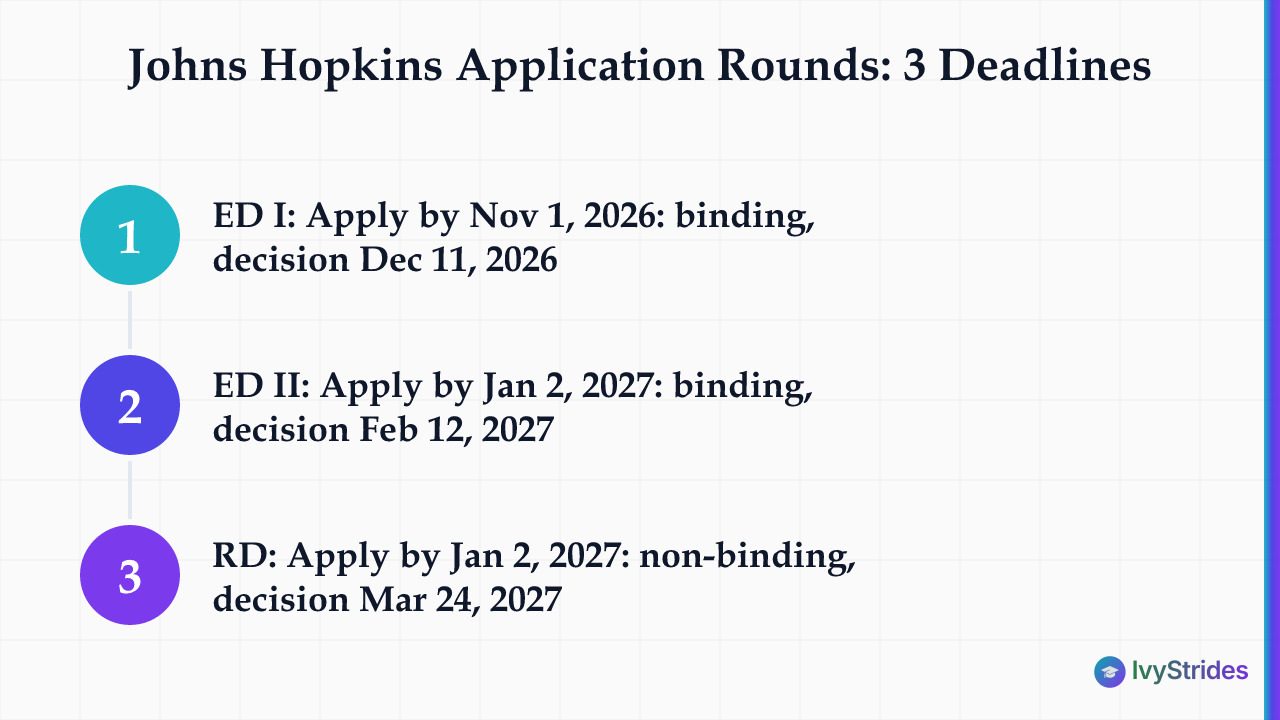
Johns Hopkins application deadlines for fall 2027 entry come in three rounds, and the only accelerated option is binding Early Decision; there is no Early Action. The ED agreement commits you to enroll if admitted, needs signatures from a parent or guardian and your school counselor, and requires you to withdraw your other applications if Hopkins admits you.
| Round | Application Deadline | Decision Date | Binding? |
| ED I | Nov 1, 2026 | Dec 11, 2026 | Yes |
| ED II | Jan 2, 2027 | Feb 12, 2027 | Yes |
| RD | Jan 2, 2027 | Mar 24, 2027 | No |
Choosing ED I by November 1 is a binding commitment, so the score, the essay, and the recommendation lineup all need to be complete before that date. Because the agreement binds you and needs those signatures, families should confirm their financial aid picture before an Early Decision submission.
IvyStrides' analysis of Hopkins' 2025-26 Common Data Set, 835 admitted from 7,639 Early Decision applicants for fall 2025, puts the Early Decision acceptance rate at 10.9%, and Hopkins says it historically admits the majority of its class through Early Decision rounds.
Hopkins encourages Early Decision applicants to finish testing no later than October of senior year and Regular Decision applicants by December, and asks anyone planning a later sitting to note it on the application, which changes the calculus for a borderline score on an Early Decision timeline. Hopkins also requires a mid-year report, due in mid-February, so it can review your grades from the first half of senior year.
Two major choices to know. Your listed major is not binding, with one exception: Biomedical Engineering is chosen as a first-choice major with no separate application, but admission to it depends on credentials and space, and you can be admitted to Hopkins without a BME place. Once enrolled, you can choose any other major across the Krieger and Whiting schools; students not admitted to BME cannot select it later.
Special programs run separately. The Peabody Double Degree requires separate applications to the Peabody Institute and the university, and you must be admitted to each independently, to Peabody by audition; Double Degree applicants can apply Early Decision I or Regular Decision, since Peabody does not offer Early Decision II. The optional Direct Matriculation Programs let you apply to one master's program (International Health, International Relations, or the MBA), with a short essay submitted in your applicant portal after the admissions application.
College admissions insights on LinkedIn: follow IvyStrides for application guidance and counseling updates.
Your next steps on the Hopkins file:
- Check your SAT or ACT superscore against the Common Data Set ranges above, and decide whether a retake fits Hopkins' testing window for your round.
- Draft the 350-word supplemental essay around how you engage across differences, not a list of activities.
- Confirm two teacher evaluations from different subjects, the counselor recommendation, and the mid-February mid-year report are on track.
FAQ: Johns Hopkins Admission Requirements and Scores
What GPA do you need for Johns Hopkins?
Hopkins publishes no minimum GPA and advises taking the most rigorous curriculum available at your high school. Its 2025-26 Common Data Set reports an average high school GPA of 3.93 for enrolled first-years, with 66.09% at 4.0 and 25.36% between 3.75 and 3.99.
How difficult is it to get into Johns Hopkins?
Johns Hopkins is among the most selective universities in the United States: it admitted 3,072 of 50,259 first-year applicants for fall 2025, or 6.1%, per its 2025-26 Common Data Set. The process is holistic: test scores, transcript rigor, essays, and recommendations all read together. No single factor guarantees admission, and Hopkins states that scores are never the only thing that matters.
Can you get into Johns Hopkins with a 3.7 GPA?
Hopkins publishes no GPA cutoff, so a 3.7 GPA is not automatically disqualifying, though it sits below most of the class: in the 2025-26 Common Data Set, 5.53% of enrolled first-years had a GPA between 3.50 and 3.74. What matters is whether it reflects the hardest courses your school offers. A 3.7 in the most rigorous curriculum reads differently from a 3.7 in a lighter load.
What ACT score do I need to get into Johns Hopkins?
Hopkins requires the ACT or SAT for fall 2027 entry, sets no minimum score, and superscores across all test dates. In its 2025-26 Common Data Set, the ACT composite for enrolled first-years who submitted an ACT was 35 at both the 25th and 75th percentile. A lower composite is not disqualifying; Hopkins considers scores alongside every other part of the application.

Hemant is a seasoned entrepreneur, investor, and growth strategist with deep ground in education and technology-driven learning. His core training is in Mathematics and Physics — he authored Physics for IB Diploma: Ultimate Revision Guide, recognized as a top student resource.