
What Is SAT Superscoring? How Colleges Combine Your Best Section Scores
On this page
- What SAT Superscoring Means and Why Colleges Use It
- How SAT Superscoring Is Calculated: A Step-by-Step Example
- Which Colleges Superscore the SAT, and How to Check
- Should You Retake the SAT When Colleges Superscore?
- FAQ: SAT Superscoring Questions
- Can you superscore your SAT score?
- Is a 1350 superscore good?
- Do Ivy Leagues accept superscores?
- Does superscoring SAT look bad?
- Your Next Step on SAT Superscoring
SAT superscoring is a college admissions policy where a school takes your highest Reading and Writing section score and your highest Math section score from separate test dates and adds them into one total on the 400–1600 scale. The result equals or beats any single-sitting total. Not every college superscores, so check each one.
That definition comes from the College Board's own explanation of the SAT superscore, which is clear on one point students miss: superscoring is each college's policy, applied to the section scores you send. Your job is to send the right scores and verify each school's policy before the deadline.

What SAT Superscoring Means and Why Colleges Use It
SAT superscoring is an admissions score-use policy that rests on the Digital SAT's two-section structure. The SAT has two sections: Reading and Writing, with 54 questions in 64 minutes, and Math, with 44 questions in 70 minutes. That's 98 questions across 2 hours 14 minutes of testing, with one 10-minute break between them. Each section scores on a 200–800 scale, and the two combine into a 400–1600 total.
Section scores are the unit. Because each section earns its own 200–800 result, a college that superscores can mix and match: your best Reading and Writing section score from one test date, your best Math section score from another. The adaptive module structure, two modules per section, produces those section scores, but it doesn't change how superscoring works. Colleges read the section number, not the module path.
So why do colleges do it? Superscoring fits holistic review. A school that superscores signals it wants your best work on each section, not a penalty for one off day in Math. It rewards targeted improvement. The University of South Florida's admissions office describes the practice the same way from the inside: an admissions office looks across your submitted test dates to build the highest combined score it can.
| Section | Questions | Time | Score Range |
| Reading and Writing | 54 | 64 minutes | 200–800 |
| Math | 44 | 70 minutes | 200–800 |
| Total | 98 | 2 hr 14 min | 400–1600 |
The section scores superscoring combines come from an adaptive module path most retakers never see explained, so how the Digital SAT is scored across its two adaptive sections matters when you plan which section to retake.
How SAT Superscoring Is Calculated: A Step-by-Step Example
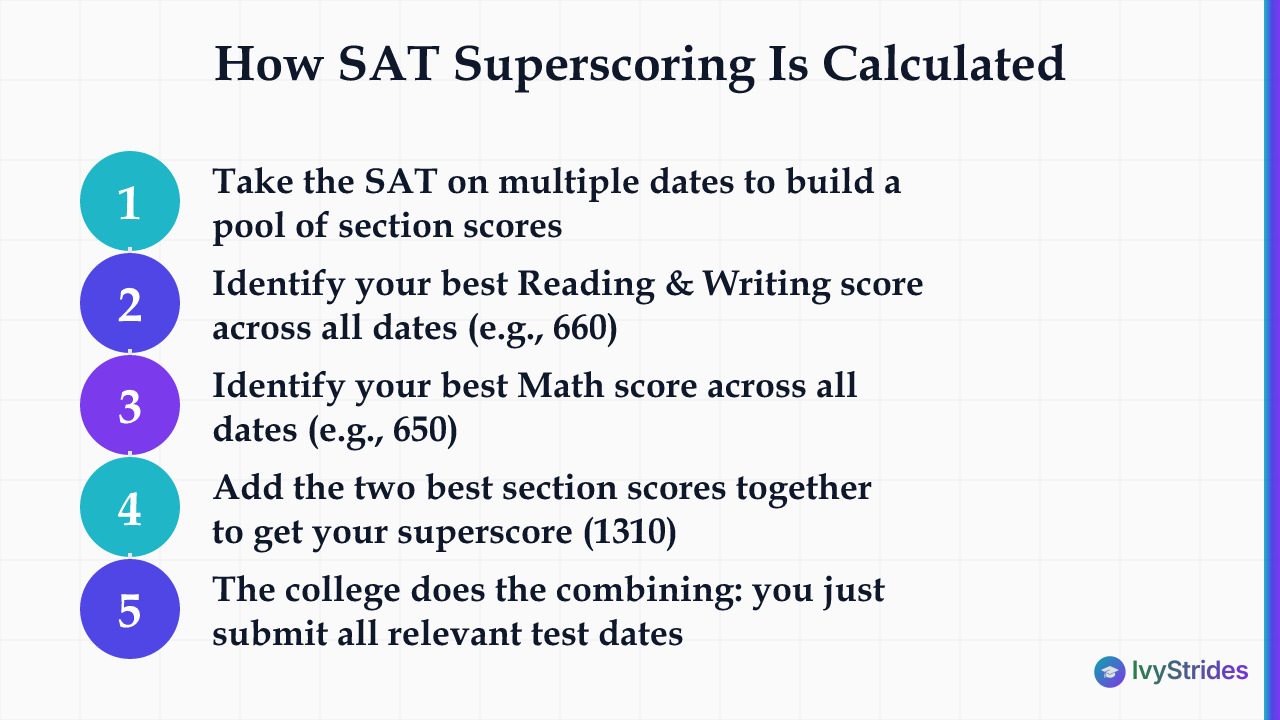
A superscore is your best Reading and Writing section score plus your best Math section score, each drawn from whichever test date produced it. The Digital SAT's two-section structure, Reading and Writing scored 200–800 and Math scored 200–800, is what makes superscoring possible: colleges simply take the best of each. That builds on the same section-score unit the structure above establishes.
Here's the arithmetic on the pattern that sends most students searching. Say you sat the SAT twice. First date: Reading and Writing 620, Math 650. Second date: Reading and Writing 660, Math 620. Your single-sitting totals look flat: 1270 (620 + 650) on the first date and 1280 (660 + 620) on the second. A superscoring college instead pulls your best Reading and Writing, the 660 from date two, and your best Math, the 650 from date one. That superscore is 1310 (660 + 650), 30 points above your best single-sitting total of 1280.
| Sitting | Reading and Writing | Math | Single-Sitting Total | Superscore |
| First date | 620 | 650 | 1270 | - |
| Second date | 660 | 620 | 1280 | - |
| Best of each | 660 | 650 | - | 1310 |
This is the score floor. At a superscoring college, a lower total on a later date can't pull you down, because the school keeps only the better of each section. Can you superscore your own scores and send one combined number? No. You submit scores from the relevant test dates; the admissions office does the combining.
IvyStrides' comparison of this example with College Board's SAT user percentile table shows what this SAT superscore adds: the 1280 best single sitting ranks at the 83rd percentile and the 1310 superscore at the 86th. That 660 Reading and Writing also sits at the 86th user group percentile for its section, a useful benchmark for reading SAT section score percentiles when you weigh a retake.
Get your Daily IV Dose on Instagram: quick study tips and test-day advice for high school students. Follow @ivy.strides.
Which Colleges Superscore the SAT, and How to Check
Superscoring is a college-level policy, not a universal one, so which colleges superscore the SAT is a question you answer school by school. Some highly selective colleges superscore the SAT. But not all do, and policies shift year to year, which is why you verify each one directly rather than trusting a list.
Highly selective schools often superscore. Penn is a concrete case: its admissions testing policy combines your highest Reading and Writing and highest Math scores across multiple tests, so whether UPenn considers your best section scores across sittings is settled in its favor. On the other side, UT Austin's single-sitting score requirement means one test date has to carry the full weight, so the score-floor logic above doesn't apply there.
| College Category | General Pattern (Verify Each School) | All-Scores Requirement? | How to Verify |
| Highly selective private | Often superscores | Sometimes | Admissions page |
| Large public flagships | Varies widely | Varies | Admissions page |
| Test-optional schools | Varies, applies only if you submit | Sometimes | Admissions page |
| Schools using one sitting | No superscore | Varies | Admissions page |
Watch the all-scores requirement. Some colleges superscore and still ask you to submit every sitting, so College Board's Score Choice, which lets you pick which SAT test dates to send to each college, won't let you hide a weaker date at those schools.
Even at test-optional colleges, a strong superscore can strengthen an application, though whether to submit depends on where the score falls against each school's published range, and test-optional policies vary by school and year, so read each college's own admissions page for fall 2027 entry. Before deciding whether to send all sittings or only the strongest, check whether each target college superscores and whether it asks for every score.
Should You Retake the SAT When Colleges Superscore?
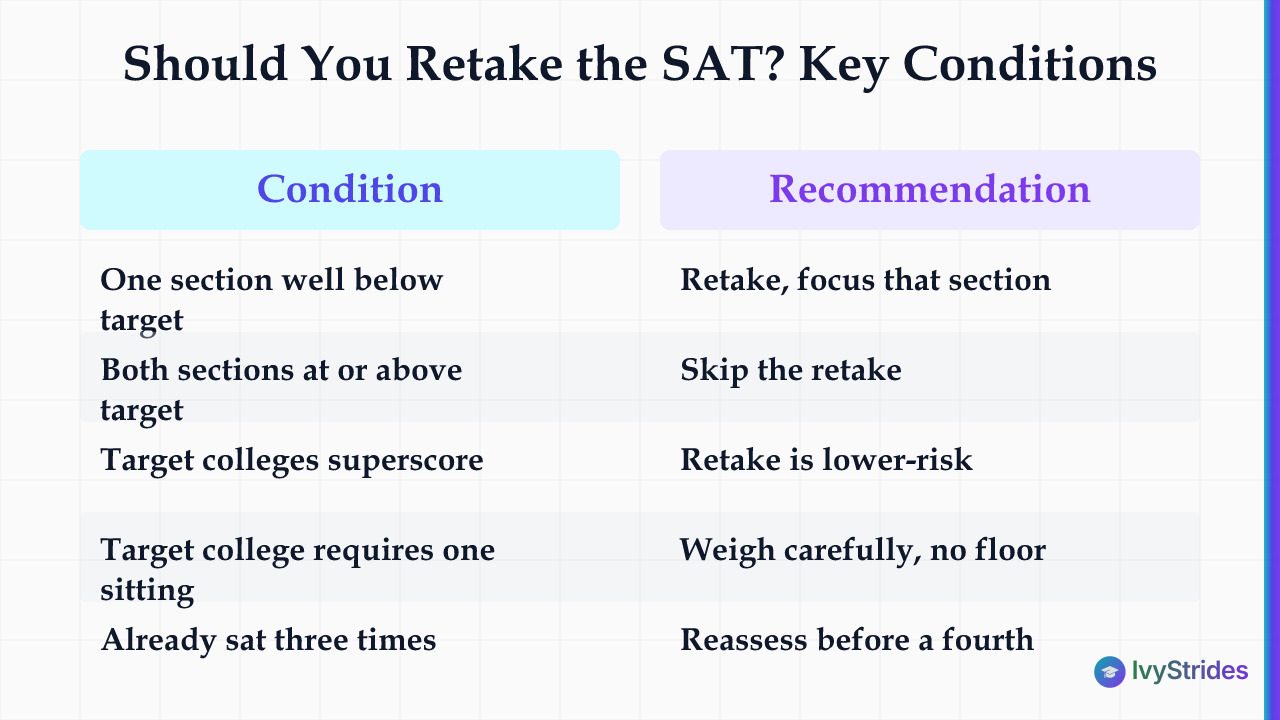
Retake the SAT when one section has clear room to grow and your target colleges superscore, because the score floor means a focused retake can only lift your superscore, never lower it. Because each retake has that floor, the question shifts from "should I retake?" to "which section should my next sitting target?"
Target the larger gap. If your Math sits below 700 while your Reading and Writing is already strong, Math is where a retake pays. If both sections already land at or above your target schools' range, another sitting rarely moves the superscore enough to justify it. Map your section scores against your colleges' published ranges, then set a retake date and section focus before the next registration deadline.
Each extra date adds test fatigue, so decide how many times to sit the SAT when your target colleges superscore before you book. If you've already sat once, the second SAT sitting decision under superscoring comes down to whether one section still has clear room to grow.
Use percentiles to judge the gap. On College Board's SAT user percentile table, based on the scores of recent graduates, a 1350 total sits at the 89th percentile, 1400 at the 93rd, and 1440 at the 95th. If your superscore is already past your schools' middle-50% range, stop. If it's below, find the weaker section and plan around it.
| Condition | Recommendation |
| One section well below target | Retake, focus that section |
| Both sections at or above target | Skip the retake |
| Target colleges superscore | Retake is lower-risk |
| Target college requires one sitting | Weigh carefully, no floor |
| Already sat three times | Reassess before a fourth |
Every retake plan should start by identifying which section has the larger gap to your target range, not by booking the next available date. If you want that plan built one-on-one, 1-on-1 SAT prep built around your section score gap starts from a diagnostic test and a custom roadmap re-evaluated weekly, then runs 28 live 1-on-1 sessions and 10 full-length Bluebook-style adaptive mock tests, each followed by a tutor review. Start with a timed diagnostic before you commit to a date.
FAQ: SAT Superscoring Questions
Can you superscore your SAT score?
Yes, if the colleges on your list superscore. You can't combine your own section scores and send one total; the college does the combining from the scores you submit. Send scores from all relevant test dates to colleges that superscore, then let their admissions office build the highest total from your best section results.
Is a 1350 superscore good?
A 1350 sits at the 89th percentile of recent SAT takers on College Board's user percentile table, which is competitive at many selective colleges. Whether it's strong enough depends on the school's middle-50% range of enrolled students who sent a score. At a school where that range runs high, a 1350 falls below it; at a school with a lower range, it lands well within. Always check the Common Data Set for each college.
Do Ivy Leagues accept superscores?
Penn superscores the SAT, combining your highest section scores across multiple test dates, but Ivy League policies are not uniform. Each school sets its own policy, and policies change, so verify on each college's admissions page before your deadline. Also check whether a school asks for every sitting, since some colleges superscore and still require all scores.
Does superscoring SAT look bad?
No. Superscoring is a common, widely accepted practice. Admissions officers who superscore expect multiple test dates and look for your best section performance, not one perfect sitting. A lower total on one date doesn't hurt you at a superscoring college, since only your best section scores from each date get used. The ACT reports its own Superscore, the average of your best ACT English, math and reading scores across attempts; if you're choosing between tests, compare the rules.
Your Next Step on SAT Superscoring
You now know what a superscore is, how to calculate yours, and that the policy varies by college. The move is to act on your own numbers before the next registration deadline.
- Pull your score reports and calculate your own superscore: best Reading and Writing plus best Math.
- Check each target college's admissions page or Common Data Set to confirm whether it superscores and whether it requires all scores.
- Identify the section with the larger gap to your target range.
- Decide whether a focused retake on that section is worth another sitting.
Watch the method, then try it: IvyStrides explains SAT and ACT question types on YouTube.

Hemant is a seasoned entrepreneur, investor, and growth strategist with deep ground in education and technology-driven learning. His core training is in Mathematics and Physics — he authored Physics for IB Diploma: Ultimate Revision Guide, recognized as a top student resource.