
The ACT for International Students and Parents: Dates, Prep, and Admissions (2026)
On this page
- What International Students Need to Know About the ACT (Quick Answer)
- ACT 2026 Format Changes: What Every International Student Must Know Before Registering
- International ACT Test Dates and Registration Deadlines for 2025–2026
- ACT Fees for International Students: What You Will Actually Pay
- Finding an ACT Test Center Outside the US: How Registration Works
- What ACT Score Do International Students Need for US Colleges?
- ACT or SAT: Which Test Should International Students Choose?
- How to Prepare for the ACT from Outside the US
- How ACT Scores Fit Into Your US College Application
- FAQ
- Can international students take the ACT?
- Is the ACT changing in 2026?
- How much does the ACT cost for international students?
- Is the ACT required for international students applying to US colleges?
- How long does it take to receive ACT scores after an international test date?
- Is ACT English harder than the SAT for international students?
- What is a good ACT score for an international student?
- Ready to Move
Yes, international students can take the ACT. Outside the US and Canada, the ACT is delivered as a computer-based exam at authorized centers in over 100 countries, scored on the same 1 to 36 composite scale used domestically. From February 2026, the international format shortens to 171 questions (down from 215), Science becomes optional and no longer counts toward the composite, and total testing time drops. Base fees run roughly $168.50 without Writing and about $188.50 with Writing, plus an international surcharge. Every major US university accepts the ACT equally with the SAT.
These figures come from ACT, Inc.'s official international pages at global.act.org and act.org. The harder work sits below the surface: choosing between the ACT and SAT, timing your sittings around limited seat availability, and building a prep plan that reflects a shorter, three-section composite. That's what the rest of this piece walks through.

What International Students Need to Know About the ACT (Quick Answer)
Here is the short version, calibrated for the 2025 to 2026 testing cycle:
- Availability: Authorized test centers in over 100 countries. Center lookup at global.act.org.
- Format: Computer-based only for international test-takers. No paper option. No at-home option.
- Scoring: Composite on the 1 to 36 scale, calculated from your section scores.
- 2026 change: Beginning February 2026 internationally, the exam shortens to 171 questions, Science becomes optional, and the composite is calculated from English, Math, and Reading only. Writing remains optional.
- Fees: Roughly $168.50 without Writing, $188.50 with Writing, plus an international surcharge. Verify current amounts at global.act.org before you register; fees change annually.
- Score release: Typically three to eight weeks after an international test date.
- Acceptance: All major US universities accept the ACT equally with the SAT.
That's the fact set. Everything downstream, prep strategy, score targets, ACT versus SAT, hinges on it.
ACT 2026 Format Changes: What Every International Student Must Know Before Registering
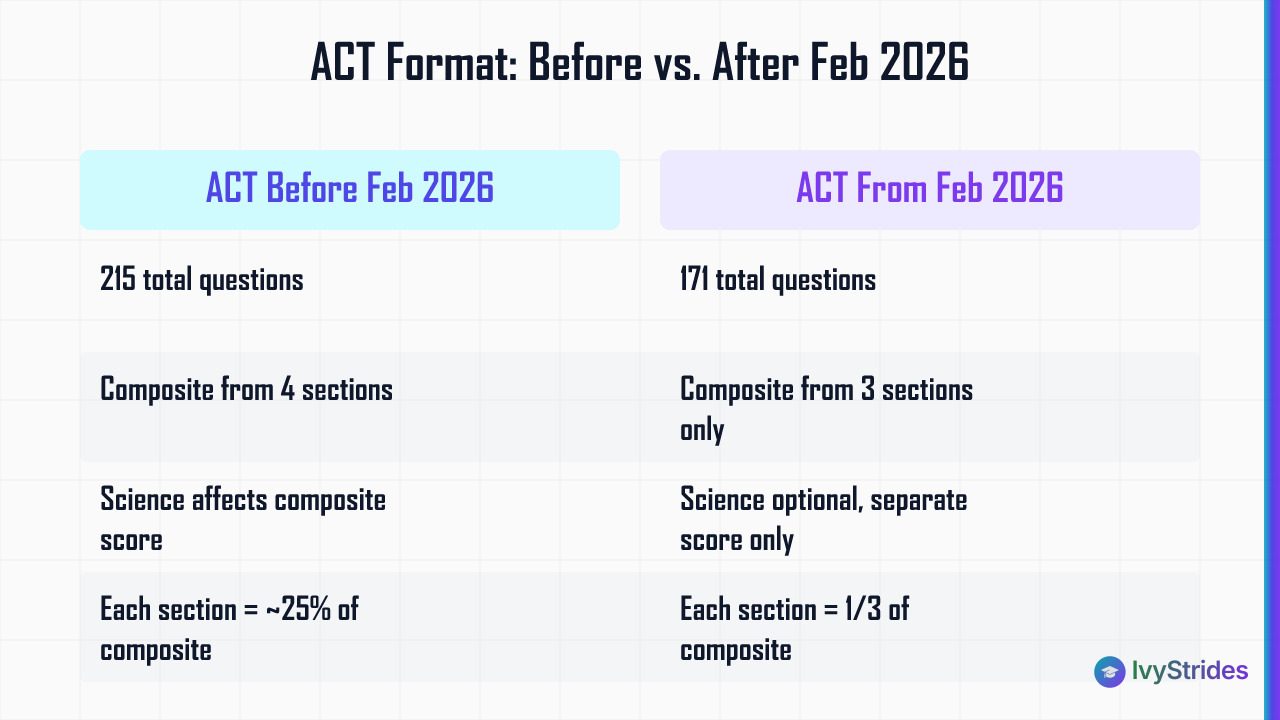
The ACT is going through its most significant structural revision in decades, and international students see the change from February 2026 forward. Three shifts matter.
One, the exam is shorter. Total question count drops from 215 to 171, per ACT's official enhancement announcement, and total testing time is reduced accordingly. Fewer questions means each item weighs more. Pacing and accuracy on the questions that remain matter more, not less.
Two, Science becomes optional and no longer affects the composite. From February 2026, the composite score is calculated from three sections: English, Math, and Reading. Science, if you choose to take it, is reported as a separate section score. It does not raise or lower your composite. Some students will still sit for Science, particularly applicants to competitive STEM programs where a strong Science section score adds a data point. Most will skip it.
Three, Writing remains optional and, as before, does not affect the composite. A handful of specific programs still ask for Writing. Check each target school's testing policy before deciding.
What this means for prep: you have less content to master, but your margin for error on English, Math, and Reading narrows. In our coaching with students in the 24 to 28 composite band, targeted work on ACT English grammar rules and ACT Reading passage timing has historically accounted for the largest composite gains. Under the 2026 format, that pattern intensifies. Every one of those three sections now carries a third of the composite instead of a quarter.
If you're already sitting between diagnostics and a first official test date, our guide on how to improve your ACT score on a retake walks through how to rebuild a study plan around a three-section composite. Verify the exact 2026 section timing and question counts against ACT's official enhancement page before you register; some details continue to be updated.
International ACT Test Dates and Registration Deadlines for 2025–2026
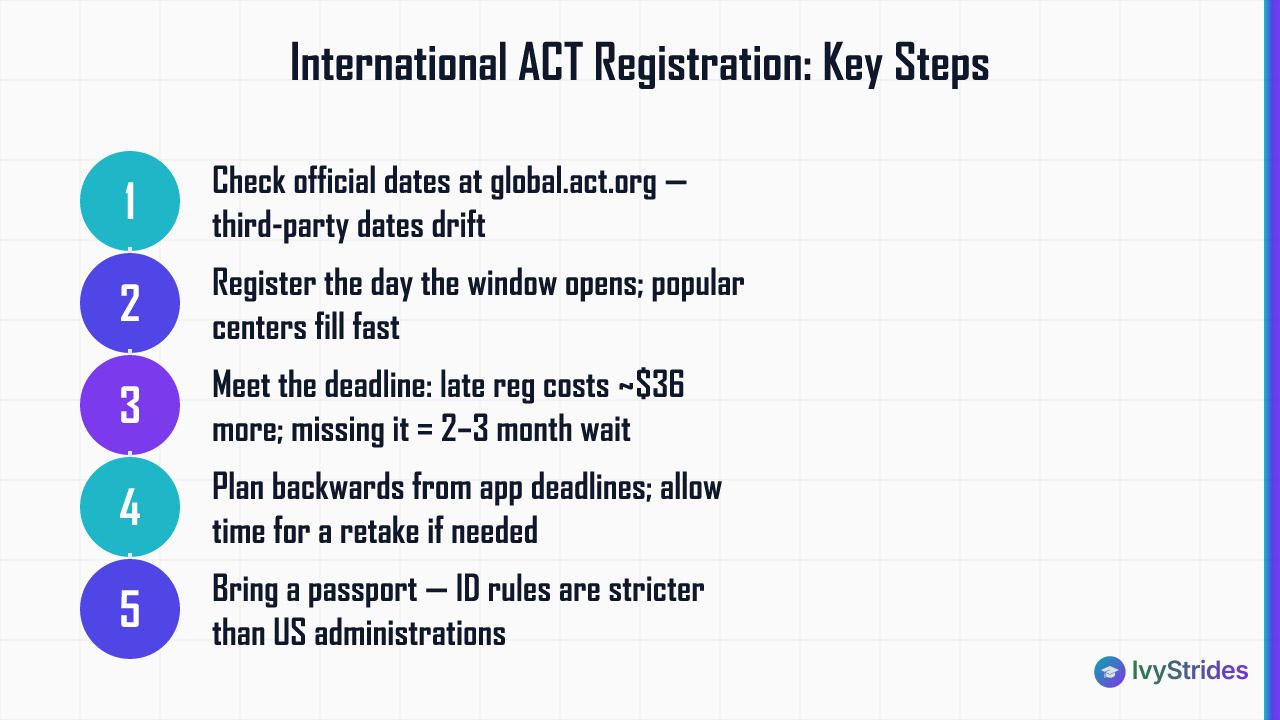
International ACT test dates run on a separate schedule from US domestic dates. There are typically five to seven international test windows across a cycle. The official calendar lives at global.act.org, and it's the only source you should treat as authoritative; third-party dates lag or drift.
A few logistical rules that trip up families every year:
Registration typically closes roughly four to five weeks before the test date. Miss it, and you enter a late registration window that costs about $36 more. Miss that, and you wait for the next international window, which could be two to three months out.
Seat availability at international centers is limited. Popular test centers in cities like Singapore, Dubai, Seoul, London, and Mumbai fill quickly. Register the day the window opens if your target center matters to you. Traveling two hours to a farther center on test morning is a bad way to start.
Score release for international CBT typically runs about three to eight weeks after the test date. Release can vary by window. Plan backwards from your application deadlines: if you're applying Early Decision on November 1, you want your last sitting no later than late September, and ideally August, to leave room for a retake if needed.
Bring a passport. ACT ID requirements for international test-takers are stricter than for US administrations; a passport is the safest bet.
For students building a self-paced prep block between now and their next test date, our act practice test online library gives you full-length computer-based sets that match the international CBT experience.
ACT Fees for International Students: What You Will Actually Pay
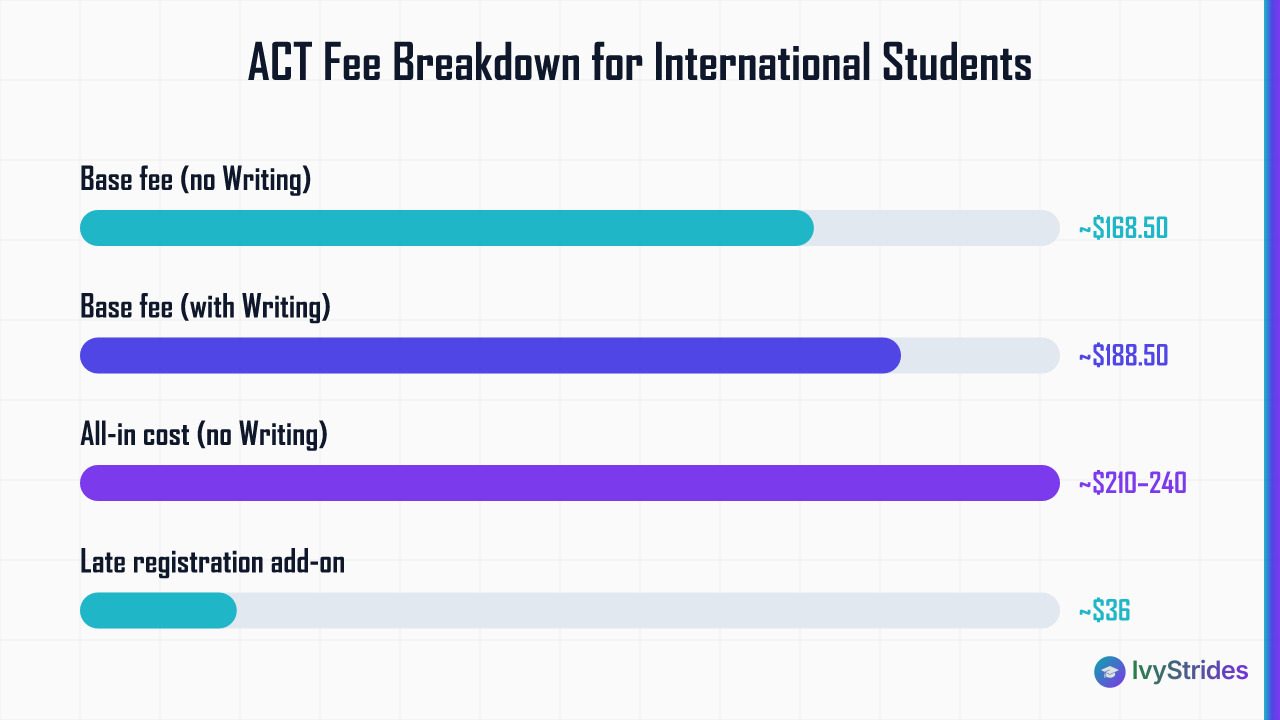
Here's the full fee picture for the 2025 to 2026 cycle. Every amount below is approximate. Verify current fees at global.act.org before you submit payment.
- Base fee, no Writing: roughly $168.50
- Base fee, with Writing: roughly $188.50
- International surcharge: an additional fee on top of the base, charged for testing outside the US and Canada
- Late registration fee: about $36 additional
- Change fee (test date or center): additional
- Score reports: first four are included; additional reports cost extra per school
The realistic all-in cost for a first international sitting without Writing typically lands roughly in the $210 to $240 range once the international surcharge is included, higher with Writing or late registration. If you plan for two sittings (a common approach for students targeting a superscored composite), budget for the full amount twice.
Fee waivers are not available for international students testing outside the US. ACT's fee waiver program is US-only. Plan accordingly.
For families weighing whether the cost of multiple sittings is worth it against a one-shot approach, our ACT prep overview explains how the diagnostic and retake structure typically works.
Finding an ACT Test Center Outside the US: How Registration Works
The registration flow is straightforward once you know the steps.
Step 1: Create an ACT web account at act.org. You'll use this same account to view scores and send reports later.
Step 2: Use the test center locator at global.act.org to find authorized centers in your country. International centers are concentrated in major cities. If you live outside a major metropolitan area, expect some travel.
Step 3: Choose your test date and register. You'll pay the base fee plus the international surcharge at this stage. Decide upfront whether you want Writing; adding it later costs extra.
Step 4: Upload a photo and confirm ID requirements. A passport is the recommended ID for international test-takers. Names on the registration must match the ID exactly, no nicknames.
Step 5: Confirm your admission ticket the week before test day. Print it or save a clean digital copy.
The international ACT is computer-based only. There's no paper option and no at-home option. You'll sit at a computer at the authorized center, work through the exam on-screen, and submit digitally. Practice on a computer, not paper, from week one. The keystrokes, on-screen highlighting, and screen-based reading all take some acclimation, especially for students who've done most of their school testing on paper.
Once you have a registered test date, the next question is how to prep from wherever you are. That starts with a diagnostic, and this is where families often ask for a second opinion before committing to a self-study path. Our 1-on-1 ACT prep program is built for exactly that decision point.
What ACT Score Do International Students Need for US Colleges?
Score targets vary by school, but the reference bands are stable. Here's how to read them.
A 27 composite places you at roughly the 88th percentile nationally, per ACT score data. That's a strong score in absolute terms. It's competitive at many strong US universities but sits below the median at the most selective ones.
The 31 to 34 range is typically the mid-50% band for most competitive private and flagship public universities. If you're applying to schools like Georgetown, USC, NYU, Notre Dame, or the top state flagships, this is the target zone. Check each school's most recent Common Data Set for the exact range.
The 35 to 36 range is where the mid-50% sits for the most selective schools: Harvard, Yale, Princeton, Stanford, MIT, Caltech, and peers. A 34 is still competitive at these schools, but the higher you go, the less your score is a limiting factor. For a detailed look at one selective school's admissions profile, our guide to Apply to Cornell University in 2026: What You Must Know shows how test scores fit into the full application review.
A quick word on the SAT concordance: a 1400 SAT is roughly equivalent to a 31 ACT on the College Board and ACT joint concordance tables. That matters when you're deciding which test to submit.
Two caveats you must hold onto:
Test-optional policies vary by school and by year. The FairTest tracker is the standing reference for which schools are test-optional in the current cycle. Some schools have returned to requiring scores (MIT, Georgetown); many remain test-optional; a few are permanently test-free. Even at test-optional schools, submitting a score at or above the school's 75th percentile typically strengthens the application. Below the 25th percentile, most families choose to withhold. In between is where the real strategy sits, and it's school-specific.
Admissions outcomes depend on the full application. A 35 does not guarantee admission anywhere. Grades, essays, recommendations, extracurriculars, and, for international students, demonstrated English proficiency all matter alongside the score. Dartmouth's admissions FAQ, for example, notes that international students may apply without ACT or SAT scores. Policies like this change; always check the current cycle.
If you want to compare test targets between the two exams, our act vs sat breakdown lays out the concordance in detail.
ACT or SAT: Which Test Should International Students Choose?
Before committing to the ACT, international students should run a diagnostic on both exams; our full breakdown of ACT vs SAT difficulty walks through the section-by-section comparison. Here's the short decision framework.
Structural differences that matter for international students:
- ACT (2026 format): Three-section composite (English, Math, Reading), optional Science, faster pacing per question, straightforward question framing, computer-based only internationally.
- Digital SAT: Two-section score (Reading and Writing, Math), adaptive two-module structure that adjusts difficulty based on Module 1 performance, no Science section, 1600-point scale, digital worldwide.
Section-strength patterns we see in coaching:
Students who read fast and pattern-match grammar rules quickly often score higher on the ACT. Students who process denser passages carefully and prefer inference-heavy reading often score higher on the Digital SAT. On math, students who like straightforward algebra and geometry with a moderate calculator-use rhythm tend to do better on ACT Math; students who prefer context-heavy word problems and appreciate the SAT's built-in Desmos calculator often do better on Digital SAT Math.
The 2026 change makes the ACT more attractive for students who were previously slowed down by Science. If Science was your weakest section on a diagnostic, the new optional format helps you materially.
The recommendation: take a full-length diagnostic on each, under real timed conditions, then compare percentile-to-percentile (not raw score to raw score). A 30 ACT is not the same as a 1300 SAT. Convert both to percentiles and compare. If you're still unsure whether the SAT format feels harder in practice, is the SAT harder than the ACT works through the comparison in depth.
How to Prepare for the ACT from Outside the US
Prep looks different for international students. You're almost certainly balancing a demanding school schedule, possibly IB or A-Level or a national curriculum, and you can't walk into a weekend classroom session at a local test-prep center. The framework below assumes you're working online.
Step 1: Take a diagnostic full-length practice test. Under real timed conditions, at a computer. Don't skip this. Everything after depends on where your baseline lands. Our online ACT practice test library is built to match the international CBT format.
Step 2: Analyze by section, not composite. A 26 composite that came from a 30 English, 28 Math, 24 Reading, and 22 Science is a completely different profile from a 26 that came from four 26s. The first student's fastest gains come from Reading; the second's plan is entirely different. Once you have a baseline, a structured retake plan built around your weakest sections is the fastest path to a higher composite; see our guide on how to improve your ACT score on a retake for the full playbook.
Step 3: Set a realistic timeline. For students starting in the 24 to 28 band and targeting 30+, plan on roughly 10 to 16 weeks of consistent work at about 6 to 8 hours per week. A consistent 6 to 8 hours per week across 12 weeks adds up to roughly 70 to 100 total study hours. Shorter timelines exist, but they usually assume a stronger baseline or lighter competing academic load.
Step 4: Work through your weakest section first, at length. English is the most rule-based section on the exam. A focused four to six weeks on comma rules, modifier placement, verb tense consistency, and rhetorical skills questions moves the needle predictably. Reading gains come from timed passage sets, not untimed practice. Here's the part most international students miss: pacing on ACT Reading is unforgiving, and in our coaching, students who practice timed passage sets from week one see faster improvement than those who start with untimed review.
Step 5: Retake full-length tests on a spaced schedule. Every two to three weeks during prep, sit a full computer-based practice test under timed conditions. Review every missed question. Add the concept or question type to a running error log.
Step 6: Decide about Science. Under the 2026 format, Science is optional. If a target STEM program values it, take it. Otherwise, drop it and reallocate that prep time to English, Math, and Reading.
For students completing the IvyStrides 1-on-1 ACT program, a 4+ composite point gain is typical when starting from a 22 to 28 baseline. The methodology sits on four pillars: a real diagnostic, targeted weakness work with section-specialist coaches (English, Reading, Math, and Science are taught by different specialists, not one generalist), spaced retesting on full-length CBT practice, and structured review of missed items.
If you're also mapping out AP exams, SAT dates, or PSAT alongside the ACT, our AP, SAT, and ACT testing plan shows how to sequence exams across grades 9 through 12 without overloading any one semester.
How ACT Scores Fit Into Your US College Application
A strong ACT score opens doors. It does not, by itself, unlock any of them. Here's how the ACT sits inside the broader application.
Test scores are one signal among many. Admissions officers at competitive US universities read the full file: transcript, ACT or SAT, AP scores if submitted, essays, recommendations, extracurriculars, awards, and any interview notes. A 34 with a weak transcript and a generic personal statement is less compelling than a 31 with strong grades, meaningful activities, and a distinctive essay.
Test-optional does not mean test-blind. Most test-optional schools still consider scores when submitted. In our coaching, we typically recommend submitting when your ACT sits at or above the school's 75th percentile mid-50% range, and withholding when it sits below the 25th. In the middle band, the decision is school-specific. Check each school's most recent Common Data Set. Test-optional policies vary by school and by year; verify at each school's admissions site and cross-check with the FairTest tracker.
Some highly selective schools do not require ACT/SAT from international applicants. Dartmouth, for example, notes in its admissions FAQ that international students may apply without ACT or SAT scores. Policies change; always check the current cycle.
AP scores strengthen your case independently. For international students building a full US admissions profile, AP courses and exam scores work alongside ACT results to demonstrate academic rigor; our guide to AP for international and homeschool students covers how to access AP exams from any country and which subjects carry the most weight.
The essay is where you become a person, not a data point. A strong ACT score opens the door; a compelling personal statement is what gets you through it, and international students often have uniquely powerful stories to tell: cross-cultural perspective, multilingual identity, unfamiliar systems navigated. If you want structured feedback on drafts and prompts, our common app essay tutor service pairs you with an essay coach who understands the international applicant context.
Your ACT score is the entry ticket. The rest of the application is what admits you.
FAQ
Can international students take the ACT?
Yes. International students can register for and take the ACT at authorized testing centers in over 100 countries. Outside the US and Canada, the ACT is delivered exclusively as a computer-based exam. Registration is handled through global.act.org, and test dates for international students differ from the US domestic schedule.
Is the ACT changing in 2026?
Yes, significantly. Beginning February 2026, the ACT introduces a shorter format for international test-takers: the total question count drops from 215 to 171, the Science section becomes optional and no longer affects the composite score, and overall testing time is reduced. The composite is calculated from English, Math, and Reading only. Writing remains optional and does not count toward the composite.
How much does the ACT cost for international students?
The base ACT fee for international students is roughly $168.50 without Writing and about $188.50 with Writing, plus an international surcharge charged on top of the base. Late registration adds about $36. Fee waivers are not available for students testing outside the US. Verify current fees at global.act.org before registering, as amounts are subject to change.
Is the ACT required for international students applying to US colleges?
Not universally. Many US universities have test-optional policies, meaning international students can apply without submitting ACT or SAT scores. However, a strong ACT score, particularly one at or above a school's 75th percentile, typically strengthens an application even at test-optional schools. Test-optional policies vary by institution and change year to year; check each school's current admissions page and cross-reference with the FairTest tracker.
How long does it take to receive ACT scores after an international test date?
For international computer-based administrations, ACT typically releases scores within roughly three to eight weeks of the test date, though timing can vary by test window. Students should check their ACT account at act.org for score release updates. Plan your test date with enough lead time before application deadlines to allow for score release and, if needed, a retake sitting.
Is ACT English harder than the SAT for international students?
The two tests measure English skills differently. ACT English focuses heavily on grammar rules, punctuation, and sentence structure across a fast-paced section, requiring quick rule-based decisions. The Digital SAT Reading and Writing section uses an adaptive format with shorter passages and more inference-based questions. In our coaching, students who prefer clear grammar rules often find ACT English more predictable, while students stronger in reading comprehension sometimes prefer the SAT format. A diagnostic on both is the most reliable way to find out which suits a given student.
What is a good ACT score for an international student?
A 27 composite places a student above roughly 88% of ACT test-takers nationally, which is a strong foundation. For competitive US universities, mid-50% composite ranges typically fall between 31 and 34; for the most selective schools like Harvard, MIT, and Stanford, the target band is 35 to 36. The right target score depends on the specific schools on a student's list. Checking each school's Common Data Set gives the most accurate benchmark for that institution.
Ready to Move
You have the format, the fees, the dates, the score bands, and the prep framework. The next step is turning that into a real plan tied to your actual baseline. That starts with a diagnostic and a conversation with a coach who has worked with international students at your score band. Learn more about how we approach coaching on our About page.

Award-winning author (South Asian Book Award) and graduate of BITS Pilani and UCLA Luskin School of Public Affairs. Brings a published writer's eye to Common App essays and grammatical precision to SAT and ACT R&W instruction.