
Brown University GPA Requirements: AP With a B or Honors With an A?
On this page
- What Brown's Very Important Factors Actually Mean for Your Transcript
- AP or Honors: Which Course Choice Brown Actually Prefers
- What a Competitive Brown Transcript Looks Like in Practice
- Brown GPA and SAT Requirements: Putting the Numbers Together for Fall 2027
- FAQ: Brown GPA and Test Score Questions
- Can I get into Brown University with a 3.5 GPA?
- Can I get into Brown with a 2.7 GPA?
- Can I get into Brown with a 1450 SAT?
- Your Next Step on Brown's Transcript Expectations
Brown University sets no minimum GPA and publishes no average. What it evaluates is rigor: how well you used the most challenging courses your school offered. Brown says it would always prefer the more rigorous approach, which at many high schools means the AP or IB course over an Honors option when both are available.
Brown states that preference on its Preparing for Brown page. The university rates both academic GPA and rigor of secondary school record as Very Important, so the two work together. Admissions outcomes still depend on the full application, not grades alone.

What Brown's Very Important Factors Actually Mean for Your Transcript
Brown University's admissions office rates eight factors as "Very Important" in Section C7 of its Common Data Set. Academic GPA is one of them, but it sits alongside seven others, so no single number admits or rejects a file. Brown reads your transcript inside a whole-person, contextual review.
The table below shows how an officer weighs each factor when opening your file.
| Factor | Brown's Rating | What It Means in Practice |
| Rigor of secondary school record | Very Important | Did you take the hardest courses available? |
| Class rank | Very Important | Counts where your school reports it |
| Academic GPA | Very Important | Read against your school's grading scale |
| Standardized test scores | Very Important | SAT or ACT required for fall 2027 |
| Application essay | Very Important | Voice, reflection, fit with the Open Curriculum |
| Recommendations | Very Important | Read for curiosity and problem-solving |
| Talent or ability | Very Important | A genuine spike, not a padded list |
| Character or personal qualities | Very Important | How you think and treat others |
Demonstrated interest does nothing. Brown rates interview, religious affiliation, and level of applicant's interest "Not Considered." Brown states plainly that contacting, calling, emailing, or visiting is neither required nor an advantage, because applying is itself taken as serious interest.
GPA is read in context, never as a raw number. Brown does not publish a recalculated GPA figure, but admissions officers read your transcript against your school's grading scale and course offerings. A 3.9 from a school with a deep AP catalog reads differently from a 3.9 at a school offering only a few AP courses.
Brown rates both academic GPA and standardized test scores as Very Important, so a strong transcript and a competitive score reinforce each other in holistic review. Brown also calls high school performance and preparedness the most important consideration in the process.
AP or Honors: Which Course Choice Brown Actually Prefers
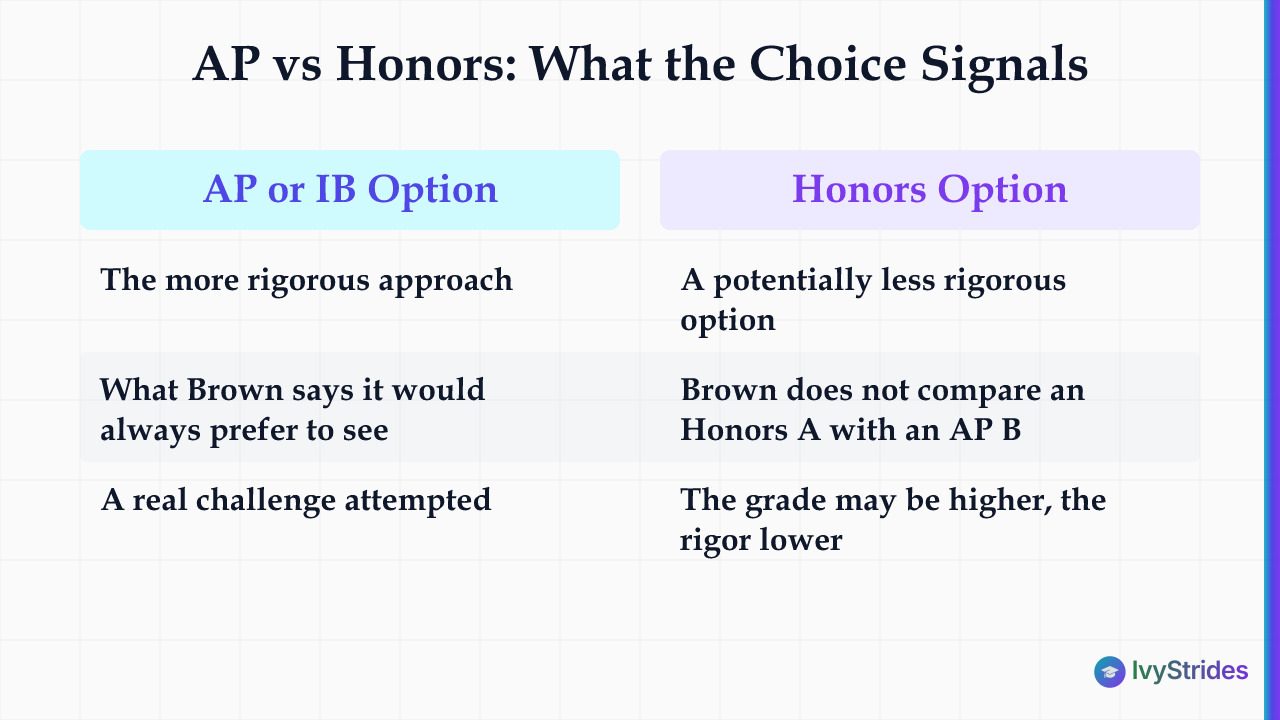
Brown University prefers the more rigorous course, which is often the AP. Its Preparing for Brown page states Brown would "always prefer to see that a student has opted for the more rigorous approach," which in many high schools means the AP or IB version of a course rather than a potentially less rigorous Honors or College Prep option. When both sit on your schedule, the AP sends the stronger signal.
Brown does not say how a B in an AP course compares with an A in Honors, only that it prefers the more rigorous approach. AP courses signal the intellectual ambition Brown's Open Curriculum is built for, and admissions officers read AP work as a marker of that ambition. The table shows how four common choices read to an officer.
| Scenario | Course Taken | Grade Earned | What the Choice Signals |
| A | AP Chemistry | B | Rigor chosen; a real challenge attempted |
| B | Honors Chemistry | A | Higher grade in a potentially less rigorous option |
| C | AP Chemistry | A | Strongest signal available |
| D | Standard Chemistry | A | Least rigor; weakest signal |
Breadth matters as much as depth. Brown expects at least four, preferably five, rigorous academic courses each year across English, math (through calculus when possible), lab sciences, history or social studies, and a world language. A transcript loaded with five APs in one subject but missing a world language reads as narrow, not ambitious.
Context protects students with few AP options. Brown does not rank high schools. It asks how well you used what your school offered, including outside learning when school courses ran out.
Check your course plan against the five-subject breadth expectation early, because a gap in world language or lab science in junior year is difficult to repair by application time.
What a Competitive Brown Transcript Looks Like in Practice

Photo by RDNE Stock project on Pexels
A competitive Brown University transcript shows four years of the most rigorous courses available, strong grades across all five academic subjects, and an upward or sustained trajectory. Brown rates class rank, where a school reports it, Very Important. Brown admitted 2,710 of 42,774 first-year applicants for fall 2025, an overall rate of about 6.3%, so the academic bar sits high.
Can you get in with a 3.5? Brown reads the full four-year pattern, not a single grade, so one B in a rigorous course rarely sinks a strong record. A 3.5 earned in the hardest courses your school offers reads very differently from a 3.5 in standard classes. Still, Brown calls high school performance and preparedness the most important consideration, so every other factor has to carry weight.
Recommendations do real work. Brown reads teacher letters for curiosity, problem-solving, openness to other viewpoints, spoken and written expression, and work ethic. Every applicant submits two teacher recommendations from major academic subjects, a counselor recommendation, and a school report. Letters that describe how you think strengthen a transcript officers read as a narrative.
Get your Daily IV Dose on Instagram: quick study tips and test-day advice for high school students. Follow @ivy.strides.
Senior year counts, before and after admission. Brown watches your senior-year load and reviews the senior-year grades of Early Decision and Regular Decision admits to make sure they continue at the same level. A lighter senior schedule carries real risk, so the grades colleges see after you apply still matter.
Use this checklist to audit your own file.
- Four to five rigorous academic courses each year across all five subjects
- The more rigorous AP or IB option wherever both were offered
- No dropped subject, especially world language or lab science
- An upward or sustained grade trajectory, not a junior-year dip
- Two teacher recommendations from major academic subjects
- A counselor who can speak to how you used your school's resources
- A senior schedule that holds its rigor through spring
Early Decision applicants face a tighter clock. Brown's CDS counts for fall 2025, 907 admitted from 5,062 ED applications, show an Early Decision admit rate nearly three times the overall rate.
Brown explains that higher rate by its stronger early pool, not an automatic advantage. Brown's Early Decision deadline is November 1, with testing completed by the last October test date. ED applicants have their counselor send first-quarter or trimester grades as soon as they are available, so senior-year work joins the Early Decision file Brown decides by mid-December. The Regular Decision deadline is January 5.
Brown GPA and SAT Requirements: Putting the Numbers Together for Fall 2027
Brown University requires the SAT or ACT for fall 2027 entry, a policy in force since the 2024-25 cycle. Brown reads scores and GPA together, each rated Very Important.
Brown publishes no score minimum and evaluates scores in context. The table lays out the policy at a glance.
| Factor | Brown's Policy | What It Means for Your Application |
| Test requirement | SAT or ACT required (fall 2027) | You must submit a score |
| Score minimum | None published | No automatic cutoff |
| Context | Weighed with background, school, test-center access | Your circumstances count |
| Superscore | Within SAT and within ACT | Best section scores combine |
| Score Choice | Accepted | You choose which dates to send |
| Below-average scores | Should not deter applicants | Brown's own guidance |
Scores are read against your circumstances. Brown weighs them in the context of educational background, socioeconomic status, home and school community, and test-center access. Brown also states that a score below its average ranges should not deter a student from applying.
Because Brown superscores within the SAT and within the ACT, your best section scores combine inside each test, never across them, and an SAT superscore still sits on the 400 to 1600 SAT scale. Knowing where your current score sits relative to what a competitive SAT score looks like at selective colleges is a concrete next step.
For families who want a plan built around Brown's course and testing expectations, IvyStrides' college counseling program sets out a month-by-month plan from the summer before 9th grade to the deposit deadline, covering the course map, testing, recommendations, the college list and essays. At Brown, the gap to close is almost never one number. It is the fit between your transcript, your scores, and the Open Curriculum story your file tells.
FAQ: Brown GPA and Test Score Questions
Can I get into Brown University with a 3.5 GPA?
Brown sets no minimum GPA and evaluates transcripts in context, so a 3.5 does not rule you out. Brown weighs course rigor, class rank, recommendations, essays, and test scores alongside grades. A 3.5 in the most rigorous courses your school offers reads differently from a 3.5 in standard classes.
Can I get into Brown with a 2.7 GPA?
Brown has no published minimum GPA and reviews every application in context. Yet Brown calls high school performance and preparedness the most important consideration in its process.
Can I get into Brown with a 1450 SAT?
A 1450 sits at the 95th percentile of SAT user-group scores, the actual scores of students who graduated in the past three school years. Brown evaluates scores in context alongside rigor, class rank, essays, and recommendations, with no published minimum. Brown states that a score below its average ranges should not deter a student from applying, so a 1450 with a rigorous transcript is a viable application.
Your Next Step on Brown's Transcript Expectations
Brown reads a transcript as a four-year story of intellectual ambition, not a GPA calculation. Rigor leads, grades and scores sit beside it, and context frames all of it.
- Choose the more rigorous AP or IB option wherever both are offered
- Hold all five academic subjects through senior year
- Confirm your SAT or ACT score is in a range Brown will read positively
- Line up two core-subject teacher recommendations early
- Send an SAT or ACT score, since Brown requires one for fall 2027 entry
Daily SAT and ACT prep on YouTube: short strategy videos from IvyStrides. Subscribe to IvyStrides on YouTube.

Rajesh is a technology leader, entrepreneur, and angel investor with 28+ years in Business & Technology Leadership and Product & Solution Engineering. He is passionate about education, mentoring, and driving digital transformation.