
Will One B Ruin a 4.0 GPA? GPA Impact, Recovery & What Colleges See
On this page
- How Much One B Actually Drops a 4.0 GPA: The Exact Math
- What Colleges Actually See When Your GPA Is No Longer a Perfect 4.0
- Will One B Ruin Your GPA in High School vs. College: Key Differences
- How to Strengthen Your Application When Your GPA Is No Longer a Perfect 4.0
- Your GPA Is Set. Your Test Score Is Not.
- FAQ: One B and Your 4.0 GPA
- What GPA is a B+ on 4.0 scale?
- What is 80% of a 4.0 GPA?
- What is my GPA if I have 1 B?
- Can I get a 4.0 GPA with one B?
- Your Next Step After One B
No, one B will not ruin a 4.0 GPA, but it will lower it. After 10 courses, one B drops an unweighted GPA to about 3.90. IvyStrides derives this figure from the inputs cited above. After 20 courses, it lands closer to 3.95. Selective colleges routinely admit students who sit just below a perfect 4.0.
A 4.0 GPA is the highest unweighted grade point average on the standard scale. Admissions readers weigh course rigor, grade trend, and test scores alongside the number itself, so the harder question isn't whether the B hurt you. It's which parts of your application you can still move before deadlines.
How Much One B Actually Drops a 4.0 GPA: The Exact Math
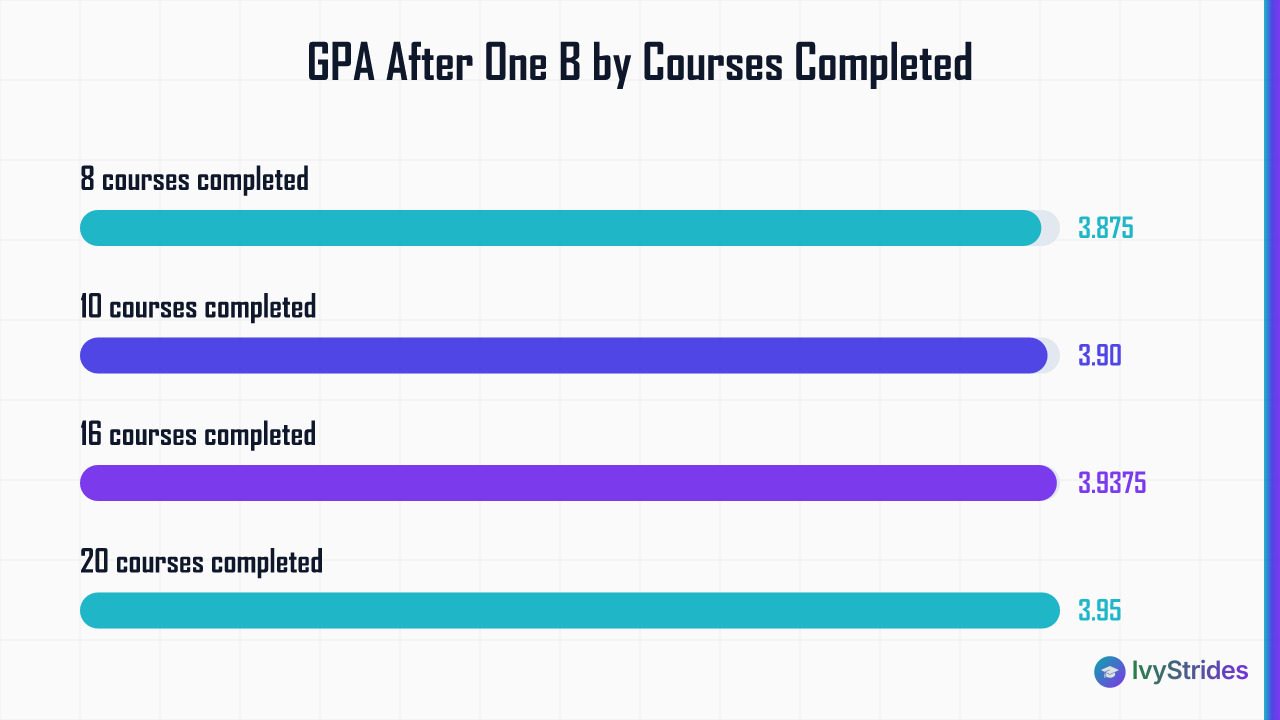
One B costs you one quality point in one course, and the credit-weighted average absorbs the rest. On the standard unweighted 4.0 scale, an A is worth 4.0 quality points and a B is worth 3.0. Your cumulative GPA averages every course's quality points, so the more courses you've finished, the less one B moves the needle.
Here's the formula IvyStrides applies at four common course counts, straight from the standard 4.0 scale.
| Courses Completed Before the B | GPA With All A's | GPA After One B | Drop |
| 8 | 4.0 | 3.875 (IvyStrides) | 0.125 |
| 10 | 4.0 | 3.90 (IvyStrides) | 0.10 |
| 16 | 4.0 | 3.9375 (IvyStrides) | 0.0625 |
| 20 | 4.0 | 3.95 (IvyStrides) | 0.05 |
The dilution effect is real. At 8 courses, one B pulls you to 3.875. At 20 courses, the same B leaves you at 3.95. Community threads on this exact question reach the same consensus: a single B lowers a high GPA, but the impact stays small and keeps shrinking as you add A's, per Reddit discussion on the topic.
Weighted GPA plays differently. Many high schools add 0.5 or 1.0 quality point for Honors and AP courses, so a B in an AP class may still count as a weighted 3.5 or 4.0 for that course. Check your school's specific policy, since weighted scales vary. If you're deciding how much rigor to load onto your schedule, our guide on how many AP classes for Ivy League applicants take gives the benchmark.
What Colleges Actually See When Your GPA Is No Longer a Perfect 4.0
Admissions readers see a 3.9x GPA as a strong number, not a flaw. Most highly selective colleges report middle-50% unweighted GPAs of 3.7 to 4.0 in their Common Data Sets, which means a 3.90 or 3.95 sits comfortably inside the admitted range at many schools. That same dilution math from the section above is why one B rarely pushes you out of the band.
Holistic review is the term for how selective colleges evaluate you: they read the GPA next to course rigor, grade trend, essays, and scores, not in isolation. Four factors modify how a reader interprets your number.
| Factor | What It Signals | How It Modifies the GPA Read |
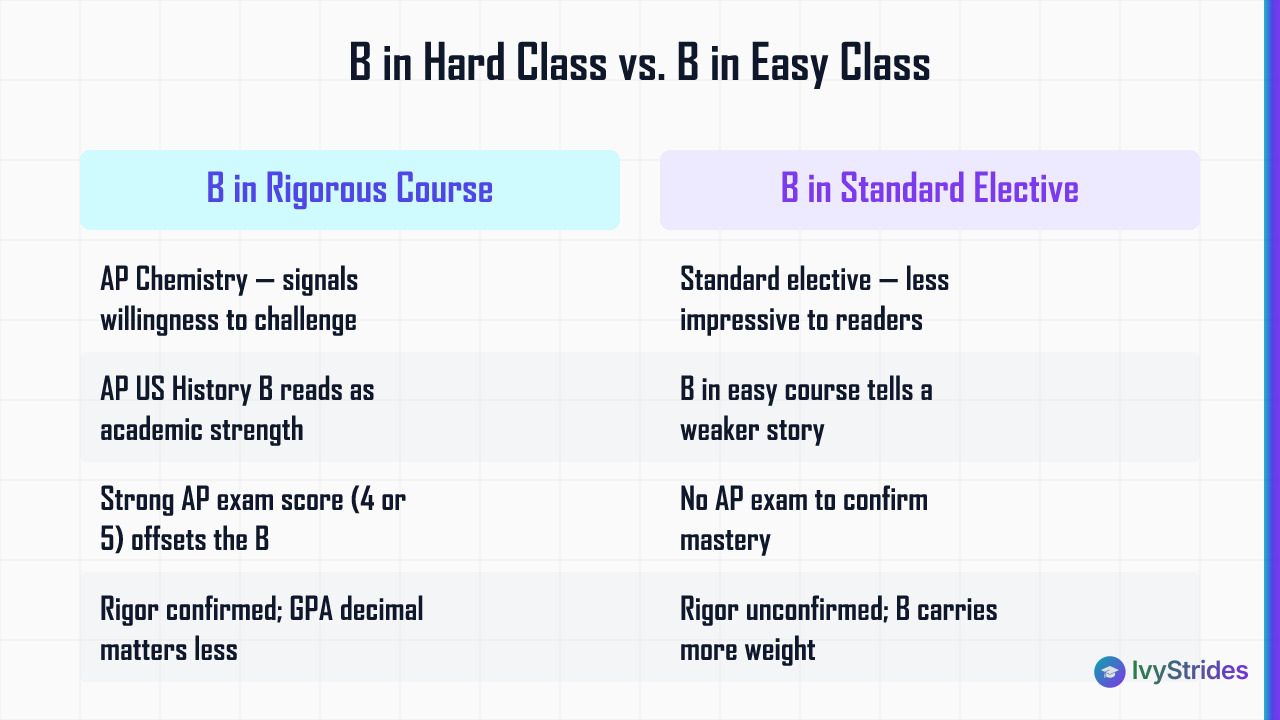
| Course rigor | Willingness to take hard classes | A B in AP Chemistry reads stronger than an A in an elective |
| Grade trend | Direction of your performance | An upward trend reassures readers |
| SAT/ACT score | Academic ability outside the classroom | A high score confirms the GPA |
| AP exam scores | Mastery of college-level material | A 4 or 5 offsets a single B |
Rigor beats the last decimal. Admissions readers we have worked with consistently note that course rigor matters more than the difference between a 3.90 and a 4.0. A B earned in AP US History tells a different story than a B in a standard elective, and readers know it.
If your GPA is no longer a perfect 4.0, a strong SAT or ACT score becomes a more important signal to admissions readers, because it confirms academic ability independent of the one grade that slipped. In our coaching with students at the 3.9x GPA band, a strong test score reinforces the academic-ability signal a near-perfect GPA already sends. To see what "strong" means by school tier, read what is a good SAT score.
Taking and performing well in AP courses signals the rigor that admissions officers weight alongside GPA, and a B in a standard course followed by strong AP exam scores can strengthen your academic narrative. We break the full picture down in does AP help with college admission.
One caveat, stated plainly. Test-optional policies vary by school and year, so verify each college's current status through FairTest before you decide whether to submit scores. And admissions outcomes depend on the full application, never on GPA alone.
Will One B Ruin Your GPA in High School vs. College: Key Differences
One B is easier to absorb in high school than in college, because you have more courses left to dilute it. In high school your cumulative GPA runs across roughly 30 to 40 courses over four years, so a single B early on gets averaged down toward zero impact. In college the GPA resets by semester, and graduate programs read it under a different lens entirely.
That same dilution effect, the one that shrinks the drop from 0.125 to 0.05 as courses stack up, is what makes recovery so achievable in high school. A sophomore who has finished 10 courses has 20 to 30 more ahead, and every A pulls the cumulative average back toward 4.0.
The recovery math is concrete. Take a junior with 24 courses completed sitting at 3.9375. If she earns straight A's in 8 remaining courses, IvyStrides calculates her cumulative GPA at (24 x 3.9375 + 8 x 4.0) / 32 = 3.953. The B never disappears, but the number moves back up.
College works differently. One B in a 15-credit semester of four other A's drops that semester GPA to about 3.87 on the standard three-credit-course assumption. Community responses on college GPA confirm the pattern: one B prevents a perfect 4.0 but generally won't ruin a high average, and it recovers as you earn more A's.
Use this checklist to steer the courses still in front of you:
- Earn A's in your remaining courses to pull the cumulative average up.
- Keep taking rigorous courses, since dropping down signals retreat.
- Track your grade trend so it reads as upward, not flat.
- Confirm whether your school weights AP and Honors grades.
- Map your remaining terms against your application deadlines.
- Build your testing plan alongside your course plan using our AP, SAT, and ACT testing plan for grades 9 to 12.
How to Strengthen Your Application When Your GPA Is No Longer a Perfect 4.0
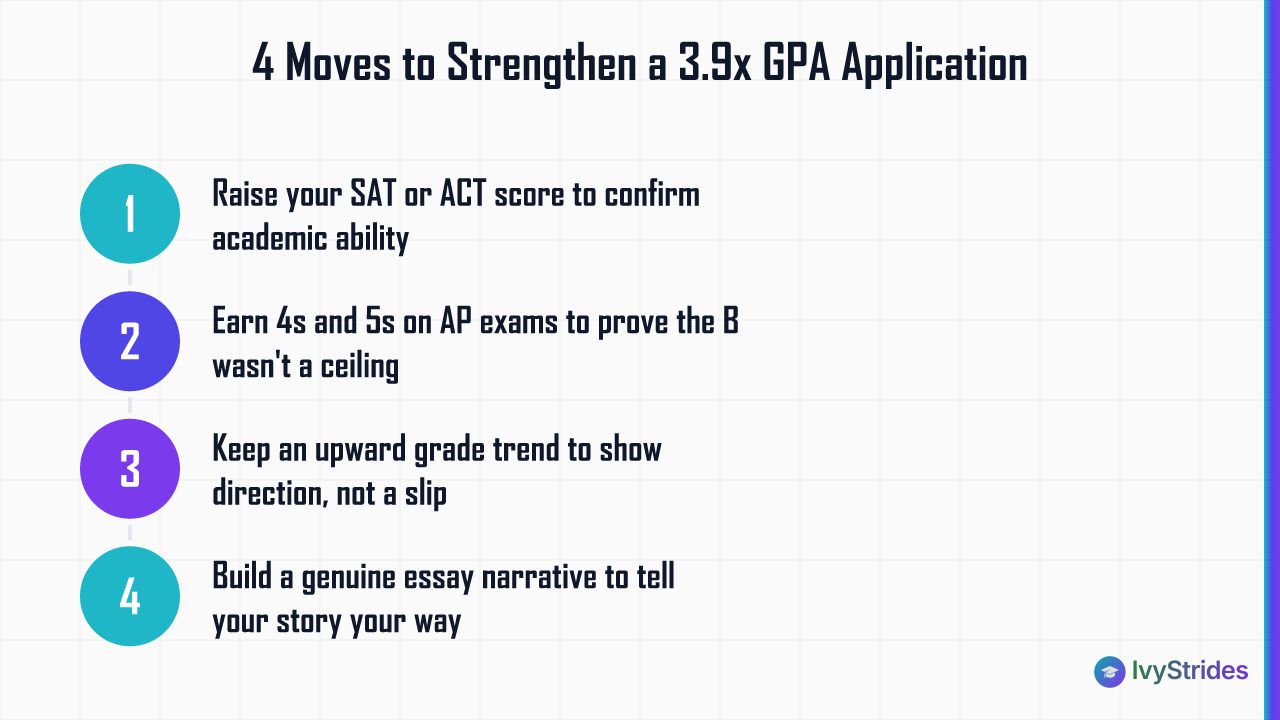
Your GPA is mostly set, but your test score, AP performance, and essay are not. These are the levers you can still pull, and they carry more weight now than the difference between a 3.90 and a 4.0. Four moves matter, in this order.
| Step | Action | Why It Matters |
| 1 | Raise your SAT or ACT score | Confirms ability independent of the B |
| 2 | Earn 4s and 5s on AP exams | Proves the B wasn't a ceiling |
| 3 | Keep an upward grade trend | Shows direction, not a slip |
| 4 | Build a genuine essay narrative | Tells your story on your terms |
Start with the test score. In our coaching with students at the 3.9x GPA band, an SAT score in the 1450 to 1550 range or an ACT composite of 32 to 35 reinforces the academic-ability signal a near-perfect GPA already sends. The methodology behind that gain lives in our guide to how to raise your SAT score 200 points.
Then the AP exams. AP scores of 4 or 5 in rigorous subjects like AP Calculus, AP Chemistry, or AP US History tell readers the B did not reflect a ceiling on your ability. Our approach to how to study for AP exams turns that into a study plan.
Then the essay. Your admissions essay is one place where the story behind a grade, a pivot, or a challenge can be told on your own terms, though it should never be a direct explanation of a single B. That's a common mistake we've watched backfire, so let the narrative speak for itself.
If you want a coach on that draft, our college essay coaching is the direct next step. We have seen students with a single B in sophomore year admitted to highly selective colleges when their AP scores, test scores, and essay narrative were strong. Admissions still depends on the full application, never on any single piece.
Your GPA Is Set. Your Test Score Is Not.
You have a 3.9x GPA, a college list, and a test date coming up. A free 15-minute call reviews your current score against your target schools' middle-50% ranges and maps the prep plan that closes the gap before your deadline.
FAQ: One B and Your 4.0 GPA
What GPA is a B+ on 4.0 scale?
A B+ is typically 3.3 on the standard 4.0 unweighted scale. One B+ in a 10-course record drops a 4.0 cumulative GPA to about 3.93. Some schools assign a 3.4 value for B+, so check your school's specific grading policy before you calculate.
What is 80% of a 4.0 GPA?
80% of 4.0 is 3.2, which corresponds roughly to a B average on the standard scale. Colleges rarely use this figure. They look at your actual GPA number and the courses behind it, not a percentage of the maximum.
What is my GPA if I have 1 B?
It depends on how many courses you've completed. With 10 courses total and one B, your unweighted GPA is 3.90. With 20 courses, it's 3.95. The table in the first section shows the exact figure for common course counts.
Can I get a 4.0 GPA with one B?
No, one B permanently prevents a perfect 4.0 cumulative unweighted GPA. But earning straight A's in every remaining course brings your average as close to 4.0 as the math allows, and a 3.95 or 3.97 is functionally identical to a 4.0 in most admissions contexts.
Your Next Step After One B
One B lowers your GPA by a small, shrinking amount and does not close the door on selective colleges. What matters now is where you point your energy.
- Find your exact GPA in the course-count table above.
- Confirm whether your school weights AP and Honors grades.
- Set a target SAT or ACT score against your college list's middle-50% ranges.
- Aim for 4s and 5s on the AP exams still ahead of you.
- Write an essay that shows who you are, not one that explains a grade.

Award-winning author (South Asian Book Award) and graduate of BITS Pilani and UCLA Luskin School of Public Affairs. Brings a published writer's eye to Common App essays and grammatical precision to SAT and ACT R&W instruction.