
What Is a Competitive SAT Score for College, Explained: Everything You Need to Know for 2026-27
On this page
- What a Competitive SAT Score Actually Means on the 400-1600 Scale
- What SAT Score Counts as Competitive by College Selectivity Tier
- What SAT Score Do You Need for Top Colleges and Ivy League Schools
- How to Set Your Personal Competitive SAT Score Target
- FAQ: Competitive SAT Scores for College
- What is a good score on the SAT test?
- Can I get into college with a 1080 SAT?
- Is 1350 SAT competitive?
- Is 1600 a perfect SAT score?
- Your Next Step on an SAT Target
A competitive SAT score depends on where you apply. The SAT is a digital exam scored on the 400 to 1600 scale. The class of 2025 averaged 1029. On College Board's user-group percentiles, a 1200 reaches the 75th percentile and a 1350 the 89th.
The average comes from the College Board 2025 SAT Suite Annual Report, and the percentiles come from College Board's user-group tables, which are based on the actual scores of students who graduated in the past three school years. The harder question isn't what counts as a strong number in the abstract. It's whether your number clears the bar at the specific schools on your list.

What a Competitive SAT Score Actually Means on the 400-1600 Scale
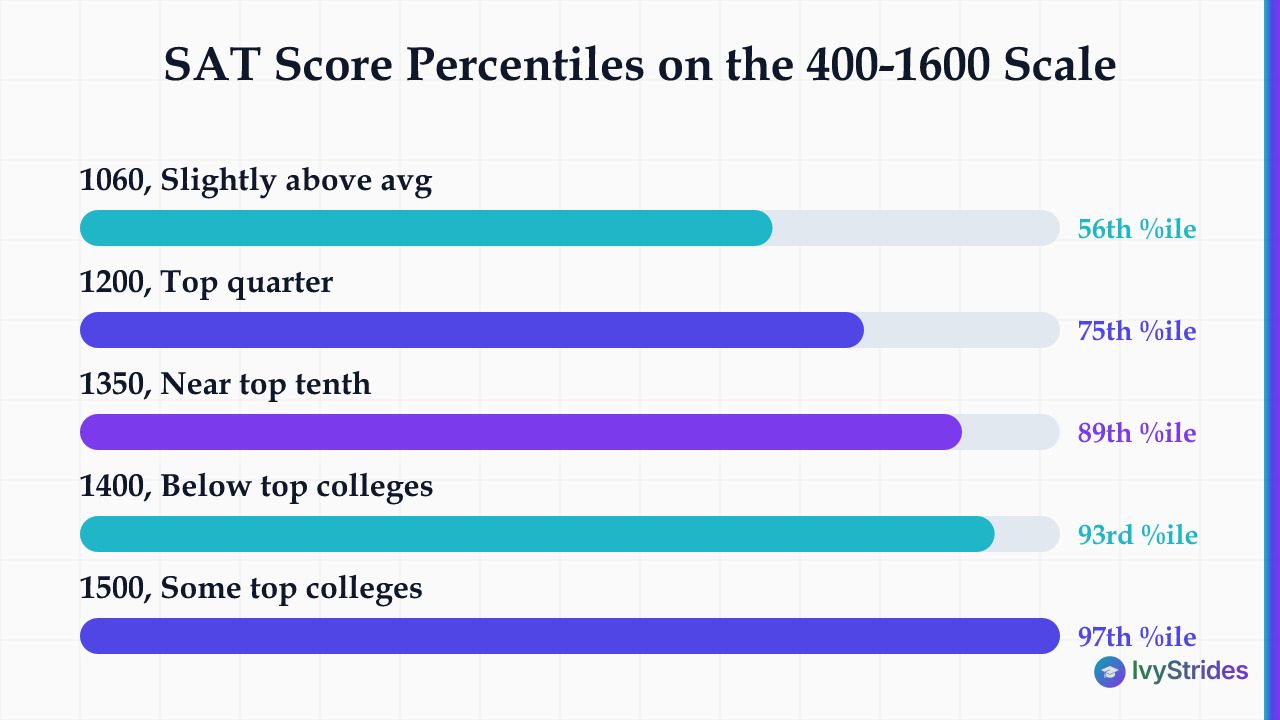
A competitive SAT score is one that meets or beats the typical scores of students who enroll at your target college. The SAT total score runs from 400 to 1600, built from two sections scored 200 to 800 each: Reading and Writing, and Math. "Competitive" is relative, not absolute. A score that is strong for a state flagship may sit well below the range at a top research university.
Start from the baseline. The national average SAT score for the class of 2025 is 1029 (College Board 2025 SAT Suite Annual Report). That is the mean of all test-takers, and it tells you where the middle of the pack sits before you look at any one school.
Percentiles do the real work. A percentile tells you what share of test-takers you scored at or above. The table below uses College Board's user-group percentiles.
| SAT Total Score | Percentile (User Group) | What It Signals |
| 1060 | 56th | Slightly above the national average |
| 1200 | 75th | Top quarter of test-takers |
| 1350 | 89th | Near the top tenth of test-takers |
| 1400 | 93rd | Still below every top-college range in the table further down |
| 1500 | 97th | Inside the range at some top colleges, below it at others |
Source: College Board SAT percentile tables (user group).
One more reference point matters. The College and Career Readiness benchmark for the Reading and Writing section is 480 (College Board score guide). That is not a competitiveness bar, it is College Board's floor for college readiness. Clearing it says you are ready for first-year coursework, not that you are competitive for a selective school. Those are two different questions, and students conflate them constantly. The mechanics behind how your raw answers become that scaled total explain why your Module 1 performance decides which second module you get, which matters once you start comparing section scores to a school's range.
What SAT Score Counts as Competitive by College Selectivity Tier
A competitive SAT score shifts by selectivity tier, so the number you need at a regional university is not the number you need at a top-10 school. The score that signals college readiness, anchored by that 480 Reading and Writing benchmark, is not the same as the score that puts you inside a selective school's applicant pool. Each college publishes its own middle-50% score range, the band between the 25th and 75th percentile of enrolled first-year students who sent an SAT.
Read the middle-50%, not a single cutoff. You find it in each college's Common Data Set and in federal NCES College Navigator data, and it shifts year to year.
Ranges rise with selectivity, but no single number defines a tier. Open-admission colleges, including most community colleges, set no SAT bar. At the top colleges in the next section, the 25th percentile of enrolled students who sent an SAT runs from 1440 to 1520, and the 75th percentile from 1550 to 1570 (Common Data Set 2025-26). Most four-year colleges fall somewhere between, so the only reliable bar is each school's own published range.
| Reference Point | SAT Score | What It Tells You |
| Open-admission colleges | No SAT bar | Admission does not depend on a score |
| Reading and Writing readiness benchmark | 480 (section score) | College Board's floor for first-year readiness, not a competitiveness bar |
| National mean, class of 2025 | 1029 | The middle of all test-takers |
| Top-college 25th percentile | 1440 to 1520 | The low end of the middle-50% at the top colleges below |
| Top-college 75th percentile | 1550 to 1570 | The high end of the middle-50% at the same colleges |
Scores can matter for merit aid too, and thresholds vary by school, because how SAT scores interact with merit scholarship awards depends on each school's own aid formula.
Test-optional does not erase the value of a score. Test-optional policies vary by school and year, so confirm each one on the college's own admissions page; a strong score still helps at a school that does not require one. A score below the middle-50% range is the hardest call, which is why submitting a borderline SAT score helps at some test-optional schools and hurts at others depending on the rest of your application.
Get your Daily IV Dose on Instagram: quick study tips and test-day advice for high school students. Follow @ivy.strides.
What SAT Score Do You Need for Top Colleges and Ivy League Schools
At the top colleges in the table below, SAT middle-50% ranges run from 1440 at the low end to 1570 at the high end. A 1500 sits at the 97th user-group percentile (College Board), yet it falls below the 25th percentile at MIT, Stanford and Columbia. But a score alone does not get anyone admitted.
Scores are necessary, not sufficient. A competitive SAT score is one part of your application, weighed alongside your GPA, extracurricular activities and personal essay (College Board BigFuture). A 1540 sits inside the range at every school in the table below, yet it never guarantees a seat. Admissions outcomes depend on the full application, not the test score.
| School | SAT Middle-50% Range | Test-Optional Status (fall 2027 entry) |
| MIT | 1520-1570 | Requires scores |
| Stanford | 1520-1570 | Requires scores |
| Yale | 1480-1560 | Requires scores |
| Columbia | 1510-1560 | Test-optional (scores required from fall 2028 entry) |
| Princeton | 1490-1560 | Test-optional (scores required from fall 2028 entry) |
| Dartmouth | 1440-1550 | Requires scores |
| Brown | 1470-1550 | Requires scores |
Ranges from each school's Common Data Set 2025-26 (first-years enrolled in fall 2025 who sent an SAT); policies from each college's admissions site for fall 2027 entry. Confirm both before you apply, because they change each year.
Rigorous coursework reinforces a strong score, and how many AP classes Ivy League applicants typically take tracks closely with what a competitive profile looks like at these schools. A 1540 sits inside every range above, yet students still ask whether a 1540 clears the bar at Harvard, Yale, and Princeton specifically, where the answer turns on the rest of the application. Test-optional policies vary by school and year, so check each college's current policy before deciding whether to submit a score that falls below its middle-50% range.
How to Set Your Personal Competitive SAT Score Target
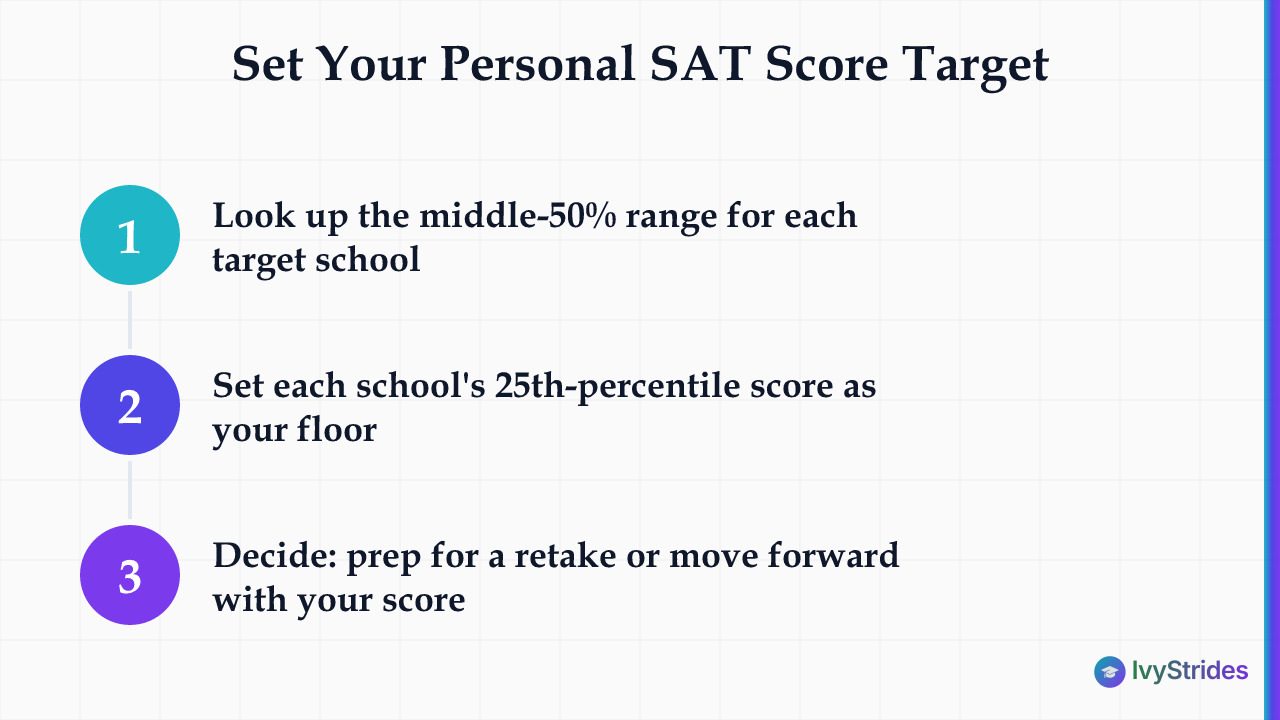
Your personal competitive SAT target is the 25th-percentile score at the most selective school on your list, because clearing that floor puts you at or above the floor at every less selective school on your list. That turns the tier ranges above into a single number you can aim for. Here is the three-step process.
-
Look it up. Pull the middle-50% range for each target school from NCES College Navigator or the school's own Common Data Set.
-
Compare to the 25th percentile. Set each school's 25th-percentile figure as your practical floor. Clear it and your score is in range; fall below and you are stretching.
-
Decide: prep or submit. If your current score clears your floors, move forward. If it sits below, weigh a retake against your timeline.
Superscoring changes the retake math. Many colleges superscore, combining your best Reading and Writing and best Math across sittings into one total. If your sections peaked on different dates, a retake targeting only your weaker section can lift your superscore without risking the stronger one. Whether a college superscores is its own decision, so confirm it.
A retake that chases points you do not need costs time you could spend on essays. When a retake does make sense, 1-on-1 SAT prep that targets the gap between your current score and your floors starts with a diagnostic test and a custom study roadmap. IvyStrides' SAT 1-on-1 program runs 28 live 1-on-1 sessions and 10 Bluebook-style adaptive mocks, each followed by a tutor review.
If your current score falls below a school's middle-50% range, build the retake around your weaker section. Scores arrive 2 to 4 weeks after test day (College Board), so count backward from your application deadlines when you pick a date. Percentile gains are uneven across the scale, so the full percentile breakdown across the 400-1600 scale helps you judge what a retake target is worth.
FAQ: Competitive SAT Scores for College
What is a good score on the SAT test?
A good SAT score meets or exceeds the 25th percentile of your target schools. The national average is 1029, and a 1200 sits at the 75th user-group percentile. Beyond that, a good score depends on each school's published middle-50% range.
Can I get into college with a 1080 SAT?
Yes. A 1080 sits above the national average of 1029, at the 59th user-group percentile, and open-admission colleges set no SAT bar. At other colleges, compare it with the 25th-75th percentile band in each school's Common Data Set; if it falls below the 25th percentile at your targets, a retake is worth considering.
Is 1350 SAT competitive?
A 1350 places you at the 89th user-group percentile, ahead of most test-takers. It falls below the middle-50% range at every school in the top-colleges table above, where the 25th percentile runs from 1440 to 1520. At colleges whose ranges include 1350, it is a score worth submitting.
Is 1600 a perfect SAT score?
Yes. The SAT uses a 400-1600 scale, and 1600 is the highest possible total, requiring an 800 on both the Reading and Writing section and the Math section. It places a student in the 99+ user-group percentile. Only a small fraction of test-takers reach the top of the scale in any given year.
Your Next Step on an SAT Target
A competitive SAT score is not one number. It is the floor you need at the most selective school you actually want, and you can find that floor today.
- Pull the middle-50% range for each target school from NCES College Navigator or its Common Data Set.
- Set each school's 25th-percentile score as your personal floor.
- Compare your current score to those floors, and if it falls short, pick a test date that leaves 2 to 4 weeks for scores before your deadlines.
- Confirm each school's test-optional policy and whether it superscores, since both shift year to year.
Daily SAT and ACT prep on YouTube: short strategy videos from IvyStrides. Subscribe to IvyStrides on YouTube.

Hemant is a seasoned entrepreneur, investor, and growth strategist with deep ground in education and technology-driven learning. His core training is in Mathematics and Physics — he authored Physics for IB Diploma: Ultimate Revision Guide, recognized as a top student resource.