
AP Tutoring or an Online AP Course: What a Falling Grade Needs
On this page
- AP Tutoring vs. an Online AP Course: What Each Format Actually Gives You
- Which AP Subjects Need a Tutor and Which Tolerate a Course
- What the 2027 AP Exam Format Means for Your Tutoring or Course Choice
- How to Choose an AP Tutoring Provider or Online AP Course: A 5-Point Checklist
- FAQ: AP Tutoring and Online AP Courses
- What do you do in tutoring for AP?
- Can I self-study AP Calculus BC?
- What are the benefits of one-on-one AP tutoring versus a group course?
- Is free AP prep enough to score a 5?
- Your Next Step on the AP Format Choice
AP tutoring is live, one-on-one instruction with a tutor who knows your subject and catches your weak units in real time. An online AP course delivers structured, exam-aligned coverage of every unit. If your grade is falling because of specific weak topics, tutoring targets those gaps directly.
Those definitions come from how each format handles a gap, and the stakes are fixed: a score of 3 or higher on an exam scored 1 to 5, since College Board labels a 3 "qualified" and each college sets its own credit policy. The harder question is which format matches your subject and the weeks you have left before the 2027 May exam window.
AP Tutoring vs. an Online AP Course: What Each Format Actually Gives You
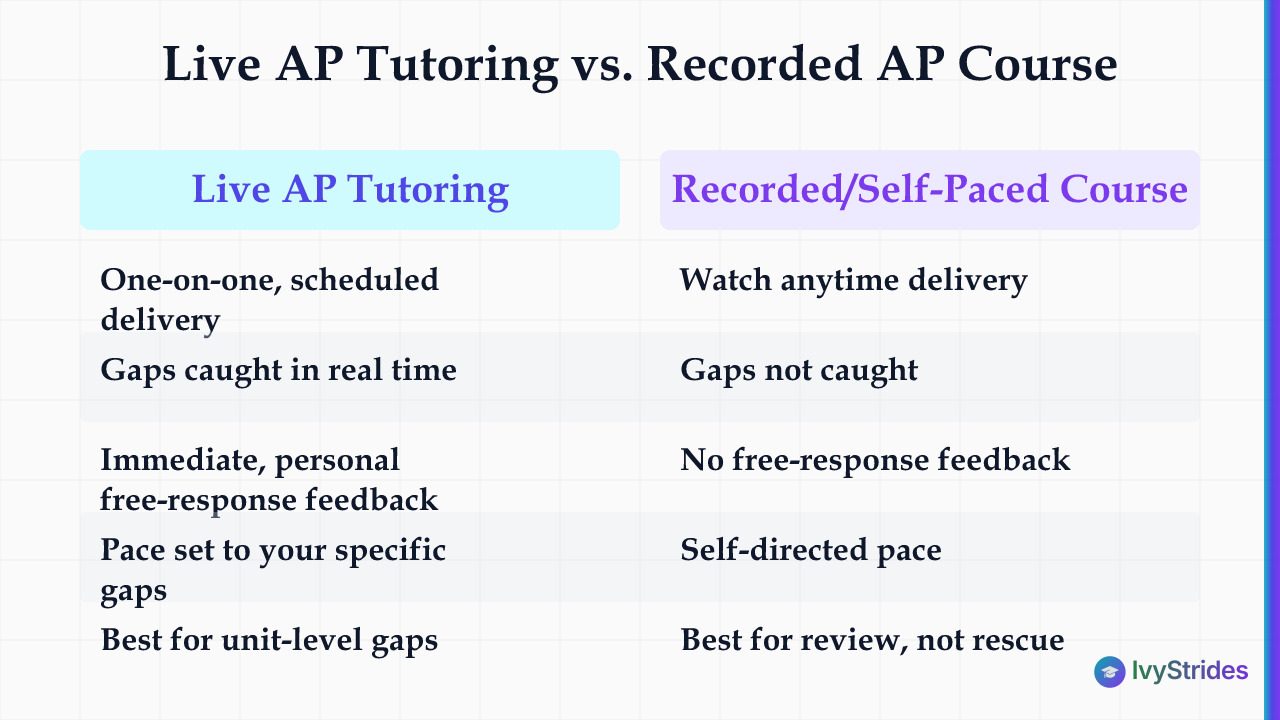
AP tutoring is live, one-on-one instruction where a tutor who knows the subject works through the exact units costing you points. An online AP course is a structured curriculum, delivered live or as recorded video, that covers every unit on a fixed schedule. The split that matters is live versus recorded: live instruction catches a free-response error the moment you make it, and recorded video cannot.
What "qualified" means for college credit. The AP exam score scale runs 1 to 5. College Board describes a 3 as "qualified," equivalent to a college grade of B-, C+, or C, and a 2 as "possibly qualified" with no college grade equivalent, per College Board.
A 4 is "very well qualified" (A-, B+, or B) and a 5 "extremely well qualified" (A+ or A). The jump from a 2 to a 3 is the one that can unlock credit, depending on the college. That's why the format choice matters: whether your grade is a few weak units or a coverage collapse changes which format reaches a 3.
The format you pick depends partly on how conceptually demanding your subject is, and the hardest AP classes to pass without a teacher are where live help matters most. And whether a 3 earns anything depends on whether online AP courses count toward college credit at your target schools. Credit policies vary by institution, so a 3 does not guarantee credit everywhere.
| Feature | Live AP Tutoring | Live Online AP Course | Recorded/Self-Paced Course |
| Delivery | One-on-one, scheduled | Group, fixed schedule | Watch anytime |
| Gaps caught | Real time | Real time, in group | Not caught |
| Free-response feedback | Immediate, personal | Delayed or group-level | None |
| Pace | Set to your gaps | Full curriculum | Self-directed |
| Best for | Unit-level gaps | Missed large portions | Review, not rescue |
| Subject expertise | Ask the tutor | Ask who teaches | Varies |
One practice note. Before choosing either format, review your most recent unit test to tell whether the problem is a single weak topic or a coverage gap across several units. Those two situations call for different interventions, and recorded video answers neither well.
Which AP Subjects Need a Tutor and Which Tolerate a Course

Photo by RDNE Stock project on Pexels
Some AP subjects need a teacher; others tolerate self-study or a structured course. Whether tutoring or a course is the right call depends partly on whether your subject is one where self-directed study can realistically close a gap before May, or one where a teacher is the only reliable path to a 3.
High conceptual load needs a live person. AP Calculus BC, AP Chemistry, and AP Biology build each unit on the one before it. A gap in limits sinks the series chapter; a shaky grasp of stoichiometry wrecks equilibrium.
Recorded video gives no feedback, so a free-response error made in one unit can carry into the next without anyone correcting it. These are where AP calculus tutoring, AP chemistry tutoring, and AP biology tutoring with a teacher who knows the subject earn their place.
Lower conceptual stacking tolerates a course. AP Psychology, AP Statistics, AP Human Geography, and AP Environmental Science reward disciplined vocabulary and concept review more than real-time problem repair. A structured plan or a live course is often enough here, without one-on-one tutoring.
| AP Subject | Recommended Format | Why |
| AP Calculus BC | Tutoring | Units stack; notation precision needed |
| AP Chemistry | Tutoring | Quantitative gaps compound fast |
| AP Biology | Tutoring or live course | Heavy content, free-response depth |
| AP Statistics | Live course | Structured review works for many |
| AP Psychology | Self-study or course | Vocabulary and concept recall |
| AP Human Geography | Self-study or course | Low conceptual stacking |
| AP Environmental Science | Self-study or course | Fact and case-study heavy |
For high-load subjects, the deciding factor is feedback on free-response structure, unit by unit. Students whose school does not offer the subject face the same choice when taking AP classes online without a school AP program.
What the 2027 AP Exam Format Means for Your Tutoring or Course Choice
The 2027 AP Exams run over two weeks in May: Week 1 is May 3 to 7 and Week 2 is May 10 to 14, per College Board, and late testing runs May 17 to 21 on the 2027 late-testing schedule. That same two-week structure is the fixed deadline every format choice has to beat. Morning exams begin at 8 a.m. local time and afternoon exams at 12 p.m. local time.
Bluebook changes what you practice. College Board says most AP Exams will be delivered as either fully digital or hybrid digital exams through Bluebook, its testing app. Whatever format you pick, tutoring or a course, it has to run timed free-response practice in conditions that mirror the real thing, not untimed problem sets.
With the main window running May 3 to 14 and late testing closing May 21, the weeks between now and exam day are the only variable a student can still control. How many weeks turn a falling grade around depends on your starting point and your subject; a single weak unit is faster to repair than three missed ones, and no honest coach promises a number.
Get your Daily IV Dose on Instagram: quick study tips and test-day advice for high school students. Follow @ivy.strides.
Your school's exam order deadlines and the exam window together set the clock, which is why AP exam registration deadlines and 2027 test dates matter before you commit to a format.
Here's what any tutor or course has to cover before May:
-
The specific units where your grade is bleeding points, named from your last unit test.
-
Timed multiple-choice sets in Bluebook conditions.
-
Free-response practice scored against the current rubric for your subject.
-
The full content domains still untested this year, if any remain.
-
A realistic week-by-week plan anchored to your exam date.
-
At least one full timed section before exam day.
How to Choose an AP Tutoring Provider or Online AP Course: A 5-Point Checklist
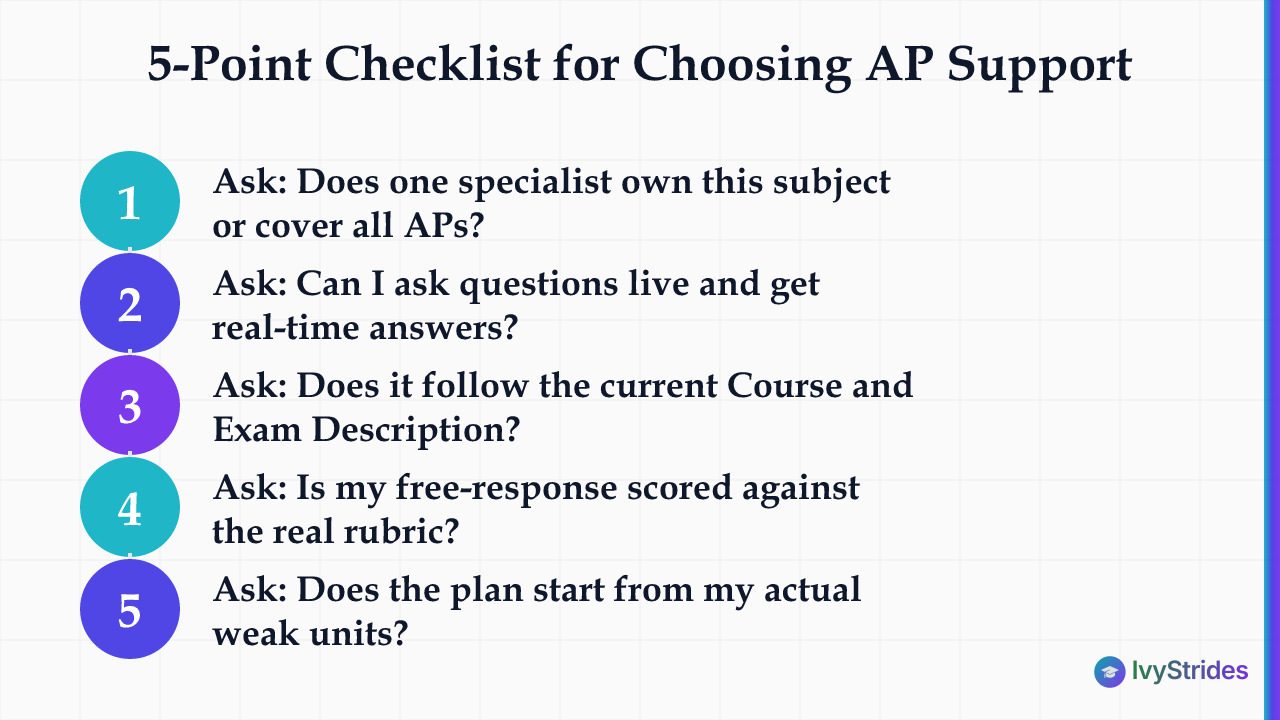
The right AP tutoring provider or online AP course follows the AP Course and Exam Description for your subject, assigns a specialist in that subject, and practices free-response under exam conditions. The timed free-response practice from the last section is the easiest piece to leave out, so make it the first question you ask.
Subject expertise is the dividing line. In high-load subjects, a teacher who doesn't fully understand a free-response error can't repair it, so ask who teaches the course before you enroll. For AP Chemistry, AP Calculus BC, or AP Biology, IvyStrides' live online AP courses with hand-graded free-response review meet two sessions a week, 1.5 hours each, in a small cohort with a tutor. Tutors hand-grade free-response answers with written feedback, session recordings go into the student portal, and full-length practice exams are calibrated to the 2027 exam.
| Criterion | What to Ask |
| Per-subject specialist | Does one teacher own this subject, or cover all APs? |
| Live vs. recorded | Can I ask a question mid-session and get an answer? |
| Exam-aligned curriculum | Does it follow the current Course and Exam Description? |
| Free-response practice | Is my writing scored against the real rubric? |
| Diagnostic-first plan | Does it start from my actual weak units? |
Ask every option the same five questions so that choosing an online AP course provider rests on answers you can compare. Your choice also depends on load: a student managing five APs needs different support from one repairing a single grade, and selective colleges read your AP course load against what your school offers. AP tutoring online is one piece of a connected plan, and AP scores alone don't decide admissions; the full application does.
FAQ: AP Tutoring and Online AP Courses
What do you do in tutoring for AP?
In AP tutoring, a tutor in your subject reviews your most recent unit test or practice exam, finds the question types you keep missing, and works through those gaps with targeted practice. Sessions cover both multiple-choice strategy and free-response structure for your subject's exam format. The point is real-time correction, not another lecture.
Can I self-study AP Calculus BC?
Self-studying AP Calculus BC is possible but difficult. The course covers limits, derivatives, integrals, series, and parametric equations, and the free-response section demands precise notation. Alone, unit-level gaps can compound quickly, because each topic leans on the last. A live course or one-on-one AP calculus tutoring adds the free-response feedback that self-study lacks.
What are the benefits of one-on-one AP tutoring versus a group course?
One-on-one AP tutoring targets the exact units where you're losing points, sets the pace to your understanding, and gives immediate feedback on free-response answers. A group course covers the full curriculum on a fixed schedule, which fits better when you've missed large portions of the course rather than specific topics. The honest test is coverage gap versus unit-level gap.
Is free AP prep enough to score a 5?
Free AP prep resources cover the curriculum and offer practice questions, but they don't give personal feedback on your free-response writing unless a teacher scores it. For a student targeting a 4 or 5 in a high-difficulty subject such as AP Chemistry, that feedback is the piece to add. They're a supplement, not the plan.
Your Next Step on the AP Format Choice
The decision comes down to one honest reading of your grade: is it a few weak units, or a stretch of the course you've lost? Name that first, then match it to your subject and the weeks you have left before May.
- Pull up your last unit test and mark whether the problem is one topic or many.
- Check whether your subject sits in the tutor column or the self-study column above.
- Count the weeks to your 2027 exam date (May 3 to 14, late testing May 17 to 21).
- If it's a unit-level gap in a high-load subject, line up a tutor in that subject before your next unit test.
Daily SAT and ACT prep on YouTube: short strategy videos from IvyStrides. Subscribe to IvyStrides on YouTube.

Hemant is a seasoned entrepreneur, investor, and growth strategist with deep ground in education and technology-driven learning. His core training is in Mathematics and Physics — he authored Physics for IB Diploma: Ultimate Revision Guide, recognized as a top student resource.