
Does Senior Year GPA Matter? What Colleges See and When They See It
On this page
- What Colleges Actually Do With Your Senior Year Grades
- Which Senior Year Grade Drops Actually Put Your Acceptance at Risk
- Not Sure Whether Your Grade Situation Is a Real Risk or a Minor Dip?
- Does Second Semester Senior Year GPA Still Matter After Acceptance?
- What to Do If Your Senior Year Grades Have Already Slipped
- Response Plan in Hand. Find Out Which Step Matters Most for Your Situation.
- FAQ: Senior Year GPA and College Admissions
- Will one B ruin a 4.0 GPA?
- How much do senior year grades matter for Early Decision applicants?
- Do second semester senior grades matter after being accepted?
- Does 12th grade GPA matter for college admissions if the school is test-optional?
- Your Next Step on Senior Year Grades
Yes, senior year GPA matters. Senior year GPA is the grade record colleges review at two checkpoints, the mid-year report and the final transcript, before confirming enrollment. A significant drop, especially a pattern of Ds or Fs, can trigger a rescission.
Those checkpoints are not informal. Common App routes the mid-year report through your counselor, and your final transcript goes to your college after graduation. The harder question is where the line sits between a dip that gets ignored and a decline that puts your offer at risk, and the sections below settle it.

What Colleges Actually Do With Your Senior Year Grades
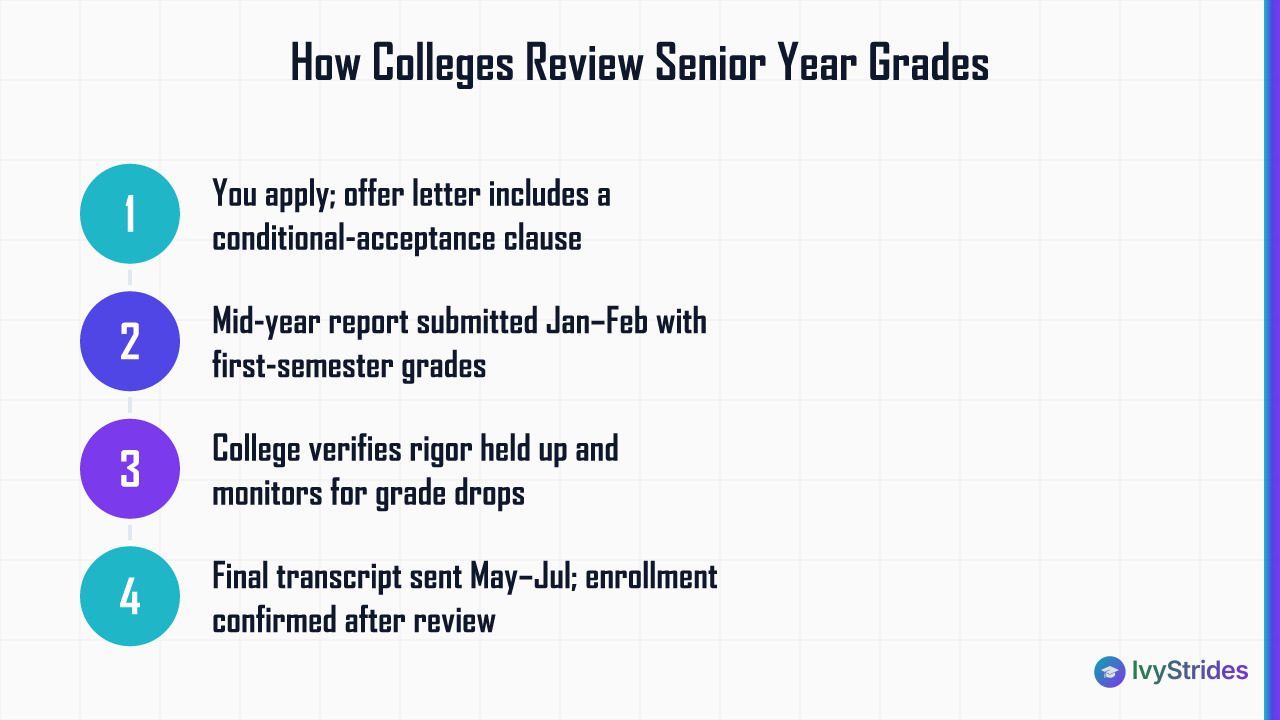
Colleges review senior year grades at two formal checkpoints: the mid-year report covering first-semester grades, and the final transcript covering the full year. Both feed a conditional-acceptance clause that most selective colleges write into their offer letters. Your admission stays contingent on the grades you keep earning after you apply.
The mid-year report comes first. Your school counselor submits it, typically January to February, and it carries your first-semester or first-trimester senior grades. Per Common App, most selective colleges require this report for regular-decision applicants. Colleges use it to verify that the rigor they saw on your application held up. So yes, first semester counts, and does first semester senior year count towards GPA is one of the most common questions regular-decision students underestimate.
The final transcript comes last. Your school sends it after graduation, usually May to July, and this is the document a college uses to confirm your spot. Enrollment isn't truly locked until the college receives and reviews it. A significant grade drop here is the most common thing that triggers a second look.
Early Decision and Early Action applicants get their answer in December, before any senior grades exist. The final-transcript review still applies to them. An ED admit who coasts to Cs and Ds in the spring faces the same review as anyone else. For a full picture of how admissions offices evaluate your entire transcript, from freshman year through senior fall, see our guide on how colleges read your transcript.
The mid-year report deadline falls inside the same January-to-February window as many regular-decision notifications, so knowing your full college application deadlines for fall 2026 helps you plan both. That window sits roughly 6 to 8 weeks after most semester-calendar schools finalize first-semester grades.
| Checkpoint | What It Covers | Typical Timing | Who It Affects |
| Mid-year report | First-semester senior grades | January to February | Regular-decision applicants |
| Final transcript | Full senior year, all four years | May to July | Every admitted student |
| Waitlist update | Updated senior grades on request | Spring | Waitlisted students |
One more note for waitlisted students: strong updated senior grades can strengthen your case. In our coaching, we have seen students on waitlists move by submitting a strong second-semester report with a brief counselor update.
Which Senior Year Grade Drops Actually Put Your Acceptance at Risk
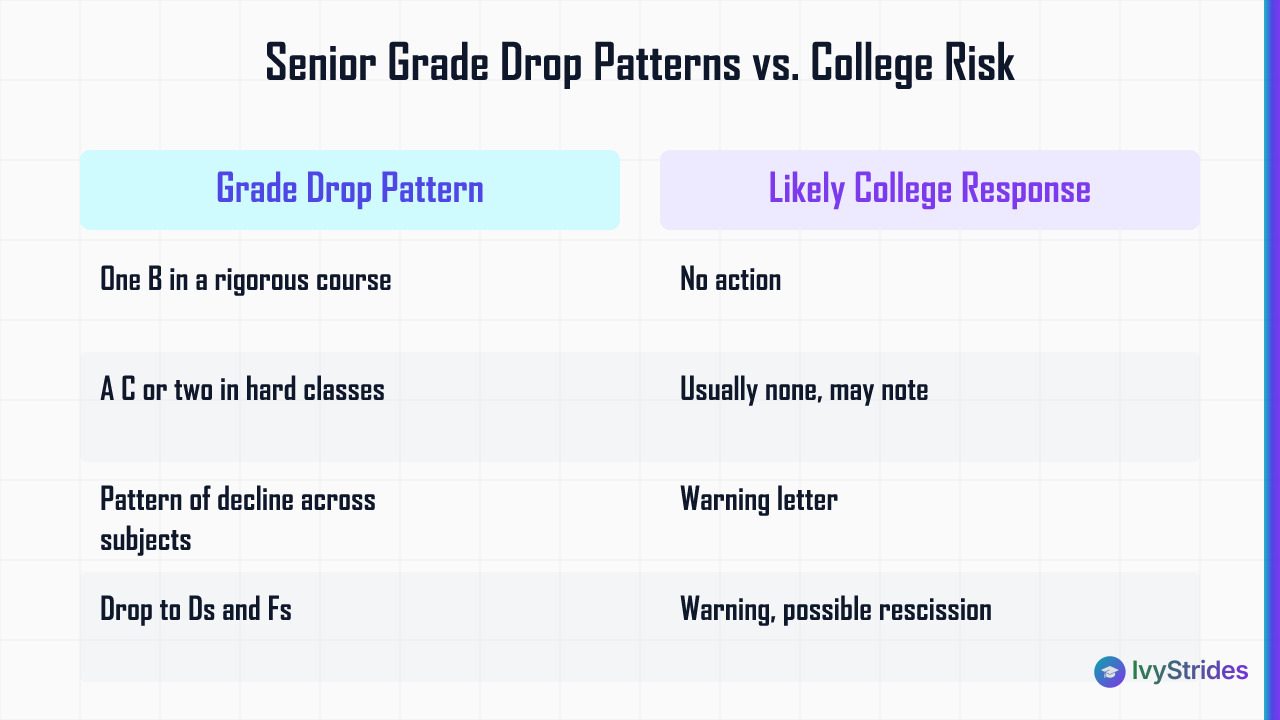
A senior year grade drop puts your acceptance at risk when it becomes a pattern of decline or falls to the D and F range across multiple courses. A single B in a rigorous class is almost never the problem. Rescission, the formal withdrawal of an acceptance offer, is real but uncommon, and colleges generally warn you before they act.
Rescission rarely comes without notice. Per Bold.org, colleges typically send a warning letter before rescinding, and the clearest trigger they cite is a drop from As to Ds or Fs. That warning letter is your window to explain and recover. Silence on your end is what turns a warning into a rescission.
Because that threshold is about pattern and severity, a slightly lower grade in one hard course reads very differently from a slide across your schedule. Admissions offices distinguish a single B in AP Calculus from four grades falling two letters each. The first is normal variance. The second is senioritis, a decline pattern admissions offices watch for. On the r/ApplyingToCollege community, the consensus holds: a lighter senior course load is generally acceptable, but bad senior year grades across the board are not.
AP courses carry extra weight. Senior-year AP grades matter because they are the most recent signal of college-level readiness admissions offices have. A common pattern we observe: a student drops one AP mid-year without telling their admissions contact, and that silence raises more concern than the grade would have. For more on how AP performance reads to admissions, see whether AP helps with college admission.
| Grade Drop Pattern | Risk Level | Likely College Response |
| One B in a rigorous course | Low | No action |
| A C or two in hard classes | Low to moderate | Usually none, may note |
| Pattern of decline across subjects | Moderate to high | Warning letter |
| Drop to Ds and Fs | High | Warning, possible rescission |
Remember: rescission decisions are institution-specific and holistic. No single GPA number guarantees or prevents one.
Not Sure Whether Your Grade Situation Is a Real Risk or a Minor Dip?
You have the risk thresholds and the pattern descriptions. Knowing whether your specific grade history is safe at each target school, and whether a proactive conversation with admissions makes sense, takes a focused review. A free 15-minute call looks at your current transcript, maps it against your target colleges, and tells you the next concrete step.
Does Second Semester Senior Year GPA Still Matter After Acceptance?
Second semester senior year GPA still matters after acceptance, because the final transcript covers the full year, including that spring. The conditional-acceptance clause runs through enrollment, not just through the initial decision. Do senior year grades matter after being accepted to college? Yes, and treating spring as a free pass is the misconception that puts the most students at real rescission risk.
Because the final transcript is what confirms enrollment, your spring grades reach the college whether you want them to or not. Your school sends that document after graduation, and the college reviews it before your spot is locked. A sharp second-semester decline, especially into the D and F range, can trigger a warning letter or, in rare cases, a rescission, the same threshold that applies to first semester.
Waitlist and scholarship stakes. Waitlisted students who submit strong second-semester grades can strengthen their case, so spring effort isn't just defensive. Some merit scholarships carry their own minimum GPA floors that apply through enrollment, and a spring drop can affect aid. Those floors vary by institution, so verify the exact number with each college and scholarship program.
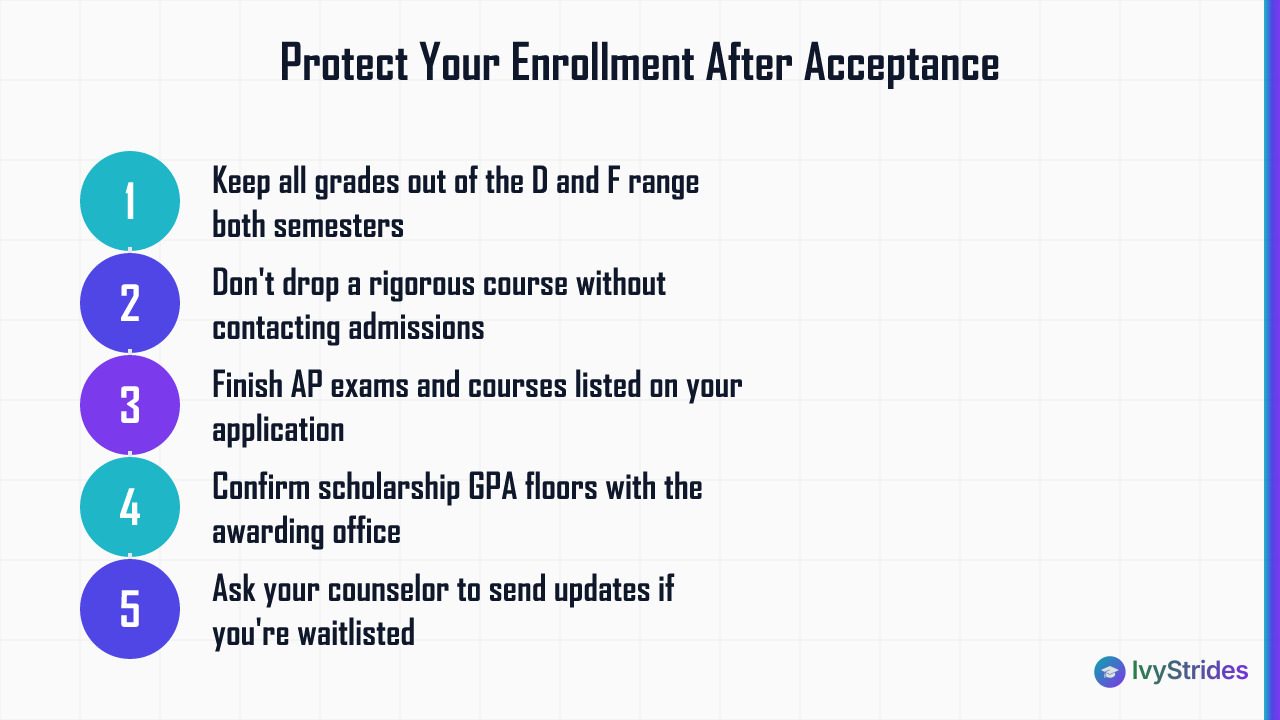
Here is what to protect before your enrollment is confirmed.
- Keep every course grade out of the D and F range, first and second semester.
- Don't drop a rigorous course, especially an AP, without telling your admissions contact.
- Finish the AP exams and courses you listed on your application.
- Confirm any scholarship GPA floor directly with the awarding office.
- Ask your counselor to send updated grades if you are on a waitlist.
What to Do If Your Senior Year Grades Have Already Slipped
If your senior year grades have already slipped, the single most useful move is proactive communication with the admissions office rather than waiting for a bad transcript to arrive on its own. Colleges generally respond better to a student who explains a dip than to silence followed by a surprise. In our coaching, students who reach out early tend to fare better than those who wait.
Because that outreach is the step that matters most, its quality matters too. A counselor letter explaining a documented extenuating circumstance, an illness or a family emergency, can accompany the mid-year report and give context the raw grades cannot. If you need to write your own statement, our college essay coaching helps you frame the situation honestly without sounding like you are making excuses.
Course load is a signal too. Dropping from five APs to three is generally acceptable. Dropping every rigorous course at once reads as a red flag. Keep the rigor you can genuinely sustain, and communicate any change before the college sees it on paper.
A strong SAT or ACT score doesn't cancel a grade drop. It can provide context in a holistic review, but admissions outcomes depend on the full application, not any single factor, and no action plan guarantees your offer survives.
-
Contact your admissions office proactively; don't wait for the transcript.
-
Ask your counselor to add a letter of context if a real circumstance applies.
-
Adjust course load carefully, keeping sustainable rigor rather than dropping everything.
-
Provide honest written context through an additional statement where the college allows one.
Response Plan in Hand. Find Out Which Step Matters Most for Your Situation.
You have the four-step response plan, the risk thresholds, and the checklist. Turning that into a concrete action tied to your actual transcript, your target schools, and the weeks left before enrollment confirmation takes a focused conversation. A free 15-minute call reviews your current situation and tells you exactly where to focus first.
FAQ: Senior Year GPA and College Admissions
Will one B ruin a 4.0 GPA?
One B in a rigorous course lowers a 4.0 unweighted GPA slightly, but it will not trigger a rescission or concern from admissions offices. Colleges separate a single grade fluctuation in a hard class from a pattern of decline across subjects. If you are worried about a single B affecting your cumulative GPA, our dedicated article on whether one B ruins a 4.0 GPA walks through the exact math.
How much do senior year grades matter for Early Decision applicants?
Early Decision applicants receive their decision in December, before any senior grades exist, so first-semester grades do not affect the initial decision. The final transcript is still reviewed before enrollment is confirmed, though. A significant grade drop in either semester can result in a rescission even for an ED admit.
Do second semester senior grades matter after being accepted?
Yes. The final transcript covers the full senior year, including second semester, and colleges review it before enrollment is confirmed. A sharp spring decline, especially a pattern of Ds or Fs, can trigger a warning letter or rescission. Minor dips in a single hard course are rarely a problem.
Does 12th grade GPA matter for college admissions if the school is test-optional?
Yes. Test-optional policy removes the SAT or ACT requirement, but it does not change the transcript review. Colleges still receive and evaluate the mid-year report and final transcript regardless of whether you submitted a test score. Your 12th grade GPA remains a formal checkpoint under test-optional policies.
Your Next Step on Senior Year Grades
Senior year GPA follows you through two checkpoints and one conditional clause, so the smart move is to know where you actually stand rather than guess. Most students worry about a dip that would never trigger anything; a smaller group faces a real decline that needs a plan.
- Identify which checkpoint is next for you: mid-year report or final transcript.
- Compare your grade pattern against the D/F and multi-subject thresholds above.
- If a real dip has happened, draft your outreach to admissions and loop in your counselor.
- Verify any scholarship GPA floor with the awarding office before spring grades post.

Hemant is a seasoned entrepreneur, investor, and growth strategist with deep ground in education and technology-driven learning. His core training is in Mathematics and Physics — he authored Physics for IB Diploma: Ultimate Revision Guide, recognized as a top student resource.