
How Colleges Recalculate Your GPA: Weighted, Unweighted, and Core-Course Only
On this page
- What a Recalculated GPA Actually Is and Why Colleges Use One
- Which Courses Colleges Include or Drop When Recalculating Your GPA
- How Selective Colleges Actually Recalculate Your High School GPA
- What a Recalculated GPA Means for Your Admissions Strategy
- FAQ: How Colleges Recalculate GPA
- How do colleges calculate your GPA?
- Will one B ruin a 4.0 GPA?
- Is a 70% a 2.0 GPA?
- Do all colleges recalculate your GPA?
- Your Next Step on GPA Recalculation
Yes, most colleges recalculate your GPA. A recalculated GPA is the number an admissions office produces after converting your grades to its own scale, dropping non-academic courses, and applying its own AP and honors weighting. The result can run higher or lower than your transcript.
Those methods are documented by admissions offices like Bucknell University, which confirms that some institutions rebuild applicant GPAs on their own scale and count only certain core classes. The harder question is what your specific number becomes, and that turns on which of your courses count.
What a Recalculated GPA Actually Is and Why Colleges Use One
A recalculated GPA is the standardized figure a college computes from your transcript, rather than the weighted or unweighted number your high school reports. Colleges recalculate because no two high schools grade the same way. One school sets an A at 90 to 100; another sets it at 93 to 100. Same performance, different reported GPA. To compare applicants fairly, admissions offices rebuild every GPA on a shared scale.
Three methods do the work. Most selective colleges use one of three approaches, and some blend them. Knowing which applies to your target schools tells you whether your 4.5 will hold or drop.
| Method | What it does | Who uses it |
| Unweighted 4.0 conversion | Strips all weighting; A=4.0, B=3.0, C=2.0 | Most highly selective privates, as a baseline |
| Weighted recalculation | Adds college's own AP/honors bonuses to the 4.0 base | Colleges that reward rigor directly |
| Core-course-only GPA | Counts only academic subjects, drops electives | UC system, many selective schools |
The unweighted method is the great equalizer. It removes your school's honors credit entirely, so a 4.6 weighted average can land near 4.0 unweighted if the underlying grades are strong. As Bucknell puts it, some institutions recalculate applicants' GPAs using their own scale, and that scale rarely matches your report card. For the full range of signals officers read beyond the number, see how colleges read your transcript.
Which Courses Colleges Include or Drop When Recalculating Your GPA
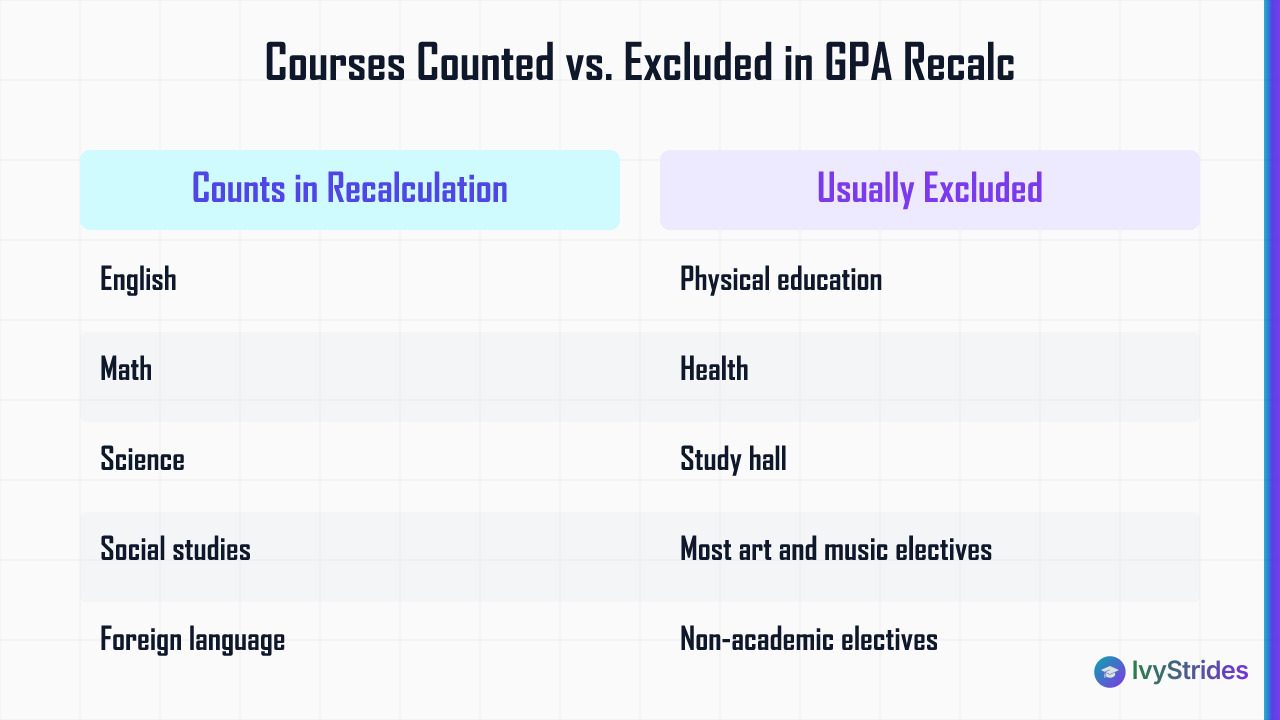
Colleges count your core academic courses and drop most of the rest. Core academic subjects are math, English, science, social studies, and foreign language. When a college recalculates, those five categories carry the GPA; PE, health, art, and general electives usually fall out entirely, per Road2College's recalculation explainer.
Why the A in PE does nothing. The grade is real, but the course never enters the math at a selective school.
| Counts in recalculation | Usually excluded |
| English | Physical education |
| Math | Health |
| Science | Study hall |
| Social studies | Most art and music electives |
| Foreign language | Teacher-aide or leadership credits |
| AP and honors core courses | Non-academic electives |
The weighting formula most colleges apply. For courses that do count, the standard bonus is +1.0 for AP or IB courses and +0.5 for honors courses, added onto the 4.0 base (Road2College). So an A in AP Biology can read as 5.0, an A in honors chemistry as 4.5, and an A in standard history as 4.0. Some colleges also drop ninth-grade marks entirely, judging you on grades 10 through 12.
Taking AP courses raises your weighted GPA and signals academic rigor, but the AP course grade, not just the exam score, is what enters the recalculation. Your 5 on the AP exam does not lift your GPA; your A in the class does. For how many of these courses selective schools expect, read how many AP classes for Ivy League. For the broader case, does AP help with college admission.
How Selective Colleges Actually Recalculate Your High School GPA
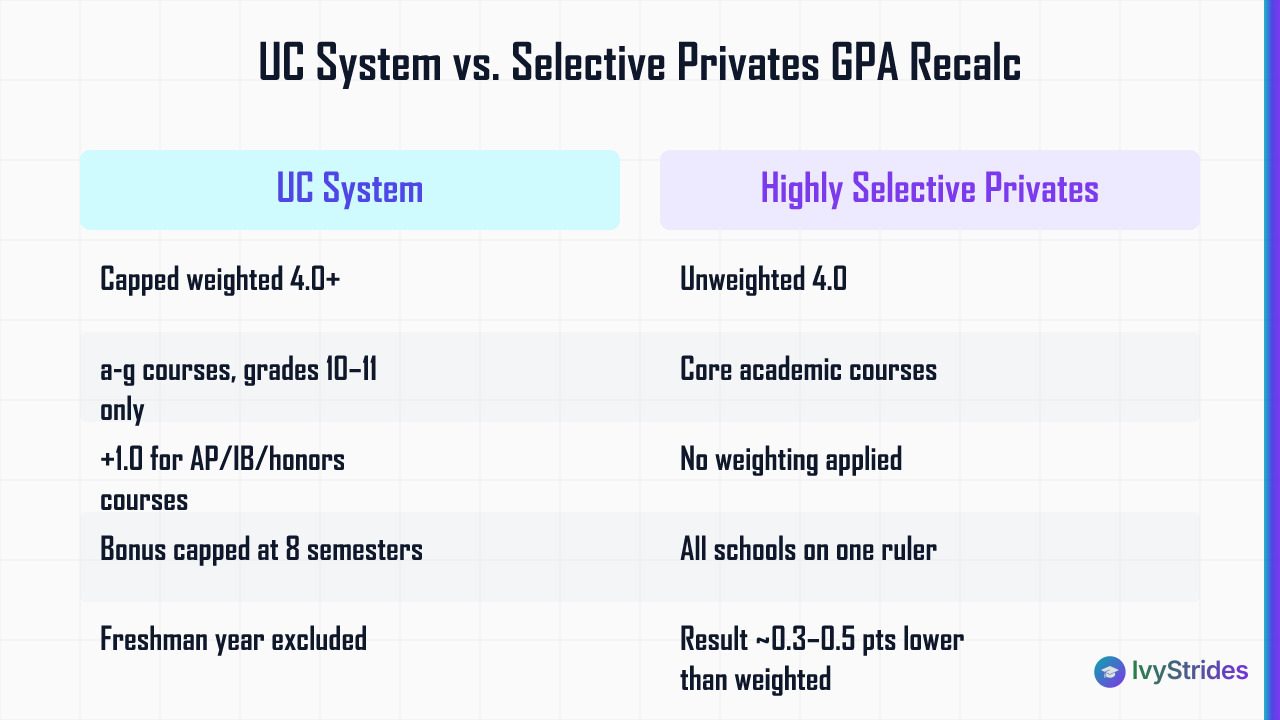
Selective colleges each run their own recalculation formula, and the differences are large enough to change your number by half a point. The three main patterns are the UC capped-weighted GPA, the highly selective private conversion to unweighted 4.0, and the core-course recalculation with a college's own weights. Because the same transcript reads differently under each, mapping your target schools to a method matters as much as the grades themselves.
| College type | Scale used | Courses included | Weighting applied |
| UC system | Capped weighted 4.0+ | a-g, grades 10-11 | +1.0, max 8 semesters |
| Highly selective privates (e.g. Stanford) | Unweighted 4.0 | Core academic | None, for comparison |
| Core-recalculating privates (e.g. UPenn-type) | 4.0 with own weights | Core academic | College's own bonus |
The UC system is the most mechanical example. The University of California computes a capped weighted GPA from a-g approved courses taken in grades 10 and 11 only. It adds +1.0 for UC-approved honors, AP, and IB courses, but caps that bonus at eight semesters. So a student loading 12 AP semesters still gets bonus points for only eight. Because UC recalculates on sophomore and junior years, a rough freshman year does not sink the initial figure.
Highly selective private colleges more often convert everything to a plain unweighted 4.0 so they can compare applicants from thousands of different high schools on one ruler. IvyStrides derives this figure from the inputs cited above. A pattern we see frequently in our coaching: students with strong weighted GPAs are surprised when a selective college's recalculated figure sits roughly 0.3 to 0.5 points lower, because their school awarded generous honors credit for courses the college does not recognize as honors-level.
To verify any single school's approach, the per-institution Common Data Set is the reliable source; some colleges, like West Virginia University, even let applicants request a GPA update on the official transcript during review. If you are worried a single grade tanks the whole thing, will one B ruin a 4.0 GPA walks through the exact math.
What a Recalculated GPA Means for Your Admissions Strategy
Your recalculated GPA should shape your course selection, not just sit on a screen. The highest-use move is estimating your own unweighted 4.0 figure now, so you know whether your target schools' middle-50 ranges are in reach. That estimate turns an abstract worry into a plan you can act on before junior-year scheduling closes.
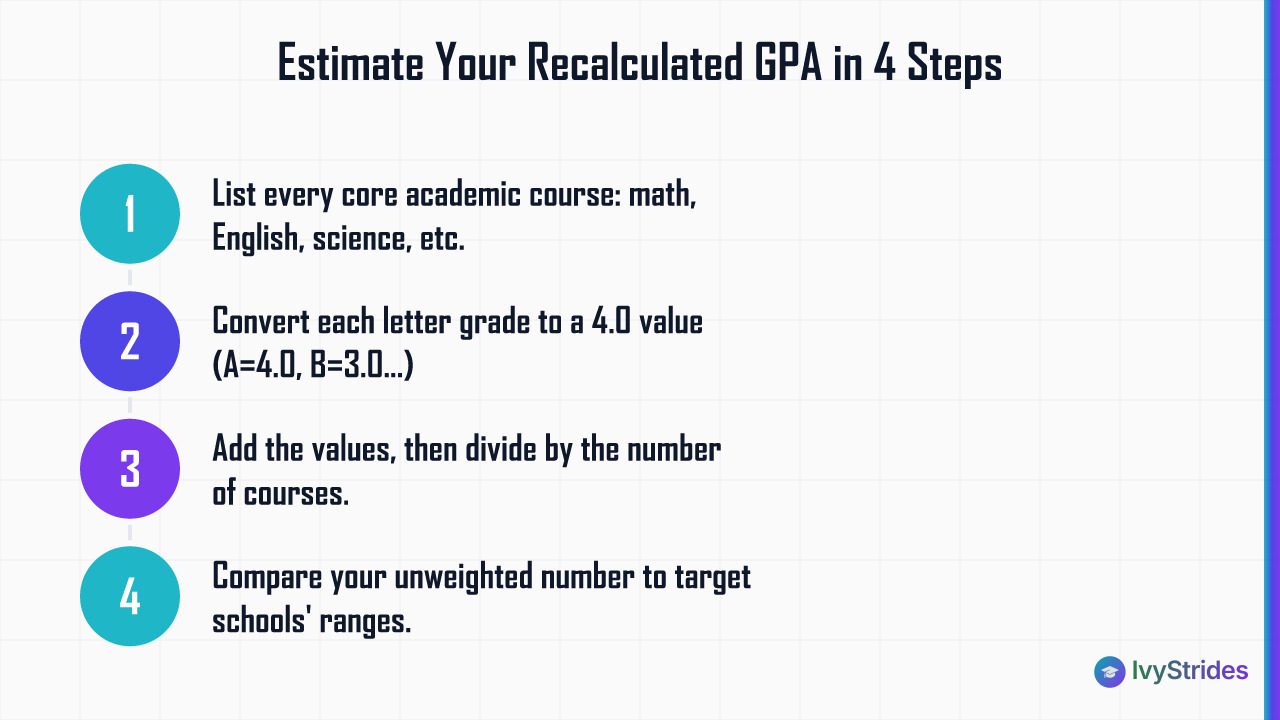
Estimating it takes four steps.
-
List every core academic course: math, English, science, social studies, foreign language.
-
Convert each letter grade to a 4.0 value: A=4.0, B=3.0, C=2.0, D=1.0, per the Mount Holyoke method.
-
Add the values, then divide by the number of courses.
-
Compare that unweighted number to your target schools' published ranges.
Course mix is the lever you control. In our coaching, students who discover their recalculated GPA is lower than expected often have room to strengthen it by shifting elective slots to core-subject AP courses in junior year. An A in AP US History lifts both your weighted and your unweighted recalculated figures; an A in a filler elective lifts neither. When the gap is real, a section specialist can help you rank which courses to add, and you can meet the tutors by subject.
For students whose recalculated GPA falls below a target school's middle-50 range, a strong SAT or ACT score can provide an additional data point that admissions officers weigh alongside the transcript. If that is your situation, 1-on-1 SAT prep targets the sections that move your score. what is a good SAT score shows the range your list expects.
Two caveats keep this honest. Test-optional policies vary by school and year, so verify each college's current policy at FairTest before deciding whether to submit scores. And admissions outcomes depend on the full application, not GPA alone; recalculated GPA is one signal inside holistic review, not the verdict.
FAQ: How Colleges Recalculate GPA
How do colleges calculate your GPA?
Colleges assign a grade-point value to each letter grade on a 4.0 scale, include only core academic courses, and average the results. Many also add +1.0 for AP or IB courses and +0.5 for honors courses before averaging. The exact method varies by institution, so the number a college computes rarely matches the one on your transcript.
Will one B ruin a 4.0 GPA?
One B in a full four-year course load typically drops an unweighted GPA by a small fraction, often from 4.0 to around 3.95 or 3.97, depending on total credits. Selective colleges read grade trends and course rigor alongside the number, so a single B in a hard course rarely changes the story. Our full breakdown lives in the linked article above.
Is a 70% a 2.0 GPA?
On a standard 4.0 scale, a C grade, typically 70 to 79 percent, converts to a 2.0. But grading scales differ: some schools set a C at 73 to 76 percent, others at 70 to 72. When colleges recalculate your GPA, they use the letter grade printed on your transcript, not the raw percentage behind it.
Do all colleges recalculate your GPA?
Not all colleges recalculate, but most selective and highly selective institutions do. Some accept the school-reported GPA; others, including the UC system and many private universities, apply their own formula. Checking a college's Common Data Set or admissions FAQ is the most reliable way to confirm its approach.
Your Next Step on GPA Recalculation
You now know that colleges strip, re-weight, and re-score your GPA, and that the number they see can differ from your transcript by several tenths. Use that before your next scheduling window.
- Estimate your unweighted 4.0 using only core academic courses.
- Check whether your target schools convert to unweighted or use a capped weighted formula like the UC system.
- Shift open elective slots toward core-subject AP or honors courses where you can earn strong grades.
- Verify each school's test-optional policy and Common Data Set ranges before you commit to a submission plan.

Hemant is a seasoned entrepreneur, investor, and growth strategist with deep ground in education and technology-driven learning. His core training is in Mathematics and Physics — he authored Physics for IB Diploma: Ultimate Revision Guide, recognized as a top student resource.