
How to Get a 5 on AP Calculus: A Coach's 12-Week Plan for AB and BC

On this page
- What a 5 on AP Calculus Actually Requires: Score Cutoffs and Exam Format
- How Hard Is It to Get a 5 on AP Calc AB Compared to BC?
- What You Need to Know Before Week 1 Starts
- The Units That Cost Students the Most Points (and Why to Front-Load Them)
- Your 12-Week Study Plan for AP Calculus AB and BC
- The BC-Only Units That Separate a 4 from a 5
- FRQ Strategy: How Partial Credit Works and Why It Changes Everything
- How to Use This Plan If You Are Self-Studying vs. Working with a Coach
- Why a 5 on AP Calculus Matters Beyond the Exam
- FAQ
- Is 70 percent enough to get a 5 on AP Calculus?
- How many people actually score a 5 on AP Calculus AB and BC?
- Can I realistically get a 5 on AP Calc BC if I start studying one month before the exam?
- What is the hardest part of the AP Calculus BC exam to prepare for?
- Do I need to answer every MCQ correctly to get a 5 on AP Calculus?
To earn a 5 on AP Calculus AB or BC, you typically need 60 to 70 percent of available raw points across 45 multiple-choice questions and 6 free-response questions scored by College Board. Roughly 20 percent of AB test-takers and 38 to 43 percent of BC test-takers scored a 5 in recent years. The fastest defensible path is a 12-week plan that starts with a full diagnostic, front-loads Derivatives and Integrals for AB (adds Series for BC), and trains FRQ rubric mechanics so partial credit lands in your column.
Those figures come from College Board's published score distributions and the AP Calculus AB/BC Course and Exam Description, both cited where each claim appears below. The harder question, and what this guide is actually for, is the week-by-week sequencing: which units to attack first, how to score your own FRQs against the rubric, and where BC students need a dedicated block of Series work.
What a 5 on AP Calculus Actually Requires: Score Cutoffs and Exam Format
AP Calculus AB and the BC track use the same structural format. You sit for roughly 3 hours and 15 minutes total. The multiple-choice question (MCQ) section has 45 questions split into two parts: 30 in the no-calculator section over 60 minutes, then 15 in the calculator-permitted section over 45 minutes. The free-response question (FRQ) section has 6 questions split into 2 calculator-permitted (30 minutes) and 4 no-calculator (60 minutes). Each FRQ is worth up to 9 points, putting the full FRQ section at 54 raw points.
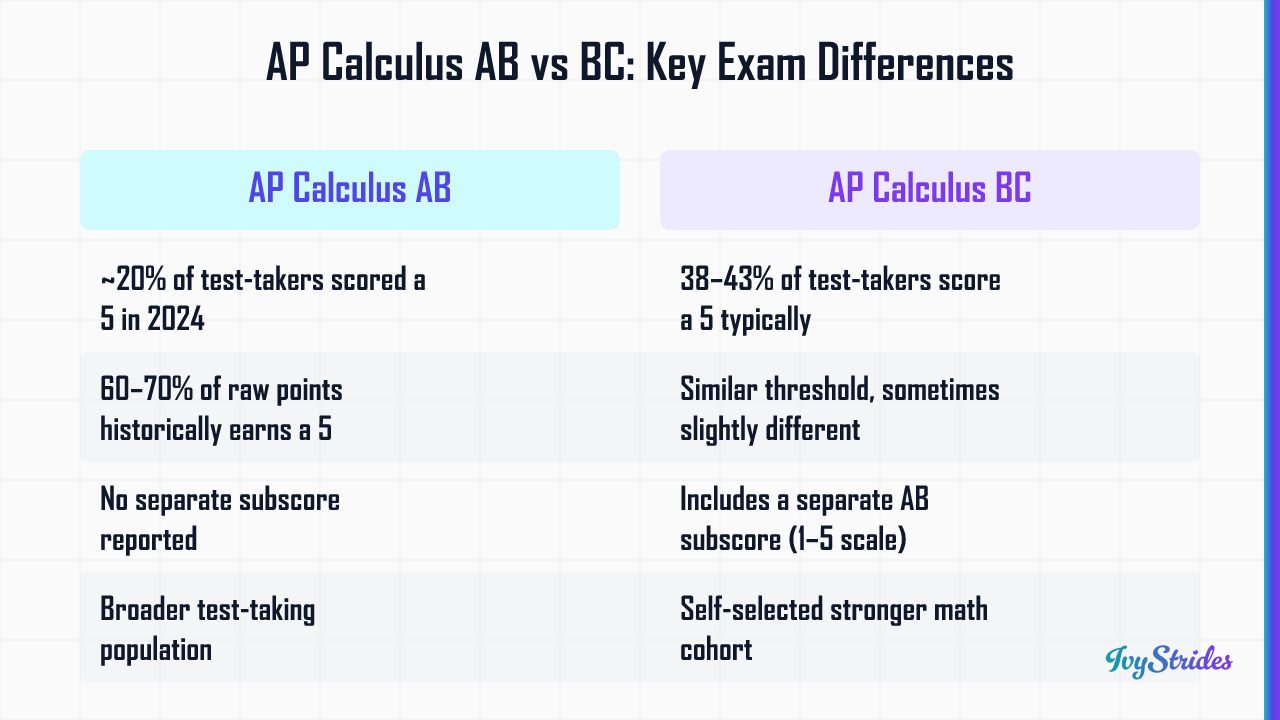
Now the question every student actually wants answered: what raw score earns a 5? There is no fixed percentage. College Board converts raw scores to the 1-5 composite score scale each year per its AP Calculus AB Course and Exam Description, and the cutoffs typically shift slightly based on exam difficulty. Based on released scoring guidelines, in our coaching roughly 60 to 70 percent of available raw points has historically landed in 5 territory on AB. BC sometimes sets a similar threshold, sometimes slightly different. The honest target: aim for 70 percent or higher on practice exams to build a buffer.
According to College Board's published score distributions, approximately 20 percent of AB test-takers scored a 5 in 2024, while BC's 5-rate typically sat in the 38 to 43 percent range across recent years per the same source. BC's higher 5-rate is not because BC is easier. It reflects self-selection: BC students tend to be the stronger math cohort to begin with.
One detail many students miss. When you take BC, your score report includes a separate AB subscore on the 1-5 scale, which reflects how you did on the AB-content portion of the BC exam. Several colleges grant AB-equivalent credit based on that subscore even if the composite BC score lands lower than hoped.
How Hard Is It to Get a 5 on AP Calc AB Compared to BC?
Here's the part most students miss. The 20 percent AB 5-rate sounds discouraging until you look at the rest of the distribution: roughly 36 percent of AB test-takers scored a 1 or 2. The gap between passing and excelling is large, and most students stuck in the middle aren't lacking calculus knowledge. They're losing points to imprecision on FRQ justification, related rates setup, and differential equations notation.
So is BC harder than AB? Content-wise, yes. BC adds parametric equations, polar coordinates, and vector functions, plus infinite sequences and series, on top of all AB content. But BC's 5-rate is higher because the students who self-select into BC have already mastered AB-level content cold. If you're deciding between the two, the deciding factor is how comfortable you are with AB material right now, not the published 5-rate.
In our coaching with students moving from a 3 to a 5 on AB, the realistic effort typically runs 60 to 90 hours of focused prep across 12 weeks per College Board's AP Calc AB prep guidance. That breaks down to 5 to 7 hours per week, weighted toward FRQ rubric practice in the back half. Students starting from a 4 typically need less, often 40 to 60 hours. Students starting from a 2 need more time than a 12-week window comfortably allows, and they usually need to address pre-calculus gaps first.
If you're still weighing self-study against a structured course, the guide on how to choose an online AP course provider walks through the seven questions every family should ask before committing.
What You Need to Know Before Week 1 Starts
Skip the diagnostic and you're guessing about which units need the most time. That's the single biggest reason students plateau. Every plan in this article assumes one thing: you've taken a full-length diagnostic practice exam and scored it honestly.
Use a released AP Calculus practice exam from College Board's AP Students portal as your diagnostic. Take it under real timing conditions, including the calculator and no-calculator splits. Then score it in two layers: raw MCQ score out of 45, plus an estimated FRQ score using the official scoring rubric for that year's release.
Once scored, build your unit-gap list. Look specifically at:
- Limits and Continuity (Unit 1)
- Differentiation: Definition and Basic Derivative Rules (Unit 2)
- Differentiation: Composite, Implicit, and Inverse Functions (Unit 3)
- Integration and Accumulation (Unit 6)
- Applications of Integration (Unit 8)
Rank the units by points missed. The top two or three become your front-loaded blocks in weeks 3 through 6.
A prerequisite check matters here too. If your diagnostic MCQ score is below 50 percent and the misses cluster in algebraic manipulation, trig identities, or function behavior, you have a pre-calculus gap, not a calculus gap. Add two weeks of foundational review with AP Precalculus online content before starting the 12-week plan. Calculus built on a shaky algebra foundation doesn't survive the FRQ section.
The Units That Cost Students the Most Points (and Why to Front-Load Them)
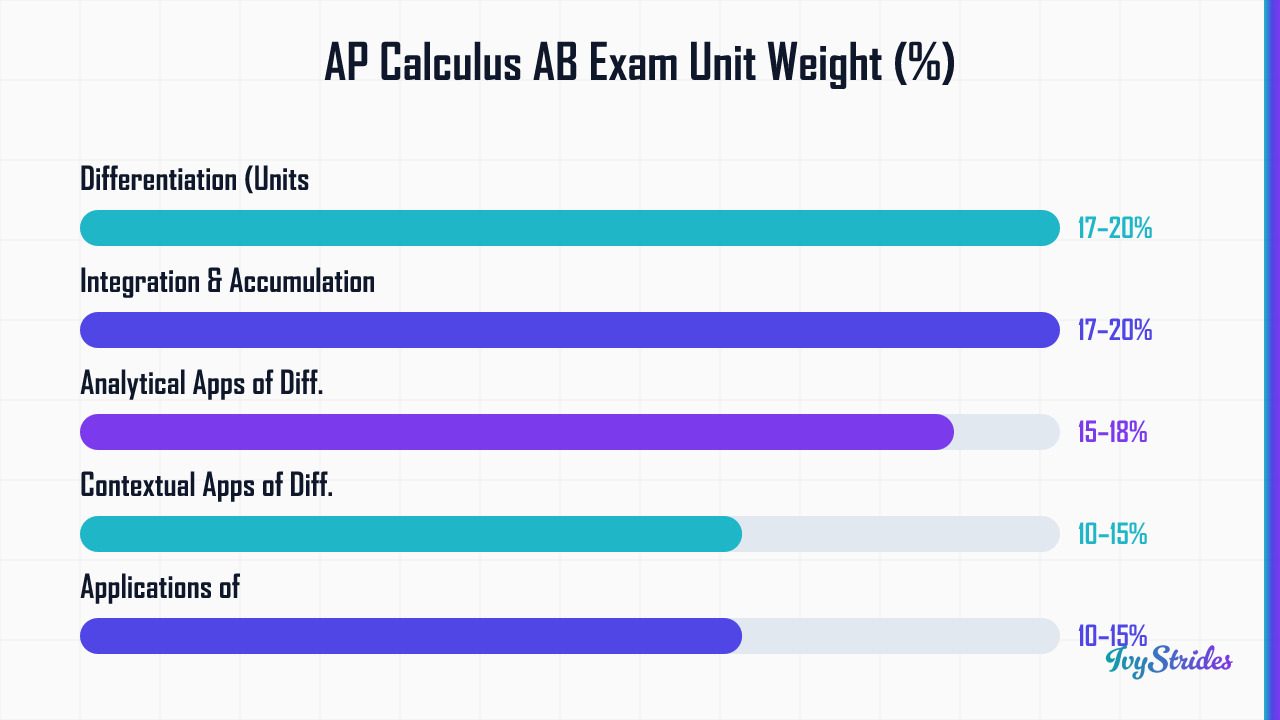
Here's what the AP Calculus AB Course and Exam Description, published by College Board, says about typical unit weight on the exam:
- Limits and Continuity: roughly 10 to 12 percent
- Differentiation (Definition, Basic Rules, Composite/Implicit/Inverse): roughly 17 to 20 percent combined across Units 2 and 3
- Contextual Applications of Differentiation: roughly 10 to 15 percent
- Analytical Applications of Differentiation: roughly 15 to 18 percent
- Integration and Accumulation of Change: roughly 17 to 20 percent
- Differential Equations: roughly 6 to 12 percent
- Applications of Integration: roughly 10 to 15 percent
For BC, all of the above plus parametric, polar, and vector functions typically at 11 to 12 percent and infinite sequences and series at 17 to 18 percent per the AP Calculus BC Course and Exam Description.
The takeaway: Differentiation and Integration together carry roughly 35 to 40 percent of the AB exam. Front-load those. Inside Differentiation, drill chain rule fluency, implicit differentiation, and related rates setup. Inside Integration, u-substitution speed and the Fundamental Theorem of Calculus (Part 1 and Part 2) are non-negotiable.
A specific MCQ trap to watch. L'Hopital's Rule misapplication is one of the highest-frequency MCQ errors we see. Students apply it to limits that aren't in 0/0 or infinity/infinity indeterminate form, and the answer choices are written to reward that mistake. Always verify the indeterminate form before differentiating numerator and denominator.
Another high-use habit is FRQ justification language. On a related rates problem, writing "because f is continuous and differentiable on [a, b]" earns a communication point that students who skip the wording lose. On a Mean Value Theorem question, you must explicitly cite continuity on the closed interval and differentiability on the open interval. The rubric awards that exact citation.
Related rates errors cluster around one mistake: not defining variables before differentiating. A junior we worked with last fall kept losing 3 of 9 points on related rates FRQs because he jumped straight to dV/dt = 4πr² (dr/dt) without first writing V = (4/3)πr³ and labeling what r represented. Define, then differentiate, then substitute. Always in that order.
In our coaching with AB students at the 3-to-4 boundary, those who skip or rush Differential Equations lose an average of 8 to 12 raw points across MCQ and FRQ combined. The unit is only 6 to 12 percent of the exam, but slope fields and separable equations appear on the FRQ predictably enough that ignoring them caps your composite. For unit-by-unit support, our AP Calculus AB service page shows how we structure each unit block.
Your 12-Week Study Plan for AP Calculus AB and BC
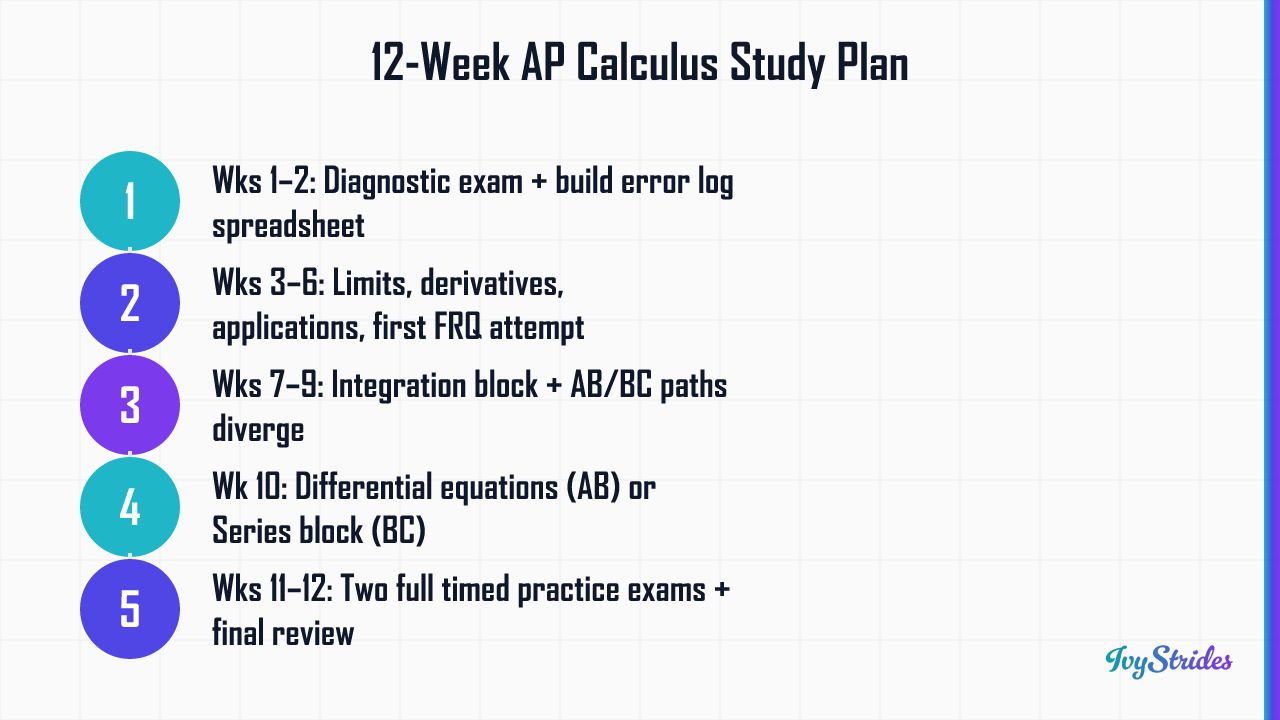
In our coaching, plan for typically 5 to 7 hours per week of focused study per College Board's AP Calc study guidance. BC students will push toward the upper end because of the added Series and Parametric blocks. A consistent 5 to 7 hours per week across 12 weeks adds up to roughly 60 to 85 total study hours. All FRQ practice should use released College Board FRQs (available by year on the AP Students portal), not third-party imitations.
Weeks 1 to 2: Diagnostic and Error Log Setup. Take a full-length diagnostic exam under timed conditions. Score it against the official scoring rubric. Build an error log spreadsheet with four columns: unit, question type, error category (conceptual, procedural, or notation), and the corrected approach. Rank your missed units by raw points lost.
Weeks 3 to 4: Limits, Continuity, and the First Derivatives Block. Drill Unit 1 (Limits and Continuity) with timed MCQ sets: 10 questions in 12 minutes. Move into Unit 2 (Basic Derivative Rules) and start Unit 3 (Composite, Implicit, Inverse). End week 4 with a no-calculator MCQ set focused on derivative rules.
Weeks 5 to 6: Differentiation Applications and First FRQ Attempt. Cover related rates, optimization, linearization, and Mean Value Theorem. End week 6 by taking one full released FRQ under timed conditions, then self-scoring against the official rubric. This is the most important self-correction exercise in the plan.
Weeks 7 to 8: Integration Block. Drill u-substitution until it's reflexive. Work through Fundamental Theorem of Calculus Part 1 (derivatives of integrals) and Part 2 (definite integrals via antiderivatives) until both feel mechanical. BC students add integration by parts here. Take two more timed FRQs and self-score.
Week 9: AB Path vs. BC Path Diverge. AB students review Applications of Integration: areas between curves, volumes by cross-section, volumes of revolution (disk, washer, shell). BC students switch to parametric, polar, and vector functions. Practice dy/dx and d²y/dx² for parametric curves, arc length, and polar area between curves.
Week 10: Differential Equations (AB) or Series (BC). AB students cover separable differential equations, slope fields, and exponential growth and decay models. BC students attack Unit 10 (Infinite Sequences and Series), which deserves a full block of its own and is covered in detail in the next section. BC students should plan at least 8 dedicated hours on Series this week.
Week 11: Full-Length Practice Exam One. Take a full released exam under exact timed conditions. Score it. Update your error log. Spend the rest of the week drilling the weakest unit and running calculator-permitted section fluency drills (store intermediate values, do not round until the final answer).
Week 12: Full-Length Practice Exam Two and Final Review. Take a second timed exam early in the week. Score it, compare to week 11, and do a final error log review. Spend the last few days on exam-day logistics: confirming the testing site, packing calculator and approved batteries, sleeping on schedule.
In our coaching, students who complete both week 11 and week 12 full-length timed exams (rather than only reviewing notes in those weeks) typically land roughly half a grade band higher than peers who skip the second exam. The two timed exams matter more than any single review activity in the final two weeks.
Students working toward a 5 on AP Calculus AB often benefit from a subject-specialist coach who can identify exactly which derivative or integration unit is costing them points. See how we structure prep at the AP Calculus BC service page.
The BC-Only Units That Separate a 4 from a 5
If you're taking BC, this section matters more than any other. Unit 10 (Infinite Sequences and Series) carries roughly 17 to 18 percent of the BC exam weight according to the BC Course and Exam Description, and it appears on the FRQ almost every year. In our coaching with BC students, those who spend fewer than 8 dedicated hours on Series before the exam rarely score above a 4.
For BC students, the Series unit alone can be the difference between a 4 and a 5, which is why IvyStrides pairs BC students with a calculus-specialist coach for targeted Series and Parametric work; details are on the AP Calculus BC service page.
Here's what you must master cold for Series.
Convergence tests. Know when to apply each one: nth term test for divergence, integral test, direct comparison test, limit comparison test, ratio test, alternating series test. The ratio test is the workhorse for series with factorials and exponentials. The alternating series test is the one most students forget to check the conditions for.
The four must-memorize Taylor series and Maclaurin series. Memorize them as expansions, not derivations:
- e^x = 1 + x + x²/2! + x³/3! + ...
- sin(x) = x - x³/3! + x⁵/5! - ...
- cos(x) = 1 - x²/2! + x⁴/4! - ...
- 1/(1-x) = 1 + x + x² + x³ + ... (for |x| < 1)
Every other Taylor series on the BC exam is a substitution or differentiation away from one of these four.
Radius of convergence and interval of convergence. This shows up on the BC FRQ with high frequency. Recent released BC FRQs (for example, the 2019 BC FRQ 6 on a power series for ln(1+x²)) test exactly this skill. Use the ratio test to find the radius, then check both endpoints by hand for the interval. The endpoint check is where students lose points because they forget the interval can be open, closed, or half-open.
For parametric equations, polar coordinates, and vector functions (Unit 9), the highest-use skills are: dy/dx = (dy/dt) / (dx/dt) for parametric curves, the arc length formula for parametric and polar curves, and the area between polar curves using (1/2) integral of r² dθ. Practice these formulas until you can write them without thinking.
One more note on the AB subscore. Your BC score report shows your composite score (1-5) and a separate AB subscore (1-5) reflecting your performance on the AB-content portion. Some colleges grant Calculus I credit based on the AB subscore alone if your BC composite is a 3 but the AB subscore is a 5. Always check your target college's AP credit policy directly.
FRQ Strategy: How Partial Credit Works and Why It Changes Everything
This is the section most competitor articles skip, and it's the single highest-use insight for students stuck between a 3 and a 5.
The FRQ section is worth 54 raw points (6 questions × 9 points each). Each 9-point question is built from a mix of three rubric point types:
- Setup points for writing the correct relationship, equation, or integral expression before any calculation.
- Process points for executing the calculus operation correctly (differentiating, integrating, applying a theorem).
- Answer points for the final numerical or symbolic result.
Some questions also award communication points for defining variables, stating units, or justifying conclusions in words ("because f is continuous on [0, 4] and f(0) > 0 and f(4) < 0, by the Intermediate Value Theorem there exists a c in (0, 4) such that f(c) = 0").
The most important rule: there is no follow-through penalty. If you set up correctly but compute the wrong final answer, you still earn the setup and process points. A related rates FRQ where you draw the diagram correctly, label your variables, and write the relationship equation can earn 2 of 9 points before you've differentiated anything. Even if your final number is wrong, those 2 points are yours.
This changes how you should practice. In our coaching, students who practice FRQs without a rubric typically underestimate their own score by 6 to 10 points because they grade themselves on whether the final answer is correct, not on what the rubric actually rewards. Always practice with the official College Board scoring guidelines for that year's released FRQ in front of you.
Calculator FRQ strategy: store intermediate values in your calculator's memory (use STO> on a TI-84) and don't round until the very last step. Premature rounding is a common rubric deduction. Also, when an FRQ asks for "your answer to three decimal places," give three decimal places, not two and not four.
No-calculator FRQ strategy: show every algebraic step. Use exact values (π, e, √2) not decimal approximations. If you skip steps and the final answer is wrong, the grader has no way to award process points. Write more, not less.
For 1-on-1 FRQ rubric coaching, our AP Calculus AB prep sessions center on this exact skill in weeks 6 through 12 of the plan.
How to Use This Plan If You Are Self-Studying vs. Working with a Coach
Be honest about which version of the plan fits your situation.
Self-study typically works best when (per College Board's AP Calc study guidance):
- You're already scoring a 4 on a recent practice exam.
- Your algebra and pre-calculus foundations are strong (you can factor, manipulate trig identities, and solve exponential equations without hesitation).
- You can score your own FRQs against the official rubric and accurately identify why you lost each point.
- In our coaching, you have the discipline to maintain a typical 5 to 7 hour weekly schedule for 12 weeks.
Coaching adds the most value when:
- You're stuck between a 3 and a 4 and can't diagnose why your FRQ answers are losing points.
- You're preparing for BC Series with no prior exposure to convergence tests or Taylor expansions.
- Your class teacher moves too fast or too slow, and your textbook isn't filling the gap.
- You have less than 12 weeks and need someone to compress the plan around your specific weaknesses.
If you're still deciding whether to self-study or enroll in a structured course, the guide on how to choose an online AP course provider walks through the seven questions every family should ask before committing.
In our coaching with AB and BC students, those who work with a calculus-specialist coach on FRQ rubric review for 4 to 6 sessions typically close a 3-to-4 gap within 6 weeks. The reason is structural: a specialist coach sees the same FRQ rubric patterns across hundreds of student attempts and can name the exact word or notation you're missing. A generalist tutor can't. IvyStrides matches each student to a per-subject specialist, not a tutor who covers all APs. For BC Series specifically, that distinction matters because Series is the unit where a generalist's expertise tends to thin out fastest.
A hybrid approach also works. Self-study the AB units using released College Board materials, then bring in a coach for BC-only Series and Parametric work plus FRQ rubric review across both AB and BC content. See AP Calculus BC coaching for how we structure those targeted blocks.
Why a 5 on AP Calculus Matters Beyond the Exam
A 5 on AP Calculus AB typically translates to Calculus I credit at the college level. A 5 on BC typically translates to Calculus I and Calculus II credit, often allowing students to enroll in Multivariable Calculus or Linear Algebra as college freshmen. That placement advantage compounds over four years, especially for STEM majors.
A 5 on AP Calculus can earn college credit at many universities, though AP credit policies vary by institution, so confirm your target school's policy directly before assuming credit transfer. College Board's AP credit policy search is a starting point, but the authoritative source is the college's own AP credit chart, usually published by the registrar or admissions office.
Beyond credit, a 5 on AP Calculus carries weight as an admissions signal in STEM applications. It demonstrates quantitative readiness in a way that GPA alone does not. That said, admissions decisions depend on the full application: transcript, essays, recommendations, extracurriculars, and standardized test scores where required. A single AP score doesn't make or break an application.
One caveat that surprises families: AP scores are not test-optional. Even if your target college is test-optional for SAT or ACT, AP scores are separate and always reportable. They're released in early to mid-July, well after college applications are submitted, so they primarily influence credit and placement decisions, not admissions, unless you self-report scores from previous years.
Before starting AP Calculus, students with shaky pre-calculus fundamentals should review AP Precalculus online content to close those gaps. A weak pre-calculus foundation is the most common reason students stall in the first six weeks of AP Calculus.
FAQ
Is 70 percent enough to get a 5 on AP Calculus?
There is no single fixed percentage that guarantees a 5 because College Board's raw-to-composite conversion typically shifts slightly each year. Based on released scoring guidelines, approximately 60 to 70 percent of available raw points has historically corresponded to a 5 on AP Calculus AB. On BC, the threshold can be similar or slightly lower in some years because the exam self-selects a stronger cohort. The safest target is 70 percent or above on full-length practice exams to build a buffer for exam-day variability.
How many people actually score a 5 on AP Calculus AB and BC?
According to College Board's published score distributions, approximately 20 percent of AP Calculus AB test-takers scored a 5 in recent years, while typically 38 to 43 percent of AP Calculus BC test-takers scored a 5 per the same source. The BC 5-rate is higher because BC self-selects students who are already strong in math. Neither exam is impossible to score a 5 on, but AB's wide spread (about 36 percent scoring a 1 or 2) shows that the gap between passing and excelling is significant and requires deliberate preparation.
Can I realistically get a 5 on AP Calc BC if I start studying one month before the exam?
It depends on your starting point. In our coaching with students already scoring a 4 on practice exams, four weeks of focused FRQ rubric work and Series review is sometimes enough to push to a 5 on BC. For students starting from a 3 or lower, one month isn't enough time to close the gap on both AB content and BC-only units like Series and Parametric functions. The 12-week plan in this article is the minimum recommended timeline for a student starting from a 3.
What is the hardest part of the AP Calculus BC exam to prepare for?
In our coaching with BC students, Unit 10 (Infinite Sequences and Series) is consistently the most difficult unit because it introduces convergence logic that doesn't appear in AB. Students must memorize multiple convergence tests, know when each applies, and write Taylor series from scratch. The unit carries 17 to 18 percent of the BC exam weight and appears on the FRQ almost every year, making it non-negotiable for anyone targeting a 5.
Do I need to answer every MCQ correctly to get a 5 on AP Calculus?
No. Based on released scoring data, you can miss several MCQ questions and still earn a 5, provided your FRQ score is strong. The exact number varies by year because the raw-to-composite conversion shifts. As a practical target, aim to answer at least 38 to 40 of the 45 MCQ questions correctly and earn at least 35 to 40 of the 54 available FRQ points. Practicing FRQ partial credit strategy is often more efficient than chasing a perfect MCQ section.
The students who score a 5 aren't the ones who studied the longest. They're the ones who diagnosed early, front-loaded the heavy-weight units, and trained FRQ rubric mechanics until partial credit became automatic. Twelve weeks is enough if you start with a real diagnostic and follow the sequence.

Two decades teaching quantitative and verbal aptitude on standardized tests. Rare dual expertise across Math and Verbal — particularly effective for students with gaps on both sides. Senior AP Mentor for our Calculus and English tracks.