
When Superscoring Will Not Save You: Four Score Patterns That Stay Flat
On this page
- The Four SAT and ACT Score Patterns Where Superscoring Provides No Benefit
- Why SAT and ACT Scores Stop Improving Across Retakes
- What a Flat SAT or ACT Superscore Actually Signals to Admissions Officers
- Flat Superscore, Real Deadline: Get a Clear Read in 15 Minutes
- What to Do Instead: The Diagnostic Step That Actually Moves a Flat Score
- Pattern Identified. Now Build the Plan That Fixes It.
- FAQ: Flat SAT and ACT Superscores
- Is a superscore of 1400 good?
- Do Ivy League schools look at your superscore?
- Is superscoring allowed on the SAT?
- Does a flat superscore look bad to admissions officers?
- Your Next Step on a Flat Superscore
Superscoring does not help when your section scores stay flat across sittings. A superscore is a college admissions policy that combines your highest section score from each test date into a new composite. Four patterns keep it stuck: uniform stagnation, section regression, a single-section ceiling, and a college that ignores superscores.
The format facts below trace to College Board and ACT, Inc.; the four patterns come from what we see in diagnostic reviews of student score histories. The harder truth is the one nobody wants after a second sitting: more attempts with the same prep approach produce the same result.

The Four SAT and ACT Score Patterns Where Superscoring Provides No Benefit
Superscoring only lifts your composite when at least one section score actually rises on a retake. On the Digital SAT, a superscore is your highest Reading and Writing score plus your highest Math score across sittings. On the ACT, it is the average of your best English, Math, and Reading results. If those section numbers don't move, the policy has nothing to combine.
The Digital SAT runs two sections: Reading and Writing (54 questions, 64 minutes) and Math (44 questions, 70 minutes), scored on a 400 to 1600 scale, per College Board. IvyStrides derives this figure from the inputs cited above. The ACT composite averages English, Math, and Reading only; Science and Writing are optional and excluded, per ACT, Inc.. The ACT core runs 131 questions in 125 minutes.
Pattern 1, uniform stagnation. Every section lands within a handful of points on every sitting. A student scores 680 R&W and 620 Math on sitting one, then 670 R&W and 625 Math on sitting two. The superscore takes the best of each, 680 plus 625, a 5-point gain for a full second test day.
Pattern 2, section regression. One section climbs while another slips, and the net is zero. Say 700 R&W and 600 Math on sitting one, then 680 R&W and 620 Math on sitting two. The superscore is 700 plus 620, which equals 1320, identical to the first sitting's composite.
Pattern 3, single-section ceiling. One section already sits near the top, so the bottleneck section is the only thing that matters, and it won't budge. A 760 R&W with a stuck 590 Math means your superscore lives or dies on Math, and repeating the whole test does nothing for the section holding you back.
Pattern 4, college policy exclusion. Some selective colleges use a single-sitting score policy, evaluating only the highest composite from one test date. At those schools your superscore is invisible. This policy varies by school and year, so verify it against each college's Common Data Set. For how colleges calculate a superscore and which schools apply it, see our superscoring explained guide.
| Pattern | What the Score History Looks Like | Why Superscoring Does Not Help | What to Do Instead |
| Uniform stagnation | All sections flat across every sitting | No section rises, so no higher number to combine | Diagnose recurring error types |
| Section regression | One section up, another down | Gains and losses cancel; net composite is flat | Stabilize the falling section first |
| Single-section ceiling | One near-perfect, one stuck | The bottleneck section never moves | Target the bottleneck only |
| College policy exclusion | Solid superscore, wrong school | Target evaluates one sitting only | Verify policy via Common Data Set |
Why SAT and ACT Scores Stop Improving Across Retakes
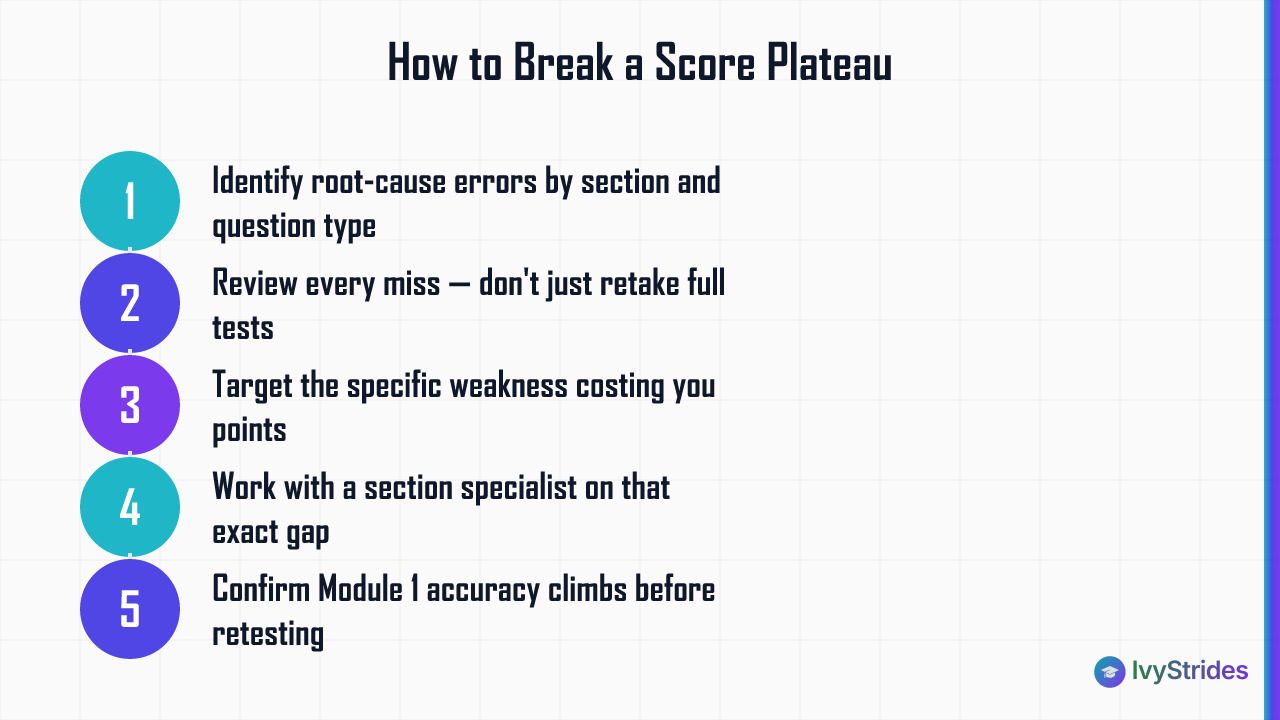
A score plateau is a composite or section score that does not move across two or more sittings, and it is caused by untreated root-cause errors, not by too few attempts. Those same root-cause errors sit underneath every one of the four patterns above. Sitting the test again without changing what you practice repeats the same mistakes on new questions, so the section score stalls.
The Digital SAT compounds this. It is section-adaptive: your performance on Module 1 determines whether Module 2 serves the harder or easier variant, and that routing effectively caps your section-score ceiling, per College Board. If Module 1 accuracy never improves, the higher-scoring Module 2 stays locked, no matter how many Saturdays you spend testing. Our full breakdown of how Digital SAT Module 1 locks in your score ceiling covers that routing.
Error type, not effort. In our coaching with students in the 1200 to 1350 SAT band who had flat superscores across two or more sittings, unresolved R&W craft-and-structure errors were the most common root cause, the same question type missed the same way each time.
On the ACT side, in our coaching with students in the 24 to 28 composite band, Math concept gaps in advanced algebra and trigonometry accounted for most flat retakes. Those aren't pacing problems; they're content the student never closed. If Reading is your sticking point, our guide on why your SAT reading score is not improving works through the fixes.
So what separates a student who plateaus from one who moves? A diagnostic categorizes every miss by section and question type, then assigns targeted weakness work to the section actually costing you points. That is the work our 1-on-1 SAT prep with a section specialist is built to run: a Math coach for the Math gap, an R&W coach for the craft-and-structure misses, not one generalist for both.
Signs your prep approach is the problem, not the test:
- You miss the same question type across two or more sittings.
- Your practice consists of full tests with no error review after.
- Your bottleneck section score varies by fewer than 20 points each time.
- You cannot name the three error types costing you the most points.
- You retook without changing a single thing about how you studied.
- Your Module 1 or early-question accuracy never climbs.
What a Flat SAT or ACT Superscore Actually Signals to Admissions Officers
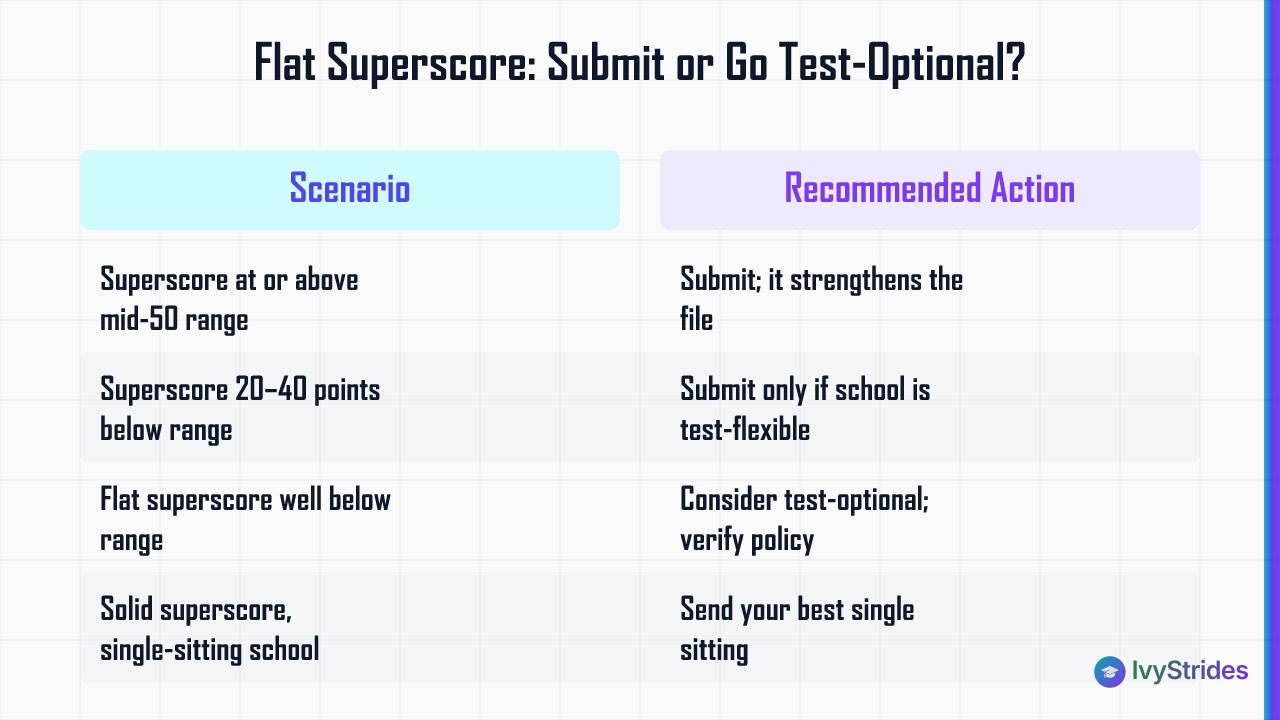
A flat superscore is not penalized the way a declining score is. Most highly selective schools, including Ivy League institutions, superscore the SAT; ACT superscoring policy varies by school and must be verified per college. Admissions officers reading three near-identical sittings mostly see a consistent number. That said, four or more sittings with no meaningful gain can raise a quiet preparation-consistency question in holistic review.
The sharper question, once you accept the superscore is stuck, is whether to submit it at all. Test-optional policies vary by school and year, per FairTest, and submitting a flat score below a school's middle-50 range is generally not an advantage. Take UPenn, whose middle-50 SAT range runs roughly 1510 to 1570 in its Common Data Set. A superscore of 1320 that hasn't moved across three sittings sits below that band, and a test-optional submission is worth evaluating. Our page on whether does UPenn superscore walks that example in full.
Always verify against the school's own Common Data Set, because policies change annually and admissions outcomes depend on the full application. If your target schools are test-optional and your superscore is flat, our guide on what is test-optional and should you submit SAT scores covers that framework.
| Scenario | Superscore vs. Middle-50 Range | Recommended Action |
| Superscore at or above the range | Inside or above mid-50 | Submit; it strengthens the file |
| Superscore slightly below | 20 to 40 points under | Submit only if the school leans test-flexible |
| Flat superscore well below | Clearly under the range | Consider test-optional; verify policy first |
| Solid superscore, single-sitting school | Range irrelevant, policy excludes it | Send your best single sitting |
Flat Superscore, Real Deadline: Get a Clear Read in 15 Minutes
You have section scores from two or more sittings, a college list, and a test date coming up. A free 15-minute call checks your current superscore against each target school's middle-50 range, identifies whether the bottleneck is prep approach or policy, and tells you whether registering again is the right move now. Students and parents both welcome.
What to Do Instead: The Diagnostic Step That Actually Moves a Flat Score

The one reliable path out of a flat superscore is a diagnostic, not another registration. A diagnostic is a timed full-length practice test whose purpose is not the score but the error map: every miss sorted by section and question type. That map tells you which of the four patterns you're in and which single section deserves your prep hours before the next official date.
In our coaching with students who had flat superscores across two or more sittings, those who ran a full diagnostic before the next retake moved their bottleneck section score by roughly 40 to 60 points on the SAT within about 8 to 12 weeks of targeted work, typical for students completing the program. Not because they tested more. Because they finally practiced the right thing.
Run the diagnostic on official material: full-length Digital SAT practice through Bluebook, per College Board, and ACT full-length tests through ACT, Inc.. Then work the bottleneck section with a specialist coach, and space your retesting so improvement has time to show. Students in Pattern 1 or Pattern 3 are usually dealing with a genuine plateau, and our how to break an SAT score plateau framework covers the section-by-section next steps.
Four steps to turn a flat superscore into a rising one:
-
Take one timed, official full-length diagnostic under real conditions.
-
Categorize every miss by section and question type, not just by score.
-
Assign targeted weakness work to the bottleneck section only.
-
Space your retesting, then verify the retake math before you register.
If your section scores are genuinely rising, the question of how many sittings to plan is covered in our guide to how many times should you sit the SAT when colleges superscore. And before you pay for another date, the framework in our analysis of is a second SAT sitting worth it checks whether the math favors it. A flat superscore plus a looming test date is a real cost, in money and in the weeks you have left.
Pattern Identified. Now Build the Plan That Fixes It.
You have a score history, a bottleneck section, and a test date on the calendar. A free 15-minute call maps the specific error types driving your flat score and hands you a week-by-week prep plan tied to your actual registration window. Bring your questions; parents are welcome to sit in.
FAQ: Flat SAT and ACT Superscores
Is a superscore of 1400 good?
A 1400 SAT superscore is competitive at many colleges, but it falls below the middle-50 range at highly selective schools, where the typical band runs roughly 1480 to 1580. Whether it's "good" depends entirely on your target school's published range, which you can check in that school's Common Data Set.
Do Ivy League schools look at your superscore?
Most Ivy League schools superscore the SAT, meaning they consider your highest section scores across sittings. ACT superscoring policy varies by school. Always verify the current policy on each school's admissions page or Common Data Set before deciding how many times to sit.
Is superscoring allowed on the SAT?
Yes. Superscoring is a widely accepted practice for the Digital SAT, and most four-year colleges apply it. A small number of schools, though, evaluate only a single sitting's composite, so checking each school's policy before you register for a retake is essential.
Does a flat superscore look bad to admissions officers?
A flat superscore does not draw the penalty a declining score does. If your superscore sits below a school's middle-50 range and hasn't moved, a test-optional submission is worth evaluating.
Your Next Step on a Flat Superscore
Figure out which of the four patterns your score history shows, then act on that pattern rather than defaulting to another sitting. The retake only pays off when a section score can actually rise, and that starts with knowing why it hasn't.
- Line up your section scores from every sitting and spot the pattern.
- Run one official full-length diagnostic and map your errors by type.
- Target the bottleneck section, then space your retest before the next official date.
- Verify each target school's superscore and test-optional policy in its Common Data Set.

Award-winning author (South Asian Book Award) and graduate of BITS Pilani and UCLA Luskin School of Public Affairs. Brings a published writer's eye to Common App essays and grammatical precision to SAT and ACT R&W instruction.