
How to Break an SAT Score Plateau in 2026: A Step-by-Step Guide That Actually Works
On this page
- What an SAT Score Plateau Actually Means (and Why It Happens)
- Why Studying Harder Is Not the Same as Studying Smarter: The Three Error Types
- Step 1: Take One Diagnostic Test Under Real Conditions
- Step 2: Build Your Error Log in 60 Minutes
- Step 3: Build a Targeted Drilling Plan Around Your Error Log
- Step 4: Fix Pacing Before You Add More Content
- Score-Band Playbook: What to Focus on at 1100-1200, 1300-1400, and 1450-1550
- 1100-1200: foundational content
- 1300-1400: Module 2 routing
- 1450-1550: precision drilling
- When to Stop Self-Studying and Bring In a Section Specialist
- How Breaking Your SAT Plateau Connects to Your College Admissions Strategy
- FAQ
- How do I break through a score plateau at the 1200 level on the SAT?
- How do I push from the high 1400s to 1520 or above on the Digital SAT?
- Is a 1480 SAT score competitive, and should I retake it?
- Is a 1480 SAT or a 34 ACT a stronger score for college applications?
- How many practice tests should I take per week when trying to break a plateau?
- Has the Digital SAT gotten harder or easier compared to older versions?
To break an SAT score plateau, stop taking more practice tests and start diagnosing why you're missing points. Build an error log from your last full practice test, categorize every missed question by skill type (not just subject), and drill only those specific gaps for two to three weeks. On the Digital SAT, the adaptive Module 2 routing also sets a score ceiling: if Module 1 errors send you to the easier Module 2, your score can't exceed roughly 1350-1400 no matter how cleanly you finish.
The format and scoring facts above come from the Digital SAT documentation on satsuite.collegeboard.org. The rest of this article is the sequence: diagnostic, error log, targeted drilling, pacing fix, and score-band playbook.

What an SAT Score Plateau Actually Means (and Why It Happens)
A plateau isn't a mystery. It's what happens when the practice you're doing no longer targets the questions you're getting wrong. You keep circling material you already know, your correct-answer rate on those questions stays steady, and your section score stops climbing.
The Digital SAT makes this worse in a specific way. The test has two Reading and Writing modules and two Math modules, and Module 2's difficulty is routed by your Module 1 performance. Land in the easier Module 2 and your score ceiling drops to roughly 1350-1400. That's structural. No amount of confidence on easy questions changes it.
The score scale is 400-1600, with 200-800 per section. The plateau bands we see most in our coaching cluster at 1100-1200, 1300-1400, and 1450-1550, each for a different underlying reason. The 1100-1200 wall is usually foundational content. The 1300-1400 wall is usually Module 2 routing. The 1450-1550 wall is usually a handful of hard question types the student hasn't isolated yet.
Breaking a plateau is a specific phase inside the broader journey of how to improve your SAT score; the tactics here assume you've already done baseline prep and are now stuck at a ceiling.
Why Studying Harder Is Not the Same as Studying Smarter: The Three Error Types
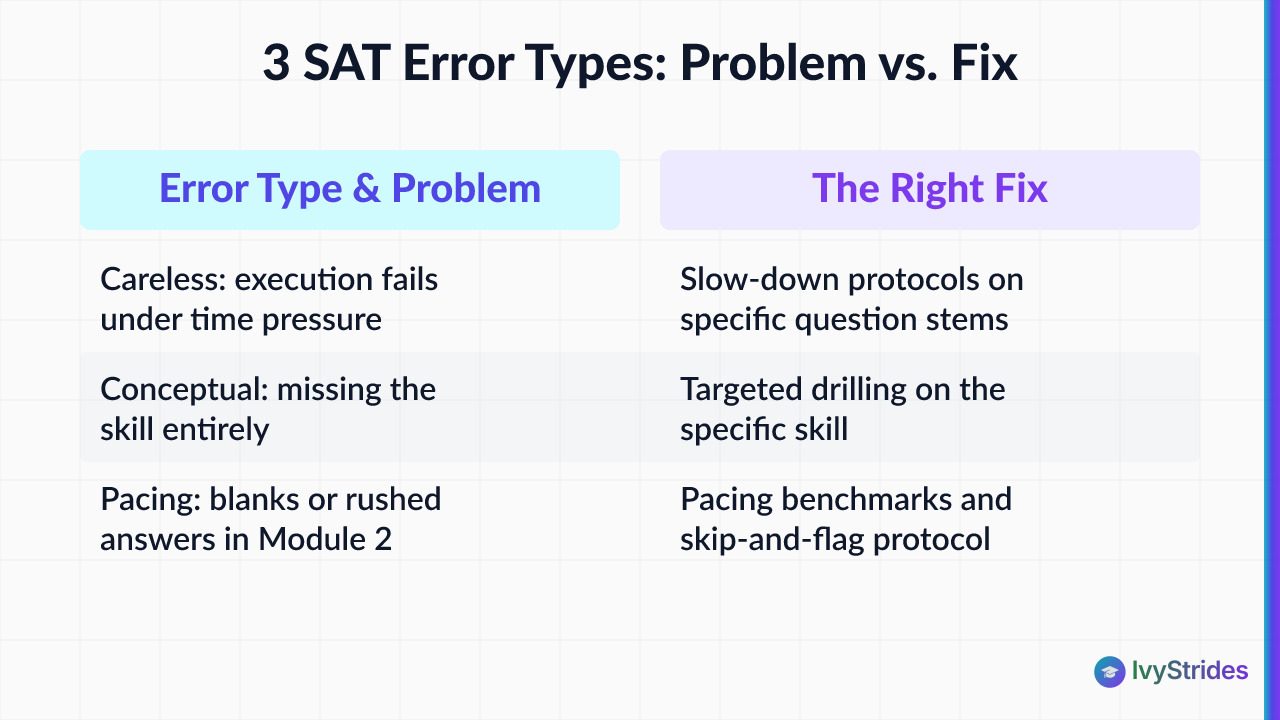
Every missed question falls into one of three categories. Each category needs a different fix.
Careless errors. You knew the content. You misread the question, mis-bubbled, or dropped a negative sign. The knowledge is there; the execution failed under time pressure. Fix: slow-down protocols on specific question stems, not more content review.
Conceptual gaps. You didn't have the skill. Systems of equations setup, transition logic in R&W, quadratic interpretation, rhetorical synthesis. Re-reading a review book won't fix this. Targeted drilling on the specific skill does.
Pacing losses. Questions you left blank or rushed in the last five minutes of Module 2. The content might be within reach; the clock beat you. Fix: pacing benchmarks and a skip-and-flag protocol, covered in Step 4.
In our coaching, students who categorize errors by type rather than by subject reduce repeat mistakes because they're addressing the root cause instead of re-reading a chapter. The tool that makes this possible is an error log. You can build one from scratch in a spreadsheet, or start from our free sat mistake tracker.
Step 1: Take One Diagnostic Test Under Real Conditions
One test. Full length. Real timing. No phone.
The Digital SAT is administered through the Bluebook app, and official practice tests are free on satsuite.collegeboard.org. Use those. Sit down at a desk, close every other tab, and take the whole thing in one 2-hour-14-minute block. Broken-up practice produces a broken-up diagnostic, and a broken-up diagnostic tells you nothing useful about how you'll actually perform on test day.
Before you commit to a plateau-breaking plan, confirm your next SAT test dates 2026 so you know exactly how many weeks of targeted drilling you have available. If you're eight weeks out, your plan looks different than if you're sixteen weeks out. If you want a curated set beyond College Board's four official Bluebook tests, our library of official SAT practice tests covers additional score-band-matched forms.
One diagnostic. That's the entire step. Don't skip it, don't estimate it, and don't use a score from three months ago.
Step 2: Build Your Error Log in 60 Minutes
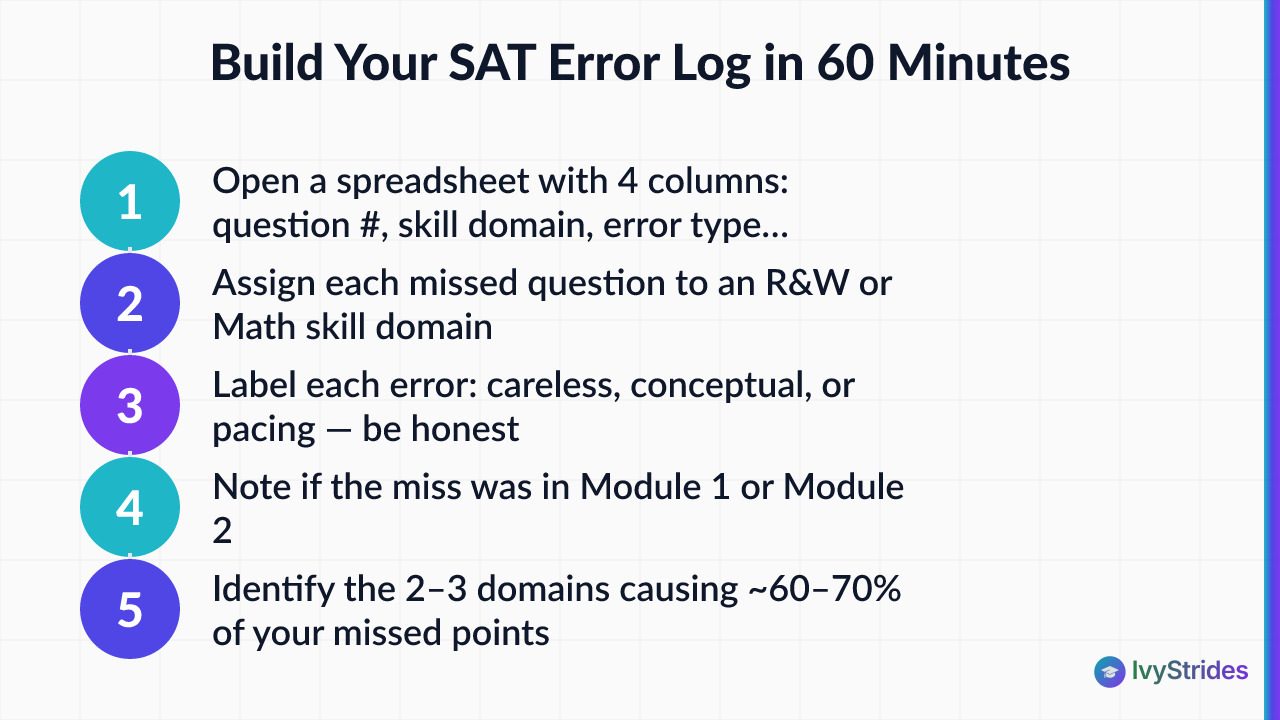
Sit down the day after your diagnostic while the questions are still fresh. Open a spreadsheet. Make four columns: question number, skill domain, error type (careless / conceptual / pacing), and module (1 or 2).
For R&W, the skill domains per College Board are craft and structure, information and ideas, expression of ideas, and standard English conventions. For Math, the domains are algebra, advanced math, problem-solving and data analysis, and geometry and trigonometry. Every missed question belongs to exactly one R&W or Math domain. Assign it.
Then honestly label the error type. Careless means you knew it and slipped. Conceptual means you didn't have the skill. Pacing means the clock ran out. Be honest here; students who label conceptual gaps as "careless" waste weeks drilling composure when they actually need to learn the skill.
Finally, note whether the miss was in Module 1 or Module 2. Module 1 errors matter disproportionately because they determine your Module 2 routing.
In our coaching, students who complete a full error log after one diagnostic typically identify around two to three skill domains responsible for roughly 60-70% of their missed points. That's the entire point of the exercise. You now know where to drill. You can also grab our error log template from our free downloads page if you'd rather not build it from scratch.
Step 3: Build a Targeted Drilling Plan Around Your Error Log
Here's the part most students miss. You do not drill all skill domains equally. You drill the top two or three that showed up most often in your error log, and you leave the rest alone until those move.
Session structure: roughly 20-30 minutes per skill cluster, three to four sessions per week. That's it. If your top gaps are transition logic (R&W: expression of ideas) and systems of equations word problems (Math: algebra), those get four sessions a week between them. Everything else waits.
Spaced retesting: take a new full practice test every two to three weeks, not every week. Weekly full tests exhaust you and produce noisy score data. Every two to three weeks gives your drilling time to consolidate into actual skill transfer.
Once you have your error log, plug the top three skill gaps into a structured SAT study plan so each week has a clear drilling target rather than open-ended review.
For students whose plateau lives in the Math section, a focused SAT math prep approach that isolates algebra setup errors and data-analysis word problems typically moves the Math score roughly 40-80 points faster than reviewing all topics equally.
In our coaching with students at the 1300-1400 band, isolating two Math skill gaps (typically algebra word-problem setup and data analysis) and two R&W gaps (typically transition logic and rhetorical synthesis) produces a typical gain of around 60-120 points over 8-12 weeks for students completing the program.
Step 4: Fix Pacing Before You Add More Content
Pacing is the quietest plateau cause and often the fastest to fix.
Per the College Board's Digital SAT timing, R&W Module 1 and Module 2 are each 27 questions in 32 minutes, and Math Module 1 and Module 2 are each 22 questions in 35 minutes. That works out to about 1 minute 10 seconds per R&W question and about 1 minute 35 seconds per Math question.
The tactical rule: in Math, any question that clearly needs more than about 90 seconds on first pass gets flagged and skipped. Finish the easier questions, then come back. Most students who leave two or three questions blank at the end of Module 2 do so because they burned three minutes on a hard question in the middle. Bluebook lets you flag and return. Use it.
If pacing losses are driving your plateau, test anxiety is often a contributing factor; managing it is a separate but connected skill worth addressing alongside content drilling. Our post on strategies to overcome SAT anxiety covers the pre-test and in-test techniques that work.
In our coaching, pacing adjustments alone typically recover roughly 20-40 points for students who are consistently leaving two to three questions blank in Module 2. That's a real score bump with zero new content learned.
Score-Band Playbook: What to Focus on at 1100-1200, 1300-1400, and 1450-1550
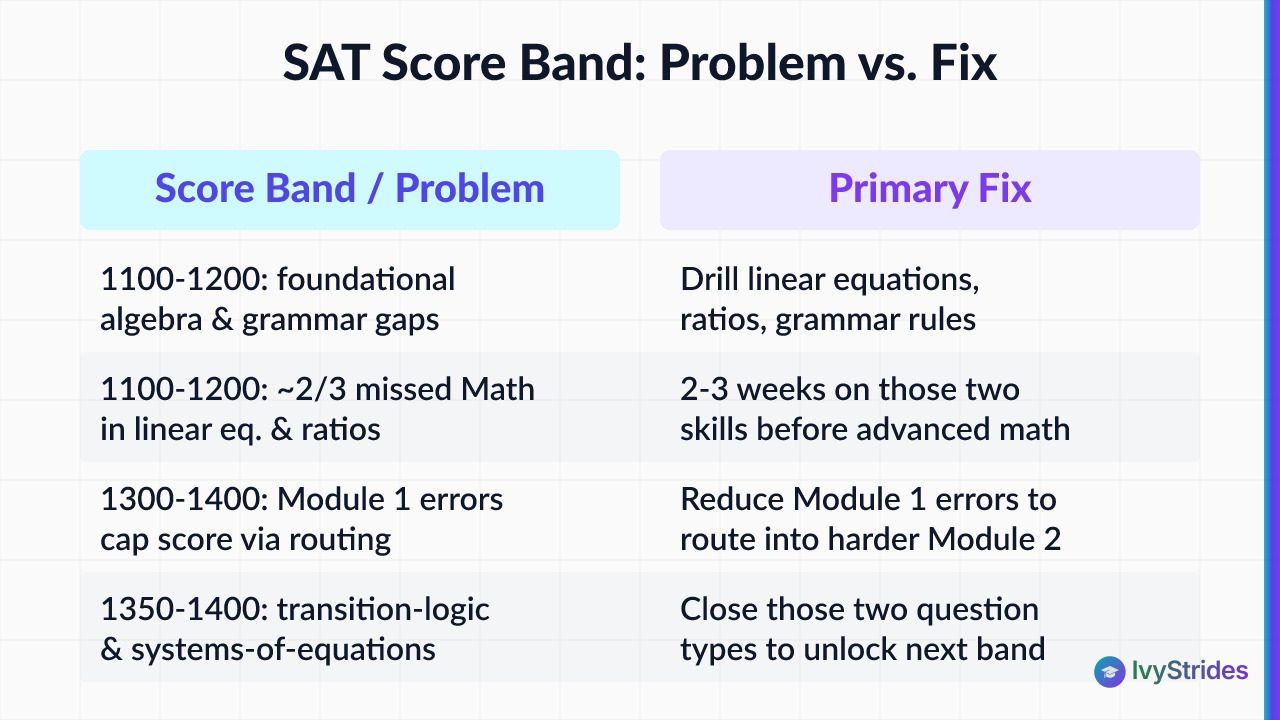
Different plateau, different fix. Generic advice fails here because the highest-use move is different at each band.
1100-1200: foundational content
At this band, the plateau is almost always foundational algebra gaps (linear equations, ratios, percentages, basic systems) and standard English conventions in R&W (subject-verb agreement, pronoun case, comma splices). Drill linear equations, ratios, and grammar rules before attempting harder question types. Advanced math questions are not your problem yet. In our coaching, students who plateau here usually have roughly two-thirds of their missed Math questions concentrated in linear equations and ratios; drilling those two skills for two to three weeks typically moves the total score before any advanced-math work makes sense.
1300-1400: Module 2 routing
At this band, the ceiling is structural. Your Module 1 error rate is sending you to the easier Module 2, which caps your score. The fix isn't to grind harder Math; it's to reduce Module 1 errors so you route into the harder Module 2. Look at your error log by module. If most misses are in Module 1, those are the ones that matter most. In our coaching, students stuck at 1350-1400 for two or more tests usually share the same pattern: transition-logic questions in R&W Module 1 and systems-of-equations setup in Math Module 1. Closing those two typically routes them into harder Module 2 and unlocks the next band.
For context on what a 1300 actually means for your college list, see is 1300 a good SAT score.
1450-1550: precision drilling
At this band, the remaining points concentrate in three to five specific hard question types: rhetorical synthesis and inference in R&W, and quadratic interpretation, trigonometry, and advanced word problems in Math. Broad review is a waste of time. In our coaching with students at the 1450-1550 band, the final 50-100 points typically come from mastering three to four specific question types rather than sweeping content review. Look at your error log. The pattern is narrow. Drill it narrowly.
When to Stop Self-Studying and Bring In a Section Specialist
Three signals. When two or more are true, self-study has hit its limit.
Signal 1. Your score hasn't moved after two consecutive full practice tests with error-log review between them.
Signal 2. Your error log shows the same skill domains appearing across multiple tests. The pattern isn't breaking. You can see the gap but you can't close it.
Signal 3. You can't articulate why you're missing a specific question type. You look at the answer, understand the explanation, and still make the same category of mistake next test.
Those are the moments a section specialist changes the trajectory. Not a generalist tutor. A specialist who works exclusively in SAT R&W or exclusively in SAT Math and can spot the exact error pattern in real time during a session. That's the model behind IvyStrides' 1-on-1 SAT prep service: separate R&W and Math coaches, not one person covering both.
Students who have plateaued for more than two practice tests often benefit from switching from self-paced review to live, coached sessions where a specialist can spot the error pattern in real time. Our comparison of live online SAT prep vs. self-paced walks through when each mode makes sense.
How Breaking Your SAT Plateau Connects to Your College Admissions Strategy
A stronger SAT score matters more than the "test-optional" headlines suggest, but it isn't the whole application.
Test-optional policies vary by school and by year. Check FairTest for the current list. Even at test-optional schools, a strong submitted score typically strengthens the application, especially for merit scholarship consideration. Plenty of selective schools have also moved back to test-required or test-recommended for 2026 admissions.
At the top of the range, scores concentrate quickly. Highly selective universities publish score distributions in their Common Data Set, which you should look up directly for every school on your list (search "Common Data Set [University Name]"). Middle-50% ranges at the most selective schools typically start around 1500 and up.
Here's the caveat that matters: admissions outcomes depend on the full application. GPA, course rigor, AP scores, essays, activities, recommendations. A 1520 doesn't admit you and a 1420 doesn't reject you. The SAT is one lever. AP scores are another. The admissions essay is a third. Working all three in parallel is how competitive applicants actually build strong applications.
For a broader framing on target scores, see what is a good SAT score.
FAQ
How do I break through a score plateau at the 1200 level on the SAT?
At the 1100-1200 band, the plateau is almost always driven by foundational skill gaps in algebra (linear equations, ratios, percentages) and standard English conventions in R&W. Build an error log from one full practice test, identify which of these two areas accounts for more missed points, and drill that area exclusively for two to three weeks before retesting. Adding more practice tests without fixing the underlying skill won't move the score.
How do I push from the high 1400s to 1520 or above on the Digital SAT?
At the 1450-1550 band, the remaining points concentrate in three to five specific hard question types: rhetorical synthesis and inference questions in R&W, and quadratic interpretation, trigonometry, and advanced word problems in Math. Identify exactly which of these appear in your error log and drill them in isolation. In our coaching with students at this band, broad review rarely moves the score; precision drilling on two to three question types typically does.
Is a 1480 SAT score competitive, and should I retake it?
A 1480 places a student roughly at the 97th to 98th percentile nationally, which is competitive for many selective universities. For the most selective schools, middle-50% ranges typically start higher, so check the Common Data Set for each target school. Whether to retake depends on your target list, how much prep time you have, and whether a realistic 30-50 point gain shows up in your error-log analysis. A free strategy call can help you decide based on your specific situation.
Is a 1480 SAT or a 34 ACT a stronger score for college applications?
A 1480 SAT and a 34 ACT sit at roughly equivalent percentiles per ACT, Inc. and College Board concordance data. Most colleges accept both equally. The better score to submit is whichever is higher relative to your target school's admitted-student range, which you can verify in each school's Common Data Set. If you're close on both, submit whichever plays to your strengths on test day.
How many practice tests should I take per week when trying to break a plateau?
One full practice test every two to three weeks is the right frequency during plateau-breaking prep. Taking a test every week without drilling the gaps identified in the previous test's error log is the single most common reason scores stop improving. Between tests, spend three to four sessions per week on targeted skill drilling, not on more full tests.
Has the Digital SAT gotten harder or easier compared to older versions?
The Digital SAT introduced in March 2024 is shorter (2 hours 14 minutes vs. 3 hours for the previous paper SAT) and uses an adaptive two-module structure. The scoring scale remains 400-1600. Direct comparisons to older SAT versions are complicated because the test has been redesigned several times. For current prep purposes, focus on the Digital SAT format documented at satsuite.collegeboard.org.
Plateaus break when you switch from volume to precision. One diagnostic, an honest error log, two or three isolated skill gaps, and a pacing fix. That's the framework, and it works because it targets the exact points you're leaving on the table instead of re-covering ground you already own.

Award-winning author (South Asian Book Award) and graduate of BITS Pilani and UCLA Luskin School of Public Affairs. Brings a published writer's eye to Common App essays and grammatical precision to SAT and ACT R&W instruction.