
Is a Second SAT Sitting Worth It? How Superscoring Changes the Maths
On this page
- How SAT Superscoring Works and Why It Changes the Risk Calculation
- When a Second SAT Sitting Is Worth It: A Score-Gap Decision Framework
- Know Your Gap. Know Your Plan. Get Both in 15 Minutes.
- What Happens If Your Second SAT Score Is Lower Than Your First?
- How to Make Your Second SAT Sitting Different From Your First
- Second Sitting Decided. Now Make It Count.
- FAQ: Second SAT Sitting and Superscoring
- What happens if I do worse on my second SAT?
- Can colleges see how many times you took the SAT?
- Is it bad to take the SAT multiple times?
- Can you take the SAT twice in a year?
- Your Next Step on a Second SAT Sitting
Yes, a second SAT sitting is almost always worth it. A second SAT sitting is a strategic retake, and roughly two in three students improve their score, per College Board's reported retake data. More decisive: most selective colleges superscore, so a partial gain still lifts your composite.
The superscoring policy comes from College Board's Digital SAT documentation. The harder question isn't whether to retake. It's whether your specific score gap, target schools, and application deadline make the fee and prep hours pay off. That's the decision this page settles.

How SAT Superscoring Works and Why It Changes the Risk Calculation
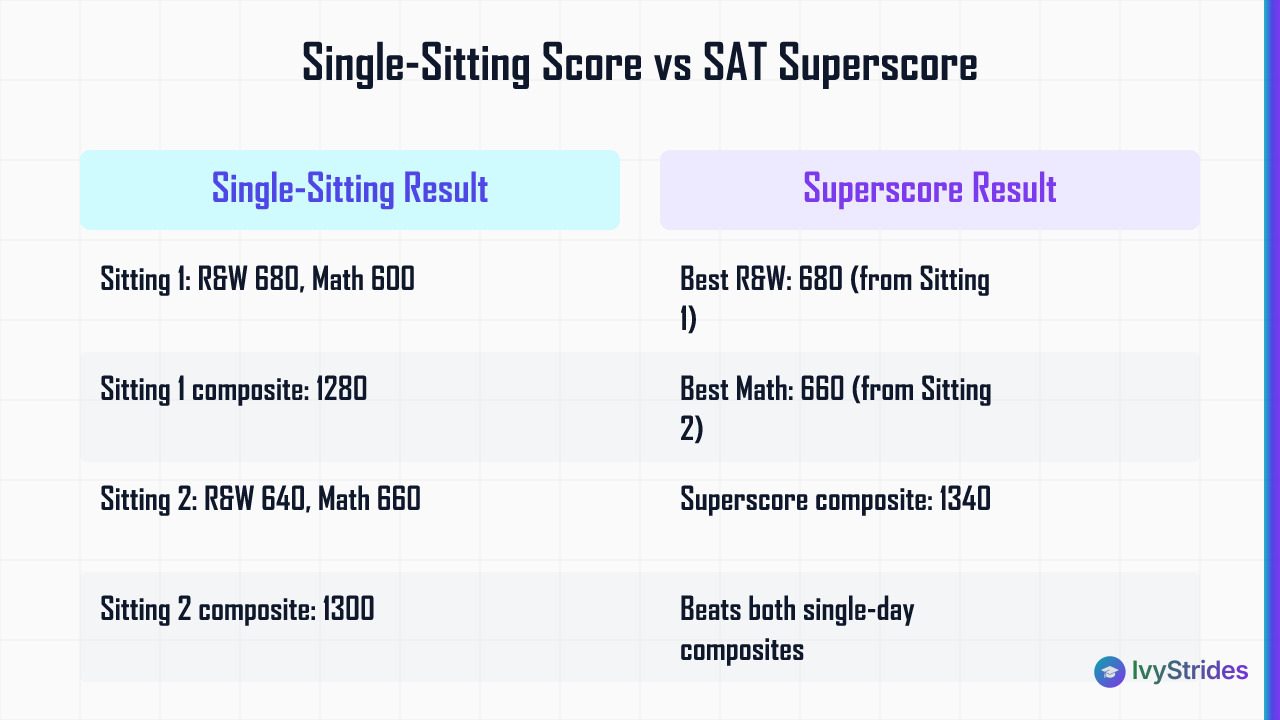
SAT superscoring is a college's practice of combining your highest Reading and Writing section score with your highest Math section score across every sitting. The Digital SAT scores each section from 160 to 760, on a total 400 to 1600 scale. Combine your two best section scores and you get a composite higher than any single test day produced.
Here's the part most students miss. You don't need to beat your old score on both sections at once. If Math jumps and Reading and Writing dips, the superscore still climbs, because the college keeps your old, higher R&W section score. That flips a retake from a gamble into a low-risk move.
Score Choice puts you in control. College Board's Score Choice policy lets you decide which SAT scores to send each college. So a rough second sitting rarely reaches an admissions office unless you send it, or unless a school requires all scores.
Verify before you register. Most selective colleges superscore the SAT, but not all do, and policies shift year to year. Check each target school's admissions page or its Common Data Set before you assume the safety net applies. For a full breakdown of which colleges superscore, see our superscoring explained guide.
| Sitting | R&W Score | Math Score | Single-Sitting Composite | Superscore Used by Colleges |
| Sitting 1 | 680 | 600 | 1280 | not applicable |
| Sitting 2 | 640 | 660 | 1300 | not applicable |
| Best of each | 680 | 660 | not applicable | 1340 (IvyStrides) |
That 1340 superscore beats both single-day composites of 1280 and 1300. College Board publishes the section ranges and the superscoring definition; IvyStrides calculated this two-sitting example from those published figures.
When a Second SAT Sitting Is Worth It: A Score-Gap Decision Framework
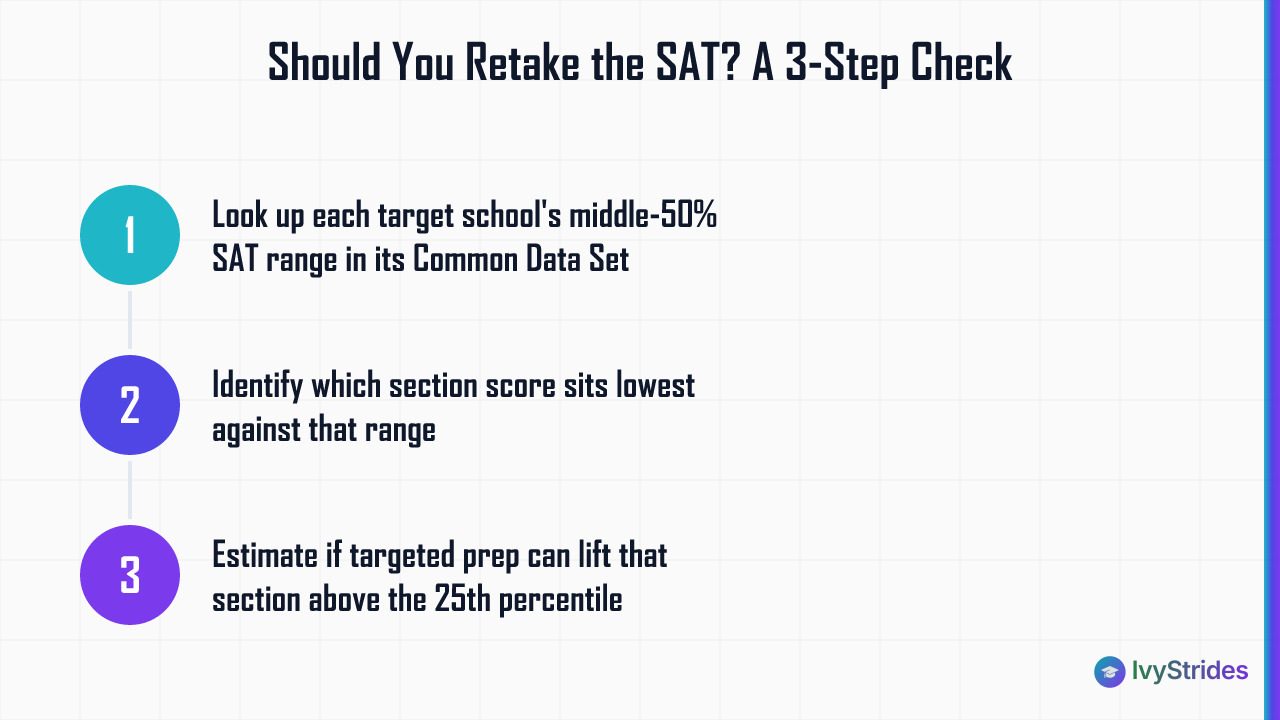
A second SAT sitting is worth it when your current section score sits below the 25th percentile of a target school's middle-50% range, and a realistic gain closes that gap before your deadline. The superscoring safety net makes the section-by-section math above the right way to run this check.
The middle-50% range is the band between the 25th and 75th percentile scores of admitted students, published in each school's Common Data Set. That range, not a generic "good score," is your benchmark. Because superscoring rewards one strong section, your decision comes down to which section score is furthest below target and whether targeted work can lift it.
| Step | What to Do | Retake Signal |
| 1 | Look up each target school's middle-50% SAT range in its Common Data Set | You're below the 75th percentile |
| 2 | Identify which section score sits lowest against that range | One section is below the 25th percentile |
| 3 | Estimate a realistic gain on that section with targeted prep | The gain would clear the 25th percentile |
Timing is the hard constraint. For an Early Decision deadline of November 1, the October SAT is the practical last sitting that returns scores in time. A December sitting usually lands after ED closes. If your round is Early Decision and you're weighing a December sitting, the timing math is different: see how a December retake fits an ED timeline through your school's exact score-receipt deadline.
Test-optional shifts the calculus, it doesn't erase it. Test-optional policies vary by school and year, and a strong superscore still helps at most selective colleges even when scores are optional. If your list is test-optional, the decision gets more nuanced: read our full framework on test-optional and whether to submit SAT scores before you skip the retake.
Know Your Gap. Know Your Plan. Get Both in 15 Minutes.
You have a score report, a target list, and a test date coming up. A free 15-minute call checks your current section scores against each school's middle-50% range, confirms which section to target, and tells you whether a second sitting is worth registering for right now.
What Happens If Your Second SAT Score Is Lower Than Your First?
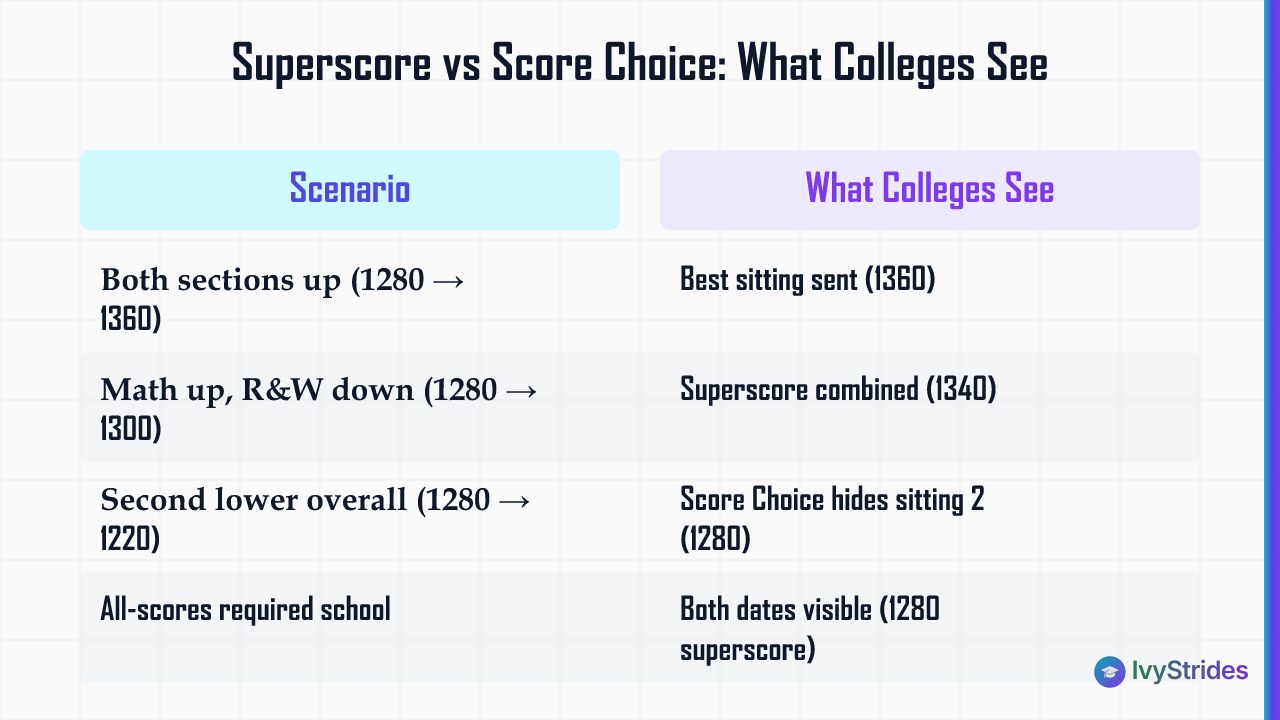
If your second SAT score is lower than your first, your superscore is unaffected. Colleges that superscore take your best R&W and best Math section scores across all sittings, so a weaker second composite can't drag the superscore down. The floor is your first attempt; the retake can only add.
That safety net is why the score-gap framework treats a retake as low-risk rather than a coin flip. The one thing a lower second sitting can't do is erase a higher first one.
Score Choice covers the rest. For schools that don't superscore, College Board's Score Choice policy lets you withhold the weaker sitting and send only your best test date. The exception: a small number of schools require you to report all scores. Check each school's admissions page, because that requirement overrides Score Choice where it applies.
| Scenario | Sitting 1 | Sitting 2 | Superscore Result | What Colleges See |
| Both sections up | 1280 | 1360 | 1360 | Best sitting sent |
| Math up, R&W down | 1280 | 1300 | 1340 | Superscore combined |
| Second lower overall | 1280 | 1220 | 1280 | Score Choice hides sitting 2 |
| All-scores school | 1280 | 1220 | 1280 | Both dates visible |
On visibility: yes, colleges can see how many times you tested if you send all scores, but most admissions offices do not penalize multiple sittings. Two or three attempts reads as normal. College Board sets no limit on how many times you can sit for the SAT, though most students find two or three sittings is the practical ceiling; see how many times can you take the SAT for the full rules.
How to Make Your Second SAT Sitting Different From Your First
A retake without new targeted prep rarely moves your superscore. Students who sit a second time without changing their approach typically gain only about 20 to 40 points. In our coaching with students in the 1200 to 1400 band, targeted work on the single weaker section drives the largest superscore gains, typically around 60 to 120 points on that section.
Because superscoring rewards one strong section, your prep should target the weaker one instead of splitting attention evenly. Start with your first score report: it breaks out your R&W and Math section scores and the question types where you lost points. That report is your diagnostic.
Adaptive modules set your ceiling. The Digital SAT is section-adaptive. Your Module 1 performance routes you into an easier or harder Module 2, and the harder Module 2 unlocks the top of the score scale. Reading and Writing runs 54 questions in 64 minutes across two modules; Math runs 44 questions in 70 minutes across two. Miss too many in Module 1 and you cap out before Module 2 begins, which is why concentrated section work beats a scattered review of both.
| Step | Action | Time Required |
| 1 | Read your score report; flag the weaker section and its top error types | About 1 hour |
| 2 | Drill the specific question types driving those errors | Roughly 4 to 6 weeks |
| 3 | Take at least two full-length timed practice tests | 2 sittings |
| 4 | Review every miss, then register for the next date | About 1 week |
Run those full-length tests under real conditions using the official free practice in Bluebook. Once you decide a retake is worth it, the next question is how to prep differently: our how to improve your SAT score on a retake playbook covers the diagnostic-first method that drives real score movement.
Reading and Writing and Math reward different skill sets, and a generalist tutor rarely fixes both fast. Our SAT 1-on-1 prep pairs you with a coach who works your weaker section specifically, using your first score report as the starting diagnostic. To keep practice scores honest, pick the most accurate SAT practice tests for the Digital format.
Second Sitting Decided. Now Make It Count.
You've got the framework: check the gap, confirm superscoring, target the weaker section, and run full-length practice. Turning that into a plan tied to your actual score report and registration deadline takes a different conversation. A free 15-minute call maps it out for students and parents together.
FAQ: Second SAT Sitting and Superscoring
What happens if I do worse on my second SAT?
Your superscore is unaffected. Colleges that superscore keep your best R&W and best Math section scores across all sittings, so a lower second composite can't reduce it. For schools that don't superscore, Score Choice lets you withhold the weaker date. The only exception is the handful of schools that require all scores reported, so check each admissions page.
Can colleges see how many times you took the SAT?
Yes, if you send scores from multiple sittings, colleges see each date. But most admissions offices don't penalize testing two or three times; it reads as normal. Score Choice lets you send only the sittings you choose, except at the small set of schools that require every score.
Is it bad to take the SAT multiple times?
No. Two or three sittings is standard and isn't penalized by most colleges. Diminishing returns tend to set in after three attempts, especially if your prep hasn't changed between them. For most students, two sittings with targeted prep in between is the most efficient path.
Can you take the SAT twice in a year?
Yes. College Board offers multiple SAT dates a year, typically August, October, November, December, March, May, and June. Testing in the fall and again the following spring is a common two-sitting plan. Check the current schedule for exact registration deadlines.
Your Next Step on a Second SAT Sitting
The decision isn't really "retake or not." It's whether your weaker section score sits below a target school's benchmark and whether targeted prep can close that gap before your deadline. Superscoring makes the downside small; your prep plan decides the upside.
Do these four things this week:
- Pull your first score report and note which section, R&W or Math, is furthest below target.
- Look up each target school's middle-50% SAT range and confirm the school superscores.
- Map your deadline backward: October is the practical last sitting for a November 1 Early Decision round.
- If the gap is real, register for the next date and build a plan that drills the weaker section, not both.

Two decades teaching quantitative and verbal aptitude on standardized tests. Rare dual expertise across Math and Verbal — particularly effective for students with gaps on both sides. Senior AP Mentor for our Calculus and English tracks.