
Superscoring Explained: How Colleges Combine Your Scores and What to Do About It
On this page
- What Superscoring Means for the SAT and ACT
- Can Superscoring on the SAT or ACT Ever Hurt You
- Not Sure Whether a Retake Will Actually Move Your Superscore?
- Which Colleges Superscore the SAT, the ACT, or Both
- How to Build a Retake Strategy Around Your Superscore
- Know Which Section to Target. Build the Plan in 15 Minutes.
- FAQ: SAT and ACT Superscoring
- What does it mean to superscore?
- Can superscoring on the SAT or ACT actually hurt your application?
- Does superscoring on the SAT look bad to admissions officers?
- How do I calculate my SAT superscore?
- Your Next Step on Superscoring
Superscoring is a college admissions score-use policy where a school combines your highest section scores from separate test dates into one score. For the SAT, that means your best R&W plus your best Math. For the ACT, colleges average your best English, Math, and Reading.
Most selective schools superscore at least one test, and that fact reshapes how you plan a retake. The policy sits at the intersection of test strategy and college selection, and it's the reason section-level gains matter as much as composite gains. The hard question isn't what superscoring means. It's whether a retake helps you, which section to target, and which of your schools actually do it.

What Superscoring Means for the SAT and ACT
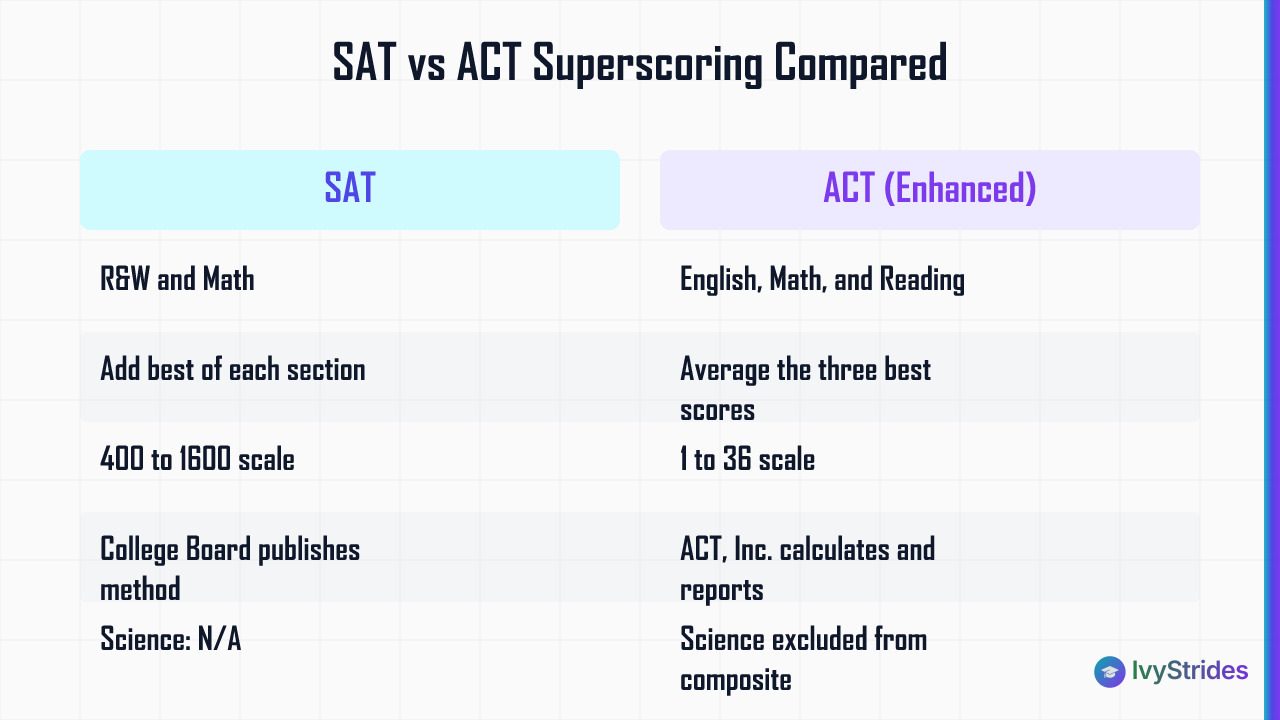
Superscoring combines your highest section scores across different test dates, but the SAT and ACT calculate it differently. The SAT adds two section scores; the ACT averages three. Get that distinction wrong and your projected superscore lands off by a wide margin.
The Digital SAT scores on a 400 to 1600 scale, split into two sections each worth 200 to 800: Reading and Writing (54 questions in 64 minutes) and Math (44 questions in 70 minutes). An SAT superscore is your highest R&W across all sittings plus your highest Math across all sittings. College Board publishes this method and supports the practice.
Worked SAT example. Sitting 1 gives R&W 650 and Math 720. Sitting 2 gives R&W 700 and Math 690. Using the College Board superscore method, IvyStrides calculates: best R&W 700 plus best Math 720 equals a 1420 superscore, higher than either single sitting.
The Enhanced ACT changed the math in April 2025. Under the current ACT format, the composite averages three sections only: English (50 questions in 35 minutes), Math (45 questions in 50 minutes), and Reading (36 questions in 40 minutes). Science and Writing stay optional and score separately, so Science drops out of the composite superscore. ACT, Inc. calculates and reports the official superscore across your attempts.
Worked ACT example. Sitting 1 gives English 30, Math 28, Reading 26. Sitting 2 gives English 27, Math 31, Reading 29. Using the ACT, Inc. averaging formula, IvyStrides calculates: best English 30, best Math 31, best Reading 29, averaged as (30+31+29) divided by 3, which rounds to a 30 composite superscore.
Want the full picture on how the 1600 scale breaks down? Our SAT scores explained guide covers the section-score system in depth.
| Test | Sections in superscore | How combined | Scale |
| SAT | R&W, Math | Add best of each | 400 to 1600 |
| ACT (Enhanced) | English, Math, Reading | Average the three best, rounded | 1 to 36 |
| ACT Science | Excluded from composite | Scored separately | 1 to 36 |
Can Superscoring on the SAT or ACT Ever Hurt You
Superscoring almost never hurts you, because a college that superscores takes your best section scores regardless of which sitting they came from. A weaker second attempt on one section can't cancel a stronger first attempt on another. The superscore only moves up or stays flat.
That fear stops students from retaking, and it's misplaced at schools that superscore. Say you score R&W 650 on your first SAT, then 620 on your second while your Math climbs. The 620 simply drops out; your 650 stands. College Board confirms that many colleges which superscore actively encourage or require all scores so they can build the highest possible combination. ACT, Inc. describes its superscore the same way: best scores across attempts, no penalty for a lower sitting.
Does superscoring look bad to an admissions reader? No. At schools that superscore, readers expect multiple test dates and calculate the superscore themselves. Two or three sittings reads as persistence, not weakness.
The one real exception. A small number of schools require all scores and do not superscore, meaning they see every sitting and may weigh the full record. That's rare among schools publishing a superscore policy, but it exists, so verify before you submit. Understanding how how to send SAT scores to colleges works, including Score Choice, matters here.
Score Choice, worth naming, is a separate College Board policy that lets you choose which test dates to send. Some colleges honor it; others require all scores regardless. Superscoring and Score Choice interact, but they aren't the same thing.
Before you assume superscoring applies to your list, verify three things:
-
Does the school superscore the specific test you took, the SAT or the ACT? Some do one and not the other.
-
Does the school require all scores, or does it honor Score Choice?
-
If the school is test-optional, does submitting a strong superscore still help your file? Test-optional policies vary by school and by year, per FairTest.
Not Sure Whether a Retake Will Actually Move Your Superscore?
You have your section scores, a college list, and a test date coming up. A free 15-minute call checks your current superscore against your target schools' middle 50 percent ranges and tells you exactly which section to target, and whether a retake is worth the prep time.
Which Colleges Superscore the SAT, the ACT, or Both

Most selective colleges superscore the SAT, many superscore the ACT, some do both, and a few do neither. No universal rule covers your whole list, so the practical move is to check each school. Some schools that require all scores still superscore; others superscore the SAT but treat the ACT differently.
The high-demand names come up constantly. Harvard superscores the SAT. MIT superscores the SAT. Both expect to see multiple sittings and build the highest combination themselves. Verify these on each school's own admissions page or Common Data Set before you plan a retake around them, because policies shift year to year.
If you are deciding whether to retake the SAT or switch to the ACT, knowing which test your target schools superscore changes the math on that decision entirely. A school that superscores the SAT but not the ACT rewards SAT retakes and neutralizes ACT ones.
Even at test-optional schools, a strong superscore can still strengthen an application, particularly if your GPA sits at the lower end of the admitted range. Just remember that college admissions outcomes depend on the full application, not test scores alone.
| College | SAT superscore | ACT superscore | All scores required | Verify at |
| Harvard | Yes | Check | No | Admissions page |
| MIT | Yes | Check | No | MIT SAT requirements |
| Princeton | Check | Check | No | Common Data Set |
| UPenn | Yes | Check | No | does upenn superscore |
| Stanford | Check | Check | No | . Also worth reading: does Stanford superscore ACT |
| State flagships | Varies | Varies | Varies | School admissions FAQ |
How to verify any school's policy. Search the college's admissions FAQ for "superscore", or pull its Common Data Set, which lists score-use practices. For a federal cross-check on a school's SAT and ACT 25th to 75th percentile ranges, use NCES College Navigator. The percentile band tells you the target; the admissions page tells you how they'll read your scores.
How to Build a Retake Strategy Around Your Superscore
Build your retake around the single section holding your superscore down, not the whole test. Because superscoring rewards section-level gains, a targeted retake focused on your weaker module, say SAT Math or ACT Reading, can lift your superscore without requiring a full-test improvement.
Start by calculating where you stand. List every section score from every test date, take the highest of each, and combine them by the right method: add two for the SAT, average three for the ACT. That number is your current superscore, and the gap between it and your target school's middle 50 percent tells you how much work remains.
Then find the use. On the SAT, if your Math is 720 and your R&W is 650, the 70 minutes of Math work you've already banked is done; your prep hours belong in R&W. On the Enhanced ACT, the same logic applies across English, Math, and Reading, with Science set aside since it never enters the composite superscore.
In our coaching, students who identify their weaker section before a retake and target it specifically see the largest superscore gains relative to total prep hours invested. A common pattern: a student scores 650 R&W and 720 Math on a first sitting, then focuses prep on R&W and reaches 700 on a second sitting, lifting the superscore 50 points without touching Math. We frame these as typical for students completing the program, never as guaranteed.
This is where a section-specialist coach does real work. A generalist splits attention across a test you've half-solved; a specialist drills the exact question types dragging one module down. Students who want a diagnostic and a section-targeted plan can start with our SAT 1-on-1 prep, which builds the retake around a real practice test. To benchmark what a meaningful gain looks like, our good SAT score guide gives you the percentile context to set a target.
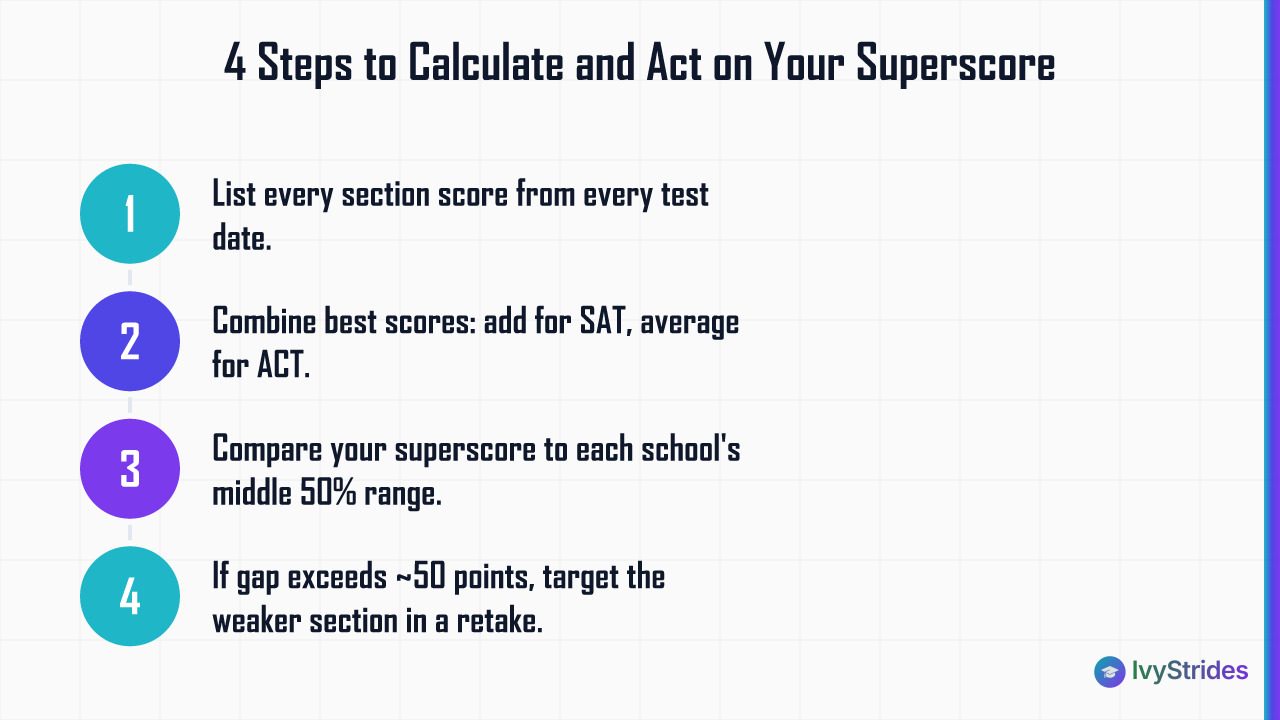
Four steps to calculate and act on your superscore:
-
List every section score from every test date.
-
Combine the best of each by the right method: add for SAT, average for ACT.
-
Compare that superscore to each target school's middle 50 percent range.
-
If the gap exceeds roughly 50 points, target the weaker section in a retake.
Know Which Section to Target. Build the Plan in 15 Minutes.
You have a superscore, a college list, and a gap to close. A free 15-minute call maps a section-specific prep plan tied to your actual test date and checks it against each school's score range.
FAQ: SAT and ACT Superscoring
What does it mean to superscore?
Superscoring means a college takes your highest section scores from different test dates and combines them into one score. On the SAT, add your best R&W to your best Math. On the ACT, average your best English, Math, and Reading. The result always equals or beats any single sitting.
Can superscoring on the SAT or ACT actually hurt your application?
In almost every case, no. Colleges that superscore take the best section scores regardless of which sitting they came from, so a weaker second attempt on one section cannot cancel a stronger score on another. The one exception is a handful of schools that require all scores and do not superscore, so verify each school's policy before submitting.
Does superscoring on the SAT look bad to admissions officers?
No. Admissions readers at schools that superscore expect multiple test dates and calculate the superscore themselves. Submitting two or three sittings is normal and reads as persistence. What matters is the final superscore number relative to the school's middle 50 percent range.
How do I calculate my SAT superscore?
List your R&W and Math section scores from each test date. Take the highest R&W across all dates and add the highest Math across all dates. For example, Sitting 1 gives R&W 650 and Math 720, Sitting 2 gives R&W 700 and Math 690. Your superscore is 700 plus 720, which equals 1420.
Your Next Step on Superscoring
Superscoring works in your favor at almost every school that offers it, but the strategy is only as good as your verification and your targeting. Confirm the policy, calculate the real number, then spend your prep hours where they move the score.
- Pull each target school's superscore policy from its admissions page or Common Data Set, and re-check annually.
- Calculate your current superscore with the right method for your test.
- Identify the single weakest section and make it your retake focus.
- Confirm whether test-optional schools on your list still reward a submitted superscore.

Award-winning author (South Asian Book Award) and graduate of BITS Pilani and UCLA Luskin School of Public Affairs. Brings a published writer's eye to Common App essays and grammatical precision to SAT and ACT R&W instruction.