
How Many Times Should You Sit the SAT When Colleges Superscore?
On this page
- How Many Times Can You Sit the SAT and What Does College Board Say?
- How Superscoring Changes the Math on SAT Retakes
- When a Third or Fourth SAT Sitting Is Worth the Prep Time
- Your Section Scores Tell You Whether a Retake Will Move the Needle
- A Sitting-by-Sitting SAT Timeline for Juniors and Seniors
- Timeline Mapped. Now Close the Section Gap.
- FAQ: SAT Sitting Count and Superscore Strategy
- How many times should you do the SAT?
- Can colleges see how many times you take the SAT?
- Is it bad to take the SAT more than 3 times?
- How often can you take the SAT in a year?
- Your Next Step on SAT Retake Strategy
Most students should sit the SAT two to three times. The SAT is a digital, adaptive exam scored on a 400 to 1600 scale, and College Board sets no cap on attempts. A third sitting pays off only when practice tests show a clear 50-plus-point gain.
Those windows come from College Board's own guidance, which advises at least two sittings. The harder question isn't whether you can sit again; it's whether the next sitting will actually raise the score colleges see, or just cost you a Saturday and a prep month. Superscoring is what tips that math, and the rest of this page works through when.
How Many Times Can You Sit the SAT and What Does College Board Say?
College Board places no limit on SAT attempts and recommends at least two sittings. You can register as many times as you want. College Board advises a first sitting in spring of junior year and a second in fall of senior year, which is where most students land their real gain.
Score Choice puts you in control of what colleges see. Under this policy, you pick which test dates to send. Most colleges accept your highest single sitting or your superscore automatically. A small number of elite institutions ask for all scores, so verify each school's policy before you register for another date.
The Digital SAT runs two adaptive sections. Reading and Writing covers 54 questions across two 27-question modules; the Math section covers 44 questions across two modules. Your performance on Module 1 sets the difficulty of Module 2, which is why section-level work, not general review, moves a retake score.
| Feature | Detail |
| Questions and testing time | 98 questions, 2 hr 14 min (IvyStrides) |
| Reading and Writing | 54 questions, 64 minutes, two modules |
| Math section | 44 questions, 70 minutes, two modules |
| Score scale | 400 to 1600 |
| Retake limit | None; at least two recommended |
| Score reporting | Score Choice: you pick which dates to send |
College Board publishes each module's length but not a single start-to-finish figure; IvyStrides sums them at 2 hours 14 minutes of testing. For the full rules on registration limits, fee waivers, and how many sittings College Board permits per year, see our guide on how many times you can take the SAT.
How Superscoring Changes the Math on SAT Retakes
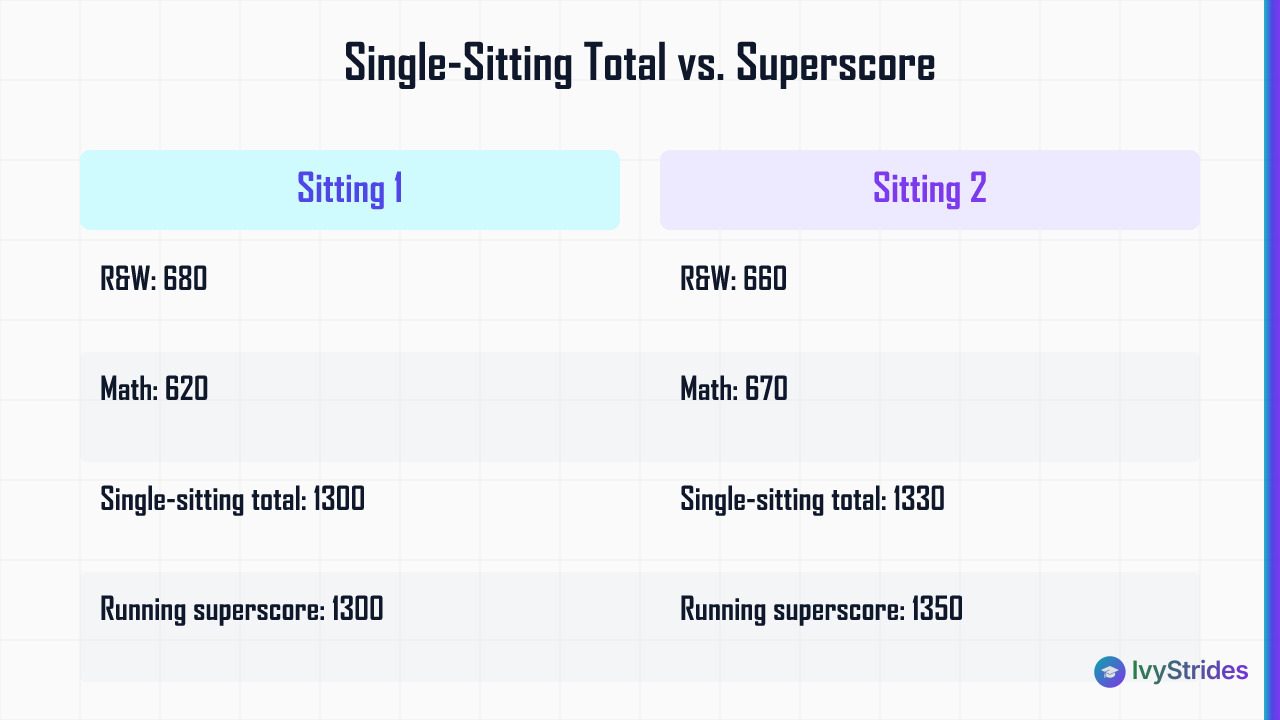
A superscore combines your highest section scores across all your test dates into one number. That rules baseline from College Board sets up the strategic shift: a strong Math on one date and a strong Reading and Writing on another can produce a superscore higher than either single sitting reached alone. So you're no longer asking "can I beat my total?" but "can I beat my weaker section?"
Because R&W and Math count as independent superscore targets, a retake that lifts one section pays off even when the day's composite comes out lower. Here's how that works with real numbers.
| Sitting | R&W Score | Math Score | Single-Sitting Total | Running Superscore |
| Sitting 1 | 680 | 620 | 1300 | 1300 |
| Sitting 2 | 660 | 670 | 1330 | 1350 |
Read the second row. That sitting's total, 1330, beats the first by 30 points, yet the superscore climbs to 1350, because the college keeps the 680 R&W from sitting 1 and the 670 Math from sitting 2. No single sitting reached 1350. College Board defines section scores and the superscore concept; IvyStrides built this example.
Benchmark against the middle-50 range, not a vague target. The middle-50 percent range spans the 25th to the 75th percentile of admitted students' scores at a college. The federal NCES College Navigator publishes these per-institution ranges (2023 collection year). If your superscore already sits inside a school's middle-50, another sitting rarely changes your standing there.
One caveat matters here: a few selective colleges request all scores rather than accepting Score Choice, and test-optional policies vary by school and year. A strong superscore still counts at many selective colleges, but scores are one input, not the whole application. If you're weighing a second sitting specifically, the section-by-section math is worked through in our guide to is a second SAT sitting worth it. For which colleges superscore and which want every score, see our superscoring explainer.
When a Third or Fourth SAT Sitting Is Worth the Prep Time
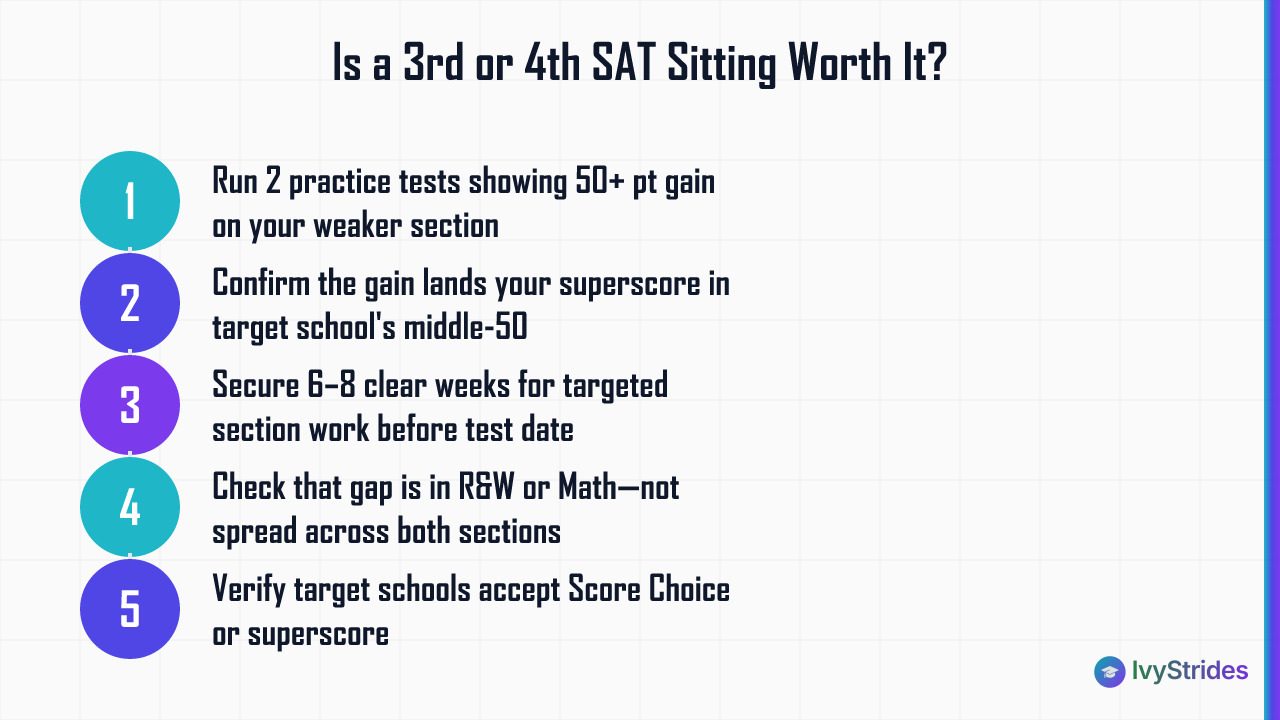
A third SAT sitting is worth it when two consecutive practice tests show a 50-plus-point gain on the section holding your superscore back. A fourth sitting rarely moves the superscore unless practice results show that same clear section improvement. The trigger is a measured score gap against your practice-test baseline, not a feeling that you can do better.
Does three or four sittings look bad? No. Under Score Choice, colleges see only the scores you send, and most schools take your highest sitting or superscore. The exception is that small group of elite institutions requesting all scores, so check before you register a fourth time. The real cost of a fourth attempt isn't a bad signal; it's the prep time.
The prep, not the fee, is the constraint. In our coaching with students in the 1200-1400 band, a third sitting produces a meaningful superscore gain when practice tests show a 50-plus-point section improvement before the registration date. Students who complete roughly 6 to 8 weeks of targeted section work between sittings are the ones who see that gain. Skip the prep and the retake usually returns your same score.
Use this before you register again:
- Two recent practice tests both show a 50-plus-point gain on your weaker section
- The gain lands your superscore inside your target school's middle-50 range
- You have roughly 6 to 8 clear weeks for targeted section work before the date
- The gap sits in R&W or Math specifically, not spread thin across both
- Your target schools accept Score Choice or a superscore
- The prep weeks won't cannibalize essay drafting or AP coursework
If most of those boxes stay empty, redirect that Saturday and that prep month toward essays or AP work, where the admissions return is often higher. Diminishing returns are real: each extra sitting demands more prep for a smaller score-ceiling gain. Once you've decided a retake is right, the section-specific prep plan for closing your score gap is covered in our how to improve your SAT score on a retake playbook. Our guide to how many SAT practice tests to take explains how to space them.
Your Section Scores Tell You Whether a Retake Will Move the Needle
You've got a score report, a college list, and a registration window closing soon. A free 15-minute call checks your current section scores against your target schools' middle-50 ranges, identifies which section to target, and tells you whether the prep time before the next date closes the gap.
A Sitting-by-Sitting SAT Timeline for Juniors and Seniors
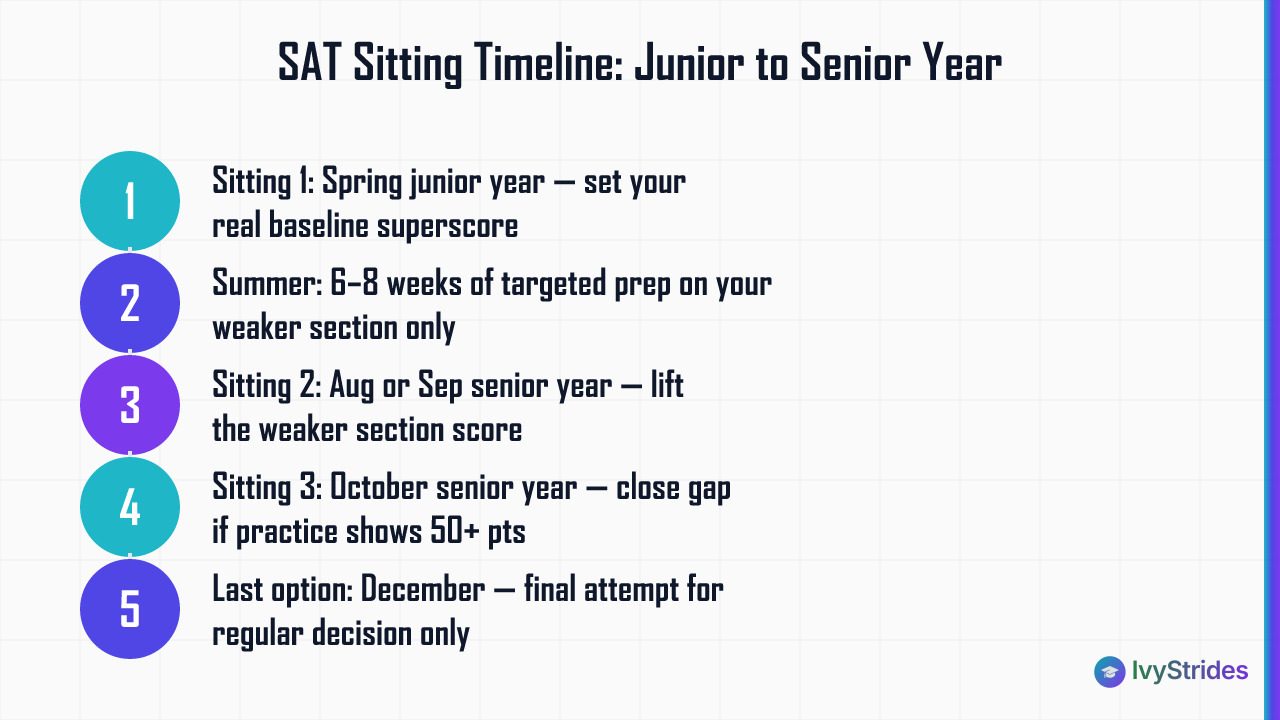
Plan the SAT across two to three sittings: spring of junior year, fall of senior year, and one more only if the practice gap justifies it. That schedule tracks the same diminishing-returns logic and leaves room for the roughly 6 to 8 weeks of section work each meaningful gain requires. Your application deadlines are the hard constraint.
Because early deadlines fall in November, October is the last sitting whose scores reliably reach most schools in time for EA and ED rounds. The 2026-2027 SAT calendar offers August, September, October, November, and December dates, so a senior can fit two fall sittings before a regular-decision deadline.
| Sitting | Recommended Timing | Purpose | Register If... |
| First | Spring, junior year | Set a real baseline superscore | Always; this is your start |
| Second | Aug or Sep, senior year | Lift the weaker section | You did 6 to 8 weeks of targeted work |
| Third | Oct, senior year | Close a remaining section gap | Practice shows a 50+ point gain |
| Last feasible (RD) | December | Final attempt for regular decision | ED/EA isn't your primary round |
| EA/ED cutoff | November | Hard deadline | October is your last scores-in-time date |
Summer is prep, not testing. Between junior and senior year, put the roughly 6 to 8 weeks toward the single section holding your superscore down rather than reviewing both evenly. That focus turns a second sitting into a real gain. For an ED applicant deciding whether a December retake fits their round, see how a December retake fits an early decision timeline.
If you have that prep window and want a plan tied to your actual section scores, our SAT 1-on-1 prep pairs you with a section specialist for the R&W or Math score that's capping your superscore. In our coaching, a 200-plus-point total gain is typical for students completing the program, though your outcome depends on your starting band and the hours you put in.
Timeline Mapped. Now Close the Section Gap.
You have the sitting count, the prep window, and the deadline. Turning those three inputs into a week-by-week plan built around your score report and your target school's middle-50 range takes a focused conversation. A free 15-minute call does exactly that, for students and parents together.
FAQ: SAT Sitting Count and Superscore Strategy
How many times should you do the SAT?
Two to three sittings covers most students. The first establishes a real baseline; the second, after targeted prep, is where most gains happen. A third is worth it only when practice tests show a clear 50-plus-point section gain is achievable before the registration date.
Can colleges see how many times you take the SAT?
Under Score Choice, colleges see only the scores you send. Most schools accept your highest sitting or superscore automatically. A small number of elite institutions ask applicants to submit all scores, so check each school's policy before registering for an additional sitting.
Is it bad to take the SAT more than 3 times?
Not inherently, but a fourth sitting rarely produces a meaningful superscore gain unless practice tests show a clear section improvement. The bigger risk is spending roughly 6 to 8 prep weeks on a fourth attempt when that time would produce more admissions value directed at essays or AP coursework.
How often can you take the SAT in a year?
College Board offers the SAT up to seven times a year in the US, with dates typically in August, September, October, November, December, March, and May. Most students fit two to three sittings into a single school year without colliding with AP exams or application deadlines.
Your Next Step on SAT Retake Strategy
The number of times you sit the SAT is a strategic call, not a fixed rule, and superscoring is what makes an extra sitting additive rather than redundant. Before you register again, run the arithmetic on your own scores.
- Take a full practice test and note your section scores.
- Compare your superscore to your target school's middle-50 range using NCES College Navigator.
- If the weaker section shows a 50-plus-point practice gain, plan roughly 6 to 8 weeks of targeted work before the next date.
- If it doesn't, redirect that time to essays or AP coursework, where the admissions return may be higher.

Award-winning author (South Asian Book Award) and graduate of BITS Pilani and UCLA Luskin School of Public Affairs. Brings a published writer's eye to Common App essays and grammatical precision to SAT and ACT R&W instruction.